As for a film society’s choices

The Eastport Arts Center was a major factor in my decision to relocate here. Quoddy Voices is one of its constituent groups.

Another was the Northern Lights film society, which only recently resurfaced but greatly diminished after the Covid hiatus.

I’ve found its offerings invigorating and sometimes disturbing. The deep discussions that follow the showings are especially valued, even for the recent Carnival of Souls and Night of the Living Dead horror vein.

What was perplexing was that the society was essentially two people, one a veteran of its 47-year history, give or take a few seasons.

They were asking those of us who kept coming each week for our input regarding possible selections from the two vendors available to us. Learning of the licensing hurdles for presenting movies even at a nonprofit arts venue was daunting. I’ll spare you the details.

I will, though, share my response to the possibilities and the situation we’re facing.

~*~

As I wrote:

Seems to me our thinking about the film society comes down to building a larger audience. That, in turn, adds considerations of “branding” – the image the public has – as well as the types of films we air and even our geographic range of appeal.

What do we show this week that will bring people back for our next film? That is, what’s our continuity or identity? What has them awaiting the next round? Are we an “art” films circle, an awards-driven following, a sensual experience sharing group? Do our screenings enhance or compete with other arts ventures in the region?

If we’re limiting ourselves to two showings a month, let me suggest making those the second and third Sunday evenings of the month. I’m feeling there might be a “bounce” in favor of that second showing, perhaps even with some common thread for the month. Let me also push for 6 pm so more viewers from throughout Washington County can readily attend. (Note, too, the problems of getting anyone out on a Sunday night, plus the competition with the winter Sunday afternoon series at the arts center and Stage East matinees.)

My thinking is that we might get some synergy and energy that way, especially in getting the word out. The Tides comes out on the second Friday (we might have occasions when the showing falls a week before that).

Orchestras and live theater companies have long relied on season subscribers but have been finding, even a few decades before Covid, that the model was eroding. Festival programming – a cluster – has been one alternative that’s created excitement and ticket sales. I’m seeing that as something that might work with the second/third Sundays model, perhaps even giving us the option of adding a fourth Sunday for a suitable extension.

That said, we are also shaped by the collections of our two distributors.

At the first, I’m steering clear of the traditional art films for now – the Italian, French, German, Japanese, etc.

Instead, I’d look at the USA (not Hollywood, for the most part, which is the global conglomerate movie center) and three Canadian films, many of them documentaries, and at the Latin films – Mexico, Cuba, Spain, Portugal, Brazil. Viridiana stands out on that front. Washington County has a large and largely overlooked Hispanic population.

Cluster options here: Orson Welles, Robert Downey Sr., Chaplin and Harold Lloyd, silents The Freshmen, The Kid Brother, The Most Dangerous Game, and King of Kings (if we can keep a straight face), Norman Mailer, John Huston (Under the Volcano and Wise Blood).

Among the docudramas etc.: A Brief History of Time (Stephen Hawking), Burroughs: the Movie, Don’t Look Back (Dylan), For All Mankind (astronauts), Gimme Shelter, God’s Country (Louis Malle), Jimi Plays Monterey or Monterey Pop, Louie Bluie, Multiple Maniacs (John Waters), Eating Raoul (Warhol).

Titles that catch my attention: The Baron of Arizona, The Beales of Grey Gardens, Border Radio, Buena Vista Social Club, Cameraperson, Carnival of Souls, Chop Shop, Clean Shaven, Desert Hearts, Detour (possibly anchoring an international film noir survey), Dillinger Is Dead (OK, it’s Italian but still), possibly with I Shot Jesse James, Drylongso, The Honeymoon Killers, Push Cart Man, Paris Texas (yeah, it’s French), A Poem Is a Naked Person, Poto and Cabengo, Routine Pleasures, Smooth Talker, Slacker, Sweet Sweetback’s Badass Song, Symbiopsychotaxism, Twin Peaks, Thank You and Good Night, and The Watermelon Woman.

Looking way ahead, sometime it might be fun to do a festival based on Japanese Godzilla fixation.

And then, at the other: For the most part, these offerings strike me as highly commercial creations most people stream at home. Still, American audiences look for star-power rather than directors, so this might provide some extra punch for attendance. That said, some offerings to consider: Barbie, Oppenheimer, Gran Turismo, Joy Ride, Insidious, Tar, Asteroid City, Dear Evan Hansen, The Little Mermaid (with ArtsWalk), The Outfit, Samaritan, The Black Phone, and Cruella (if it’s not too Disney).

~*~

Well, we’ve had a second meeting and set a course for the next year, one that seems to be generating a buzz. We’re focusing on one boffo film a month, with both a matinee and evening showing, and tying the offerings into other events happening in town, when possible.

The first one is indeed Barbie on the Thanksgiving weekend.
Asking us singers for our suggestions was a bit unnerving

One of the unanticipated developments in my life after I retired from the newsroom was that I became an amateur choral singer, first as a charter member of Revels Singers in Boston and now with the much smaller but no less excellent Quoddy Voices.

In that, I’ve been blessed to work under four incredible music directors and also experience a few other fine conductors, each bringing something unique to the enterprise.

Still, the newest vocal maestro is truly one of a kind, yet still of the highest standards.

When he stepped up to the task in September, he handed out stacks of sheet music from four or five different sources, a very wide range of repertoire, maybe 30 pieces in all.

We set about sight-reading these, and I found myself getting teary as I recalled earlier experiences. Leadbelly’s “Bring Me a Little Water, Sylvie” was a staple of the Boston Revels’ autumn equinox Riversing along the Charles River, and backing up our teens’ choreographed routines was always exciting. “Wild Mountain Thyme” always ended the spring equinox concert, with David Coffin leading the audience gathered into a large circle, holding hands. “All God’s Critters (Place in the Choir)” raised many other memories, especially of Quaker children but also with the composer himself, who lived just outside Dover. And then there was Sweelinck’s joyous “Hodie,” my introduction to polyphony at the opening of the second classical concert I ever attended, the Roger Wagner Chorale around 1960. Never, ever, would I have imagined actually singing that – well, not until the past few years.

~*~

While I’m relatively new to being a member of a musical ensemble, I can say it’s a remarkable identity to assume. We expect to be followers, even with our own grumbling in the back row.

And that’s where Gene threw us a curve ball this fall. He wanted our opinion in what pieces we want to do, including those on our upcoming holidays concerts.

As others said, “The conductor’s always come in with the the pieces and said this is what we’re going to perform. Let’s get started.” To which, in our new situation, they added they were feeling a bit disoriented and perhaps even dismayed.

Well, he did want us to rate the pieces before us, something like a homework assignment, so here’s what I added to my ratings sheet:

“I’m guessing that many of the others will be leaning toward pop/rock songs they’re familiar with and find fun. As you see, I lean the other way, looking for pieces that stretch me to explore and achieve more. Looking at scores from the bass line is a fresh perspective. The tenors and ladies typically get most of the action while we’re stuck in the basement. (No pun intended.) Or even sidelines. I don’t mind holding a drone note in modal music, including Eastern Orthodox services, but what I’ve seen in the pop/rock harmonies seems pretty rote, uninventive, or shallow with little to hold my continued interest, especially if we were to do some deep rehearsal.

“On the other hand, doing one-time run throughs, perhaps with an audience, could be a fun community event, our own version of a pops concert. Summertime, even?

“Or even a hymn sing?

“Still, you asked, and thanks for that. And you’d still get my vote if we were selecting a music director. (My, that was an experience with my previous choir down in Boston.)”

~*~

I am happy to report that the Renaissance and other classical repertoire that I favor came in at the top of the stack, but there’s also a healthy blend outside of my usual comfort zone. The process did cut into our concert preparation time, but I’m confident we’ll catch up.

This really is a fun group to be part of, and that runs top to bottom and back up. I’d say things are percolating.

Looking for God in the details

The architect Ludwig Mies van der Rohe is often credited as the origin of the quip, “God is in the details,” but the phrase actually goes back much earlier.

Still, however tedious but essential, details do extend to the minutia of building and sustaining a marriage, a family, and a wider community. You can also apply it to any number of other things, including business, sports, the fine arts, politics.

In researching Quaking Dover, I am left with many gaps in the records of Friends’ godly endeavors. When, for example, did Dover Friends cease to run their own schools?

In addition, in writing a history, the details can drive one mad.

May I suggest the devil’s at work there, too?

Election reflections

These shoulder elections, where nobody’s running for national office, are still important.

In small places like Eastport, getting someone to run even unopposed for local office can be a challenge. We had all the bases covered, although the surprise was when a write-in candidate won one of the two city council seats.

I can’t imagine that happening in a bigger setting, but who knows. A write-in for president? My!

Statewide, a radical proposal to take over the two widely hated electrical utilities failed. Big money is hard to comprehend, even if we’ll be paying it one way or the other. The frequent storm outages won’t be going away, nor will the continuing higher-than-national bills customers here receive. Somehow, I don’t think the issue will be going away, despite the lopsided tallies.

Just how much do those emergency home generators cost altogether, anyway, as insurance against the current setup? It’s not that many households before we’re talking billions.

Otherwise, the initiatives moved in a progressive direction, including the right-to-repair measure.

I am relieve to see opportunities for right and left to come together at a local level, however gingerly.


We’ve come to appreciate the cruise ship visits

While Eastport has the deepest natural port in the continental U.S., that’s not often led to a lot of big-ship landings.

Cargo shipments, especially, have suffered over the past decade.

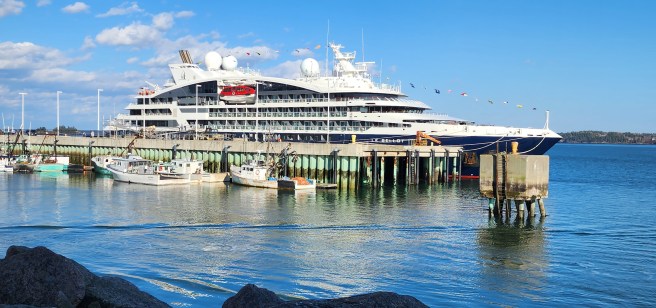
Last month, though, the city saw a record number of cruise ship visits, sometimes running one every other day over two weeks.

We’re getting what’s often termed mid-sized cruises, up to a thousand passengers, in contrast to the floating cities that might deliver five times that. Frankly, mid-size fits us fine.

One factor has been Bar Harbor’s reaction to being overwhelmed, down at the edge of Acadia National Park. And Portland, further down the coast, is a big city in contrast.

As a result, Eastport is being discovered as a place that offers a taste of a quintessential Maine fishing village without the hype.

As one younger woman said while walking past our home, “Today was AMAZING!” Imagine that, in a small town seemingly so far away from anything.

French liner Le Bellot, docked at Eastport’s Breakwater, visited town last week.

So far, these arrivals during the fall foliage season have extended our tourist season. The place typically shuts down by mid-September but these arrivals have extended that into early November. They’ve even given some, but not all, of our galleries and stores their best business days of the year. That’s a huge impact on a fragile, marginal downtown.

The landings also benefit the Breakwater and its workers, and let’s not sleight the purchases of junk food snacks at the IGA and Family Dollar by ships’ crews – sometimes up to another 600 people. They do load up.

We do enjoy seeing happy couples walking around our neighborhood with cameras in hand. Our conversations with them have been upbeat. Others have enjoyed bus tours to the Roosevelt compound on Campobello Island and the West Quoddy Light in Lubec or autumn foliage.

Economically, it’s an alternative to the Airbnb purchases that have been pulling housing away from working families, the very culture that’s a big part of the draw to our city. We do need more jobs that provide benefits, too, though that’s another big issue, one basically at the national level. I’ll save that for another time.

For now, let’s acknowledge what I’m seeing as a positive step, one that might even extend our spring shoulder season.

Losing a reclusive neighbor we never really met

Moving to a new community three years ago meant meeting new neighbors, and Eastport, as we’ve found, can be a friendly place, even for us who are “from away.”

But one of our abutting neighbors was very-hard-of-hearing, as my wife discovered in attempting to talk to her, and ignored my attempts of waving in greeting. In many ways, she resembled my late asocial mother-in-law, not only physically but also in a heavy cigarette habit. Don’t know if she rolled her own, though. Still, she seemed to relish her independence and had a support system that included a few handymen I could approach with problems to address. Which they did.

We did worry about her occasional drives to the grocery or doctor or wherever. She could barely see over the steering wheel while puffing away, for one thing. And her backing out of the driveway did appear questionable. Still, she eventually returned home, apparently unscathed. I did see her one day in the IGA parking lot receiving a lot of help packing her trunk with her purchases.

I did wonder about her living in a big house all by herself, though that’s not uncommon in a town that’s largely elderly.

So flash forward to a day before what was left of Hurricane Lee was to hit town and I looked out the kitchen-sink window to see a police officer nosing about, checking her car, knocking on her door (and receiving no answer). No surprise there, her lawn-mowing and snow-removing crews got much the same.

Still, he was persistent, making repeated calls from his cruiser after trying all doors and walking around the house.

The next thing I knew, an hour or two later, was a white glove through her apple trees and the black SUV before the blanketed gurney came into focus.

Even before the obituary, an online search gleaned details that she had been born in Eastport to the manager of the local Newberry’s store and, when it closed, moved by stages to Upstate New York, and then, after college, to San Francisco before the Summer of Love and a career in banking.

And then, in retirement, she returned to her roots – from the City on the Bay, as we say, to the City in the Bay.

Her maternal side ran back to a family of Loyalists who fled to St. Andrews, a neighboring community in New Brunswick, before relocating to Eastport early on, while her paternal line was Pennsylvania Dutch by way of Virginia.

The family’s eventual obituary adds details.

~*~

In the aftermath, masked family and friends have been working steadily over two weeks to collect bags of trash and purge the house, including a colony or two of rats. (The rodents, it turns out, are well established in our end of town today – one more challenge to address.)

This also raises the question of just how much I leave to others after my own passing, and how much I need to clear out before then.

In the meantime, other questions loom, including the meaning of life for each of us.

We do wonder who will be living there next – hopefully not one more Airbnb but a real family with kids.

Onward! As I like to say.

Not that I wouldn’t love hearing the rest of her life story.

Forget Disney, give Pluto his due

Yes, the tiny one-inch ball with its moon Charon, at one-half inch, out on that branch.

We won’t get into the shock of the dwarf status revision within the lifetime of some of us, in part in consequence of the discovery of that moon.

As a further twist, the Aroostook system has two Plutos, one inside the Houlton tourism center, where it represents the orbs’ average distance from the sun (40 miles in the scaled version), and this one presenting its more current placement in its wildly elliptical orbit, a relative 33 miles from Presque Isle for the next 20 or so years.

In tune with Neptune

With a 21.3-inch diameter and placed 31.7 miles from the sun in Presque Isle and having many moons too small to be presented at this scale, this stormy mystery orb also hints at the vast span of our solar system.

By this point in the drive, I’m really struck by the emptiness of the solar system and the space beyond. It’s essentially a vast, overwhelming nothingness. These are like pins in the proverbial haystack. And then, take heed of the incredible balance of forward motion and the sun’s gravity holding each one in place.

Science can attempt to answer the “How” in our ponderings, but as for the “Why,” if one even exists? That would mean facing questions of religion or theology. I’m not even touching on the mythological dimensions of these specks in the night sky.

Is it all an accident or some intentional mathematical outcome? Hmm, is there a neo-Calvinist turn in this thinking? We have miles to go yet.

In my previous visit to Aroostook County, I remember my amazement at passing this puzzling presentation only to encounter Saturn about 20 minutes later. Now I know it wasn’t one person’s quirky obsession.