As I’ve previously posted, social critic Tom Wolfe was perplexed that the hippie era didn’t produce any great novels. He’s wrong, of course, starting with Norman Gurney’s deceptively modest Divine Right’s Trip.
Reactions to earlier Red Barn posts suggested that many of the most influential books were nonfiction, including Wolfe’s own Electric Acid Kool-Aid Test but extending to Zen and the Art of Motorcycle Maintenance and the Whole Earth Catalogs and a whole lot more.
But there was notable fiction, beginning with Edward Abbey, John Nichols, and Richard Brautigan.
More recently I’ve come across ebooks at Smashwords that attempt to reflect the wide variations in experiences of the era.
One, for instance, takes a hermit’s perspective in retreating to the mountains outside Los Angeles. Another, the trials of being an activist. Yet another, the life of sex and drugs. And then there’s the spiritual trip. We even have descriptions of living the life in the deep South. You get the picture. Hippies came (and still come) in many varieties. No one size fits all, and I doubt any one novel could cover the range.
Naturally, I have my own fiction entries yet to be considered.
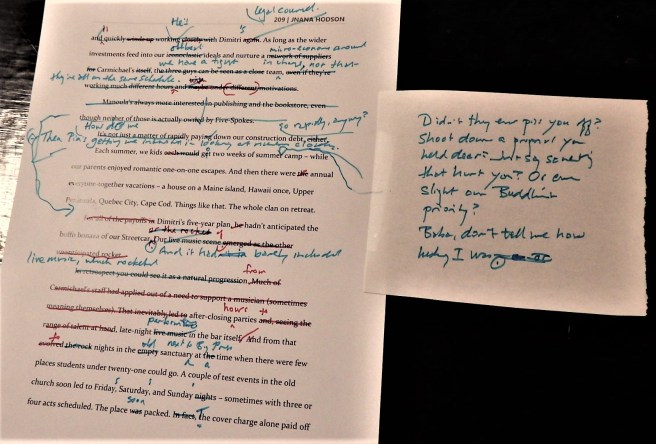
I’ve mentioned the deep revisions What’s Left underwent on its way to its current incarnation. Most of the work was done entirely on the computer, but a few rounds on paper helped, too. Here’s a sample from maybe Round Nine.
One of the basic bits of advice given to a writer is to envision your reader. It’s one that’s always troubled me, though. Could it be because I carry multiple identities as a writer? Poet, novelist, Quaker, retired journalist, with overlapping interests?
As a poet, I can’t describe the audience that shows up for a reading — the individuals seem to represent all types. Picture my readers? They could be anywhere in the subway car I’m riding!
OK, maybe it’s a younger, or at least more hip, crowd, but not entirely.
Back in April, Smashwords co-founder Jim Azevedo presented a six-hour writers conference via Zoom for ebook authors newbie and long-standing. I found it a rich experience and must applaud his stamina in sitting in front of his computer screen camera that long.
From this to …
His candid advice about rival Amazon prompted me to bite the bullet and look into reformatting my novels for Kindle Direct Publishing as one more digital retailing site for my work. I am, after all, fiercely loyal to Smashwords. Still, with Amazon, the most exciting thing is that I can now offer my work in print-on-demand paperback editions as well. I’ve come to love ebooks, but paper is, well, a special world to me.
Amazon has cleaned up many of its earlier formatting issues, and I can say my maiden foray went surprisingly smoothly. The one hiccup came with the paperback cover – my existing one was too small to run full-size. I compromised by reducing it within the glossy black background field.
I recently posted about tweaking that cover, which I did back before the online conference. Fortunately, it holds up to the new twist that’s been added to my thinking.
Azevedo spent some time covering the importance of covers, something I’ve previously blogged on. Frankly, from a design point of view, I find most book fronts to be cluttered and unfocused, combined with artwork that often strikes me as soft.
The making of a hippie
Maybe it’s all my years in journalism, but I’ve long leaned toward photographs as having more impact than paintings or drawings, and I want a strong graphic element other than type. Ebooks have an additional challenge of appearing, as Azevedo said, like postage stamps at the digital retail sites. That means any cover graphics have to pop if they’re going to catch your attention at all. You can’t be the least bit subtle.
What really struck me in Azevedo’s pitch was his insistence that a good book cover makes a promise.
What? The cover doesn’t mirror the story?
No, a promise.
As I started pondering potential new fronts for my paperback releases, his point kept kicking in. The result is a slew of new ebook covers already. Here I thought I’d be keeping what I had, but instead felt a need for improvement.
There was no escaping the necessity for a cover to have an emotional appeal, a gut-level reaction from a potential reader. Just who am I trying to entice? I’m not a famous writer, like Tolstoy or Stephen King or even Kurt Vonnegut, whose name alone could sell copies.
Still, thanks to an earlier project, I have a clearer concept of my ideal reader than I had in the past. So I’m not simply trying to stop a shopper for a moment’s reflection, as I might with a “literary” appeal. No, I’m trying to connect with her soul and spirit. Whew! So much for that calm bookish repose.
From this to …
Let’s jut say I’m aiming for real readers rather than schoolteachers or librarians. You know, the kind of readers who just might turn into not just fans but superfans, as Azevedo touts, the ones who tell everybody they know about the hot unknown book they’re devouring.
Flash forward and look what’s happened to my Subway Visions cover. The previous one set the underground urban tone, but just what’s the promise? It looks pretty static. Waiting for a train to somewhere, but what then?
The new cover, though, gives a totally different impression. Its brightly tagged subway car goes careening into the depths. We’re not just standing around, waiting, but off into the action. The typeface and solid color provide a retro take on old-fashioned paperbacks. Whoopie! As a reader, I expect to be entertained. We’re in for a wild trip. Well, there’s the promise. Come along with me.
Finding the right image, of course, is a challenge. I lucked out on this one, even though it required a long search and then winnowing down the other options. One where the photos all ultimately lost out.
Along the tubes to nirvana
I do hope that big piece of graffiti doesn’t say something truly embarrassing.
Daffodil Uprising was a bit more wrenching.
I’m quite fond of the clean appearance of that single bloom, but as I came back to the question of promise, I didn’t see the cover suggesting anything. It just stands there, like a monument.
The new cover, though, suggests a row of daffodils blazing into full bloom. It’s colorful and happy, reflecting much of the hippie expectation, without getting caught in the time warp. Yes, the story includes Flower Power but it’s more about youth and shared discoveries rather than Sixties. I’m surprised how fresh this new cover feels.
That’s appropriate, since my extensive revisions of these works sought to move them into being more about NOW than exclusively back THEN, even when the tale is full of what has become ancient history to most of the populace.
As I hunted for the new image, I wound up sorting through thousands of MsMaya’s mesmerizing abstract flower creations before finding one that captured something resembling daffodils. But then it blooms into something much more. Once again, the photos failed to make the final cut.
I was long overdue for a reading orgy — you know, an indulgence in books — and a little while ago, before the quarantine, in fact, I immersed myself in ebooks by other authors at Smashwords. Some of the volumes are even free.
If you’re curious about what I was reading, zip over to the books reviewed by me at the bottom of my Jnana Hodson page at Smashwords.com. Yes, I thought about posting the reviews here, too, but there was already a lot on the agenda.
Most of the ebooks touch in one way or another on topics in my own novels. It’s lovely finding kindred spirits. Well, it’s a lot like the ways we here at WordPress connect, too.
At a recent online writers’ conference, I was convinced to bite the bullet and release my novels at goliath Amazon in addition to the alternative ebook retailers where they’re already available. As I began pondering the new hurdles and strategies, I looked at Hometown News as a first offering.
A few years ago I had replaced the original cover, which sought to convey a sense of an idyllic small town where children could grow up safely, at least at the onset, with another of more urgency, reflecting the broader sense of the ultimately dystopian novel.
The new photographic image, though, was problematic.
The flames coming out of the residential window had the emotional message I wanted to convey, but they kept eating up the title and author credit, no matter which color I tried.
So I came up with this, trying to employ a trendy design element:
Returning to it now, though, I still felt an unease. The solution, in the end, was to make the artwork a bit smaller to give it more impact. Got that? It doesn’t make sense, but here’s how I’ve gone:
By the way, it’s now also available in paperback and Kindle at Amazon, as well as at Smashwords and affiliated ebook retailers.
My newest book, Nearly Canaan, is a thorough reworking of three earlier novels that now flow together as one.
Here are ten reasons the new version is new and improved.
The book now focuses on the question of what impact one person can make for lasting good in our world, especially in and through our closest relationships.
Jaya’s professional identity in her pioneering approach to nonprofits administration is quickly and more clearly established. Her career and its demands become a source of major conflict in the course of the story.
Her character now grows out of her role in Yoga Bootcamp, which provides further understanding of her motivations and inner direction.
The actions now show that the best intentions may have unanticipated negative consequences.
Jaya’s desire to find an appropriate way of personally expressing her spiritual experiences finally creates a unique artform.
Events are no longer left hanging at the end of what was the first novel. Life moves on in the aftermath of disaster.
The overall work is now structured within three large, overarching sections, each presented by a different teller. The first one, focusing on Jaya, is comprised of three telescoping parts that propel the action to the distinctive landscape where the second and third sections also take place. The second section is told by one of Jaya’s yoga students while the third is told by a young wife who’s been a close neighbor. Each of them reveals details unknown to most of the other characters in their social circle.
The story now has a short fourth section as a coda. I’m especially fond of it.
Once again, changing some of the names of characters makes a huge difference, especially when that leads to fond nicknames. Just see what happens to Jaya’s beau, especially.
I have far more sympathy for Jaya’s husband’s situation, even if it’s what he pressed so hard to find himself in.
In my novel What’s Left, Cassia’s clan wasn’t like a typical happy family. Hers was more like a hippie circus extending from the restaurant they jointly owned and operated. Much of their joy sprang from the fact they were different.
Only when tragic events rocked their course did they begin to resemble others around them.
It’s an inversion of Tolstoy’s great opening to Anna Karenina.
Likewise, their road to recovery includes their distinctive application of kefi, a Greek approach to living that defies precise translation. Still, I try in my novel. Cassia’s aunt Pia embodies it.
Sometimes details advance a story. And sometimes they raise unnecessary hurdles. In my novel What’s Left, what Cassia discovers about her deceased father (her Baba) is much better than this. So I cut it.
Hey, how many 12-year-olds would even know what a biochemist is? Or, for that matter, 16-year-olds, depending on when she’s making the connection? You still get the drift in the final version.
Under a different system of education, he might have become a biochemist or mathematician. He had leanings that way, which were not supported over time. So instead, he became a photographer — a very adept one who leaves behind what I’m finding to be an astonishing archive of social upheaval and redirection.
~*~
Oh, my, she wouldn’t ever say that last sentence, would she? Of course it had to go!
The point of her observation, though, remains pertinent. Many kids are thwarted at key points in their development, not just educationally, either.
What would you say has been a crucial obstacle in your past? How have you coped? Has it changed the direction of your life?
~*~
A large Queen Anne-style house with a distinctive witch’s hat tower something like this is the headquarters for Cassia’s extended family in my novel What’s Left. If only this one were pink, like hers.