Reading a history with your own hand in the game

Here we are, Thanksgiving Day, and I’m finally getting around to my reactions to Nathaniel Philbrick’s 2006 hit, Mayflower: Voyage, community, war.

Admittedly, having examined some of the period he covers, from the origin of the faithful and their sailing in 1620 through their struggles up to 1677, but from the settlements north of Boston, I come at the book from a different perspective than most readers. I appreciate his efforts to present the Separatists – the term he settles on rather than “Pilgrims” – as distinct from the Puritans who would invade New England a few years later. I also appreciate his emphasis on the non-members of the faith who participated in the Plymouth Colony settlement as well as the heavy financial burden the enterprise carried, which are details I develop more briefly in my own volume, Quaking Dover: How a counterculture took root and flourished in colonial New Hampshire.

What struck me in my reading was how little awareness Philbrick conveyed regarding the activities not just on the Piscataqua watershed, the center of my book, but north of Boston in general, including Salem, especially in the years before the Puritan influx. Sir Ferdinando Gorges, whom I see as the godfather of New England, is not even mentioned, though he and his investors were active behind the scenes in England. The Piscataqua venture was a source of food for the desperate Plymouth settlement and provided twice as much funding for anti-piracy efforts, among other things.

Philbrick, not surprisingly, takes a conventional gloss on Thomas Morton and the Merrymount settlement without noting that its roots were in Devonshire folkways, not just in personal eccentricities. Dismissing him as “a jolly down-on-his-luck lawyer from London” overlooks the argument that the settlement was thriving and apparently more successful, economically and as an attraction, than Plymouth.

Philbrick’s examination of the attempted Wessagussett settlement as a Plymouth satellite clarified some of the events for me, since it falls between Plymouth and Dover as the oldest permanent settlements in New England. I am also glad that he included the struggles and near devastation of the Jamestown settlement for perspective. The Virginia colony, like the Mayflower, tends to be romanticized in the public eye. The gritty realities need to be spotlighted, too.

He acknowledges the second ship to the Plymouth settlement, the Fortune, in the fall of 1621, which doubled the population of the colony as well as its growing pains. The next ships, the Anne and Little James, arrived in the summer of 1623, but only one is named, briefly. I follow their impact through immigrant William Hilton, the brother of the founder of Dover, New Hampshire, and a Fortune passenger. His wife and children came on the Anne. Though he’s often erroneously identified as co-founder, he didn’t arrive north until he was ejected from Plymouth after he and his wife had a child baptized by the Anglican John Lyford, an event that triggered events that Philbrick briefly notes. I am now wondering if Lyford later, in 1628, performed the first Anglican wedding in New England, the one uniting Samuel Maverick and the widow Amias Cole Thomson on an island in Boston Harbor. That, too, weaves back to my book.

Within the period covered in Mayflower, Quakers were making inroads into the Plymouth colony, though Philbrick makes only fleeting reference to the persecutions led by the Puritans.

While he goes into great detail regarding the Pequot War and the one after, known as King Philip’s, he makes no mention of the mock war games in Dover in 1676 that sent an estimated 400 or more Natives into captivity and is often credited as bringing the King Philip’s conflict to an end. Some were hanged but many, women and children, especially, were sold into slavery and exported.

Still, he develops a much more complex understanding of conflicts among the varied tribes and their leaders than is usually seen. The concept of a unified “Indian” front quickly crumbles away.

I’m also interested in the Winslow lines that left Plymouth, including those who came to the Piscataqua region about the time William Hilton did and others who joined with Dover Friends in establishing a Quaker presence in what eventually became Greater Portland, Maine.

For southern New England, the closure of King Philip’s War, where Philbrick’s book ends, essentially ended the conflicts with the First Peoples. Not so in the north, where fresh outbreaks would hammer on for decades, abetted by the forces of New France, ending only with the Treaty of Paris in 1763.
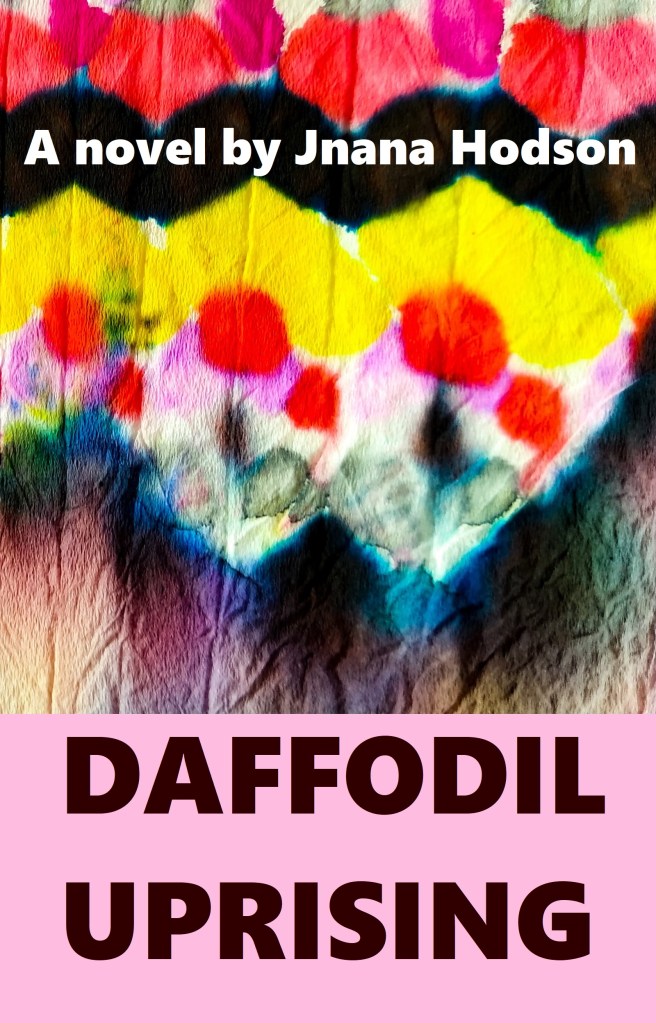
How can I not be delighted by this?

Writing often feels like working in a vacuum. Believe me, feedback from real readers – positive or negative – makes a huge difference.

How can I not savor a review like this by Girlpower at Amazon:

You’ll enjoy reading all of Jnana’s books, you won’t be disappointed.

Her reaction to Daffodil Uprising continues:

Jnana draws me back into the counterculture past we have in common. The book flows and takes you back into everything hippie during the seventies where most of the baby boomers found themselves. It was an exciting time, a revolution, fueled by peace and love, we were very different than our fathers and mothers.

His characters are people who reminded me of friends during that time. We experimented with drugs, and had more than one partner but it was an empowering time for women. Our fathers were of the silent generation who kept their heads down, we were no longer. We allowed ourselves the time to have a little fun. [It was also] the birth of organic food, which is now coming to bear fruit. The progressive generation gave birth to many of the things today that started back during those days.”

She turns to Kenzie’s days at Daffodil University, where he finds his bearings and has more than a few relationships and that unique casual sex that lived for itself and asked for nothing more.

Jnana in his free-flowing style gets down to it, explaining relationships. Kenzie got caught up in an affair with a woman who’s cheating …It took me back in time on a magic carpet ride. … Many generations are interested in how the hippie generation lived back then.

The making of a hippie

Available at the Apple Store, Barnes & Noble’s NookScribdSmashwords, Sony’s Kobo, and other fine ebook retailer and at Amazon in both Kindle and paperback.

A BIT MORE ON HIPPIE LIT

One of my lingering questions wonders why the intensity of the hippie experience didn’t flower more fully in fiction.

Yes, I know hippies were considered “laid back” and “mellow,” but that’s only part of the picture. A lot of what we felt was indeed incredible and new. Yet while the music of the era gives both lyrics and a soundtrack to the late ’60s and early ’70s, the literary parallel runs thin. Most of the prose is in the non-fiction side of the aisle – memoir, especially, and sociology – works like Barry Miles’ Hippie. Within that flourished a range of small publishing operations, such as Straight Arrow Books and Ten-Speed Press.

But novels are another matter.

As I’ve already noted, Richard Brautigan and Gurney Norman (Divine Right’s Trip) did give wondrous voice to the action. Add to that Maxine Hong Kingston’s Tripmaster Monkey, T.C. Boyle’s Drop City, and we’re soon at the fringe. Thomas Pyncheon’s Vineland, Lisa Mason’s Summer of Love, and Jan Kerouac’s Baby Driver get nods. I’d add Edward Abbey, Tom Robbins, and John Nichols to the list. And then?

Well, there’s always my Freakin’ Free Spirits cycle at Smashwords.com. All four volumes.

As Michael Wards, author of Bitch, a novel about Berkeley 1968-73, commented on an earlier post here, “Today I don’t think 20-year-olds would believe their grandparents were capable of anything that actually happened then.”

That, I suppose, is the entire point. We came so close to a real revolution across the social and economic spectrum. That vision needs to be kept alive and rekindled. Especially in the face of today’s repressive regime.

HOMAGE TO OTHERS IN THE ARTS

The tradition of art inspiring art is a long one. Perhaps we might even see a redundancy there and shorten the sentence to “Tradition inspiring art is a long one.” Or more accurately, “Traditions inspiring art are long.”

At the moment I’m reflecting on my poetry collection, 50 Preludes & Fugues, which springs in part from Dmitri Shostakovich’s 20th century homage to Bach. There are, we should note, two sets each with 24 preludes with fugues. I became acquainted with some of these piano pieces in college, via a budget LP recording apparently with the composer at the keyboard. (Memory had a young American pianist, as it is, but now I think it was the composer himself at the keyboard.)

And then these engaging, sometimes haunting, works disappeared from general public awareness.

Decades later, a Naxos CD set of the complete cycles by Konstantin Schebakov allowed me to rediscover their range – the discs were often playing as I drafted and revised the new poems. Still later, through a Christmas gift from my younger stepdaughter, I gained the opportunity to closely examine Keith Jarrett’s exploration on the ECM label, after hearing selections of his performances on public radio broadcasts.

What continues to amaze me is how different the two interpretations are. The Russian Schebakov is crystalline, restrained, centered on each chord and its ringing. The American Jarrett, in contrast, develops the phrasing – these pieces sing. Which version do I prefer? Or which is, in some way, “better”?

I can’t say. Instead, I’d argue that each is a counterpoint for the other, both springing from the same root. And that as a consequence, we’re all richer for their advances.

In the arts and if faith, we all build on deep roots that have come before us.

WHAT MAKES A POEM, ANYWAY?

Even poets will often have difficulty defining exactly what a poem is. As if there’s a single measure for poetry to begin with.

To call it “slow prose” seems to me to slight both poetry and prose. Robert Bly once faulted traditional English-language poetry for the way it’s commonly functioned in the role of sermons, with any inherent wildness diluted or tamed. How much politeness can a poem contain, anyway?

One distinction might arise in parallels to music. There are good reasons composers set poetry and not prose to a score – and not all of them have to do with metrics or form. A good poem has much of the indefinable emotional sensation of listening or performing music, apart from any linear explanation. Both somehow take us into the darkened recesses of our soul.

Maybe I’ve come too much under the spell of what Bly instead calls “leaping poetry,” which can be found throughout the oral traditions of so-called primitive peoples or in many pages of Scripture, including the Bible, or in the visions of Asian, Latin American, or French poetic seers.

Not that it’s easy to veer far from our roots in linear composition, or at least speech. Many contemporary poems obviously arise as a strand of journaling or even confession – and I’ll plead guilty there, too, though hopefully I’ve compressed, distilled, and transformed my material into something, well, full of imagery and free flight that makes a particular become universal as well.

There’s also the continuing struggle of just how far a poem can run from the very basis of language itself and still communicate some underlying sensation or experience. Choosing pieces to read before an audience, as I’ve found, can lead to a much different selection than I’d have for on-page presentation, where more linguistically fragmented work might be more engaging.

Could it be, then, that the question then isn’t so much what a poem is but rather what it are? And then, how many of those elements exist in this work or that?

MEMORY, IMAGINATION, AND LITERARY INTENT

A passage in an essay by Joyce Carol Oates stopped me cold in my tracks:

Literature is not a medium that lends itself well to the Surrealist adventure of disponibilite. Even radically experimental fiction requires some strategy of causation, otherwise readers won’t trouble to turn pages. Unlike most visual art, which can be experienced in a single gaze, fiction is a matter of subsequent and successive gazes, mimicking chronological time, as it is locked into chronological time. … (“Inspiration and Obsession in Life and Literature,” New York Review of Books, August 13)

So that’s been my “problem” as a poet and novelist? A surrealist adventure? Oh, my! I’ve long been fond of surrealism, often because I often see and hear life in that vein. While stopping short of subscribing to any manifesto, including those that gave rise to dada and surrealism, their ambitions continue to suggest possibilities for artistic exploration and discovery. As for chronological narrative, certainly there must be other ways to relate an event. Right? Well, even the alternative realities of dreams seem to emerge along timelines of some sort, even if they overlap from episode to episode that form what is remembered as a single dream event. A poem, moreover, can aspire to exist purely within a given moment it expresses, even if the reader returns to the lines repeatedly.

Maybe my saving grace here is in my assumption of invisible roots – everything happens for a reason, even accidents. (You don’t have to impute divine intervention there, either.) Perceiving these underlying currents, as some would suggest, demands something other than Aristotelian logic. Hence, the surrealist option, among others.

I do like Oates’ sense of gazes adding up into a quilt-work pattern, though, especially when they can bounce off each other to create yet something more.

And then her essay takes a remarkable turn that reinforces my invisible-roots assumption:

The hypocampus is a small, seahorse-shaped part of the brain necessary for long-term storage of factual and experiential memory, though it is not the site of such storage. Short-term memory is transient, long-term memory can prevail for many decades … If the hypocampus is injured or atrophied, there can be no further storage of memory in the brain – there will be no new memory. I have come to think that art is the formal commemoration of life in its variety – the novel, for instance, is “historic” in its embodiment of a specific place and time, and its suggestion that there is meaning in our actions. It is virtually impossible to create art without an inherent meaning, even if that meaning is presented as mysterious and unknowable.

Again, I’ve long viewed my writing as an attempt to remember what’s right in front of me in my life. Let’s face it, everything often seems chaotic. Times of reflection and self-evaluation are crucial. It’s easy to leap from there, as I’ve found, into meditation and the Quaker practice of group worship grounded in silence itself. Along these lines, Oates puts all this into another framework:

Without the stillness, thoughtfulness, and depths of art, and without the ceaseless moral rigors of art, we would have no shared culture – no collective memory. As if memory were destroyed in the human brain, our identities corrode, and we “were” no one – we become merely a shifting succession of impressions attached to no fixed source. As it is, in contemporary society, where so much concentration is focused upon social media, insatiable in its fleeting interests, the “stillness and thoughtfulness” of more permanent art feels threatened. As human beings we crave “meaning” – which only art can provide; but social media provide no meaning, only this succession of fleeting impressions whose underlying principle may simply be to urge us to consume products.

The motive for metaphor, then, is a motive for survival as a species, as a culture, and as individuals.

Of course, I would see true religion, not art, as the provider of “meaning.” And now the conversation would turn lively.

CRITICS AND A MODEL OF POETIC INTENT

Arts critics are often portrayed in the negative. Listen, for example, to the excerpts of voices who denigrated what became symphonic mega-hits or operatic standards. It’s a long list.

On the other hand, some critics (when it comes to classical music, dramatist Bernard Shaw and composer Virgil Thomson come to mind) have proved invaluable in sifting through artistic output and finding those jewels who would otherwise be lost in the volume before us and the drive for monetary success. Quite simply, good critics glean value from gems lost in the estimation of box-office success, bestseller popularity, and high audience ratings. With an eye for lasting quality, they guide individuals to work – and workers – they esteem.

As I look at the flood of artistic output on the Internet in our time, the role of good critics appears to be more crucial than ever.

Let me add that good critics are also teachers. I’m deeply indebted to people like Hub Meeker of the Dayton Journal Herald or Winthrop Sargeant of the New Yorker for their role in shaping my artistic awareness. As I’ve found over the years, reading a familiar critic becomes an active dialogue.

This leads me to a recent essay by the poet Charles Simic, long a star on the University of New Hampshire campus one town over from where I live. In “The Incomparable Critic” (New York Review of Books, August 13), he touts a collected volume of reviews by Helen Vendler and her examination of contemporary poets, centering down to her high estimation of one in particular:.

However none of these [William Carlos Williams, Gertrude Stein, Robert Frost, even the Beats] had the audacity, she points out, to switch back and forth between the sublime and the ignobly ridiculous as [A.R.] Ammons did. … for Ammons there is a “continuo of the personal – the ‘noise’ of the everyday mind – from which the lyric rises and into which it subsides.” This setting “of the lyric moment within its non-lyric ‘surround,'” Vendler writes, “is the fundamental device of modern poetry, from The Waste Land to this day.

That, in itself, is an audacious insight, of one reviewer to another.

Apart from any specific works, what is described is an ideal I admire – one I’ve sensed present in the works of Philip Whalen I’ve admired. And so we continue, writing and reading, in whatever quest we follow.

HOW WOULD THE AUTHOR REACT?

I never know what will show up in our household after a Saturday morning round of yard sales, and Vince Passaro’s novel Violence, Nudity, Adult Content is a perfect example. At least it wasn’t another chair.

OK, it’s a catchy title – one I’m afraid generally oversells the story. While the novel’s excellently written, what really strikes me is the way it’s essentially four related novellas that are woven together. And, yes, it is set in Manhattan.

There’s the big law-office intrigue and infighting. There’s the one rich client’s murder case. There’s another lawsuit resulting from a brutal sexual attack. And there’s the marriage with two young kids that’s coming unraveled. (So far, it’s not that different from the three stories in a single television episode of Love Boat, a formula that quickly spread across programming. Here, though, the braiding feels more integrated into a whole. Well, not everyone was on the boat at the same time, in effect.)

Now, for a little confession. In a more conventionally structured novel, I will often leap ahead somewhere around the middle to the final pages. If what I find there makes perfect sense from what I’ve already learned, I’ll likely drop the book – perhaps picking it up later and skimming for supporting details. Of course, it the plot’s much thicker, I continue on the linear course.

What I found myself doing in this case was jumping from page to page to pick up just one of the threads, all the way to the end, before returning to the point of departure and following another thread the same way. Hey, I was pressed for time! The fact that one of the threads, presented as emails, appeared in a different font made the process that much easier.

So I’m left wondering how the author would feel about readers like me. Or whether an author even cares how a reader moves through a story.

Maybe it just depends on the book. Or an ego.

CHANCING UPON A DESIRED TALE

In today’s publishing world, it’s impossible to keep up with the output. Even in a specialized niche.

I recall asking an English department chair at a respected college if she’d heard of so-and-so – the kind of novelist who gets reviewed by the New York Times both in its daily edition and again, independently, in the Sunday Book Review section. The answer was no.

(In fairness, she and her husband always introduce me to a range of fine authors when I scan their many home library bookshelves.)

Why wasn’t I surprised?

More recently, recognizing the extent of Greek-American influence in my own community and throughout much of the Northeast, I began searching for works that might reflect its family life and culture. Even a search by a public library research desk came up pretty empty. The Greek-American authors we did find seemed to be writing about other things.

There are, as I’ve noted, a few exceptions, but there should be more.

And then, by chance, I picked up Jeffrey Eugenides’ The Virgin Suicides. His was one of the Greek-American names I’d come across, but this story was focused on five sisters in a Roman Catholic family. I quickly resonated with the Midwestern setting of the story, which easily fit into a band across northern Ohio and Indiana and, as became more apparent, southern Michigan. This was familiar terrain, not far from my native soil – and another one that is rarely represented in literary fiction (yes, I know the objections to the term – but how do we distinguish it from commercial genres that are sales driven?). Despite its gruesome premise, this is a humorous book, befitting the thwarted desires and misunderstandings of its adolescent male observers.

And then, on page 171 of the paperback I was reading, came a glimmer of the novel I’ve been seeking. In the household of the narrator’s friend Demo Karafilis, we encounter his grandmother, Old Mrs. Karafilis, who generally stays to her room in the basement, where she keeps her memories of growing up a Greek in Turkey who managed to escape with her life. The next three-and-a-half pages are an incredible portrait that left me yearning for the novel-length development. As Demo explains it, “We Greeks are a moody people. Suicide makes sense to us. … What my yia yia could never understand about America was why everyone pretended to be happy all the time.”

What I discovered a few nights later, in the stacks of the library I’d consulted earlier, was the elusive Greek-American novel. How could it be so invisible after being acclaimed on Oprah’s list and even awarded a Pulitzer Prize? It was Eugenide’s second novel, a 529-page masterpiece.

Maybe part of it has to do with the sexuality theme that masks everything else – the narrator’s peculiar adolescent gender shift thanks to a recessive gene and the impact of earlier incest. Well, it is a riveting tale. For me, though, the primary story of Middlesex is the multigenerational presentation of a Greek-American family and its culture, done in a matter-of-fact way, with nothing sentimentalized. It’s an incredibly rich novel, no matter which part of the narrative claims your attention.

Not to take anything away from all the novels of ethnic life in New York City or Chicago or the regional flavors of New England, the South, southern California, Texas and other Far West locales, it’s safe to say many other strands of American life are greatly underrepresented or even missing entirely.

Any you want to point out?

NOT JUST BETHLEHEM, THEN

In early postings about creating a suitable bibliography reflecting the hippie era, your comments suggested some of the best works are in the realm of non-fiction, in contrast to Tom Wolfe’s demand for the big novel. Yes, as we discussed, there are some good novels, the bulk of them proving that small is beautiful, in contrast to Wolfe’s standard.

My reflections the other day on Patti Smith’s memoir, Just Kids (2010), added the underground artistic scene in New York to the list and has me thinking just how different the hippie centers could be. Most of them, as I see it, eventually wound up around college campuses.

Some recent overviews of Joan Didion’s life work have brought her 1968 collection of essays, Slouching Towards Bethlehem, to mind. Without going into criticism that she concentrated on the scandalous rather than the broader scene, what is stirred in my revisiting her essays is how localized and fleeting the hippie outbreak could be as it developed.

Quite simply, what fit one neighborhood or time didn’t necessarily fit others.

Haight-Ashbury, after all, soon morphed into back-to-the-earth networks or even rural communes, along with other situations, leaving its name to linger as a legend.

I mention this simply as a reminder of how far we are from a clear understanding of this remarkable history, much less its continuing – and pervasive – streams of action.

As for the big novel? Maybe it’s still waiting to happen.