You never know what we'll churn up in cleaning a stall
Like the American bison that dominated the prairie, the continuous ocean of tall grasses, which for so long spread from a corner of Ohio into Montana and Colorado, has been decimated. Homesteaders – seized by a fever to possess farmland of their own – sowed apprehension in their furrows. Inhabitants and land itself now lay open to chronic infection. After each harvest, the Breadbasket of the World, the Interior States of the American Soul, is left vacant, a stubble desert awaiting rebirth. Descendants of those who made this band agriculturally productive bear both its blessing, in economic output, and curse, as if no one can entirely escape the desperation that prompted settlement in the first place. In the recesses of the psyche, inheritors of these spaces must likewise sense themselves to be buffalo-people, and then fear they, too, may be heir to this fate. Pushed to the fringes, the intrinsic beauty and spiritual potential of the heartland are easily overlooked, both by the remnant population and the world’s policy-makers. Today’s farmers are mechanics, first and foremost. Cry, then, for harmony and healing – a proper reentry into Canaan, a taste of balm in manna. Look, ultimately, to the surviving bison and tall grasses with their underlying lavender shadings. Respect the faint drumming, growing louder.
The sky of America’s interior West is a dry eternity – an intense blue I see reflected in the cornflower bloom, or certain other blossoms, such as flax.
Curiously, the flower itself has no direct relationship to the cornstalk or ear. Its naming presents a mystery, to the modern ear, at least.
Now that I dwell under the commonly milky skies of New Hampshire, I find the blooming cornflower celebrates that vibrant blueness in my memory, and locales suddenly overlap in my mind, making me grateful to once again acknowledge that fullness and contrast. By extension, the cornflower blue sky extends to open spaces reaching westward from the Great Plains, with another set of experiences within me.
Gaze, then, into such deep color, undiluted, and its inexplicable essence.
One thing I strive to avoid in my Hippie Trails series of novels in a sense of nostalgia. Admittedly, the music, especially, can bring back groovy feelings. (The close reader will notice how little of it I touch on directly, but rather I try to look at other facets of the experience.) And, yes, it is easy to get wistful with some of the memories – Woodstock, for example, while conveniently overlooking all of the physical discomfort, or for some of the lost social life and friendships – but there are good reasons we can’t and don’t go back. Our youth, obviously, has turned to aging, and our freedom turned to responsibilities, many of them ones we’ve chosen.
We need to emphasize that much was not happy. There was desperation, in fact.
The period and the movement were far from perfect, but we also had glimpses – epiphanies, for some – and their influence is far from completed.
If we wholesale deny the dreams and prophetic directions we experienced in that youthful outburst, we cut ourselves off from our higher nature – and both we and our largely society are impoverished as a consequence.
As I look at the array of problems facing America and the world today, I sense that the more serious currents under the surface of the hippie outbreak may finally provide some much needed direction, if we can be honest with ourselves and our history.
That’s definitely not nostalgia, no matter the anthems and hymns in the music of the era.
~*~
To learn more about my novels, go to my page at Smashwords.com.
From a note dated 11 June 2005: Old North Bridge
Dixieland band on a pontoon party boat on the swollen Concord River
passing two Revolutionary War era uniformed re-enactors
on a hot, sweltering day.
(My younger one pointed out to them how their uniforms were wrong.)
Incongruous merriment.
How freely, all the same.
If classical music’s to find a fuller audience in America, the works of our own composers need to be presented. Especially those I call the Illuminists, after the great painters who finally have found widespread appreciation.
I love the orchestral works of John Knowles Paine, George Whitefield Chadwick, Amy Beach, Arthur Foote, MacDowell, Griffes … and no other composer spanned so much change within two decades as Charles Ives.
We know only the surface. Listen closely, and you’ll find none of them sounds truly German, despite the accusations. Even were it true, we need to remember (a) German was the standard for classical music, so much so that even Dvorak suffered, and (b) German was a central component of American culture at the time, anyway – it was even a required language in many major city high schools.
Acknowledging this puts Aaron Copland within a longer tradition, and all of those who follow.
Now, if our major orchestras would only live up to the challenge. Is it really to much to ask that they play a fourth of their repertoire from their home base?
She never did drugs, and she married a soldier. She was a faithful mother and wife. She doesn’t even know the smell of marijuana, and she talks to her legislators rather than standing in a demonstration.
But in my book, she’s still a hippie. There’s no question where she falls on the granola-heads to fundamentalist spectrum.
I’d give you my reasons she’s a hippie, as far as I’m concerned. But I bet you know others who are something like her. So I’d like to hear some of the qualities you perceived that help us break the stereotypes, at least when thinking of hippie.
There was the night when my daughters – at the time, one in college, the other beginning high school – had been chattering about something that prompted me to get out the yearbooks. Show them what things had been like back then, when Bob Dylan was just going electrified, Vietnam was ramping up, and hippies, well, were still more than a year away in the future. (My wife insists this came up on my birthday.)
Their reactions weren’t quite what I expected. Yes, there was the giggling, especially over the girls’ flip-style hair and A-line dresses. And their dismissal of some beauties I’d lusted after, as well as their agreement on others. Initially, they couldn’t find me in the pictures, and then, when they did, they started laughing: “You’re everywhere! Is there a group where you weren’t an officer? Hey, he even has some poetry here!” As well as my wife’s, “My, you were cute back then.” Which pains, in a way: I’m not now? Of course, I was the skinny, clueless intellectual back then – and generally unloved. To my further surprise, my girls declared that the boys in my high school class were generally pretty attractive – “They look put together,” as they put it – compared to those today. Maybe it was all the ties and shorn heads. I thought we looked pretty dorky. Still do, looking back.
A bit later, one night at the office, as one of my coworkers was complaining to another about the latest machinations by her son’s teacher, and his high school’s draconian response, I remembered that I’d been having a fleeting sense that this would have been the year for my 40th reunion – that is, if anyone was still in charge. With all of my moves about the country, though, they’d long since lost track of me. I’d never made any of the reunions anyway, either being unemployed at the time (and thus short of cash), unable to get the vacation time off or budget for the air fare, or even learning of the last one a couple of months after it happened. Lately, though, there have been some tentative Web searches for individuals, which did lead to a posting of some items from The Hilltopper, from when I was editor-in-chief. So now, around midnight, I decided to Google, just in case, a reunion notice might be posted, somewhere. And lo and behold, there it was. The Victory Bell, and then photos from their 35th anniversary gathering.
The Web site itself wasn’t in the best shape. A bit of nosing about did turn up a notice that there would, indeed, be a 40th observance, though because “we’re especially short of funds,” no mailings would be sent out. (As if they had my address.) But do I want to spend an evening in an American Legion hall with a DJ and people trying to make happy? The idea gives me the creeps. I’m a country dance kind of guy, or would at least prefer a setting where conversation would be facilitated, rather than masked.
Still, something in my awareness was pierced, and the emotions could not be restrained. For 40 years, from my perspective, at least, these classmates have been frozen in time. Their supple flesh and worldly inexperience, preserved intact. Jarring, then, comes the notice on the site, informing of the death of one who had been incredibly desirable, with side-by-side photos of her at 18 and then aged. As are notices of a cluster of others, now deceased. I click again, to photos from the 35th reunion, and am appalled. I recognize no one. They’re loud, badly dressed, and have not aged well. Finally, I find a few photos with the people identified, and then admit some are actually in pretty good shape. Another icon leads to a listing that includes married surnames, and the trail of these classmates is no longer lost from my sight. Further Web searches, for instance, present one I’d idealized who is now spouting political drivel, while another – once the epitome of cool sexuality and now apparently divorced in the past five years – is teaching knitting or quilting in a fundamentalist church. I return to the class Web site. Wonder about the Adonis club males, and just how did so many become so grotesque? As for the dress, strange tans, paunches, and wrinkles, the gray or dyed hair, or lack thereof: this is what I thought I wanted to return to, after college. Here, I must confront the reality that some – essentially the reunion crowd – were able to stay in town, largely on the one side of town, at that – while some others have been scattered to the winds. After all, I am among those “location unknown.”
How could I possibly begin to relate to them all of the twists in my own life – the ashram experience, the orchards and mountains of the Pacific Northwest, the St. Helens eruption, my Quaker progression and return east, publication of experimental novels and countless poems, the divorce and finally coming to have children when many of them are enjoying grandchildren, to say nothing of having a wife who’s nearly the age of their own children?
I looked at the posted photos and wondered, who are all these old people? Wondered, too, how I ever escaped that circle. (Oh, vanity!)


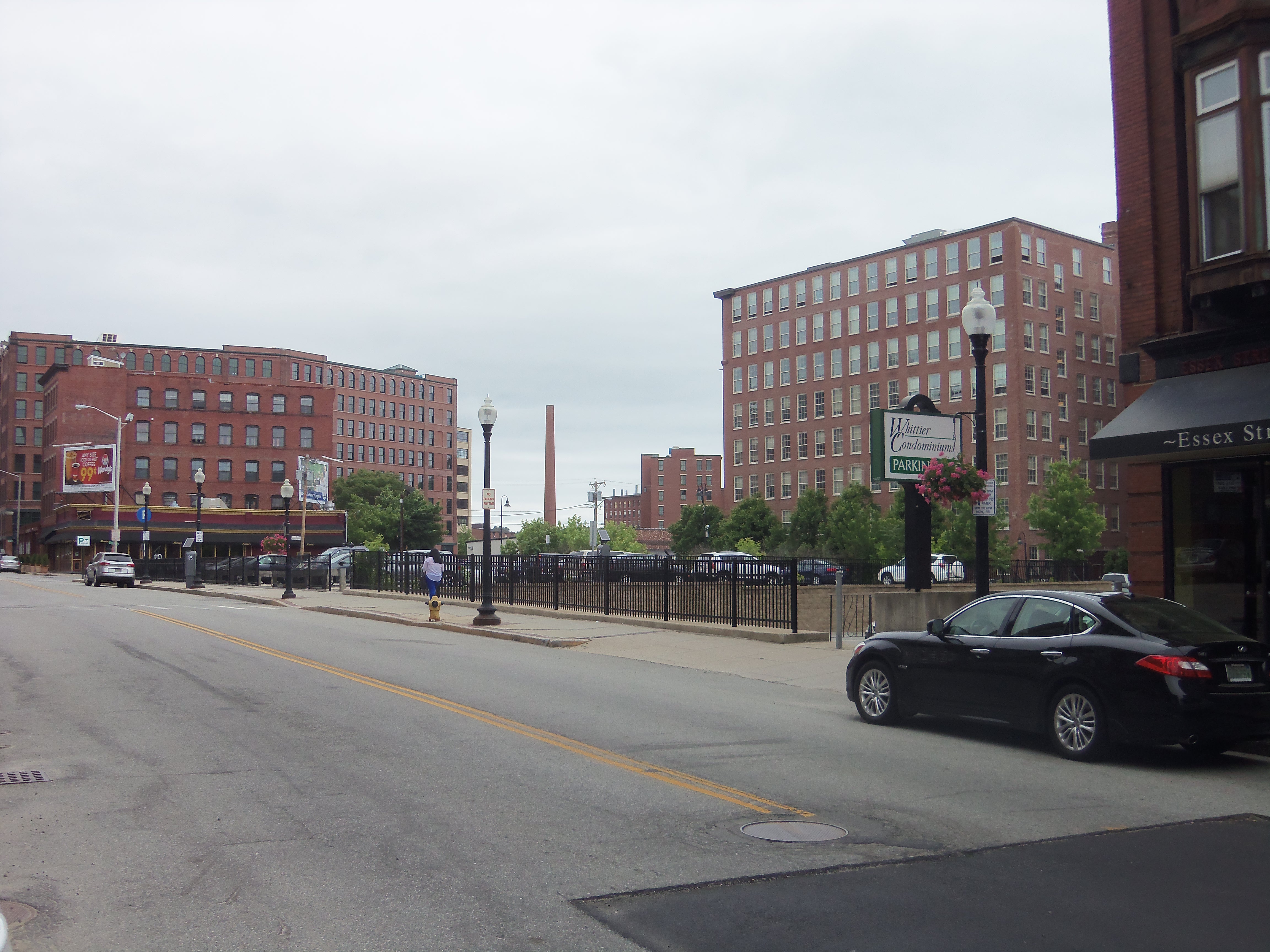
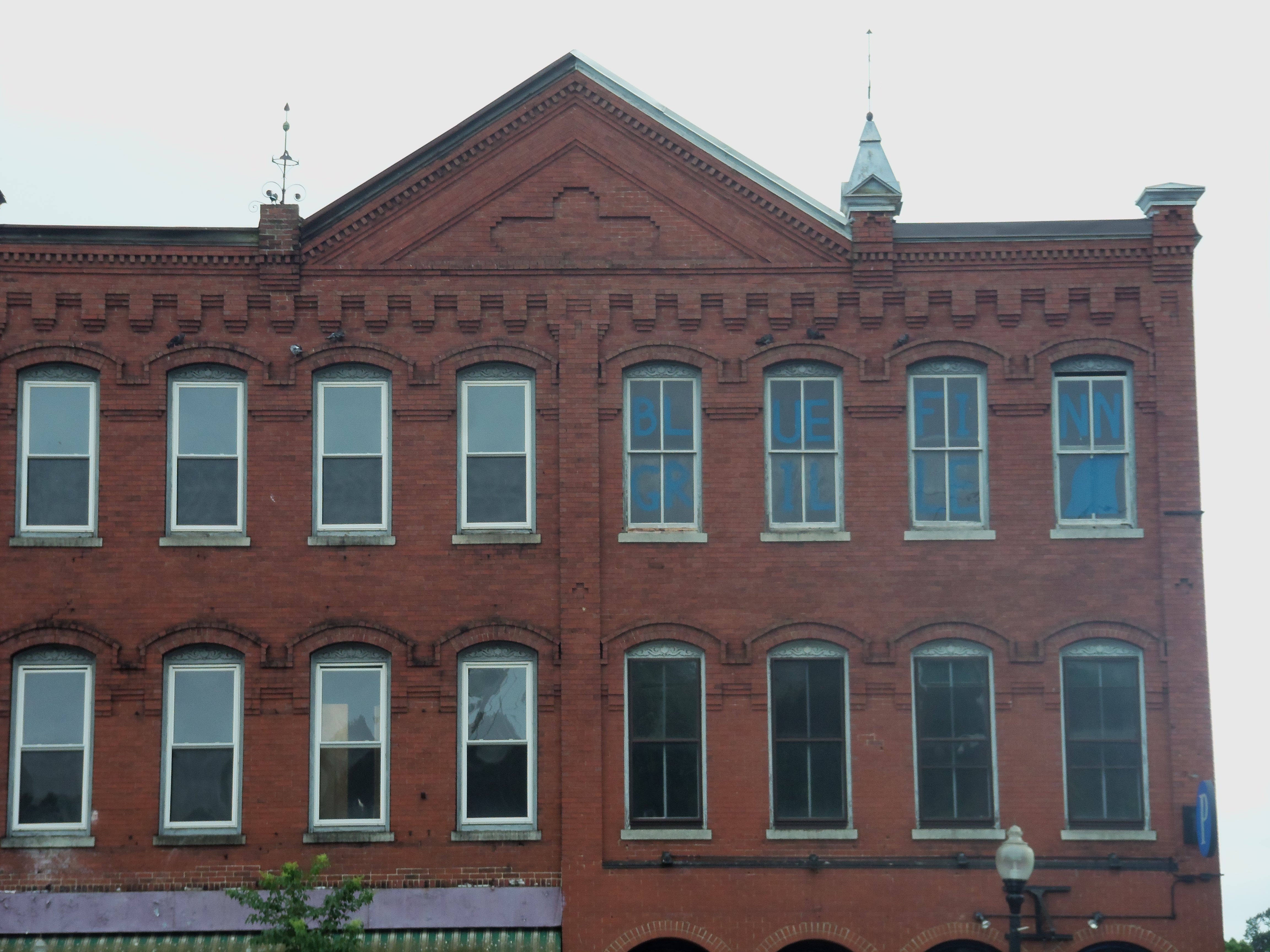
New England’s waterways are dotted with historic mill towns. The Merrimack River alone could boast of the water-powered industrial centers of Manchester and Nashua in New Hampshire as well as Lowell, Lawrence, Haverhill, and Amesbury downstream in Massachusetts, along with Newburyport and its harbor.


While textiles were the focus of much of New England’s mill output, the power was applied to other products as well. Haverhill, for instance, emerged as a center of shoemaking, by 1913 producing one of every 10 pairs in America and earning it a whimsical nickname of Queen Slipper City. Its earlier commerce rested on woolen mills, tanneries, shipping, and shipbuilding.


Like many of these once industrial centers, the city has been struggling to adapt to new directions and refit its legacy of old structures.
By the way, in Yankee style, it’s pronounced HAY-vril and is today a city of 60,000. But the river still runs through it.


Look at a lot of the bikers or some of today’s teens and you can see they’re carrying some of the hippie legacy. The long hair, especially, and the desire to be as free as Gypsies. But something there doesn’t quite fit, either.
Too much military, for the bikers – the peace vibe ain’t there.
As for the teens, I don’t see the playful side that accompanied the late ’60s and early ’70s, along with all the desperation. Even the drug use seems different, maybe purely numbing rather than mind-expanding.
I’ve already mentioned some of the hippie streams I see continuing. But I haven’t said much about the darker side. I’m open for some suggestions and comments here. Feel free to weigh in. Anybody still picking up hitchhikers, for starters?