Lobster boats prep for a fast racing season start

Informal racing out on the open waters was already a longstanding tradition when the Maine Lobster Boat Racing Association formed and launched its first races in 1964.

Fishing is a dangerous occupation, one luring a gnarly but dedicated gang into its ranks. It’s said they have salt water in their veins, or as I’ve heard them say of themselves, they’re either crazy or dumb – or both.

It should be no surprise, then, that here in Maine, lobstermen come together on summer weekends to race their boats. They have a pick of at least one every weekend.

Yup, race. Lobster boats don’t exactly look sleek or graceful – they’re built to work in all kinds of weather and take a beating. But they also have powerful engines. I had no idea just how powerful.

Besides, guys being guys, lobstermen have long boasted about their beloved boats – many are named after sweethearts and children, after all. Comparing theirs against their peers’ meant putting their words to the test.

All of that has led to a circuit of races starting in Boothbay and ending in Portland, with ten or so other sites along the way.

With that in mind, here are ten more bits to consider.

  1. Each race is different. Some draw more than 100 boats. The lengths of the races vary by location. Some routes are less than one mile, while others stretch over a few miles. Some courses are straight, while others are loops.
  2. Depending on the location, the winning speeds vary. The fastest boats typically reach 50 to 60 miles an hour, though a record 68.3 mph was recorded in 2022.
  3. The emphasis is on regular lobstermen, not professional racers, and additional events may be scheduled after the summer’s taken off. While prizes are awarded at the end of the season, the racers participate mostly for the thrill and its bragging rights.
  4. Typically, the races are divided into categories by boat type. For example, there may be separate runs for workboats under 24 feet length, gas-powered workboats of more than 24 feet, and diesel-powered workboats of more than 24 feet. There’s even a Class O category for non-working boats, any length, any horsepower – shall we guess these are out-and-out racers?
  5. In 2022, the entries ranged from 30-horsepower outboards to a 1,400-horsepower, 44-foot-long vessel named Bounty Hunter IV.
  6. For the races, they’re stripped of their gear and any other extraneous weight, or so I’m told.
  7. As for boat names? Maria’s Nightmare II and Wild Wild West give you an idea.
  8. While many spectators watch from the shoreline, others head out on the water to get close to the action. Some ferries and boats offer race day trips.
  9. The Moosabec Reach annual races are the closest event to me – and the only one in Washington County. The one-mile course runs between Jonesport and Beals Island, ending just before the bridge that connects Jonesport to the island. The race used to include going under the bridge, but that stopped after lobstermen crashed while trying to navigate under the bridge and around other boats.
  10. Since the Maine lobster boat races are in the summertime, it’s best to bring sunscreen. For distant viewing, binoculars are recommended. Other handy items to pack include refreshments and a sweatshirt in case there’s a cool ocean breeze.

Acid test mystic: Isaac Penington (1616-1679)

Unlike many of the early Quaker voices, Penington was well educated and respectable, the eldest son of a Lord Mayor of London. He even became William Penn’s father-in-law. But his joining with Quakers led to harsh persecution, including imprisonment six times, as well as intense spiritual experiences he described in various writings, including his letters.

A critical reader will recognize that articulating what is ultimately non-physical or confirmable is a difficult challenge. What Penington achieves remains insightful, personal, yet universal. There’s nothing dogmatic or doctrinaire or theoretical or speculative, not when grounded in personal practice.

His style fascinates me, long sentences that coil around and around as they move toward a core. Pulling a short quotation from them proves difficult without losing the wider field of wonder. As an example, “Give over thine own willing, give over thy own running, give over thine own desiring to know or be anything and sink down to the seed which God sows in the heart, and let that grow in thee and be in thee and breathe in thee and act in thee; and thou shalt find by sweet experience that the Lord knows that and loves and owns that, and will lead it to the inheritance of Life, which is its portion.” Eighty words, in all – typical.

Somehow, I find myself contrasting him to the Muggletonian William Blake a century and a half later, who struggled with similar challenges for a much different result.

What to pack for the trip

brought latest Paris Review and Harper’s
as reading along with Vincent Katz pages
maybe stimulation

didn’t read anything, really, apart from some entries
in the free guide to lighthouses I had picked up
nearly a decade earlier


So here’s the official advice before setting forth:

We are very relaxed and informal on board, so bring comfortable outdoor clothes. If possible, use a duffel or collapsible bag to pack your gear. Hard suitcases are sometimes difficult to store in the cabins.

The weather may be cool or warm, so include pants, shorts, long and short sleeve shirts, a sweater or sweatshirt and a jacket. When the wind picks up, things cool off, so think layers when you pack.

Don’t forget your bathing suit, either for sunbathing or a quick plunge in the ocean.

Soft soled shoes are best, and an extra pair may come in handy. Sandals also work well on board or on the beaches we visit.

If you have a rain slicker, bring it along just in case. We do have extra rain gear on board if you can’t bring your own.

Also, if you can, check the weather for Camden, Maine online before you pack. It may give you an idea of the specific weather for your trip. But remember that it is always slightly cooler out on the water.

We provide towels, linens, blankets, pillows, and all the food and non-alcoholic drinks. We have an icebox on board for passengers to use if they would like to bring along their own beer, wine, etc.

Bring a camera with extra batteries, sunglasses, lots of sunscreen, a good book, binoculars, a journal, and your musical talents/instruments (if they are transportable!). If you want to sleep on deck under the stars, bring along a sleeping bag. Some folks bring charts or GPS’s to keep up with our route.

Once we leave the dock, we operate on 12 volt DC power. There are USB outlets for charging phones – please bring your own USB cord. We do have limited 110 volt AC power (like in your house) that can be used for medical machines and for occasional charging of batteries. Please let us know when you book if you will be needing 110 volt AC power to operate a medical machine.

What a relief when spring arrives!

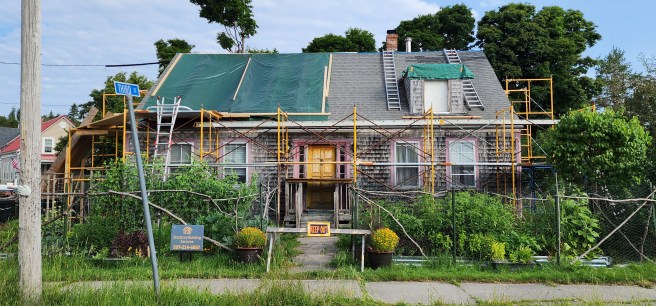
There was a seasonal correspondence with the renovation project and the winter season.

In a clime like ours, weeks pass when everything outdoors seems dead. Outside our vision, though, things are preparing for rebirth. Maple sap starts running, for instance, as the syrup makers know. And then the first flowers pop up.

Something similar was happening with the house work.

I mentioned the wiring. Here’s another look as it developed.

New wiring.

And then the plumbing.

And here I was expecting metal pipes rather than flexible tubing.

Selecting the toilet, tub, shower, and so on took more time than anticipated, especially when two separate trips to Bangor – a full day each – turned up nothing at Lowe’s, Home Depot, or Frank W. Webb.

You can’t always go by the description you find online or in a catalog.

I am looking forward to finally being able to take a bath without feeling like a pretzel. It’s been four years, in fact.

Visible progress was even appearing on the new exterior on the gable ends.

We love the little detail of the upturned notch on these cedar shake shingles. It matches the earlier ones that will remain on the other half of the exterior.

And the dividing walls along the center started coming down.

Do I sound impatient?

Is small really beautiful?

One place I was appearing as a writer was in the small-press realm. Largely unseen and at the fringe of the literary world, its prolific, low-circulation reviews, quarterlies, ‘zines, chapbooks, and even full-sized books reflected a passion for literature, an intense mission, or outright ambition rather than an accountant’s commercial motivation. Many were marginally funded, mimeographed or photocopied, while others had more traditional printers, perhaps even typesetters, and a few of the biggest even had paid staff. Most were edited by dedicated individuals or partnerships; others by an institution or circle; and still others by college English departments, with either students or faculty as the team.

It’s where the action was – and remains.

Among the book publishers, Black Sparrow and Copper Canyon stand out, along with Shambala for a Buddhist focus.

In general, university book presses garnered more respect and financial backing and weren’t open to those of us who weren’t in a professorial track.

In college, I had been told of a widely recognized poet who averaged 20 rejections for every poem he had accepted in one of these journals. That was meant as inspiration to keep us lesser voices from despair.

Well, a few years later, I was getting about 20 rejections for every batch of five poems I mailed out. Still, I got more than a thousand acceptances. They usually paid me with two contributor’s copies, or did before the action shifted online. There are some fine online sites, by the way, if you look.

The track was how you were supposed to build a reputation and even entice an agent or editor. I think they were all too busy to notice.

A newspaper career was usually supposed to grow the same way: start out on a small daily somewhere out in the sticks, one with next to nothing pay, and work your way up. Or as one critic warned publishers, this was a process of eating your young. Or your seed corn, in another version.

(The highest income I ever reached, by the way, was the national median. And that was thanks to our Newspaper Guild contract, unlike most of our rivals.)

~*~

Acceptances created another challenge, drafting a contributor’s note.

I noticed that many of the writers listed their most recent book or two, but I really didn’t have that much. Others went with where they were teaching or working on an advanced degree. With my name distancing myself from the more common tag I used in the newsroom, naming the newspaper wasn’t really an option – and not that wise, anyway, if the content was of a controversial nature, as many still saw the hippie movement.

The solution, then, was to look for some bit that would make me more human. Do try it, if you’re asked to come up with something similar. Even be flip, if you can.

~*~

The World Wide Web has taken all of this in a new dimension, of course.

We bloggers are essentially producing ‘zines or similar small journals. We even have photography as a regular option, not a given back in the day.

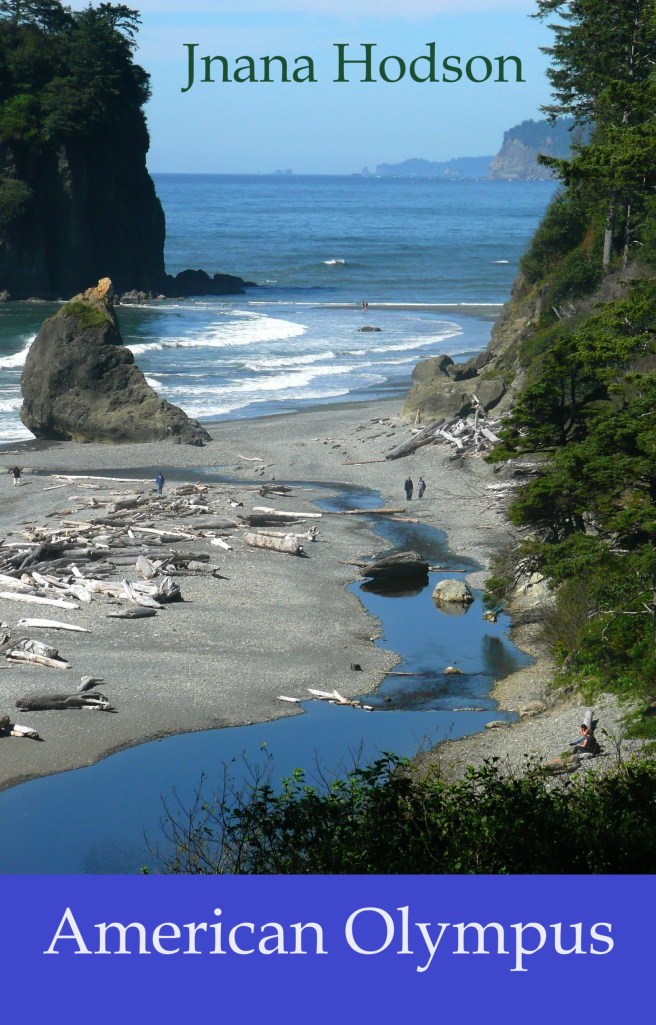
I’ve even gathered my published poems along with newer ones and published them as free PDF chapbooks at my own online imprint, Thistle Finch, a sister to this Red Barn. Do look it up.

More crucial has been the growth of ebooks and on-demand print publishing, which I’ll discuss in an upcoming post.