THIRD TIME’S A CHARM

Just want to thank all of you who have downloaded your own copy of my novel Hippie Drum and to say how much I hope you’ve enjoyed it.

Since it’s my third published novel, and another in what’s considered the “experimental” literature realm, I’m grateful for all of the positive reaction.

If you haven’t yet joined the club of readers, let me encourage you to join now. Just click here for your own free copy.

MORE ANCIENT HISTORY

As I said at the time, there I was, actually, admitting that about now, whenever that was, it would be nice to find a big chunk of time to work on some new poems. Hadn’t done diddly since my week in the Maine woods, back in October, years ago. Had a big project lined up, the first draft already keyboarded – but other projects intruded, including a book-length prose manuscript I tried launching with a holistic Certified Public Accountant. Most of that volume was already written, but getting her input sometimes felt like pulling teeth. Figured that one would occupy my “writing” space through May. And then it went nowhere.

Was also trying to master the new computer means that my reading time was spent mostly with those fat manuals – good thing they’re indexed! Wished I could get those damn AOL logos off the bottom of my screen, too. I shifted over to Mindspring – for now, at least. And one more thing to master, in time, this e-mail process! (Well, I was already doing my checks from the terminal, and had a lot of the genealogy input. Transferring old 5.25-inch floppies in WordPerfect 4.1 was now possible, thanks to a drive a friend installed a month ago, but very time-consuming – a lot of garbage had to be removed with S&R, a big job when you’re handling drafts of novels! I expected to be nibbling away at that well into the autumn.)

As I was telling a certain woman in the midst of all this:

OK, you do have me reading the celebratory Poppy Z., at least in snippets as I find time. A month or so ago, I turned to one of the Goths in our poetry circle and mentioned there was an author a ‘zine editor-friend of mine out in Chicago raves  about, and somehow one piped up, “Oh! Poppy Z. Brite!”- so there you have it! (My friend, by the way, is in N’Orleans for Fat Tuesday and some recovery time thereafter – but I sense it’s part of a much bigger story I shan’t touch on just now, except that it looks like all the nasty fallout.) What impresses me most with PZB right now is how masterfully she handles dialogue – especially with seemingly inarticulate people. How evocative it is! (Envy time.) Since you have been smitten by N’Orleans (as, somehow, has a colleague at the office – again, another story), I must recommend an astounding novel by John Gregory Brown, Decorations in a Ruined Cemetery, which kept me up most of one frigid night in that cabin in Maine – as logs roared and sizzled in the fireplace – a box of Kleenex by the finale is advised, too – a real vortex of history, place, and those realms of caring for others that sometimes can never be spoken directly. By the way, did you catch the Streetcar Named Desire opera telecast on Public Television? Andre Previn’s music somehow intensifies an already sizzling text, and the casting would do Hollywood great. Less than a week after it was aired, I found myself spending an afternoon with a Cajun welder and his wife, whom my companion for the day had told me was involved with another man. Talk about things that cannot be spoken directly!

At any rate, much of your prose delves into matters that are generally not spoken directly – especially by a woman and by one who is still at an age when they are fresh! Matters of sexuality immediately stir up conflicts – lust versus love, power balances and reversals within relationship, passions/desires/dreams, promises and betrayals, egos, appetites, aging, vulnerabilities, layers of intimacy or distancing, pleasure/pain dimensions, possessiveness/freedom, giving/taking, nurturing/devouring. And that’s before we even touch on money, time, labor, wealth matters – the stuff that triggers most divorces – or questions of child-rearing or larger family interactions.

My, how much we had stirred up at the time! And how much lingers …

GETTING FREE OF GUILT EDGES

A renewed compulsion had me rethinking, reworking, pruning, and punching up much of my earlier writing – the dozen unpublished novels; the genealogy research and narrative; several hundred poems, many of which had been published in literary quarterlies; and varied essays and journal entries. It hit with a vengeance, and was given extra clout at New England Yearly Meeting one August when, in a prayer circle, it was made clear to me that these labors are an exercise of talent, a gift, rather than a self-indulgence that had too often before stirred feelings of guilt.

For the first time in my life, I felt free to undertake this labor, the writing that does not pay the bills but somehow keeps me intellectually and artistically alive. What a blessing! (Never underestimate the power of prayer!)

Again, cleaning up these works and seeing them published may be one more way of bringing some closure to what too often seems a honeycombed life! Writing pulls so many of these threads together.

I began trying to set aside one free day each week as a no-automobile day, a kind of sabbath for writing, reading, or reflection; even with my usual three days off at the time (Sunday News worked a double shift every Saturday), achieving this goal became surprisingly difficult – but wonderfully rewarding when it did.

In some rich ways, it became a kind of retirement, even while being employed elsewhere full-time.

REMEMBERING JULIA

The Canterbury Shaker Village is a remarkable place to revisit history. I’ve had a lifelong appreciation of Shaker architecture and furniture. In fact, we used to bicycle out to what had been a Shaker village and catch crawdads in the stream. Our denomination also had its orphanage and retirement center at another former Shaker village not far south of us, and I remember touring its remaining buildings.

But Canterbury was one of the last two villages, and one Friend speaks fondly of his conversations with the sisters. Today it is a well preserved living history museum.

So one weekday, when I was free of the office, my girlfriend and I went up for a tour. As we arrived, I noticed one of my coworkers, Ellie Ferriter, and in greeting, asked what she was doing there. “I’m here to meet Julia Child,” she replied. Yeah, sure. “No really, she’s here to tape an interview with the chef.”

One of the things the museum had done was open a restaurant with a menu drawn from the distinctive Shaker recipes, and there was reason to celebrate the cuisine.

Sure enough, when we came back from our tour, there was Ellie, interviewing Julia. Now Ellie was a large woman, but Julia was larger – in fact, towering above and around the interviewer. I hadn’t expected that, even though one profile had described her as having very long legs when she went to work in military intelligence back during World War II.

Julia had already had a long influence on me. In high school, when we finally got a TV set that included UHF, I could finally watch the “educational station” out of Cincinnati, and there, through the snowy image that barely came through, I was introduced to exotic foods like lobsters, asparagus, artichokes, baguettes and croissants, hollandaise. Well, introduced to their concepts and preparation. The actual introductions would come across the years, and what had been exotic has long since become standard.

We settled into the Creamery, the small restaurant, for lunch – my girlfriend and I along with a couple from England at one table, Julia and Ellie at the next one. We could overhear every word. Our English visitors, meanwhile, had no idea who Julia was.

Later, I noticed Julia sitting alone in a shaded spot. Wondered if she was lonely or just needed a break. I was tempted to approach and introduce myself, but refrained.

*   *   *

About that same time, I was talking with a woman who knew someone whose husband conferred with Julia several times each year, and the wife was expected to serve lunch – a daunting prospect. What do you prepare for one of the world’s most famous cooks and food writers? And then she discovered that a boiled lobster and fresh green salad were always savored.

How I’ve come to love that insight when facing a seemingly impossible assignment – a simple but elegant solution, as the Shakers demonstrated, may be the ideal.

Here’s to Julia’s 101st birthday.

THE MANY MEANINGS OF MEETING

Quakers use the word meeting in many ways. Originating in the mid-1600s in England, Friends understood that church meant the body of believers – not the building, not the denomination, not the structure of hierarchy. Thus, you didn’t go to church – you gathered with the church. And so, the church (that is, people) met. The gathering of the faithful, and their time of worship, quickly became known as a meeting. Within it, we meet with each other and with God – early Friends proclaimed Christ had come to teach his people himself, and they sat in what became known as expectant waiting for his presence. Modern Friends may prefer other terms to describe the experience, even while retaining an awareness of Spirit-led worship. (I might add that in today’s frenetic world, an individual also meets with himself or herself, especially at the beginning of the hour, personally collecting scattered experiences of the week and renewing one’s sense of inner direction.) When we have a building set apart for worship, it is called, logically, a meetinghouse – here, we meet. In addition to the meanings of meeting as the people and as the worship service, Quakers also began to apply  the term to congregations and organization; this is based, curiously, on the frequency of each group’s gathering for the conduct of its business and discipline, or what we now usually call faith and practice. The local congregation is typically known as a monthly meeting. Neighboring monthly meetings participate in a quarterly meeting, four times a year. And the quarterly meetings come together as a regional yearly meeting, which has sessions once a year. (There are some variations within this, but in terms of decision-making authority, the monthly/quarterly/yearly connection holds). Thus, my congregation, Dover Monthly Meeting, is part of Dover Quarterly Meeting and New England Yearly Meeting.

All of this originated in response to the open worship and the desire to strengthen and deepen it. Early Friends soon perceived themselves as a people of faith, rather than as motley individuals, and that vision has left a treasured legacy of social change that is taken for granted by most people today. Again, I’ll leave that discussion to a number of excellent Quaker history volumes.

Even so, as we begin to participate within our spiritual community, we realize that when we’re faithful, the whole is greater than the sum of its parts. Here in Dover, I’m constantly surprised to find how far our activities extend, within the meeting itself (in all of its meanings) and throughout the surrounding towns and various networks of concern. Surprised, too, at the range of talent and skill in our midst. In the history of Friends, we have somehow come to rely on committees to meet our common organizational needs. I’m not sure when this emerged, and believe that early on, many of the tasks were performed within extended families, but today’s Quaker meetings depend on Friends’ service on various committees – everything from Ministry and Worship or Pastoral Care to Finance or Trustees to Religious Education or Building and Grounds to Hospitality or Peace and Justice Concerns. In practice, what I’ve observed is that these never all function smoothly at the same time. Even so, they extend our understanding of waiting from one of expectation to one of service, a meaning we see in language through terms such as waiter or waitress or lady in waiting. As I’ve said, in practice, sustaining a weekly hour of silence is not easy, individually or as a group. Nonetheless, I still find it’s essential, both ways.

SMOKING GARDEN

At night these strands twinkle.

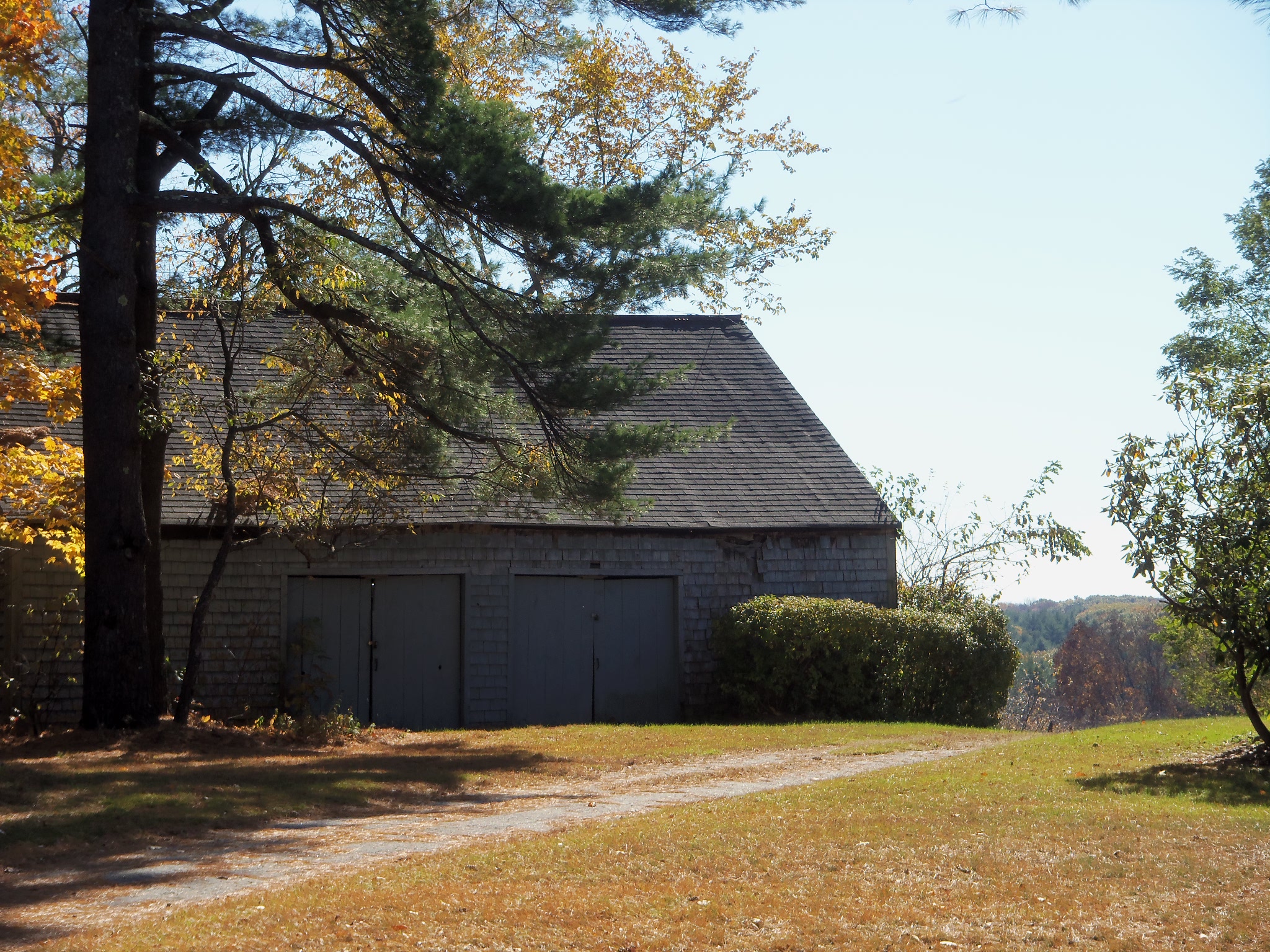
I’ve mentioned the space we whimsically call the Smoking Garden – the funky patio, as it were, beside the barn.

It’s great for late afternoon and evening dining all summer, or parties ringed by Tiki torches, though it’s been a while.

Even so, here it is.

BIRDS AS BYSTANDERS

A ring of blue jays is sounding an alarm somewhere close by. Who knows what it is this time.

So I stop typing, get up to look out the window, just in case they’re in view. What I see instead is a grandstand of smaller birds – sparrows, juncos, chickadees – all sitting contentedly on branches and facing the action.

Here we have it: the idle curiosity of us all.

SPLITTING THE RENT

Yes, splitting the rent, as I remember it, way back when leaving home and living not with a spouse or a lover, but instead sharing a dorm room or an apartment as a matter of economic necessity. You would wish otherwise, of course, for a space all your own, with privacy. In all of this transition, all the same, the unanticipated connections. As if you would ever go back.