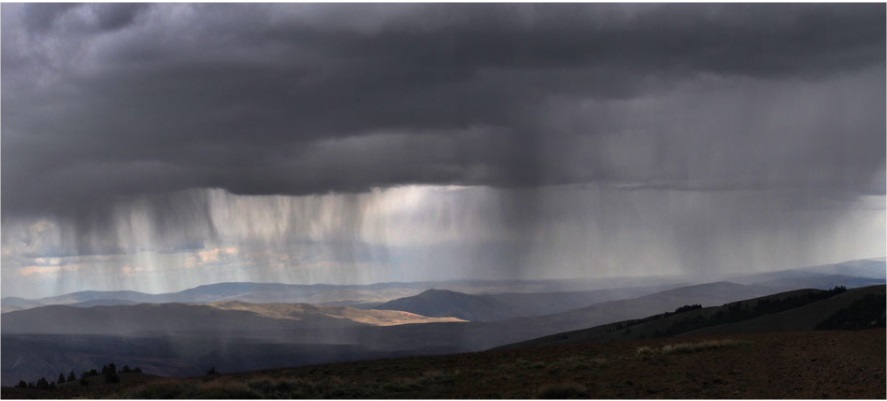
HERE OR THAY-ER
Some folks in Washington are all too happy to approve $240,000 grants to buy armored trucks for little ‘burgs like Dover – while trying to derail health care for all Americans as too expensive.
Huh? These things add up … quickly.
GETTING BEYOND LIKE OR DISLIKE
One of the secrets to living a richer life comes in learning to evaluate experiences beyond a simple like or dislike – especially on first encounter. So many of the delights of living are found in acquired tastes. Returning to a challenge for new insights. The critical examination and perspective.
So it’s been with the opera, so much classical music, visual art, beer and wine, even literature I’ve come to love. To say nothing of Holy Scripture. Or the places I’ve lived. To be honest, there are often stretches in a long hike I might admit I don’t like, especially if the insects are biting and the incline’s steep, no matter how much I’m enlivened by the entire outing.
Somewhere along the line, I’ve learned to distrust what comes easily. In living with a piece of art, you may realize fatal flaws behind the initial flash, or to your continuing delight you may find the revelations expanding.
Part of the transition comes in learning to see value in ambiguity and paradox, or to find riches in the shadings of gray beyond simple black and white. It’s not an argument for self-torture or meaninglessness, but rather a willingness to suspend disbelief long enough to consider many other dimensions.
Yes, I like pizza. But, as an illustration, I never would have discovered the joys of manicotti if I’d insisted on the familiar pie that one night.
At the moment, I’m cracking open the Bartok string quartets by means of repeated listening and finding such beauty beneath their outward gruffness. Any examples you care to add the list?
HOW MUCH IS ENOUGH?
Why does Dover need a BearCat when the Seacoast Emergency Response Team already has one parked just down the road?
And when was the last time it was really needed?
I’m beginning to think the vote was a result of this long, weird winter we’ve had. Not that the truck would do any good with a plow attachment.
ANABAPTIST ETC.
As I said at the time …
You ask about “Anabaptist.” I’ll try for a short answer and hope it works. In the early Protestant Reformation, three major streams emerged. The Anabaptists accused the Lutherans and Calvinists (Reformed, Presbyterian, and English Puritan churches, among others) of not carrying the faith far enough and, as a consequence, were severely persecuted by them and the Roman Catholics. As the first to argue for a strict separation of church and state, they became pacifists who warned that any official state church seriously compromises the Gospel. The movement exists today as Mennonites, Amish, Church of the Brethren (or, in its older forms, Dunker), River Brethren, Bruderhoff, Amanas, Hutterites, and – by extension – the Society of Friends, or Quakers. It traces its roots to the Waldensians, the communalistic radical Christian movement against whom the Inquisition was launched. Its traditions include non-violence, simplicity, discipleship, community. You can see the absurdity in having one of them as a military chaplain! (In Catch-22.)
The term itself means “rebaptized,” an argument that infant baptisms (which that first generation had undergone, before the Reformation emerged) were invalid: the only authentic acceptance of faith could be made as an adult.
Because the Mennonites took literally Amos 5:23, “I will hear thy viols no more,” they banned instrumental music from their lives. Somehow, though, they practice four-part unaccompanied singing that seems to be part of their genetic endowment. Their hymnals cover the range of church music, from all denominations and eras, as long as it sings well. Whether gathered as six or eight people standing in a circle in someone’s living room, or as six hundred adults singing a Bach chorale at a wedding, the effect is quite moving: you have to be loud enough to contribute to the worship, but soft enough to be aware of everyone else. As an old-style Quaker once told me, “Jnana, thee has to remember that in their singing, the Mennonites are experiencing something very much like what we feel in our silence.”
Kenneth Rexroth, whose ancestry was in the Dunker/Brethren tradition, details much of this history in one of his collections of essays. (Don’t have the title at hand, but it’s the one about communalism.) Another poet who was Brethren is William Stafford.
You mention Thomas Merton. He inherited some of this tradition through one of his parents who was Quaker. But he felt the liberal Meeting (as Friends’ congregations are known) he attended as a child was well-intentioned but superficial, and yearned instead for the depth of its earlier generations. The rest, as they say …
Have you seen Kathleen Norris’ The Cloister Walk? As a Protestant who draws strength from her retreats and friendships in the monasteries of the Great Plains, she has some wonderful insights into abbey life.
OK, I promised to keep this short!
And I do hope your parking problems with J have found an appropriately adult resolution, other than your turning the other cheek – which, to continue all this theology, was originally an act of defiance, causing the abusive person to lose face. (By the way, 7th and Race, I take it, is Zinzinnati?)
Blessings …
BETTER OPTIONS
Homeland Security’s grant of $240,000 to my placid city of 30,000 to purchase an armored truck for the police department illustrates one thing:
Those folks in Congress who keep harping on government spending aren’t reticent when it comes for doling out the big bucks for items that do little or nothing for the common American.
Since Dover is an unlikely spot for terrorists to attack, could we use some of that money to pay off student loans? For starters?
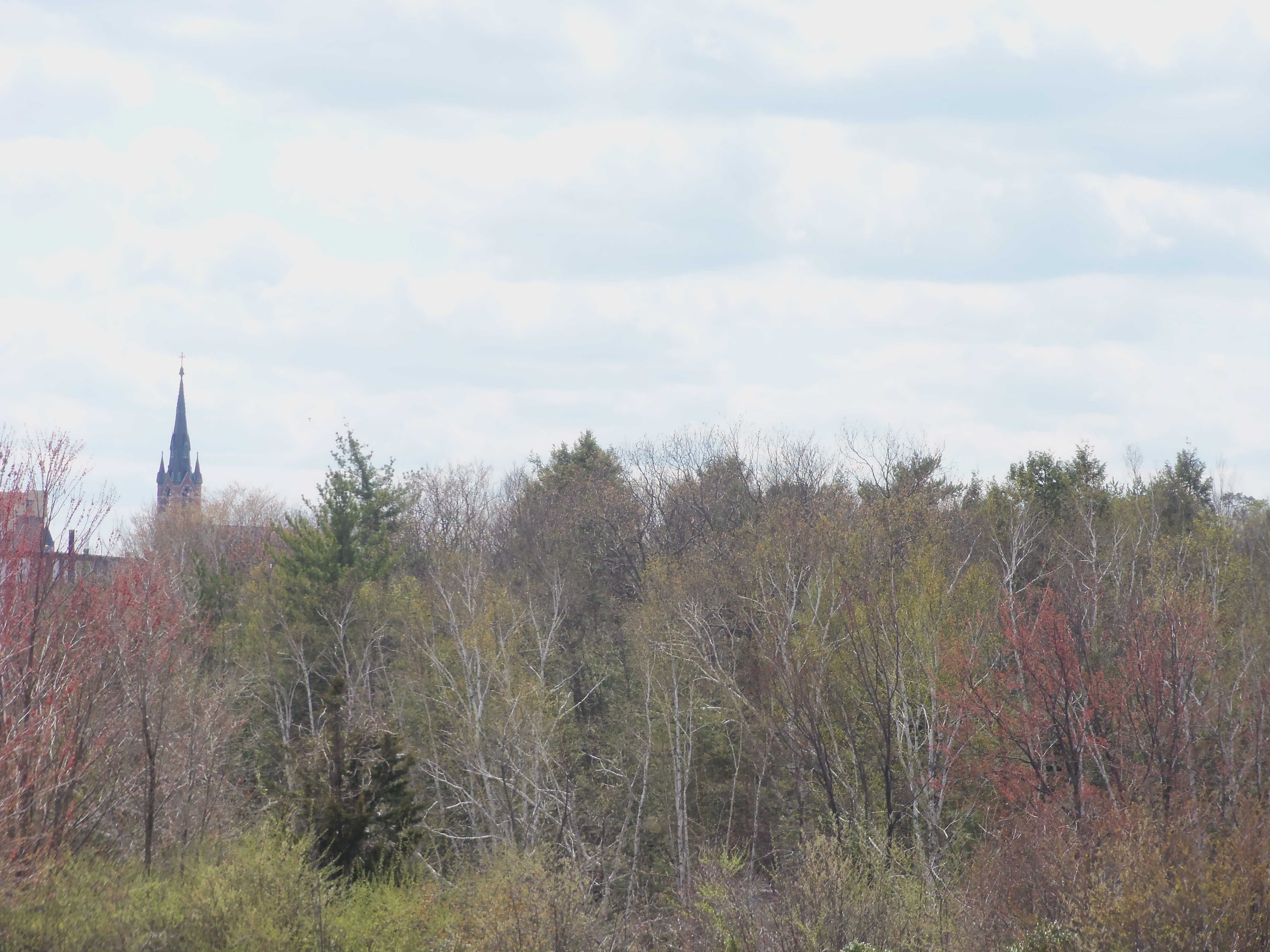
WHEN SPRING ARRIVES IN NEW ENGLAND
A LITTLE LESSON IN MARGINAL UTILITY
You know, the $240,000 grant to buy our police department an armored truck would go much further in local classrooms.
I know of a local public charter high school that could really use it, with plenty to spare, just to approach the per-student spending of the neighboring high schools. Not that they don’t need that kind of infusion, either.
A NEARLY PERFECT NOVEL
Way back in my senior year of high school, I remember a moment when our English teacher invoked the dictum that all fiction requires conflict – and my immediate contrarian reaction blurted out, “No, it doesn’t!” My objections were gut-level rather than coolly reasoned and certainly wouldn’t have held up to the novels that were capturing my attention at the time – Brave New World, 1984, and Animal Farm. Yet seeded somewhere in my aesthetic, the low-key, nonviolent approach to a story lingers. Few of us, after all, are parties to a murder, which is a key component of so much fiction. And Kurt Vonnegut’s advice to take a nice character and inflict the worst possible calamities on the poor soul still offends my spiritual proclivities, never mind so many passages in the Bible. Yes, I’ll now admit that true character can be shaped and revealed in intense confrontations and struggles. That is, conflict.
Still, my own entries to date have focused on day-to-day realities drawn from my own observations – attempts to comprehend contemporary social interactions, even if they appear to be history by the time the words finally appear in public.
~*~
In retrospect, my admiration of so much of Richard Brautigan’s output probably arises in the laid-back meandering of his hippie-era characters and their encounters. Think of Trout Fishing in America for starters.
~*~
More recently, Nicholson Baker has emerged as my favorite embodiment of the nonviolent sensibility. You could argue that nothing happens in the first 50 pages of The Incredible Story of Nory, and yet the tension is already mounting. To construct a successful novel on a father’s bottle-feeding session of an infant (Room Temperature) or a short escalator ride (The Mezzanine) is artistically courageous. Book of Matches, meanwhile, takes off on the simple premise of sitting by a fire in the predawn hours of deep winter – it could almost be blogging.
His latest volume, Traveling Sprinkler, pretty much slipped under the radar, yet impresses me as a nearly perfect example of the no-major-conflict novel. His main character, the minor-league poet and anthologist Paul Chowder, faces nothing more challenging than the question of whether his ex-girlfriend will return to him as he muddles through middle age. Yet along the way, Baker weaves in ruminations about the American health system and public education, the advantages of rhyming in song lyrics in contrast to poems, aspects of recording technology, basics of bassoon performance, collectors’ perspectives on lawn sprinklers and related outdoors gear, experiences of Quaker worship, and some travel pointers for Portsmouth, New Hampshire. Billed as a sequel to The Anthologist, it stands well on its own as a rich and deeply personal tapestry. What could be better? Even without a slew of dead bodies?