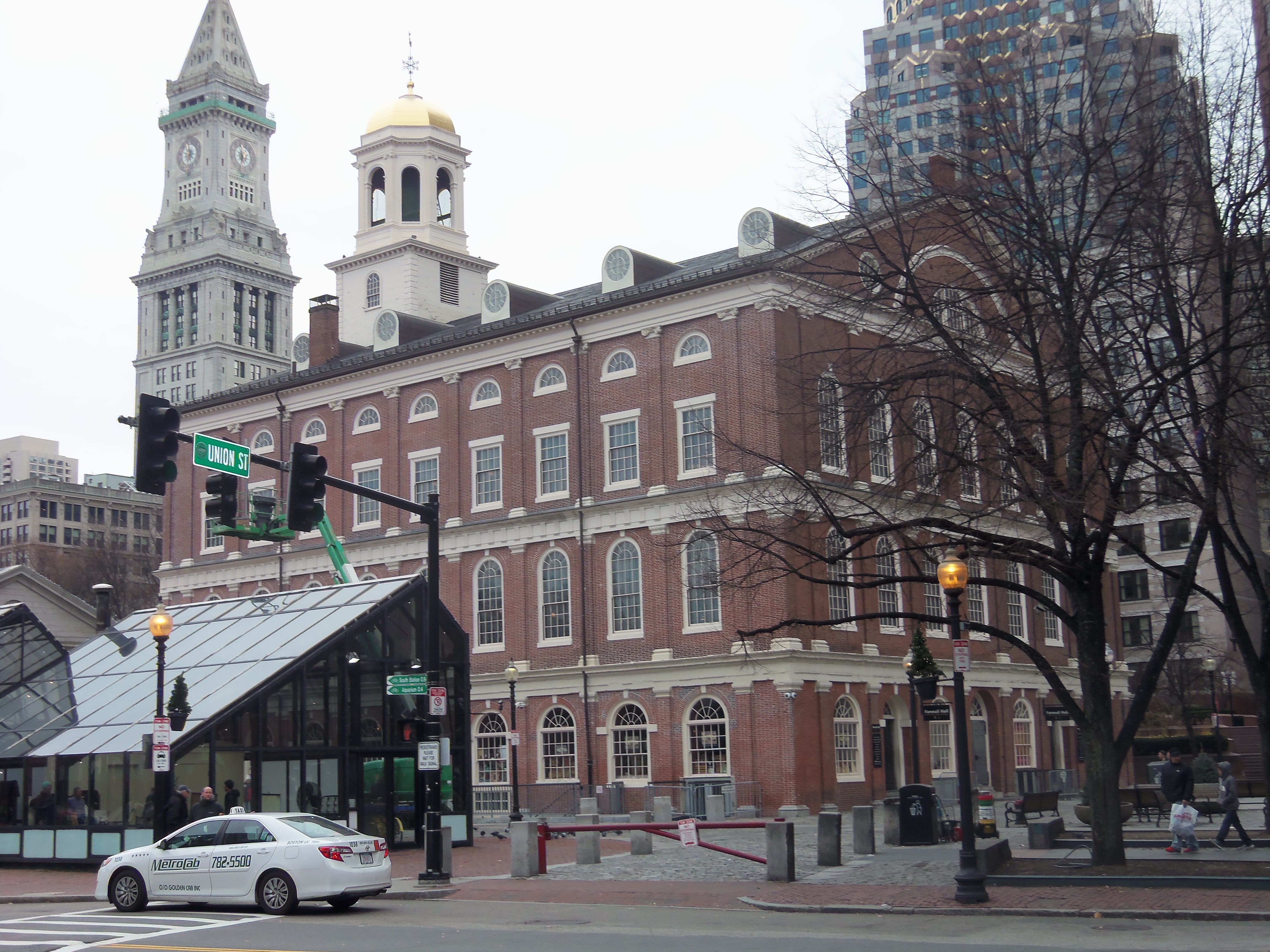

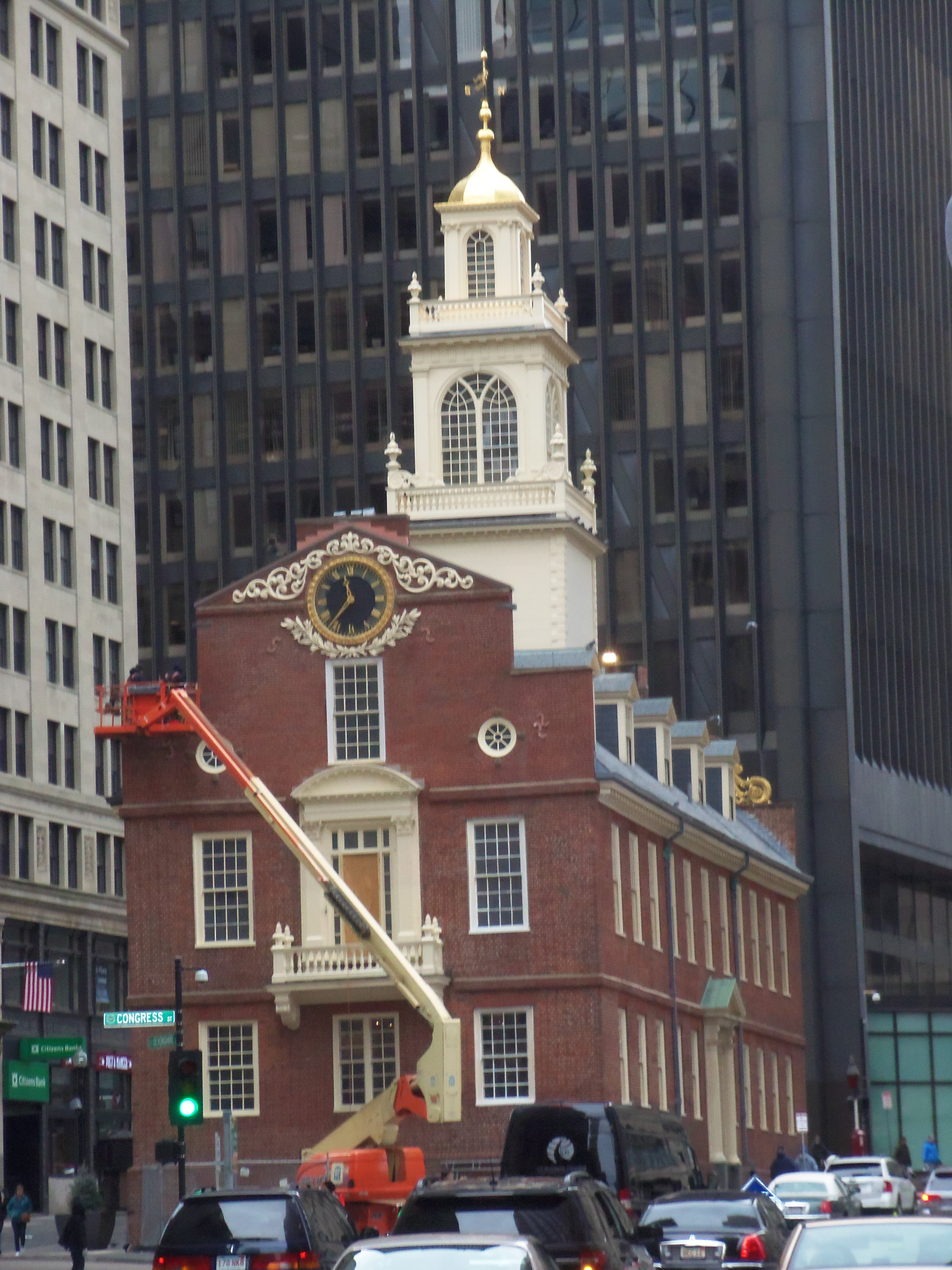
Faneuil Hall, Quincy Market, and the Old State House stand close together in downtown Boston. It doesn’t take much to imagine historic figures appearing here.
Or even some celebrity athletes.
There’s always a surprise around the bend.
You never know what we'll churn up in cleaning a stall
Faneuil Hall, Quincy Market, and the Old State House stand close together in downtown Boston. It doesn’t take much to imagine historic figures appearing here.
Or even some celebrity athletes.
There’s always a surprise around the bend.
For many folks – especially of the male gender – nothing adds more stress to the approaching holidays than the matter of gift-giving. Matter? Should I instead say requirement or obligation or necessity or, uh, finals examination? That’s even before we get to any consideration of price tags or value.
We (ah, the crucial confession!) just don’t get it. And when we think we do, it’s usually with some very useful item they’ll see as totally lacking sentimental value. A garbage disposal, for instance? (OK, I avoided that one.)
Being married to a woman who has a sixth sense in this realm, moreover, has not only been illuminating but heightens my apprehension. She’s not one for flowers or jewelry or chocolate, for starters, at least on the receiving end. No, it’s her sense of empathy in finding some surprise she knows the receiver will appreciate. Often it’s humorous – and often it’s useful without being, shall we say, utilitarian. It’s downright psychic.
I can point to the binoculars or the little recorder that captures our choir rehearsals or the turtlenecks I seem to live in these days. Sometimes they’re even baffling, those things I didn’t know I wanted or needed until, well, time proves otherwise.
There’s no way, either, to top the panini press she presented a dear friend. It makes him think gratefully of her almost daily. It’s also proof that she listens carefully for clues no one else seems to notice.
Locating appropriate gifts – and it’s really something other than shopping – is an enterprise she tries to have largely wrapped up (sorry for the pun – the wrapping comes later) by Halloween. Well, that relieves some of the pressure – many of her finds actually come at yard sales as early as May, and there are other bargains to be found through the summer and fall, if you’re alert.
She’s the one, by the way, who can’t comprehend how a mother could have no clue to what her kids like or want. Just know that it’s fuel for a rant.
But I rather treasure it for the way it gets us guys off the hook just a tad. That mother, that is.
Now, from my end, I’m further along than I would have been before I met her. But I’m still distinctly playing second fiddle. Or even viola.
Regulars at the Red Barn no doubt are aware I’m among those who feel religion is important. Not just any religion, even though it can be a starting point. And not exclusively mine, no matter my reasons for touting its virtues.
My perspective, to be candid, values the prophetic stream as it runs through the centuries of the Bible, along with an alternative Christianity that emphasizes the Holy Spirit and practice based in small circles with elders and personal experience. As I said, not just any religion, no matter how much my understanding has drawn on yoga and Zen and Tibetan Buddhism or Native American wisdom. Admittedly, the elements I hold high can be found outside the Judeo-Christian mainstream, and much I’ve learned from them has informed my own faith journey.
In reflecting on ecumenical sharing, I might also point to ways contrasting faith communities can occur within a denomination. Ways Irish Catholics might differ from, say, Italian or Brazilian. In the Quaker world, not everyone meets in silent worship – many have pastors and choirs, and we might note there are more Friends in Nairobi than in Philadelphia.
One remarkable presentation of this is found in a book I received for Christmas from a future Episcopal priest. Several years would pass before I actually got around to reading it, but the impressions last.
Rodger Kamenetz’ 1994 The Jew in the Lotus initially struck me as a cutesy title with its twist on the Tibetan Buddhist chant, Aum Mane Padme Hum, which is sometimes translated as the jewel in the lotus. But the narrative is more a discovery of faith through personal encounter. Beginning as a secular, or non-observant, Jew, the author is invited to be part of a delegation who will meet with the Dalai Lama to discuss their faith. He seems to be there purely as the neutral observer. In the journey and its preparations, though, Kamenetz discovers how little he knows about his Jewish legacy and how radically different the practices of the other members of the party could be. His eyes are opened to new ranges of thought and feeling. What the Dalai Lama most wants to learn is ways his followers might survive apart from their homeland – something Jews have been doing for millennia. But that doesn’t prevent some lively discussion of esoteric teachings about dakini, as he sees them, and thousands of angels everywhere, as some of Kamenetz’ companions experience them, or of Kabala, too – things new to Kamenetz.
Religion, then, can lead to wider ways of viewing the world around us. There’s more to life than materialism or empirical thought can embrace. How, after all, can you discuss love or hope or selfless service from a concrete reality basis?
Or, as St. Paul observed, trying to speak of these can easily sound like folly.
So who’s to say there aren’t angels dancing in the snowflakes? Or on the tip of my beloved’s nose? Sounds like a good start for a poem, if you ask me.
Here, in the midst of the annual holiday season excess, is a good time to remember that for most of our history, Quakers did not celebrate, in their words, “that day the world calls Christmas.” In New England, at least, they were joined by the Puritan legacy. In Massachusetts, for instance, Christmas was not legal until the 1850s.
Of course, these days it’s very difficult to ignore the hoopla – especially if you have children present. And I’m not even going to get into that Santa Claus stuff.
What I will do, however, is speak of the practice of Advent – observing the weeks building up to Twelfth Month 25th as a period of preparation and anticipation. Babies, after all, arrive only after nine months (or so) of pregnancy, and there’s much to be said for the changes in both the mother and the father in that period. Some Advent calendars come with verses and stories for the family to share over dinner.
Admittedly, by not bringing the tree in until Christmas Eve and not taking it down until Epiphany (the real Twelfth Day of Christmas, contrary to what some advertisers broadcast), you’ll be out of step with most of American society. That can have its own revelations, as you recognize the struggle some other faith traditions have here. But you may also find that unwrapping the presents can just be the beginning of a holiday fullness, not its anticlimax. Actually, our tree usually stays up a few weeks past Epiphany, but that’s another story. Oh, yes, and remember to have a few oranges. (Speaking of other stories.)
~*~
My wife makes reference, too, to all the Puritan diaries from New England, which recorded December 25 pointedly and repeatedly as “an ordinary day.”
 Thanksgiving raises thoughts of New England Puritans, even though they differed in many ways from their fellow Calvinists, the Pilgrims – the ones who celebrated that first round of feasting.
Here is Sir Richard Saltonstall (1586-1661), a Puritan who founded Watertown, Massachusetts, in 1630 before his return to England.
 The birds and squirrels have already harvested the sunflower seeds. I like to leave the stalk up anyway, just as a perch for the critters.
As the say, politics makes strange bedfellows. Still, hearing this one floated around remains startling:
A Trump-Carson ticket?
As one wag retorted, it’s the demeaned and the devout.
Well, you could see it as one attempt to cover all the bases.
Those first years out on your own introduce their own drama. Typically, you split an apartment with others who just might also be friends. On that entry-level wage, your address will likely be in a rather marginal neighborhood. And then there’s the life on the street, day and night.
Maybe you move on to something better. Or maybe this simply continues. But it has its own unmistakably funky nature.
For me, it’s found in a few blocks near the Riverside. Stop over when you can. There’s always tea or coffee. We’re up on the third floor.
~*~
 To see more, click here.
Even in the face of the outrages over the corrupting clout of the superrich investment in partisan politics, a fresh insight can prove haunting. And let’s not dignify that as “donations.” That’s my reaction to a passage from David Cole’s review of Burt Neuborne’s new book, Madison’s Music: On Reading the First Amendment.
It’s not just at the highest levels, either. When the infusion of cash hits smaller races, the whole system gets bought.
As Cole’s “Free Speech, Big Money, Bad Elections” (New York Review of Books, November 5) points out:
… increasingly sophisticated gerrymandering has ensured that many elected offices are sinecures for one of the two major parties. In the House of Representatives, only about forty seats, or less than 10 percent of the chamber, are filled in genuinely contested general elections. The results can be perverse.
I happen to live in one of those seats that’s become contested, after decades of being a Republican stronghold. Cole, however, presses his case that many of the general elections are rigged in favor of one side or another:
In North Carolina in 2012, the popular vote for House members was 51 percent Democratic and 49 percent Republican. Yet North Carolina’s delegation to the House consisted of nine Republicans and four Democrats. North Carolina’s state legislature had packed Democratic voters into four districts, ensuring that Republicans would win the other nine. …
So who’s really representing the people? And who are the winning officeholders really representing? It’s not just North Carolina, either, as Cole notes:
Democrats received more than half of the House votes in Arizona, Michigan, Pennsylvania, and Wisconsin in 2012, and did not get a majority of House seats in any of them. In what sense can such outcomes be called democratic?
Considering the low turnout rates in general elections – a consequence, as Cole details, of a sense of futility for many would-be voters or outright obstacles put in their path – an observer can wonder how much of the public the winners really do represent. That is, if 49 percent of a 40 percent turnout can win 247 seats in the House (this is a theoretical model, mind you), one could argue that the majority of the House of Representatives represents just 20 percent of the public. And if the Freedom Caucus, about 20 percent of that party, insists on dictating its ideology on the rest of the nation, that could be a mere 4 percent trying to run the country. In some places, that would be considered a coup.
Yes, I know the numbers wouldn’t all fall that neatly in one direction or the other. But it’s scary, all the same.
Henry Kissinger once admitted that the realities of being Secretary of State overturned his expectations of the position. Before taking office, he saw the role as akin to being Zeus on Mount Olympus – the divine expanse of time and perspective to make wise decisions of long-lasting statesmanship. Instead, in the turmoil of relentless global crises, what he encountered was more like being an NFL quarterback on a Sunday afternoon in autumn. You had to do something fast and hope for the best before you got clobbered. Talk about high pressure? Lives were often at stake.
That insight comes back to my mind each round of presidential primaries where I live. Remember, the State Department is only one Cabinet position reporting to the White House. And it’s puny compared to the Pentagon.
Whoever wins in November 2016 will have to be able to find people who can fill these positions, and then find the time to manage their work. How can anyone possibly touch base with them even once a week, much less act with sufficient knowledge? Well, a quarterback has both the rest of the team and the coaches – plus a week to prepare and a lot of time on the sidelines, if his defense is doing its job. Not so the President, with rounds of dinners and photo ops and having to make public announcements on seemingly every news development as it happens …
I’ve seen reports on the time demands on the Chief Executive and how many of our recent examples have lived with no more than four hours of sleep a night. That’s inhuman. Period. Here’s one point where those arguing for smaller government could build their case. I’m listening.

