to the glory of, et cetera
just keep singing
or moving your fingers
all these years, still floating
Poem copyright 2016 by Jnana Hodson
To see the full set of Partitas, click here.
You never know what we'll churn up in cleaning a stall
to the glory of, et cetera
just keep singing
or moving your fingers
all these years, still floating
Poem copyright 2016 by Jnana Hodson
To see the full set of Partitas, click here.
This time of year, the world makes a special nod to the genius of Johann Sebastian Bach, who was born on March 21, 1685, in Eisenach, Germany.
When I first explored classical music, in the late ’50s and early ’60s, Bach was a much more distant figure than we encounter today. Yes, he was considered one of the three greatest composers ever, but largely in a scholarly consideration. Rare performances of his music itself largely focused on the organ works – infrequent events outside of their application in religious services in churches having both outstanding instruments and musicians – or came about through a few soloists who championed his instrumental compositions. Think of E. Power Biggs, Pablo Casals, Wanda Landowski, Rosalyn Turek, or the Bach Aria Group.
Harpsichords, for that matter, were a novelty, and the Brandenburg Concertos were typically performed with a piano as a substitute in the ensemble. How strange that sounds today, when these once exotic pieces are among the most frequently played works on classical radio stations, and commonly in period-instrument bands at that.
For one thing, the repertoire is not as defined by symphony orchestras as it was then – a break for Bach, who wrote little that would fit into their programs, even in a scaled-down mode. Today, we have chamber orchestras, community choruses, and period-performers to champion other avenues of composition.
Seems strange to consider how much the classical music scene has changed during my lifetime. For perspective, Vivaldi and Mahler were even greater rarities. And for many of us, the jazz-influenced Swingle Singers gave us the first clue of just what Bach’s scores might unleash.
We’ve been liberated from the heavy-handed, smoky, Romantic-era, Victorian approach I first encountered. What’s happened parallels the breakthroughs in painting restoration, where old masterpieces were finally stripped of the layers of dark varnish that we’d assumed were part of their intended appearance. What a brilliant, startling, controversial revelation that was! How garish rather than reverential we found much that was finally released to the light. How playful, how scandalous! What joy!
Thus it’s been with Bach, too. In the right hands, the mathematical purity of Bach’s inventions is utterly heavenly, intimate, sensual. To sing the parts with others is a marvelous balancing act of hearts and minds dancing in spirit together. Gone is any sense of a sermon in sound – this comes closer to prayer.
Add to that the demands of daily craftsmanship imposed on Bach, meaning that he created work after work more or less on deadline, with little time for major revisions, and the results can be seen as all the more impressive. No wonder we’re left agog in the face of what we discover in what he timeless wonder he discovered and embraced.
rounded stones of the shoreline
or a garden path glisten
many navy blue or nearly straw
others speckled with indecision
speckled, within and without
what grows hard as rock on a rock
nearly black stones exposing white ridges
to the light, blue veins, like mothers
slate-blue orb cleft with white quartz
some color of cooked lobster
glow of berries
in dull eddies
of clamshell or snout of rising seal
given an eye, the face of a cod or shark
approaching with its mouth closed
another burnt
and still burning
none yet look like washed potatoes
between them, broken mussels and sand
firm in clear brine
each retaining its shape, for now
Poem copyright 2016 by Jnana Hodson
To see the full set of seacoast poems, click here.
In her inimitable, understated, and right-on-target way, she jotted in the corner of the Meeting minutes: “I hope thee feels the Spirit of our Lord with thee in thy life, Jnana – a full covering for all thee does. Seek his care. In Christ’s love, Susan.”
Naturally, she hit me in a period in which I wasn’t feeling His presence in everything – and had come to that realization myself. What her quick notation did was kick me into getting back on my knees regularly and into Scripture, too. Now that’s divine oversight! As a result, Meeting First-day was wonderful, and turned into the entire day – wound up spending much of it with another Friend who would turn forty the week before I did, a guy who had expressed to me back in Eleventh month the difficulty he had with my messages in Meeting (an ex-Catholic, he was growing in the Spirit – and in our day, he was able to come to unity with me on crucial points). We visited a couple in Maine, and then hit My Life as a Dog, his first and my third viewing – the movie gets better every time.
~*~
For more Seasons of the Spirit, click here.
The mind dances here and there, rarely in a linear fashion. So what’s on my mind these days? How about counting on these fingers?
~*~
~*~

Yes, I’m still swimming laps in the indoor pool, the one in downtown Dover. Glad he’s not in my lane.
what happened to all the nuts
planted back there
acorns with their hearts ripped out
all his transports in this cosmic trap
in the breach the yard could as easily be jammed
with half-buried books
waiting to be devoured
all the same, he darts into hidden pages,
spitefully aware his plot was unfolding
more than ever expected
Poem copyright 2015 by Jnana Hodson
To read the full set of squirrelly poems, click here.
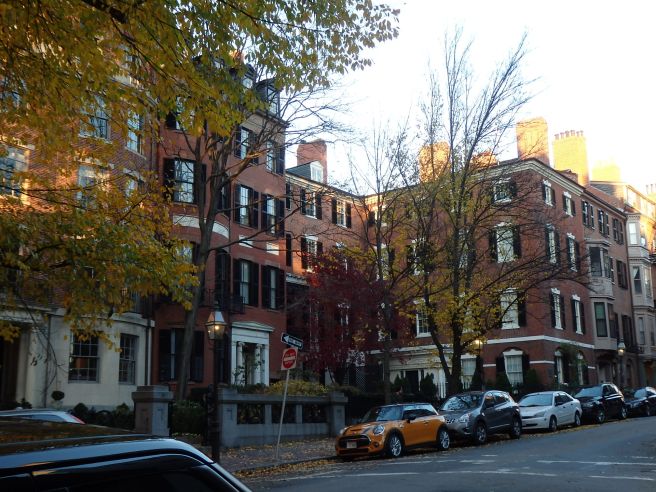
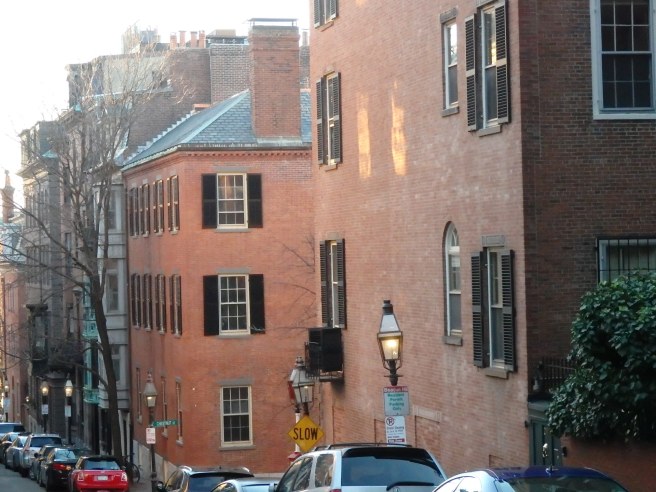
Beacon Hill’s narrow streets and closely set homes invite pedestrians to enter a timeless order and grace. It’s hard for us not to imagine living here early in the 19th century as American ideas took hold.
Boston is a rich and varied destination – the Hub of New England, or the Universe, as they used to say. Living a little more than an hour to the north, we’re well within its orb.
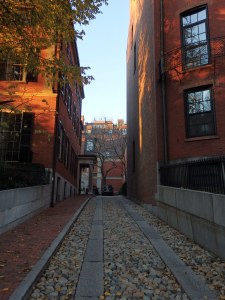
As I listen, I realize the locals don’t consider the surrounding ridges to be mountains. Although these “foothills” or just plain “hills” are as tall as Pennsylvania’s Alleghenies, shorn of trees, to speak of “mountains” signifies that one must drive away into forest. The time comes to hike in unfamiliar high country.
I drive west, into a mountain pass, and park at the trail head.
Climbing through clouds on Sheep Lake Trail, I identify snow lilies, phlox, two whistling marmots I mistake for groundhogs, and a ptarmigan. In these topless mountains, snow and rocks glimmer atop jagged white threads that twist, plunge, and roar over miles. In this clarity I recount a friend’s determination to perceive the important task to perform each day — a focus she achieved in the sunset of her young death. Go on.
The next outing, I follow another friend’s favorite trail. My valley of orchards and meadows stretches behind in a twilight of small-city lights and barren blue ridges. In golden splay dusk, I learn to fear glaciers atop volcanic spines and in their grooved depths, too. So much depends on which way you turn. Clouds, one moment pink, shift into slate-blue. Think of a great-uncle’s farm in Ohio flatlands when green-wood ringed the fields and autos were novelties; and how, when the United Brethren in Christ build their new sanctuary, one tree furnishes enough lumber for all the pews. Such timber is long gone from most of the Midwest, and nearly gone here, as well.
Strangely, adjusting to such disorientation can allow one to see more than the landscape with fresh eyes. I begin reckoning my birthplace afresh, too. I perceive a native poetry now vanished: in flat terrain they coined Sweet Potato Ridge Road when they became sensitive to what had been called Nigger Pike, after work crews that came out from the workhouse jail in the city; Diamond Mill Road was made of limestone gravel flecked with quartz or mica, but named for the distillery beside the rails. What could be in those rural lanes I had sped along on the way to the farm to cause their ghosts to arise out here? I think, too, of the hayloft I had delighted climbing in, even though the old folks feared I’d fall through and be trampled by cattle; more ominously, some shed rafters I walked like a high-wire artist had hogs rummaging below, with razor snouts and teeth and a latent taste for blood. That farm acreage is scarcely like these Western orchards or open ranges, yet something echoes. It’s earth and air. Sunshine and clouds. My days in the mountains are airy conifers. I could be a pioneer, in spirit, at least. My ancestors settled those Ohio tracts. Another line, a bit earlier, settled North Carolina Piedmont. Here, I find unspoiled corners.
Perhaps bears do drink beer. Rocks, leap from mountaintops into oceans. Naked breasts, swell from snowmelt pool to sky.
Against this wall, between his desert and the frigid sea current, I declare my vast ignorance: left to myself, I’d likely starve, soon sicken of berries, and have never caught fish properly or gutted a rabbit. Somehow, I wait to be fed. Thus, one point of my Dedicated Laborious Quest involves learning to be wholly myself — embracing flaws as well as talents, as I search out my own boundaries.
Away from the office and encircled by an ever-renewing earth — even an apparently lifeless desert that restores his sanity and a brand of insanity, too — you may find that every trail you follow brings you closer to your own attainment, your emerging sense of place and mission within the universe. As for looniness — ah, loco! — you soon appreciate how all are in some way at least un poco, indeed.
For more insights from the American Far West and Kokopelli, click here.
Sometimes in exploring a niche of history, you come across an unexpected incidental detail that significantly alters your previous perception. For example, many of the earliest Quaker tracts and books bear the imprint of Giles Calvert, a publisher and bookseller at the Black Spread Eagle on Ludgate Hill near St. Paul Cathedral in London.
So extensive is his Quaker role that I’d assumed Calvert (1612-1663) was a member of the Society of Friends. For one thing, he was the elder brother of Martha Simmonds, an early Quaker convert and a central character in the notorious Bristol Controversy of 1656 that led to the blasphemy trial and conviction in Parliament of a leading Friends’ minister, James Nayler. The connection intensifies when you discover that two years earlier she had joined with Friends and the next year married Thomas Simmonds, who (according to one account) took over the shop from Calvert, by then the leading publisher of Quaker literature. And Martha Simmonds (1624-1665) was hardly shy about public protest and witness on behalf of her faith. She’s a controversial figure in her own right as she challenged much of the male leadership of the emerging Quaker movement.
One earlier connection I’d come across was Calvert’s role as publisher of Gerrard Winstanley’s True Leveller (or Digger) writings from 1648 to 1652, the year the Quaker works begin appearing. Winstanley was a radical religious and political thinker and leader, one who later had an influential role among Friends even if he drifted away for a while – his life leaves many questions and holes for the curious.
Still, it’s enough to strengthen Calvert’s position as a Quaker vanguard.
In my recent reading of Douglas Gwyn’s Seekers Found: Atonement in Early Quaker Experience (Pendle Hill Books, 2000), a broader portrait emerges.
Gwyn makes a critical connection that begins with Parliament’s attempt to impose Presbyterianism on the Church of England. “One factor that doomed the project to failure was the suspension of censorship of the press,” itself a parallel to the suspension of mandatory church attendance amid the waves of civil war. “Religious ideas that before 1642 had circulated only below the surface, if at all, now reeled off presses in exponentially expanding numbers. Propaganda pieces, ranging from one-sheet ‘broadsides’ to tomes hundreds of pages long were printed and sold at low cost.”
This had my mind leaping backward to the sense that many underground religious and spiritual streams had somehow survived in Britain for centuries, in part because of valiant efforts that kept the Roman Catholic Inquisition at bay. Queen Mother Joan of Kent’s influence at the trial of John Wycliffe and the Lollards in 1378 remains a pivotal moment in the history of freedom of religion. We were a long way from tolerance, but it was far superior to the terrors of the papal machine.
Gwyn, though, introduces Calvert at this later point beginning in 1642, “One of the most notorious publishers of dissenting literature … among the first publishers in England who was not also a printer.” (That, in itself, is a fascinating detail. I had assumed he handset the type himself, placed the paper and ink of the flat press, and collated and bound the pages. Instead, he served as a go-between.) “Over the course of his career,” which began in 1643, “he published more than 600 of the most radical tracts and books written in England during that period. … Calvert was questioned, fined, and imprisoned briefly on various occasions for his publishing activities, but he was never really silenced. Once the door was opened for a free press, it was never to be effectively closed again.”
It was enough to send me back to Christopher Hill’s classic The World Turned Upside Down (Penguin, 1975), where Calvert gets two mentions, the first for his Quaker service. In the other, a longer overview, Hill observes, “The printer Giles Calvert’s shop perhaps came the closest to uniting the radicals in spite of themselves – ‘that forge of the devil from whence so many blasphemous, lying scandalous pamphlets for many years past have spread over the land,'” as one critic put it. Hill then notes that A.L. Morton, the leading scholar on the Ranter movement, “stresses the importance of Calvert as a unifying force.” Hill has Calvert working as late as 1662 “still inciting the publication of seditious literature, and after his death in 1663 his widow continued his policy.” Unclear is whether Calvert was still with the Black Spread Eagle or working more independently; either way, he was a force who’s largely unknown today.
It’s heady stuff, of course. Here we have a champion in the history of freedom of the press and the circulation of revolutionary ideas itself. At the moment, Giles Calvert gets a single sentence as his Wikipedia entry – and that notes his publication of John Saltmarsh, another important influence on Quaker thought, as Gwyn delineates.
As a writer and editor, I am as fascinated by the idea of a bookstore that also showcases its own line of books and pamphlets as I am by the existence of a bold publisher of revolution, political, spiritual, or even literary. Think of City Lights Books in San Francisco in our own time, with its line of poetry from the Beat and Hippie years. No doubt there are many others over the centuries.
I wonder, too, about the bookstore itself. Was it more like a newsstand, with the latest blast hot-off-the-press as must-have material? (That has me thinking of record stores back in the Beatles era!) Think, too, of the audience hungry for the most recent release – in contrast to our surfeit of information today. What were the discussions like, too, in deciding whether to publish a piece or edit it or, perhaps, in gathering customers around a table to debate the merits of the most current issues? Who frequented the shop, for that matter?
Imagine, if you will, the movie version. I want the key characters to be ink-stained, for starters, and maybe tobacco smokers.
Actually, I’m beginning to wonder. Would this be more like a porn shop? At least before the Internet took over? Customers entering surreptitiously, hoping not to be seen? And then slip away again?
Well, Quaker was a term of derision. As well as one of scandal. Bear it as we may.
relocating
once again recognize
some possessions as useful
simplicity, sincerity, modesty, honesty, justice
that dwell in the Life and Power
when goods are tools
style arises within purpose
* * *
addressing basic practices
ordering well-made clothing
that’s both simple and expressive
and fits properly
liberates
from inbred feelings of victimization and deprivation
O Holy One
to choose what is not fickle
instills elegance
of clear function
I’m a sucker for clean, balanced design
outward expression of orderly life
gingerly facing the idolatry of things
made from metal, wood, stone
and yes, plastic
look, there’s nothing wasteful
O Holy One
elegant is also simple in design and execution
though not always easily accomplished
(the skillful hand and eye – the years of mastery)
Poem copyright 2016 by Jnana Hodson
To see the full set, click here.

