SEASONS OF SPIRITUAL COMPANIONSHIP

OF COURSE WE’RE PUZZLED to observe how many conversations begin with comments about the weather. Everybody can see it’s snowing or raining or feel the heat and humidity. What’s actually happening, of course, is the establishing of a commonality – putting ourselves in a shared space. You make a joke in reply, or a factual statement, and edge into conversation, however superficial or deep, gossipy or plaintive.

No matter how introverted or reclusive an individual is, being human requires social interaction. From birth, we require more nurture and protection than other animals do before we are able to move about on our own, much less survive. We learn from each other, and we are highly vulnerable, despite all our acquired knowledge. We are creatures of culture, not inherited instinct. We make bargains and trade. We court and seduce with words as much as our dance steps or glances.

While experiential religion demands individual practice and awareness, few of us undergo its labors and trials all alone. We find mentors and companions along the way, people who have also encountered and value these matters. Even a secluded monk has an abbot or guru; a nun, her mother superior. Confession is part of the practice. What we find of value we feel compelled to pass along.

Our affinity with these spiritual companions has its own intimacy. These friends hold a mirror to ourselves, to point to our shortcomings and prod us to reach for ever greater fidelity to our purpose. They provide harmony and, when we fail, counter self-loathing and blame with compassion and comfort. Ideally, this exists between husband and wife. Sometimes it is found between prayer partners – two people who agree to hold each other in prayer through the week. Much of the life in the monastic confines of the ashram endeavored on this plain, though the bonds broke down quickly outside of it. Whether one-on-one or within the circle of a community of faith, this companionship has the added dimension of spiritual presence and encounter. Sometimes it spans denominations, when the “invisible church” opens in conversation with another or in venturing into a small group along the way, as I have with Mennonites and Brethren. Sometimes it appears in the context of romantic relationship, in the quest for mutual aspirations.

As much as I’d like to say spiritual companionship is forever, the reality often proves otherwise. I’ve seen those who have maintained this through a lifetime, including couples who’ve become connected through the marriages of their children. More often, I’ve found intense periods where paths cross for a year or two and then part.

Typically, the interactions are words spoken together. Sometimes, as in the excerpts that follow, they arise in lengthy correspondence. Who knows what trail will be left from the emails of the Internet.

~*~

For more Seasons of the Spirit, click here.

ON INTO ARIES  

Why wait for the dust to settle? Here are 10 bullets from my end.

~*~

  1. First crocus, first hyacinth. More welcome signs.
  2. “Ice out” in our yard – the first day you can walk a diagonal pathway without stepping on snow.
  3. At the feeder, our goldfinches have regained their yellow, first as a tone under the gray and then full-out bold. How rapid the change!
  4. Jazz trumpeter Clark Terry had a special relationship with the University of New Hampshire, one town over. His legacy continues around here. Still wish I’d heard him live, when it was an option. Remember, he taught the incomparable Miles Davis. And my, how I remember that night!
  5. How I love Robert Rauschenberg’s concept of Combines! Neo-Dada, me? Harvesting? (As in wheat. Or driving into fields of corn.) His approach infuses so many of my poems and much of my fiction. What got me labeled as a Mixmaster. Let’s see what we can throw together. Don’t leave out Roy Lichtenstein, either, with his Ben-Day dots fetish from the hot-type days of newspaper production. Oh, how that dates my sense of contemporary!
  6. Another magazine renewal form, among those I’ve let drop. Constrained income has meant limiting my memberships, too.
  7. Here, in a period when I’m supposed to be emerging from my shell, I find myself retreating instead.
  8. In the graffiti at the top flight of the observation tower: “Sometimes love just isn’t enough.” (Looking down, I saw no evidence the author had acted rashly.)
  9. What do we make of capitalism that buys a company and then expects the workers to make concessions to pay for the move? Shouldn’t the ownership go straight to the workers?
  10. Buzzards – more properly, “turkey vultures” – have returned.

~*~

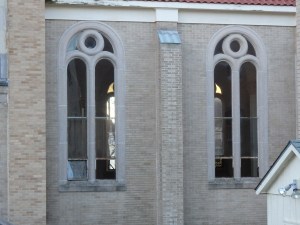
The spires show signs of serious damage.


The stained glass has been removed as St. Charles Roman Catholic church awaits demolition. Just three blocks away from St. Mary Roman Catholic, the two congregations had sharp differences, as some oldtimers will relate. One originated in the Quebecoise immigrants; the other, in the much earlier Irish. Now they're part of one parish.
The stained glass has been removed as St. Charles Roman Catholic church awaits demolition. Just three blocks away from St. Mary Roman Catholic, the two congregations had sharp differences, as some oldtimers will relate. One originated in the Quebecoise immigrants; the other, in the much earlier Irish. Now they’re part of one parish.


Water damage had weakened the structure, and repairs were deemed too costly, especially after the city's three Roman Catholic congregations were merged into one parish.
Water damage had weakened the structure, and repairs were deemed too costly, especially after the city’s three Roman Catholic congregations were merged into one parish.


PLAIN GRAY AND GRAYING

Within the range of distinctives
of nasty red, the Capitol black
the ethereal albino instead
he aligns with the eastern gray
and the western gray.

Yet who would be saint of the squirrel?

Not Lord Rama, who caresses one
as a pet. Nor the cultivating Hermes.

The Blackfoot know him as Old Man.
As he was becoming.

*   *   *

of course squirrels have faith
of a practical sort
in running the wire, in leaping from a branch
and landing a full eight feet between trees
with such airy jurisdiction

*   *   *

in a flash         such as music
or the tail        as a sail

just leap
and grab hold somewhere    

*   *   *

the question, at heart, what was in his blood?
as well as what was it becoming?
not the patriarch, then          free from bondage

*   *   *

overhead, the years overlap
underfoot, the roots tangle

to be light, then         lighter than pigeons
or laughter and tears

become gray pussy-willow                 at the end of winter

Poem copyright 2015 by Jnana Hodson
To read the full set of squirrelly poems,
click here.

MAYBE IT STILL COMES DOWN TO MEANS VERSUS ENDS

In the aftermath of the recent national elections, trying to make sense of the American scene today is, well, downright scary. The fact we have one party so willing to risk constitutional crisis rather than work cooperatively on solutions to common problems strikes at the very heart of democracy. And that’s before we get to the divisions revealed geographically, demographically, and economically.

Several of the phrases floating around the campaigns continue to ring in my ears. Describing one party, we have an “echo chamber” of “misfits,” which begins to look far larger than would be healthy for any society. And for the other party, the race came down to a “technocrat” versus “activist,” in itself suggesting a division between an appeal to the brain versus the heart.

Much of this situation, I’ll contend, springs from a lingering state of denial involving the encounters of those of us who came of age during the 1960s and ’70s. Coming across a summary of William Clark Roof’s 1993 A Generation of Seekers: The Spiritual Journeys of the Baby Boom Generation, I had to sit up and take notice when he noted that a low level of community involvement accompanied our search for personal meaning. It’s something that’s certainly happened across American society over recent decades, although I’d say increasing demands on our careers and suburban family lifestyles have taken their toll, too.

As Douglas Gwyn comments in Seekers Found: Atonement in Early Quaker Experience:

Roof’s study confirms many impressions of baby boomers in the ’60s, but adds a new perspective. Many tried drugs, were sexually active, and went to rock concerts and political protests. But many did not. Half of those surveyed say they did not try drugs; a third never attended a rock concert; and 80% were not politically active in that period. On the whole, Roof finds boomers to be nearly evenly divided between traditionalist and countercultural affinities.

A conventional view might look at this split along the lines of the Vietnam war issue, with the traditionalists joining the military and the hippie side in full opposition. But Roof’s criteria turn the angle: more than a few servicemen experimented with pot and other drugs in ‘Nam, along with free love, and moved easily into hippie circles on their return. Meanwhile, I sense more than a few hippies never did drugs, out-of-wedlock sex, or political protests. For them, maybe it was all about the music?

As Gwyn continues his reflections on Roof’s study, he prophetically notes:

But in subsequent decades, with a tightening of the American economy, the assumption of abundance often turned from utopian to belligerent, as Americans vented their frustration over lowered or failed expectations. Given their expanded subjective and expressive registers, boomers are already more likely to consider themselves wounded by defects in their religious upbringing. When religious institutions or leaders fail their expectations today, boomers are all the more likely to feel cheated, wounded, or even victimized.

It’s not just religion, let’s be honest. This cuts across the entire society.

Gwyn makes one other argument that lingers, one that involves the kind of association each seeker is drawn to. One is process driven, and the ways we can become captive to the mechanics of a particular system. (He names capitalist democracy as an example.) Here, the procedures outweigh results. I love his observation, “If civility is too strongly identified with democratic processes, then true seeking and conversation to one’s neighbor will tend to be subverted. Caucus politics or the contest of interests may usurp the conversation.”

The alternative, goal driven identity, can override the process altogether, in which the ends justify any means of getting there.

The vital tension Gwyn encourages “requires a disciplined and sustained dialogue between seriously considered and passionately held positions,” a “drama of faith, which is played out upon a level civic stage of public concern.”

Quite simply, where is that dialogue today? And where is the open exchange in questioning and refining the factual essence of the positions? An “echo chamber,” on either side, simply cannot do the job.

~*~

More of my own reflections on alternative Christianity are found at Religion Turned Upside Down.

REST IN THE AGES

Tucked away in a corner of the park, this gate.

The burial ground in Boston Common is the resting place of early patriots, among them the composer William Billings – the latter, by assumption rather than documentation. Historians will note that the headstones in the city’s oldest graveyards no longer stand over their intended bodies, but were moved around by convenience.

Boston is a rich and varied destination – the Hub of New England, or the Universe, as they used to say. Living a little more than an hour to the north, we’re well within its orb.

It's a classic New England scene, in cities, towns, and isolated countryside.
It’s a classic New England scene, in cities, towns, and isolated countryside.


BACK TO BACH

This time of year, the world makes a special nod to the genius of Johann Sebastian Bach, who was born on March 21, 1685, in Eisenach, Germany.

When I first explored classical music, in the late ’50s and early ’60s, Bach was a much more distant figure than we encounter today. Yes, he was considered one of the three greatest composers ever, but largely in a scholarly consideration. Rare performances of his music itself largely focused on the organ works – infrequent events outside of their application in religious services in churches having both outstanding instruments and musicians – or came about through a few soloists who championed his instrumental compositions. Think of E. Power Biggs, Pablo Casals, Wanda Landowski, Rosalyn Turek, or the Bach Aria Group.

Harpsichords, for that matter, were a novelty, and the Brandenburg Concertos were typically performed with a piano as a substitute in the ensemble. How strange that sounds today, when these once exotic pieces are among the most frequently played works on classical radio stations, and commonly in period-instrument bands at that.

For one thing, the repertoire is not as defined by symphony orchestras as it was then – a break for Bach, who wrote little that would fit into their programs, even in a scaled-down mode. Today, we have chamber orchestras, community choruses, and period-performers to champion other avenues of composition.

Seems strange to consider how much the classical music scene has changed during my lifetime. For perspective, Vivaldi and Mahler were even greater rarities. And for many of us, the jazz-influenced Swingle Singers gave us the first clue of just what Bach’s scores might unleash.

We’ve been liberated from the heavy-handed, smoky, Romantic-era, Victorian approach I first encountered. What’s happened parallels the breakthroughs in painting restoration, where old masterpieces were finally stripped of the layers of dark varnish that we’d assumed were part of their intended appearance. What a brilliant, startling, controversial revelation that was! How garish rather than reverential we found much that was finally released to the light. How playful, how scandalous! What joy!

Thus it’s been with Bach, too. In the right hands, the mathematical purity of Bach’s inventions is utterly heavenly, intimate, sensual. To sing the parts with others is a marvelous balancing act of hearts and minds dancing in spirit together. Gone is any sense of a sermon in sound – this comes closer to prayer.

Add to that the demands of daily craftsmanship imposed on Bach, meaning that he created work after work more or less on deadline, with little time for major revisions, and the results can be seen as all the more impressive. No wonder we’re left agog in the face of what we discover in what he timeless wonder he discovered and embraced.

ROUNDED WITH LIGHT

rounded stones of the shoreline
or a garden path glisten
many navy blue or nearly straw

others speckled with indecision
speckled, within and without
what grows hard as rock on a rock

nearly black stones exposing white ridges
to the light, blue veins, like mothers
slate-blue orb cleft with white quartz

some color of cooked lobster
glow of berries
in dull eddies

of clamshell or snout of rising seal
given an eye, the face of a cod or shark
approaching with its mouth closed

another burnt
and still burning
none yet look like washed potatoes

between them, broken mussels and sand
firm in clear brine
each retaining its shape, for now

Poem copyright 2016 by Jnana Hodson
To see the full set of seacoast poems,
click here.

WELCOME THE MARGINALIA, TOO

In her inimitable, understated, and right-on-target way, she jotted in the corner of the Meeting minutes: “I hope thee feels the Spirit of our Lord with thee in thy life, Jnana – a full covering for all thee does. Seek his care. In Christ’s love, Susan.”

Naturally, she hit me in a period in which I wasn’t feeling His presence in everything – and had come to that realization myself. What her quick notation did was kick me into getting back on my knees regularly and into Scripture, too. Now that’s divine oversight! As a result, Meeting First-day was wonderful, and turned into the entire day – wound up spending much of it with another Friend who would turn forty the week before I did, a guy who had expressed to me back in Eleventh month the difficulty he had with my messages in Meeting (an ex-Catholic, he was growing in the Spirit – and in our day, he was able to come to unity with me on crucial points). We visited a couple in Maine, and then hit My Life as a Dog, his first and my third viewing – the movie gets better every time.

~*~

For more Seasons of the Spirit, click here.

AS THE SAP FLOWS

The mind dances here and there, rarely in a linear fashion. So what’s on my mind these days? How about counting on these fingers?

~*~

  1. Wet, sloppy snow? The kind that falls all day, making me want to scream each time I look out the window, even when it’s half melting on the street and ground and even though I no longer have to commute through its hazardous, annoying conditions. The mere thought of it, though, has us going stir-crazy.
  2. Maple-sugaring season, for some of our friends. Just listen to all the discussion regarding this year’s sap run.
  3. Blame the switch back to so-called Daylight Saving Time. Keep feeling I’m way behind. Look at the clock, it’s 1:30 p.m., then have to tell myself it would have been only 12:30 just a few days ago. This internal ticking!
  4. Revisiting Wagner’s epic Ring Cycle (four operas spanning 17 hours, which somehow pop up for me in late winter), I confess it’s hard for me to wrap my head or heart around the mythological story. Gods who are not omniscient or who are ruled by lust – that is, who are not omnipotent – make the first obstacle, even before we get to all the reliance on magic and potions. Only when I see them as today’s celebrities does any of this come into focus. And then there is the matter of flawed parenting and marriage. Even more tantalizing is the concept of casting the “gods” as the superrich who are bankrupting America – off they go to their compound.
  5. In observing the Eastern Orthodox dietary restrictions for Advent and now Lent, I’m made more aware of the world’s poor and hungry. Reach for milk for my coffee or for an egg or cheese or butter, then pull my hand back, realizing they’re dairy products, and thus prohibited for the stretch. Under a lacto-vegetarian regime, which I’d practiced in my past, these would be acceptable. The vegan alternative is so much stricter. How out of reach our Western abundance is for so many in the world. As my wife says, the practice makes us tea-totaling oil-free vegans. Curiously, our temporarily limited diet (or “fasting,” in the terminology) does not have me feeling penitent but rather, as we pursue it, has me delighting in ranges of food we normally slight. Even so, I’m really looking forward to feasting come Easter.
  6. Considering many of my favorite hippie-era writers, I’m surprised to see how apolitical many of them are. Richard Brautigan, ever so playful – or even Jack Kerouac, who inspired so many of us. I am open to alternatives, like John Nichols or Edward Abbey, though their writing feels far more conventional and less heartfelt. Makes for a fresh way of revisiting the literature of the era, especially as it leaps ahead to our current political situation.
  7. Insecurity is a manifestation of ego, standing counter to humility.
  8. A sense of being released in to the NOW for the NEW. The way some work continues.
  9. How do people in the construction trades schedule their lives? Do the calls for repairs, remodeling, and new building really average out week after week?
  10. No idea what’s on tap for tomorrow.

~*~

New England Aquarium.

Yes, I’m still swimming laps in the indoor pool, the one in downtown Dover. Glad he’s not in my lane.