Ever been in a Christmas show?
SO THIS IS THE GOOD LIFE?
Why wait for the dust to settle? Here are 10 bullets from my end.
~*~
- Is anything more relaxing than sitting in front of a wood fire? Even when it means sitting on the floor?
- Gift-buying husbands? Just look! As she says, they’re subjected to indentured shop-itude.
- First day of winter and the flannel sheets should be on the bed by now, if not earlier. Flip the mattress and rotate, too.
- Our traditional Christmas dinner includes fresh homegrown Brussels sprouts, which means I’m out in the garden harvesting – sometimes in several feet of snow. Likewise with kale and chard: frost improves the flavor.
- Let me suggest Mary, as the mother of the church … a slightly different twist on the Nativity story.
- For someone who’s lived under relentless deadlines, Christmas itself can be seen as another damn deadline. Or series of deadlines. This year, I think I’m ahead.
- Still, I’m deeply grateful for the sense of release – notes, poems, correspondence … the logjam broken … now that the poems and novels are available.
- Grandfathers have grandfathers too. In case you’re in one of those inner-child perspectives.
- What are the theological dimensions of Alzheimer’s or dimentia? Where are the connections – the response ability – when your story gets so fragmented you’re no longer connected to anything you encounter?
- Tell me something true.
~*~

LOOKING OUT
picnic table with a block of snow 2-feet deep atop it
and a hole at the center
extraordinary deep purple in the Siberian irises
Quaker ladies abloom on the meeting burial ground –
even on the Friends graves in Pine Hill Cemetery
the ox-eye daisies I lifted from rock and sand
to transplant here – my wife’s beloved June flower,
the blossom smaller and more delicate than the Shasta
old woman across the street with her phlox
sunflower, yes
forest sunflower
jungle sunflower
and the jingle, from the neighbor’s
wind chime
Poem copyright 2016 by Jnana Hodson
For more, click here.
BEACON OF THE SEASON
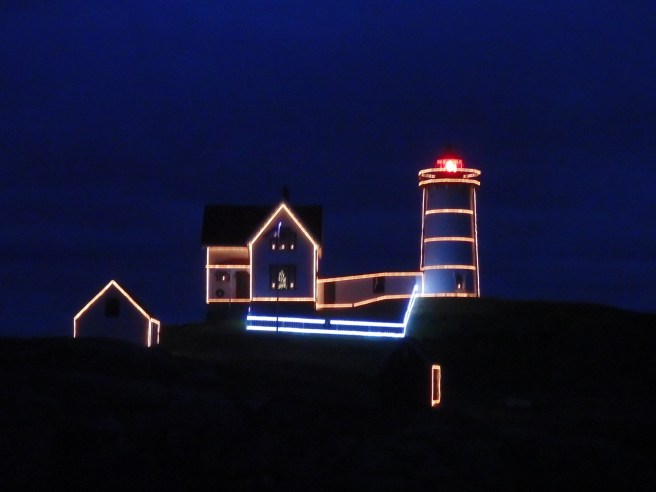
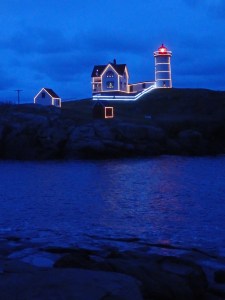
The lighthouse at Cape Neddick in York, Maine, is one of the most photographed in America. Also known as the Nubble Point Light, it has a red beam to distinguish it from other nearby beacons. Each Christmas season, it’s outlined in holiday fare. Here’s how it looks.
JUST WONDERING
Ever cut your own tree?
BENDING THE BEAT
I could imagine myself an orchestral conductor, but there are many things that must be trusted to the players themselves. Something like Rubato, within a musical phrase, comes to mind. And then, in a flash, it’s passed. Reflect on that with these poems.
~*~
For these poems and more, visit Thistle/Flinch editions.
WHAT HAPPENS WHEN THE QUOTATIONS BLUR?
When someone speaks of an event while quoting someone else, how accurate is that quotation? How much is a recasting by the teller, perhaps years after the event being related?
In drafting my newest novel, as I turned to a first-person narrative by someone who never even met many of the characters she’s telling about, I realized that her quoting them was actually a filtering through her own voice. In other words, the precision of their voice was in question. Would it be right to put their input in quotations marks? Or eliminate the quotation marks and let the telling float in and out of some recollection?
I’ve opted for the latter. Will it work for the reader, though? We’ll see.
THE SILENCE IN BEETHOVEN
When it comes to the fine arts, we love our biographies of tortured genius, and Ludwig van Beethoven serves the storytellers admirably. Baptized December 17, 1770, in Bonn, his tempestuous and tragic life was one of failed love affairs, strained friendships, and especially the deafness that accompanied his greatest musical achievements. And yet many of us find him not only speaking for us but also extending inspiration in the quest for fullness and fidelity.
In part it’s a story of the way Bach, Mozart, and Beethoven reestablish the center of classical music, centering it in the German-speaking world far from its Italian roots and the Renaissance genius of Monteverdi and Palestrina.
As I discussed earlier this year, Beethoven’s popularity rests largely on works that he wrote in the second half of his life, past the age of Mozart’s death, the years that encompass what are known as his Middle (or Heroic) and Late periods. The years accompanied by deafness.
For much of my life, I’ve not been alone in finding that what most appealed to me were the works from the Middle period – the Fifth, Sixth, Seventh, and Ninth symphonies, the violin and “Emperor” piano concertos, the Rasumovsky string quartets – stirring works raging with dramatic struggle and promised victory. With all of their emotional parallels to athletic contests, these have justifiably ensured his enduring public adoration.
More recently, though, they’ve given way in my estimation as the Late period works have risen in preference. Quite simply, these have never been considered all that accessible. Many of them defiantly turn their back on the audience in a pursuit of boldly intricate, often extended, musical puzzles that plumb the depths of human despair, loneliness, resolve, as well as lofty heights. Indeed, for years the assumption has been that these are not for public consumption but are rather reserved for private investigation among the cognoscenti, should they be so honored.
SHELLS UNDER THE RIGGING
fingers stiff, numb
on ice-encased rigging
any fire in the hull
a hazard
tend the footing, Jack,
and stay dry, if you can
steering around the storm
* * *
hell comes without
flame
without smoke
under the prow
* * *
impressed
by chance misfortune
or the flight from somebody
gone astray
rolled together, creaking
skin to crab shell
all the same
lost, for the cold duration
Poem copyright 2016 by Jnana Hodson
To see the full set of seacoast poems, click here.
AND HAVE A GOOD DAY?
In the early days of Friends, they’d often greet each other with the question, “How does Truth prosper among you?” Not “How are you doing?” or even “Good morning.”
Strikes modern ears as puzzling, even problematic, beginning with that verb prosper, which we tend to consider along financial terms rather than thrive or even proliferate. Equally unfamiliar is the idea of Truth being active – alive – rather than static and unchanging.
To further thicken the plot, consider their linkage of Truth and Christ, so the question also asks, “How is Christ alive among you?”
How would you answer that!
~*~
For more along these lines, take a look at Religion Turned Upside Down.

