My newest novel revolves around young adult couples
I’m delighted to announce that my newest novel has just been published.
Nearly Canaan focuses on the lasting impact a single person can have, but its details often erupt from committed young adult couples interacting with each other.
The story takes off once Jaya leaves the ashram in Yoga Bootcamp.

As she ventures forth to resume her career and teach yoga on the side, she becomes enmeshed in erotic passion, despite her best intentions. As she becomes half of twosome, she’s also influenced by two other couples – her lover’s parents and his pastor and wife Wendy.
Soon after, when Jaya and her beloved move on to the Ozarks, they grow close to another young couple, their new neighbors.
And when they arrive at last in their promised land, two more young couples as well as their landlords in the orchard weave into the action.
I didn’t set out with these overlapping circles as my model, but that’s what’s emerged. It’s quite exciting, actually.
The new novel is a thorough reworking of three earlier books – Promise, Peel (as in Apple), and St. Helens in the Mix.
Be among the first to read it!
Ultimately, the new series is all about Jaya
Cassia is not the only character who’s had me drastically revising my earlier fiction.
Jaya, the central figure in what now stands as Nearly Canaan, has more recently had me doing the same to six other published books.
First, before Cassia became part of my life in What’s Left and the earlier stories now told in my Freakin’ Free Spirits cycle, Jaya emerged in a set of revisions in what became the three novels Promise, Peel (as in apple), and St. Helens in the Mix.
Initially, her part wasn’t even female – and while transforming her wasn’t exactly literary gender reallocation surgery, it certainly changed the dynamic of the story, which became older woman/younger man, with the woman being the tall dark sophisticated stranger being pursued by a hot young guy.
In the early drafts, she wasn’t yet a yogi, either, but rather a Sufi.
The stories themselves were about encountering specific landscapes as much as the individuals themselves.
A few years after their publication, I decided to restore them to my original intent of one volume but realized drastic revision was necessary. First, they needed to be cut significantly to fit into what would still be a “fat” and hopefully juicy book. Second, I needed a clearer understanding of Jaya’s actual career as well as her companion’s character. And, third, a fuller comprehension of her lasting influence was required. That led to the new version, Nearly Canaan.
It still felt incomplete, though. Her earlier spiritual training needed to be told. While she had talked briefly about her ashram experiences, they didn’t align completely with my yoga novel. But they could.
I reopened the manuscript, changed one of the eight students to be Jaya, and then changed the gender of the guru throughout. That led to a slew of drastic alterations and additions, moving the novel from Ashram to Yoga Bootcamp.
That gave me two novels in a series, but a series needs a third or more, I felt.
But wait, there’s more.
Continue reading “Ultimately, the new series is all about Jaya”
Now that the numbers are in
I’ve long worried about the influence of political surveys on the elections themselves. That is, any scientific purpose they claim still pollutes the subject they’re investigating. And that’s before we get to candidates who remake their image and message to fit popular opinion, even if it doesn’t change their behind-the-scenes policies one whit.
As humans, we like to be on the winning side, after all, and published surveys add pressure in that direction. On the other hand, the opposing camps just might react by ramping up their anger and energy in a drive for an underdog upset. In that regard, the survey findings are more like the betting odds given on a sports event.
These elections should be more than a game or an entertainment ratings number. They’re too important for that.
I was happy to see that in New Hampshire’s first-in-the-nation presidential primary, many voters stuck to their convictions. Nobody saw Amy Klobuchar’s rise coming, but many were impressed seeing her face-to-face or in what they heard from others who had. The other supporters we met were generally soft-spoken but firm in their decision. Frankly, I was usually amazed to realize we weren’t alone, that there were others who had come to the same decision. I’ll confess we were bracing for the worst when the election results started pouring in. Now we’re feeling some vindication, and definitely smiling.
The irony here, of course, that her climb to a third-place finish now puts her in a spotlight that is expected to sway other primary results down the line.
We’ll just have to see how it all adds up.
Foreign news can hit close to home
The reports of the Wuhan coronavirus outbreak are disturbing enough, even when it seems so far away. For many people outside of China, the news is mostly curiosity, perhaps even of a morbid fascination.
But then we get headlines of a few possible cases popping up here in New Hampshire, individuals who recently traveled from China. Still, those have been limited to other parts of the state, a distance away from us.
Where it gets personal for my wife and me is thinking of Chinese students we’ve hosted in our home for a month or so apiece while they worked volunteer internships in our community. They’re from that part of China, though not Wuhan itself. In effect, they put a face we know on the event and have us concerned for their health and safety and that of their families.
Yes, sometimes it is a small world.
Hey, just wait till you’re old
No to brag, but I’m in pretty good shape for my age. Admittedly, that’s setting the bar low. Still, there’s a lot I don’t like when it comes to getting older. For example.
- Everyday aches and pains. Well, I was fine until I took up daily exercise.
- Slowing down. I run out of energy in tackling chores, for one thing. An hour or two and I’m ready to quit. On the other hand, retirement has allowed me to focus more fully on my writing and reading projects. At least when the chores don’t get in the way.
- Balding and graying. Among other matters of vanity.
- Diminished sex drive. Ouch! Let’s not call it libido.
- Fuzzy memory. OK, I do have a lot more crammed into my cranium, but retrieving specifics can be difficult. And that leads to worries about Alzheimer’s or dementia. Not that I can stop any of the aging progressions, which could be a point of its own.
- Realizing all the babies in the neighborhood have now graduated from high school or college. At least the ones when we moved here. Or, for that matter, being called “Sir” rather than “Dude.”
- Being required to take a handful of pills every morning. Well, it could be worse, like rounds twice a day. Obviously, we’re not talking about recreational drugs, either.
- Seeing old acquaintances for the first time in years and being shocked at how old they’ve become. Sometimes I don’t even recognize them. Worse yet, they don’t recognize me.
- Overhearing things. Like the kid in the swimming pool locker room who turned to his uncle and proclaimed, “That man’s old,” when I’m the only other person present.
- And this. Realizing I’m now the oldest generation in many of my circles and expected to fill the role of the Old Wise One. The ones who went before were so much better.
~*~
What can you add to the list?
4 what?

What we’re looking for in a potential nominee
Each presidential primary season, I’m amazed by the number of people who file to run in the New Hampshire race even though they have little or no political experience. Yes, we have them again this leap year.
They have no hope of winning or usually even adding anything useful to the conversation.
Even among the serious candidates, I’ve come to see that having good ideas is not enough to make for a viable president. A commanding presence, leadership skills (including an ability to listen and accept critical positions from your inner circle), and effective organization are also essential. Quite simply, is this someone with traction as a nominee?
Political experience is also crucial. Directing a major corporation is not the same as managing a public enterprise. Some states and cities have budgets and work forces rivaling big businesses, but the dynamics are quite different. I do wish some of the billionaire candidates, hopeful as they are, had chosen to run for a governorship or Congress first, get their feet wet and learned through OJT.
So here we are, shaking things out.
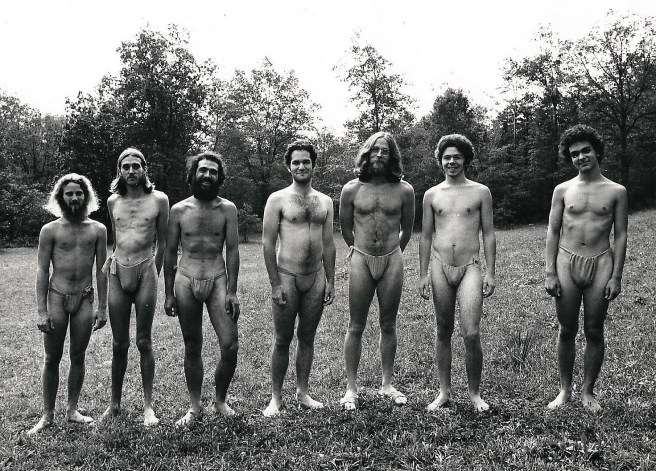
Standing in our brahmacharies
My novel YOGA BOOTCAMP describes the events of being initiated into brahmacharya and being given the two strips of cloth cut from the guru’s robe as our new underwear, supposedly to restrain our male sexual impulses. As a bit of real-life evidence, here we are at the Poconos Ashram in Pennsylvania in mid-1972. The girls found it highly amusing, especially since we were all living under celibacy.
This folksy trend seems to be spreading
Anyone else struck by the number of presidential candidates running on a first-name basis? Pete, Amy, Bernie, Tulsi, Tom, Beto, and for a while Kamala. In contrast to those who run on their more formal surnames. You know, the folksy thing. Or at least something easier to remember. It works if your moniker isn’t too generic, say like John or Mike or Mary, I guess.
It’s not entirely new. I mean, historically there was Honest Abe and Teddy the Rough Rider and later Ike and Adalai and then Hillary. Or even the initials, JFK and LBJ.
In local elections, our neighbor recently won the mayor’s seat. Well done, Bob.

