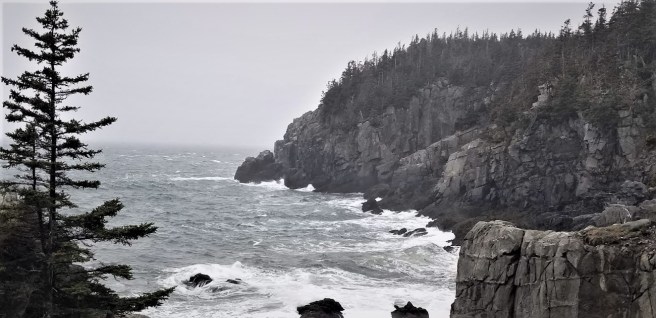
Be sure to carry a raincoat in the Olympic Peninsula

The Olympic Peninsula, set off in the northwest corner of the continental U.S., is a unique place. My longpoem American Olympus is a travelogue of one week we spent camping there.

Here are ten things to consider.

~*~

  1. Size: About 3,600 square miles, it’s a large arm with the Pacific Ocean on the west, the Strait of Juan de Fuca on the north, and Puget Sound on the east. You can’t drive straight through it, by the way – only around the perimeter.
  2. Distinctive features: The Olympic mountain range fills the center. It’s dominated by 7,980 foot elevation Mount Olympus, which has seven notable glaciers. The peninsula’s Pacific coastline (including 73 miles inside the national park) has impressive sea stacks and dense old-growth rainforests.
  3. Precipitation: The Hoh Rainforest receives 12 to 14 feet of rain a year – that is, up to 170 inches. In contrast, the eastern half of the peninsula, facing Seattle, is in a rain shadow, where lawns and gardens may require irrigation. The mountains, as you may have guessed, get buried in snow.
  4. Public lands: The peninsula includes Olympic National Park and national forest, plus designated wilderness areas and state parks. The national park itself covers nearly a million acres.
  5. Rangers: The national park has 139 full-time rangers. Seasonal support pushes that to 256 in season, assisting nearly three million visitors a year.
  6. Natives: It’s home to eight contemporary tribes of Native Americans and ten reservations.
  7. Population: 104,000 people. The largest city is Port Angeles, 20,000 residents.
  8. Wildlife: Cougars, bear, elk, bobcats, eagles, salmon.
  9. Freshwater attractions: Glacier-carved and crystal-clear, 12-mile-long Lake Crescent is up to 624-feet deep. Average depth is 300 feet. The peninsula also touts 13 significant salmon-bearing rivers, most of them wild, plunging from the mountains to the sea.
  10. Who was Juan de Fuca? The band of seawater between the peninsula and Canada is named for a Greek maritime pilot who lived from 1536 to 1602. Though we know him by his name in Spanish, he was Ioannis Phokas, sailing in service of King Philip II of Spain. He claimed to have discovered the strait on a voyage in 1592, and though much of his report departs from reality, a few details make it possible that he was just a lousy recordkeeper.  

~*~

What’s the wildest place you’ve explored?

Sea stacks are shown at Ruby Beach. The Olympic Peninsula coastline is often strewn with tangles of fallen trees like this.

I’m still fascinated by the potential of stories that come out of subways

Millions of people ride the subways each day, and many of them read English. In fact, you’ll see many of them are deep into books as they’re transported. Yet I’m surprised how little writing reflects this experience. Where else can you see so much humanity sitting right in front of you or dashing past?

Well, my Subway Visions tries to convey my experiences, real and imagined.

Two significant nonfiction books are Jennifer Toth’s 1993 The Mole People, based on her year of reporting on the plight of the homeless people who took to living in the tunnels under Manhattan in the Reagan years, and Jacqueline Cangro’s The Subway Chronicles, a collection of essays by the likes of Jonathan Lethem, Francine Prose, Calvin Trillin, and Lawrence Block. By the way, Block admits a fondness for including subway scenes in his prolific output of novels.

My survey of ebooks at Smashwords has added others to the list, not all of them in New York City. One tells of a year playing music in New York’s stations. Another of collecting umbrellas in Tokyo. There is a fondness for seeing the underground as the gates of hell, with one volume in particular standing out as a masterful fantasy that’s meticulously researched.

To see what I’ve found and my reactions, go to the reviews at my Jnana Hodson at Smashwords page.

Got any related transportation books to recommend? Trains, buses, airplanes? Other?


When it’s time to downsize

Think of your “desert island list” applied to real life.

Gee, trying to cut it to even a thousand books or recordings seems impossible, at least in my case.

Would there even be sufficient room for all the survivors at the new destination?

And that’s before the clothing and kitchenware and …

What would be hardest for you to pare down?


On the road to satori

Like Zen, my mind works in strange ways, and this is how I too often see things.

How I often see or hear life around me.

I can imagine a Buddhist sutra in which two monks observe the sign. They’re walking, of course, rather than driving.

The first says something pithy asking how Zen, being nothing, can do anything, much less work.

And the second replies that work’s nothing, too. But it’s not lazy.

Better, I suppose, than “ZZZ Working,” which many assume while passing the usual sign and seeing the crew standing by idly.

If you like this, please clap with one hand.

I’m feeling a little vindication

When I recently applied subtitles to my novels, I gave Reports From Trump Country to Hometown News, even though the events in the story take place, by implication perhaps, during the Reagan years in a small industrial city out in the Rust Belt.

Now the August issue of Harper’s magazine has come out with “The Challenge of the Rust Belt: Can Biden pry it from Trump’s grip?” touted on the cover, and I’m feeling some vindication in the Trump connection in my subtitle.

Vindication? I hate to admit that the Vindicator was a big rival for me in a town that looked very much like Rehoboth, and it had entrenched strength against a small upstart like ours. We were responding quite well, until the larger economy turned against us.

The Vindicator’s home base already resembled a bombed-out German city, left with only several miles of steel mill shells, so we were well within the Rust Belt.

Many communities, especially in the Midwest, simply haven’t recovered from the sharp decline of American manufacturing in the ’70s and ’80s or from the blow to the myth that you’ll be rewarded if you just work hard enough. So much for the work ethic itself.

No wonder this is my dystopian novel.

Now, 40 or so years later, those things really haven’t improved. Let’s be honest. There really is a Groundhog Day surrealism in many locales. We really need a better end for the story – mine and Harper’s – than what I’m seeing.

Not that Cassandra had an easy time of it. either.

How divinely appropriate

In my novel What’s Left, her mother inherits a name whose attributes suit her well. The chaste Roman goddess Diana (or Artemis in Greek) rules the hunt, the moon, childbirth, and nature. In the story, she’s calm and faithful, with a spark of fire that infuses her music-making and likely much more. I even have her evolving into much more of a night-person than her early-rising husband, though I hadn’t thought about that connection till now.

~*~

As I wrote earlier:

The real hunt had begun. With practice, within this lifetime, however long or brief, a remarkable enlightenment might yet blossom into wisdom. From flowers and bees, the harvest comes.

“Come, Dhyana, let us sit together. Let us ride in unison. That is all.” He accepted fully, “The female energy is my Shakti power.”

~*~

Given the urgency of her father’s Buddhist practice, it’s entirely fitting that his wife — Cassia’s mother — would share in the experience. Here he also recognizes an Eastern perception of a uniquely feminine spiritual energy that would complement his own nature — in a way also honoring the goddess essence of Diana’s own name.

By the way, if you’re interested in the origin, meaning, and pronunciation of my name Jnana, visit the Bio page here at the Red Barn. Think it fits me?

Do you know anyone whose first name perfectly suits their personality? Or how about someone who’s the exact opposite of what you’d expect?

~*~

Roman goddess Diana

~*~


With a few distinctive touches

The transformation of the former newspaper plant downtown continues. What had been an essentially blank wall against the children’s museum and park is opening up to take advantage of its views that include the bend in the river.

The crown, common to the late 1800s buildings up the street, came as an unexpected but traditional touch.


I happen to love big windows with a corner view, as I imagine these have.