what upset me was the basic ineptitude that causes such accidents and delays to happen, still, if it hadn’t been for a couple of foolhardy neighbors one-thirty a.m., fire alarm, dashing outside before smoke in a neighboring apartment turned into flames, only then did I think who brought the blaze under control with fire extinguishers while eating way too much smoke, the fire trucks would have arrived to an attic entirely aflame so I should have carried my computer files out, too, but why the fire department took thirteen minutes to respond from a station just five blocks away is inexcusable
Ten big things to tackle right away in our new project
The Cape we bought was listed as circa 1865, but from some of the detailing, we’re guessing it was more likely around 1835. A bird’s-eye view map from the 1835 shows a house on this site, though maybe not this one.
Many potential buyers passed on the place, for whatever reasons. It is definitely a fixer-upper, but it feels good, and we like its in-town, close-to-the-ocean location.
One chimney was in peril of collapse, and it’s already been removed. The fuel-oil tank had to be replaced. Also done.
We’re looking at the work ahead in two stages.
The first, of course, is more essential. The second, renovating the place more for our dreams.
Not that I especially wanted another This Old House kind of series, but this time we think we can tackle the project more comprehensively, rather than piecemeal.
Here’s what’s on our plate as soon as possible:
- Insulate exterior walls.
- Repair foundation and cellar. Work from the bottom up.
- Level the flooring.
- Rewire, to accommodate more electronics and appliances, especially, and add grounded outlets.
- Replace windows.
- Straighten and fix gutters.
- Touch up and repaint exterior trim.
- Add a garden shed. We really miss our barn and need more storage space.
- Remove the old fireplace iron insert (now sitting in the middle of a room) and the big wood cookstove.
- Remodel and update kitchen.
Looking at highly motivated people for inspiration
Do you ever look around and see people who seem to get a lot more done than others? I could tell you about some of the lifeguards at the indoor pool where I swim, the ones who do their school homework when they’re not watching us splashing around. Uh, swimming laps — something they can do four times faster than us geezers.
Well, in my novel What’s Left, the narrator has a similar question, one regarding many members of her family. (You won’t find it in the final version of the book — but it’s true all the same.)
I return to the question, How do they manage? All that they do?
~*~
Her aunt Nita, as we’re told, sticks to a routine and limits her evening activities. Her father could easily split his workweek into 20 hours of photography and 20 of Buddhist focus. Her mother would be putting in more at the press but still devoting considerable free time to practicing and rehearsing music.
Some others just seem to go without sleep or rise before dawn to get an early jump on things.
Tell us about somebody you know who seems to be super-human. Do they have some secret you see?
~*~

A sure sign of spring

Moving past Covid
Yes, we were Zooming, as our monthly gathering of religious leaders in town has been doing for the past year, but the suggestion did come as a jolt.
For decades now, the largely informal group has been a way of supporting each other, clergy and laity, as friends and neighbors, and out of that has grown joint activity, such as our community-wide Thanksgiving, Blue Christmas, and Martin Luther King services or overnight shelter for the homeless in the depth of winter or recognition of challenges we face as congregations. It’s one of the things I will especially miss in moving from Dover.
“We need to think carefully about how we come out of Covid,” the Congregational pastor mused. “We need to give it the same attention we did going into the restrictions.”
We still haven’t had the conversation. Maybe we will on our next agenda. But she’s right. Our new normal won’t be the same as the old.
I’ve been hoping that when the restrictions are lifted and we’re all immunized, we’ll be hungry to be back in public get-togethers more than ever, including worship. But there’s also the reality that we’ve fallen out of social habits and may cling to our newer stay-at-home routines. There’s a recognition that for some, continuing the online connections may be beneficial – for invalids or people living at a distance, especially. In addition, a Zoom session can be more convenient than driving hours to a committee meeting, as we’re finding, though it also has drawbacks.
As organizations, we appear to have kept a loyal core but also seen, I sense, newer participants drift away. Can we find ways to lure them back or attract others once we’re “open again”?
~*~
You’ve probably already seen the report that for the first time since the figures were kept, church, synagogue, and similar membership in the U.S. has fallen below 50 percent. Some of the reaction has noted a difference between joining in a congregation in contrast to unaffiliated “spiritual” identity. Some other commentators have derided religion altogether, but we should also be aware of declining membership in various associations across the board. One of the things that struck Alexis de Tocqueville about American society in his travels in 1831-1832 was the degree to which we were joiners. Not just in churches but also trade and economic associations, fraternal societies, political parties, lodges and clubs, sports teams, choruses, bands, and theatrical groups, and more.
While I don’t consider myself to be especially “social,” I’m still a member of a half-dozen groups, and I’m not counting those that are essentially an annual donation and a membership card or magazine in return.
Not so for the younger generation. One daughter does belong to the county beekeepers’ group, but that’s it.
As others have noted, that’s not a good sign for building democracy or community.
~*~
But folks are understandably restless. Already, everyplace seems to be booked up for vacation travel. (Glad we have a place that’s suddenly “in.”)
That transition from lockdown to normal now promises to transpire over the summer, giving organizations a chance to anticipate the changes and readjust more slowly. There’s so much we don’t know, after all.
And we haven’t even touched on the future of retailing and other local business.
What are you looking forward to post-Covid? And when?
Think you’ll miss Zoom?
A vital extension opens on the community trail
Dover’s four-mile-long community trail is a gem and has provided more than a few photo ops I’ve shared here at the Barn. Its southern leg starts at the Amtrak station downtown and, until recently, ended unceremoniously at residential Fisher Street with some delightful scenes in-between. Considered the urban leg, it’s paved for bicycle use as well as pedestrians and runners.
The northern leg kicks off at Fourth Street and follows the Cocheco River up to Watson Road, with its waterfalls and dam. One kink in that route – approaching at the Spaulding Turnpike bridge – was cleared up a few years ago, as was improved access to the trail itself at Fourth Street more recently. Some memorable cross-country skiing from the Watson Falls down to the Spaulding and back had me feeling I was up in the White Mountains rather than still inside the city limits.
Now, after being on the drawing board for more than six years, a 2,000-foot-long portion of the rail-to-trail pathway has extended the southern end almost all the way to the Sawyer Mills apartments and made ready access for middle- and high-school students.
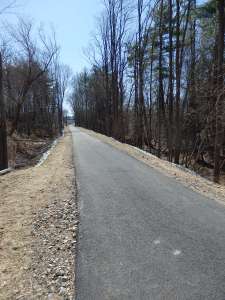
There were complications getting permission to skirt some commercial properties along the way, as well as drainage issues and some serious poison ivy. Remaining railroad ties made walking difficult – forget the bicycle or the baby stroller.
Now that winter’s over, the stretch has been graded and paved and, where necessary, fenced off – in a stylish way, I’d say – and while some final touches remain, it’s already attracting happy pedestrian traffic.
You can bet I’ll be checking it out on my return visits.

What I don’t like about gardening
If you’re still on the fence about breaking some sod and scattering seeds or selecting six-packs of young plants, think about this.
- Gardening is time-consuming. There’s a lot to do before planting and harvesting. Even before and after. Wouldn’t you rather be doing something else?
- Heartbreaking. There’s always a sacrificial crop each year. You never know which one it will be.
- Demands weeding. And more weeding. Especially if you’re largely organic. They’re back in a flourish overnight.
- Messy. You have to have someplace out of sight to hide all the pots and bags you’ve pulled out of the shed or garage. As for those weeds you uprooted? They get thrown somewhere.
- Debris-producing. You can’t compost it all, especially the woody stuff. And, yes, you can put that in those big brown-paper bags and haul them to the dump, or you can find somewhere to establish a brush pile. And then, at some point, you’ve got to do something with that brush pile before it requires a building permit.
- Anxiety-producing. Just listen to my wife watching the weather report or me anticipating the water bill when we’re having to water intensely through a dry spell. And that’s before hailstorms or frost warnings or …
- Unforgiving. For example, when a crop arrives, it’s often a flood that must be picked pronto or spoil. And just picking it isn’t enough. You can’t eat it all, so somebody has to can or freeze it. Now! Before it starts rotting or wilts.
- A magnet for invaders. Birds, picking out sees and later berries. Slimy garden slugs, taking bites out of anything fleshy, like strawberries and tomatoes, or greens. Squirrels digging mindlessly, often planting walnuts as they go, which then sprout into stinky treelets with tenacious roots. Woodchucks, which can devour a row of their choice overnight. (See item 2.)
- Costly. Those bags of potting soil and additives and pesticides (even organic) add up, as do the flats of seedlings, even once you’re past the round of catalogue orders at the beginning of the year. As I was saying about the water bill?
- Let’s not overlook replacing broken tools. Or lost ones.
~*~
Well, all those benefits do come at a price. Best you know now!
Fellow planters, be frank. What other downsides would you acknowledge?
When siblings and their spouses work together
My novel What’s Left includes reflections on a first generation of a family business dynamic, somewhat like one I also describe in passing in Nearly Canaan.
In reality, the model of a restaurant run by two brothers and their wives was one I observed in a small Midwestern city where I edited the local newspaper. In this case, their roots were Italian, not Greek, and the economy was essentially farming and two large factories, without a university or county seat to boost business.
Do you have any insights on ways siblings interact when they run a business together?
Kinisi 51
Whwy?
Yoo!
Seedlings under lights


