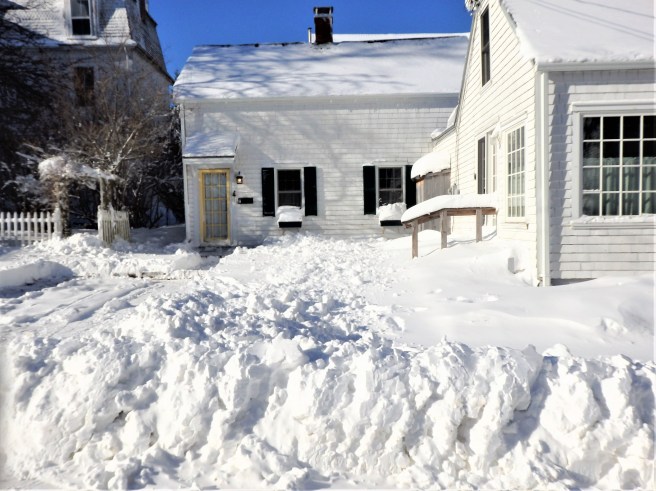
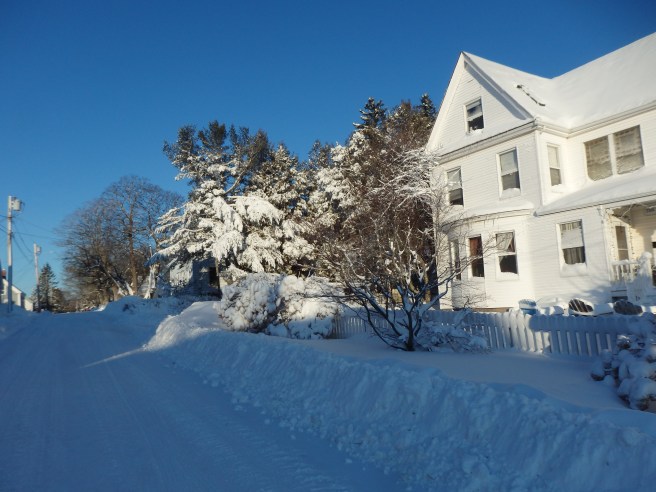
Weather Underground kept scaling back its anticipated snowfall here, cutting it to a tad over three inches. Instead, we woke up to this yesterday, about 9½ inches after a day of blizzard conditions. Seemed strange going from near whiteout one day to cloudless blue the next.
Gotta dig out to make room for more.Should I mention this was a break in our ongoing gale conditions?
We’re bracing for subzero temperatures in the coming nights, but a minus four is still ten degrees warmer than just up the road. And then another half-foot is on the horizon.
I know we’re hardly alone when it comes to scenes like this, and I’m grateful I no longer have to commute through hazardous storm conditions.
thinking the cleaner bag full I discovered the rubber drive belt had snapped meaning a trip to the shop and the next day was Sunday as she had left it all the same, dust and sweep, wet mop, and rinse, move tall stacks about, sort items but what if we don’t? refill the trash can, love, after all, would expose this . honestly I won’t quit so simply whatever past is mine . pay dearly, of course, for these revelations. so make room for more labor . brush and chop, returning to the same spot rather than scurry onward
I thought we Dover Quakers – or more formally Friends – had our long history covered. I had even helped Silas Weeks, way back, in some of his research for his definitive volume on New England Quaker meetinghouses and burial grounds.
Frankly, after revising and republishing seven novels after the appearance of my eighth, I wanted a break.
A big break.
These are supposed to be my retirement years, OK? Admittedly, I had long imagined devoting myself to the writing as a big part of that dream, but really!
But then a casual request for an overview of Dover Friends history changed everything. It came indirectly, through someone in another denomination who was active in our Sanctuary movement. But then, going back through my filing drawers, I came up empty – couldn’t even find my folders of notes. What we did have was mostly about our three meetinghouses over the years – especially the structure where we’ve worshiped since 1768 – along with a few prominent events.
This left me unsettled.
Unlike many other denominations, the Society of Friends, or Quakers, is first and foremost about its members. Our definition of church is the body of believers – not the building or the polity and definitely not the ordained clergy. It’s why we call our building a meetinghouse and why we organize as Meetings, reflecting the times and ways our church-people come together. Church can happen whenever and wherever we are, even over dinner in our homes or chance encounters on the street or in the midst of social activism. And vitally it’s not just us – we’re meeting God, too.
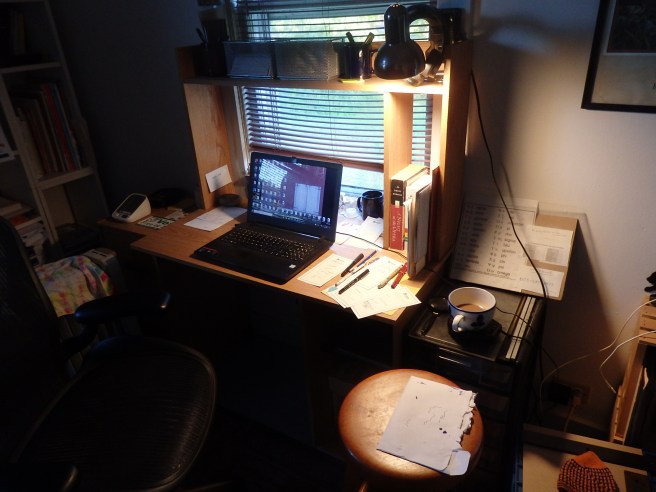
I spent a lot of time at my impromptu workstation in Eastport, Maine, last year working on a history of Quakers in Dover, New Hampshire. And I arrived with what I thought was a largely finished manuscript. I was mistaken.
~*~
WHAT NEEDED TO BE TOLD was the lives of the individuals and families who were the essence of one of the oldest Quaker Meetings in the world.
I resisted as long as I could but finally succumbed. Who were they? Why were they so willing to risk severe punishment and persecution imposed by the Puritan authorities? And in the face of that, how and why did a third of Dover’s population quickly become Quaker? And several generations later, start fading away?
With the 400th anniversary of the settling of Dover – and thus New Hampshire, too – coming up next year, the timing for our side of the history felt right.
Now that the book’s written and revised, I’ll be sharing some of my findings with you as well as news of publication itself as that nears.
~*~
WHAT EMERGED IS A PARTIAL HISTORY, as in partisan, with my focus on a radical religious subculture that thrived in a unique, out-of-the-way, locale. Partial, as well, to the independent streak of New Hampshire against more powerful Massachusetts authorities to the south. Partial even in being incomplete as well as lacking footnotes, and not even the work of a professionally trained historian.
The story is also partial in being biased toward a sequence of unusual, sometimes roughhewn, figures and their families – not all of them Quaker – and inclined especially toward the narrative they shape.
The roots, as you’ll see, arise in the very beginning of English settlement. Forget what you’ve assumed about New England before Paul Revere and Sam Adams and the American Revolution and Boston as the Hub of the Universe.
A lot had already happened before the first Puritans sailed into Boston Harbor. Let’s look instead to Dover, which lays claim to being the seventh-oldest continually inhabited European settlement in the United States.
In the standard telling of the founding of today’s city of Dover, New Hampshire, two brothers arrived from England in the spring of 1623 and settled at the mouth of Great Bay on the Piscataqua River, upstream from the Atlantic Ocean. The brothers were fishmongers, members of one of the oldest and wealthiest guilds, or great companies, of London.
Except, as it turns out, one of the brothers didn’t arrive until a few years later.
Instead, the cofounder of the new settlement was a fishmonger apprentice who would be an important figure in the early years of the colony.
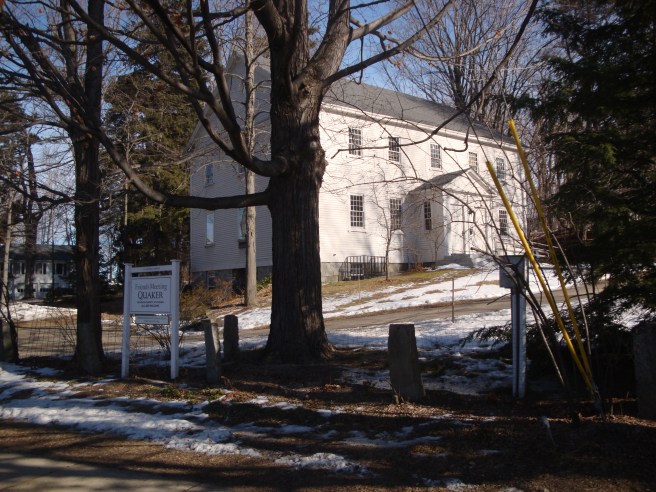
The meetinghouse, Dover Friends’ third, is home to the faith community today. It was erected in a single day in 1768.
~*~
YOU’LL PROBABLY BY AS SURPRISED by this alternative take on New England history as I’ve been. It’s not just Quakers. There’s much more to New England’s past than a Thanksgiving dinner and a riotous tea party followed by a midnight ride and the shot heard ’round the world or even the notorious witch trials.
Here at the Barn, you’ll definitely be hearing a lot more about this big project through the coming year. Believe me, some of the findings will be startling.
I like to think that natural beauty can be found anywhere, but I have to admit that too often, what’s happened is that brute ugliness has prevailed in far too many places, typically as a result of greed. There’s no excuse for much of that, either. A little extra expenditure could have added grace to any development, created visual intrigue, lessened the harshness. Urban or rural or what’s in-between, alas.
Whenever possible, I chose career moves that opened me to natural or artistic settings and inspiration – along with opportunities to shine professionally. It’s meant avoiding suburbs, for one thing. Sometimes, though, it’s also meant invoking a sliding scale of value – you know, finding pockets of serenity within otherwise harsh localities. And then there were some other postings that principally industrial, even when it was mostly farmland. So it’s been a mix.
Still, as I’ve said, I came to realize that had I remained in my native corner of Ohio, I wouldn’t have been able to write poetry, the vibe was simply wrong. Or, if I had, it would have been much different from what I’ve done.
On the other hand, the four years I lived two hours east of Mount Rainier, back in the late ’70s, gave me repeated access to one of America’s greatest national treasures, often from lesser-known perspectives. What memories! And that’s before I turn to much of the back country and wilderness that was closer to our home. I even came to love the beauty of the desert where I was living, a landscape that initially struck us as hideous.
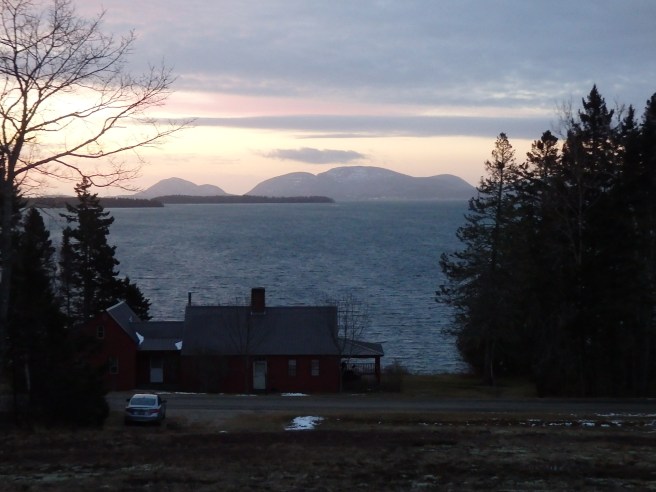
Mount Desert Island, home of Acadia National Park, glimpsed from the east.
Now I’m finding myself dwelling two hours east of an even more popular natural park, Acadia. Already, I have glimmers of many backwoods and remote rocky shores to explore in-between.
Technically, all of Downeast Maine is also Acadia, the French name of the region. For most folks, though, Acadia means the park.
The biggest land mammal out west was the elk, while here in northern New England, it’s the moose. Just as the celebrated shellfish here is lobster, rather than Dungeness crab.
The fact is, for many people, either place is about as close to paradise as you’d find on earth.
And, yes, I’m feeling lucky – or especially blessed – that way.
It’s hard to believe the Red Barn has just passed its tenth anniversary. Frankly, I thought this blog would be going dormant by now, that we would have exhausted everything I have to say or show, but that’s not what’s on the horizon after all.
Instead, thanks to our downsizing and relocating to a remote fishing village with an active arts scene on an island in Maine (whew!), I promise you the best year yet. And, yes, Dover back down the coastline will still be a big part of the mix, but in a new way.
Each year, the Red Barn has changed its emphasis somewhat, and in doing so explored new fields while leaving others behind. Looking back, I’d say it’s made for a natural evolution. The poetry, for instance, has moved over to my unique digital Thistle Finch imprint. Much of the Quaker experience has gone to my As Light Is Sown blog. And newspapers just aren’t what they were, while their “war stories” fade into a foggy past.
During that decade, though, my novels were finally finding publication, and that provided a lode of new material and thinking to share with you.
Photography also became a much bigger part of the mix, thanks to my digital cameras, so much so that I can now claim shooting as one of my hobbies.
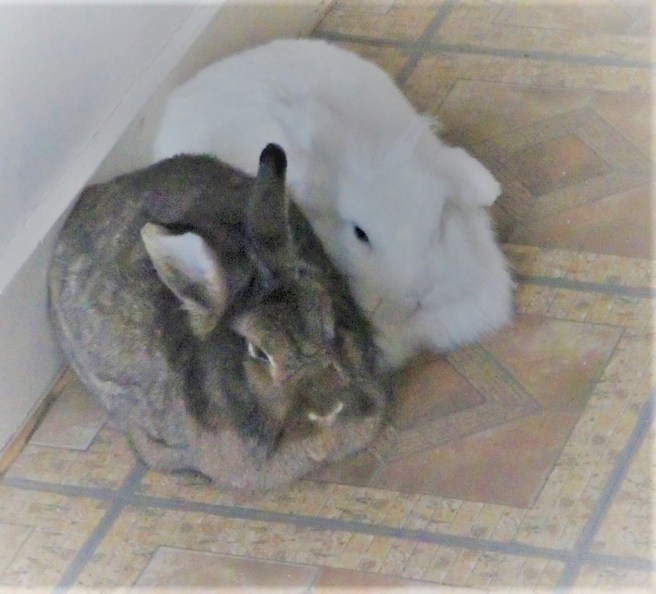
Add to that the bunnies and vanity plates and some wordplay, for a little fun, which will continue, as will the Tendrils.
The original visual artwork from my high school portfolio, alas, has been depleted. Let me confess that as the pieces came up, I often wondered why I had done this or that back then. There are some wild leaps of intuition that amaze me now, not that I’d ever venture such confidence these days. Ah, youth! (Sigh.)
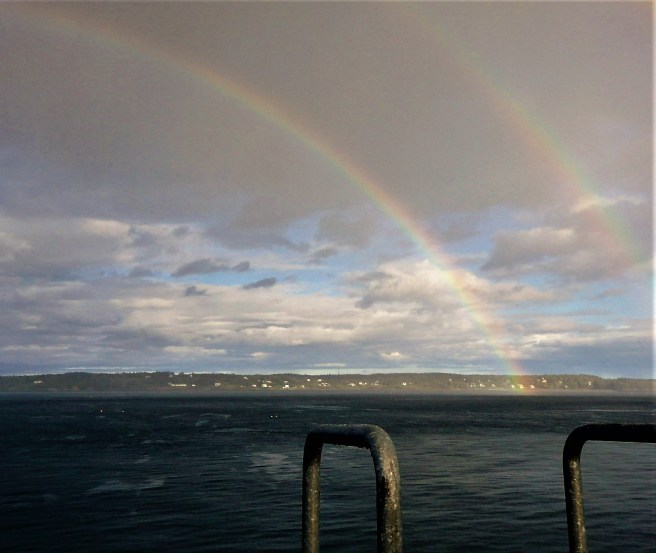
A double rainbow, as seen when I was caught in an unexpected shower behind us last summer.
What’s new this year is a close look at Eastport itself and the surrounding Bold Coast and Sunrise County. It’s a remarkable landscape with a host of fascinating characters and wildlife. Having been here a year now allows for some perspective in the discoveries, ones you, too, will be sharing. The encounters have opened a whole new world for me, even as part of upright New England. They’ve also revived many sensations I’d been forced to leave behind in the Pacific Northwest more than 40 years earlier. I hope to be able to convey that awe of natural wonder. I still can’t believe this landlocked Ohio boy looks out the window and sees the ocean daily.
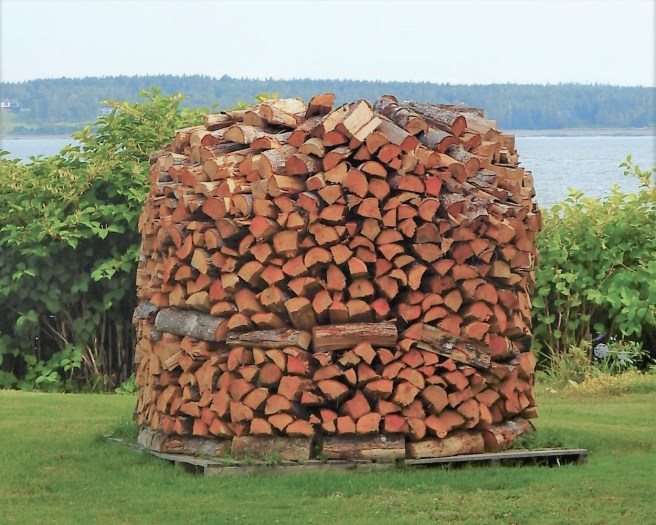
A neighbor’s first holz hausen firewood pile, though it took him three efforts to get it right. I didn’t miss stacking firewood last year, but I definitely missed the comfort of wood-stove heat through much of the winter.
The year also provided me with a writer’s retreat, long stretches of solitude while the rest of the family remained behind, apart from their festive visits.
I was already well into the first draft of my next book when we uprooted but quickly got back down to business here. Alas, after showing the manuscript to a circle of beta readers, it was back to the drawing board for a thorough reworking. I should have been suspicious when the book seemed to write itself. Without revealing too much, I will say the project keeps me connected to Dover but in a fresh way. You’ll definitely be hearing much more while it inches along toward publication.
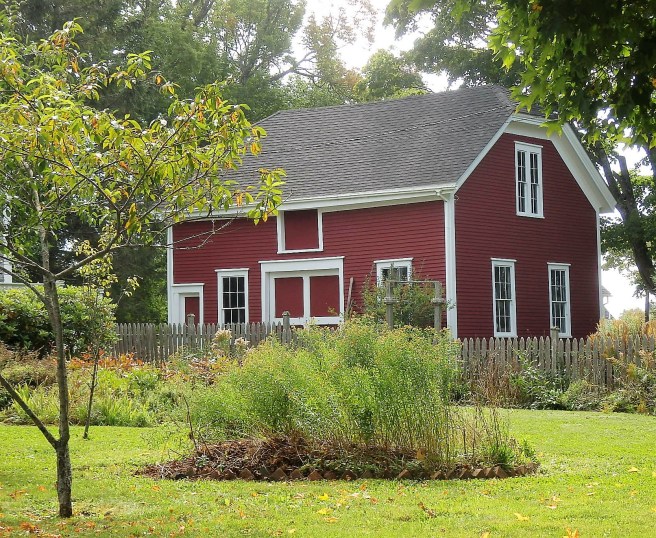
Another neighbor’s red barn just isn’t the same as the one I left behind.
The barn itself has become a memory, a symbol of the longest place I’ve lived in my life, and maybe even my roots in the farming heartland.