an aged whiskey
between two maritime cannons
You never know what we'll churn up in cleaning a stall
an aged whiskey
between two maritime cannons
Here’s hoping my reflections on life here at the Barn stimulate an awareness of so many of the riches around you, too.

there’ll be no gardening to ground down to the end of this place bitterly eliminating so much accumulation before swimming through the cloudy first day at liberty disregarding temptation right off the bat to say nothing of ferocious loving What discipline will emerge? except in the leaves of greenhorn pages there’s work awaiting, oh boy, I bought this overnight woods heavy and wet but daily shaving’s a pain so perhaps by the time thee sees me again I’ll be scraggly not paying bills is hardly superfluous still wish you were here on the trail
A couple of incidents regarding my daughter’s chickens have me thinking about human affairs.
Her hens were increasingly picking on one another and squabbling until an incident with a neighbors’ dog posed a terror. In response, they instinctively banded together, including their otherwise useless rooster. For weeks after, their antisocial behavior was transformed, focused on a common enemy.
A year later, the same thing happened when a red tail hawk picked off two of the hens in the yard.
That leads to the question:
Do we humans really need some villain, however small, to make our own lives meaningful?
We see it in politics, for sure. And in sports. As for personal development and ethical living?
I am convinced we need to keep an eye on Satan, in whatever garb, but also need to be careful we don’t start “preaching for sin,” as early Quakers cautioned. The fact is that in fiction it is much easier to create a believable bad guy than a good one.
So even secular novelists must make sure to avoid exclusivity in their vision.
We also need to keep another eye on the Light and its leadings. Otherwise, well, we’d still be chickens at the mercy of foxes and weasels.
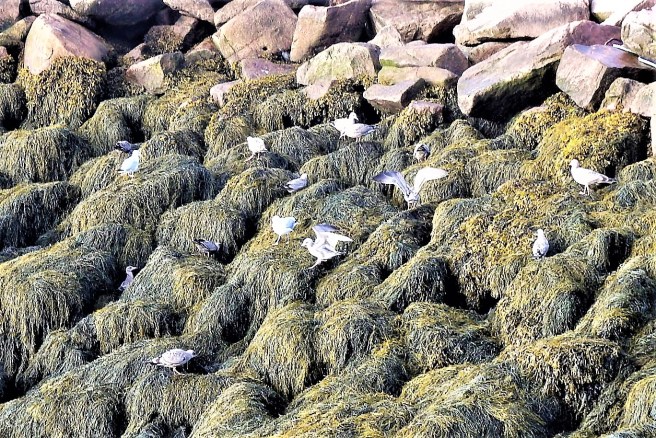
Alexander Shapleigh, an eminent merchant, sailor, shipowner, and shipbuilder from Kingswear in Devon, knew the New World coasts early. For instance, on September 20, 1610, he was recorded as master of the Restitution of Dartmouth when it was seized by the pirate Robert Stephens while returning from a fishing voyage to Newfoundland and bound for Portugal.
It wasn’t the only ship he owned. The largest was the Golden Cat, of 450 tons – twice as large as most of the ships of the time, such as the Mayflower, and three times as large as Sir Francis Drake’s Golden Hind.
Alexander and his descendants were soon pivotal in the founding of Maine. His son-in-law, James Treworgy, served as his principal agent.
Treworgy was instrumental in the purchase of five hundred acres at Kittery Point in 1636 and the erection of the first house in today’s town of Kittery – one that would later be occupied by William Hilton when he moved from Dover Point. Under the agreement, he was “to pay annually 100 of Merchandable Codde dride & well conditioned as Acknowledgmt to the Royaltie of Sir Ferdinando Gorges Knight … to be payd … uppon the Feast of St. Michaell ye Arch Angell. Moreover if hereafter there shall be any Profitt to be raised for Keeping a ferre within the sd Limmetts yt then Sir Ferdinando Gorges Knight … is to have One Halfe of the Benefit & Mr John Treworgy … the other Halfe.”
Perhaps the Hiltons had a similar agreement with Mason and his heirs.
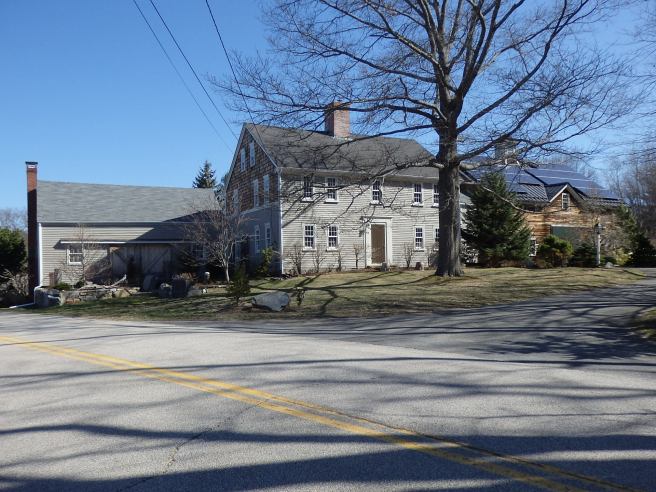
On January 10, 1637, Shapleigh also obtained another eight hundred acres in today’s Eliot, where the next year he built a large dwelling known as Kittery House, named after his manor of Kittery Court overlooking the River Dart in Kingswear and lending the Maine town its name. The new house was two stories that included a kitchen, cellar, and garret – ten rooms in all, plus a brewhouse, barn, and outbuildings. It is said that the first cup of tea in this country was brewed here.
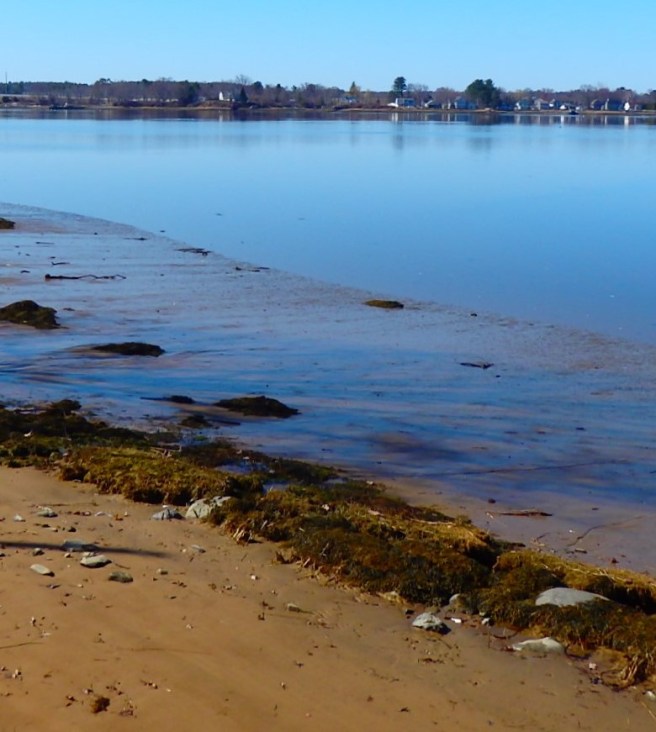
The Eliot site was on Sandy Hill straight across the Piscataqua from Hilton Point, at what’s sometimes referred to as Watts Fort or Point Joslyn. Here he also built a sawmill and another mill both powered by the tide at today’s Shapleigh Old Mill Pond, which adjoins the river. Tide pouring into the pond in one direction ran the mill, as did the release of impounded tidewater on its release. The Eliot estate soon emerged as the base of Shapleigh operations rather than the property at Kittery Point downstream from Portsmouth.
The proximity to the Hiltons across the river underpins a much different understanding of early development of the region than I’d previously imagined. Barely a mile separated the two settlements. The importance of today’s Eliot and the three Berwicks in those years turns out to be greater than the conventional histories convey when they refer to the locations as Kittery, the town that encompassed them, suggesting that those events took place far downstream in the shadow of Portsmouth. Not so.
Quite simply, the development Dover – and later, its Quakers – was closely intertwined with that of Eliot and the Berwicks along the river, and more flourishing than assumed.
~*~
Treworgy appears to have still been in the area in 1647 but disappeared sometime before July 1650, when his wife is described as a widow. As one genealogy notes tersely, “like other males of the family, he vanished early and without record.” Or, by another account, he was killed by Indians. Or a third, with him in Nova Scotia in 1650, where he had gone in the interests of fishing.
Nothing is known of Alexander after 1642, other than he, too, was deceased by 1650.
~*~
Treworgy’s widow, Catharine Shapleigh, then wed Dover founder Edward Hilton sometime after the death of his first wife. You could say it was an example of “marrying the girl next door.” They then relocate to Exeter, where their children marry eminently.
William Hilton, meanwhile, moved into the Kittery Point house after relocating from Dover, and then less conspicuously on into Maine. Makes me wonder about the nature of the brothers’ relationship – or how their wives interacted.
~*~
The figure who most interests me is Alexander Shapley’s son, Nicholas.
In 1641 Treworgye sold his holdings, including his boats and other fishing trade equipment as well as his real estate, to his wife’s half-brother, Nicholas, for 1,500 pounds, to pay off creditors.
Just north of the Kittery House compound on the Piscataqua riverbank is Sturgeon Creek, an impressive inlet at high tide and about two miles downstream from Newichawannock, or South Berwick, and it was soon attracting inhabitants. The neighbors dwelling around Sturgeon Creek even convinced the elder Shapleigh and Treworgy to enlarge the house into a garrison for protection against Native raids.
~*~
Once Nicholas Shapleigh arrived for good in his own vessel in 1644, he quickly amassed great wealth as a lumber merchant, building a sawmill and gristmill and gaining great influence. During the troublesome times of the changing governments in the in the Province of Maine, he was either elected or appointed to most of the offices in the hands of the government or the people. He was one of the first three selectmen of Kittery after its incorporation.
He managed to balance forces. He was a loyal follower of Gorges and his King, yet was among the first to take the oath of allegiance to Massachusetts after it took control of Maine in 1652. Despite being a leader of the Royalist movement that opposed Puritan rule, as Provincial Councilor, he nevertheless accepted appointment by the Massachusetts authorities to be treasurer of the Maine province and be the major in command of its militia. Nor did his strong royalist views prevent him from becoming business partners with Puritan merchant Humphrey Chadbourne, his niece’s husband. A staunch Anglican, he sheltered Quakers and yet owned slaves. As a soldier, he and Richard Waldron were appointed on February 21, 1676, to treat with the Indians for peace during King Philip’s War. (In September, however, Major Waldron shattered any hopes for ending the hostilities.) In 1678, with Captain Francis Champernowne, once of Dover, and Captain Fryer of Portsmouth, he was appointed by Massachusetts to settle a peace with Squando and all the Sagamore upon the Androscoggin and Kennebec rivers. They met the Natives at Casco and entered into articles of peace on April 12, 1678. This treaty put an end to the distressing wars which had existed three years and had greatly reduced the number of inhabitants in Maine.
Nicholas was sympathetic to the itinerant Quakers, so much so that he, too, was often considered one.
In 1663, for instance, when he was accused of favoring the Quakers, the town constable was ordered to go to Shapleigh’s house on First-days to prevent the holding of meetings there. In 1669, he and another selectman plus the town clerk were all accused of being Quakers and removed by the county court. The town then had to elect others.
In 1674 he was imprisoned in Massachusetts but released on the plea of his half-sister Catherine Hilton and the payment of two hundred pounds.
Nicholas Shapleigh died in 1682, age sixty-four, killed by a falling mast at a ship launching at John Diamond’s, across the river from Portsmouth.
As I look at the many purchases and sales of lands by the Shapleighs and others, it appears unlikely they were planning to settle long there themselves. I’m left wondering if the real purpose had to do with shipbuilding – waterside sites where the vessels could be launched, as well as proximity to lumber. That would also explain the many sawmills we find mentioned, for more than just houses or barns.
~*~
Check out my new book, Quaking Dover, available in an iBook edition at the Apple Store.
Welcome to Dover’s upcoming 400th anniversary.
In theory, at least, for a writer, nearly anything – or everything – is potential fodder. In my case, that leads to a new blog post, poem, or scene in a novel, but for others maybe a movie or streamed series of episodes or podcast.
Nicholson Baker demonstrated this quite charmingly in his alleged novel Book of Matches, striking on a practice of lighting a fire every morning in the dark depths of a northern New England winter. Novel? It’s simply a very lovely piece of masterful writing and insight, period. Any conflict is subtle.
But I am drawing the line at trying to do anything with a chart of daily blood pressure readings, before and after doubling the dosage of a prescription.
And that’s after bypassing those colonoscopy photos, with or without commentary of a travel guide sort.
Those of my age might understand or sympathize, but younger readers would no doubt be put off unless they possess a truly twisted mind. I can’t imagine the backlash. Besides, it just ain’t sexy.
In all fairness, I hate to admit I’m finding it harder and harder to comprehend a lot of the humor, video content, and even dialogue from their end of the spectrum. That part’s just scary, perhaps reflecting the realities they face. Should we start with global warming and its consequences?
Perhaps a typo I nearly released a moment ago suggests its own new genre. Fuction. Or fruction. With or without a k.
We don’t need to resort to physical gestures, do we?

Within the continental United States, these arctic bogs are found only in Maine, where they’re known locally as heath. These magical openings in the forest host a variety of unusual plants and even rare animals like the crowberry blue butterfly. The forests themselves are often thick with arboreal lichen – Spanish moss – which thrive in the cool temperatures and fog, as well as mossy bog.