Accused of something. What?
Eyewitnesses.
Dayton, with a bridge and subway.
Subway?
You never know what we'll churn up in cleaning a stall
Accused of something. What?
Eyewitnesses.
Dayton, with a bridge and subway.
Subway?
Is it just me but are power outages becoming more common, more widespread, more severe?
That would fit the forecast of climatic instability, otherwise known as global warming, which is no longer undeniable.
Remember the scoffers who first decried the prophets as ridiculous, denied the causes, spent millions to ensure their profits, and ultimately said there’s nothing we can do about it, contrary to what those insightful prophets had warned?
I’m looking for a better option than paying for a propane-powered generator that further lines the pockets of a source of the problem. Got it?
Those guys should be paying us.
End of this jeremiad, for now.
For most of the first century, Dover dominated both New Hampshire and neighboring Maine.
It was the core of population, for one thing, as well as the oldest continuing settlement.
It also had significant water power, unlike Strawbery Banke, the future Portsmouth.
But Portsmouth, in turn, was closer to the Atlantic and had a viable harbor, leading it to become a center for adventure capitalists and merchants plying the ocean for trade at the same time Dover’s fishing focus diminished, in part a consequence of the sawdust in the water from the lumber trade.
Hampton (1636) and Exeter (1638) were both founded by men seeking religious freedom from Massachusetts. How’s that for a turn of affairs as well as a challenge to the argument that the latter was established in a quest for religious liberty while New Hampshire folks were interested only in lucrative gain?
Hampton long remained the most agricultural of the lot. Exeter did have water power for mills both there and in today’s Newmarket, yet it soon aligned with some powerful Puritan families. As did a elite portion of Hampton.
There were even the poor collected off the streets of London and shipped to New England, who may have then drifted northward.
Maine, meanwhile, began to coalesce around York, one town over from Dover.
Today, each of them remains somehow unique, within a New England identity.
Hampton, for instance, has a suburban sprawl feel with colonial touches. Exeter, with its prestigious Phillips Exeter Academy, could easily be one of the old towns abutting Boston but yet isn’t. The novelist John Irving calls it Gravesend. Continuing on, Portsmouth is a magnet for wealthy residents and resembles wealthy port towns all along the New England coast. George Washington, after all, did both sleep and worship there. It definitely has a superiority complex. And Dover, once a major textile mills and railroad center, is taking off as a family-friendly town with a viable, pedestrian-welcoming, downtown. It has, to me, the most practical yet visionary community spirit.
The differences are a subject well worth investigating. In the meantime, I’m keeping my focus on everything touching Dover.
It is, after all, the center of my new book and the city’s 400th anniversary as the oldest of all.

It’s really elegant thin glass that turns iridescent when light strikes through it, with or without the martini.
It and a set of metal olive skewers came wrapped at Christmas and have been duly admired and enjoyed since.
This sequence, from my time in the Pacific Northwest, remains eerily prescient.
DRIVING THROUGH ALLEGHENY FORESTS “out east,” I come into a small city. At an oblique Y intersection, I veer to the right and am struck by a large three-story apartment building with stately columns and porches on the front. Not that different, really, from one on Far Hills Avenue in my past. While this intersection initially seemed like the downtown, it’s only a prelude for a real downtown a mile or so further on.
After moving back, to eastern Ohio, I went driving one day into Pennsylvania and came into Warren via a route that eerily matched the dream. The sense of déjà vu was overwhelming.
I’M THE GROOM IN a Quaker wedding. The event moves outdoors, under an impressive beech tree and golden pools of sunlight. In the background is a large, old house of an unfamiliar style, part of a sedate farm. The bride’s off a bit, the center of attention, somewhat blurred but with distinctive flaxen hair stretching well-beyond her waist. I’m deliriously happy – so much so, I awakened with the cry (at least in my sleep), “But I can’t be doing this! I’m already happily married!”
Later, after my first wife had left, I was traveling from North Carolina to Philadelphia and, crossing through Delaware, came upon my first three-story federal-style house that I was aware of. A few months later, I became engaged to a woman fitting the one in the dream. She was Quaker.
AHA! I FIND MENTION in my journals of climbing a fire tire in Allegheny National Forest and coming out into Warren, Pa., noting, “how weird! the town seems to have three downtowns (no suburban malls) and one comes to an intersection … just like a dream I had (but I didn’t meet the ‘Quaker girl.’)”
In the decades since, I relocated to a locale where such houses are common and then in a Quaker service married a woman who easily fits the dream, though her hair is less flaxen.
Don’t know if this is still in the Wikipedia bio page, but it is revealing:
“This man has a very large ego and has hurt the feelings of a choral singer I know. He can be insensitive. Please proceed with caution. This is the ‘kind version’ of what I actually want to say. Thank you.”
Well, the subject did survive seven years as an assistant to a stellar conductor who, according to what I’ve heard from insiders, bordered on sadistic, despite the heavenly perfection of performances under his baton or the public mask of his celebrity.
As I’ve heard said of surgeons, they tend to adopt the operating room mannerisms of their mentors, however tyrannical, outrageous, or circumspect.
Two people I know who have worked under the entry’s subject have only admirable things to say about him.
For now, I’d like to know more about the anonymous person who posted the entry and why. Perhaps as a cautionary tale for all of us in our leadership roles.

Getting a wood-burning stove is high on our list of home improvements.
In researching my new book, Quaking Dover, new findings pointed me in fresh directions. Sometimes they came in examining something I knew a little about already. Here are a few:
Order your copy of Quaking Dover at your favorite bookstore. Or request it at your public library.
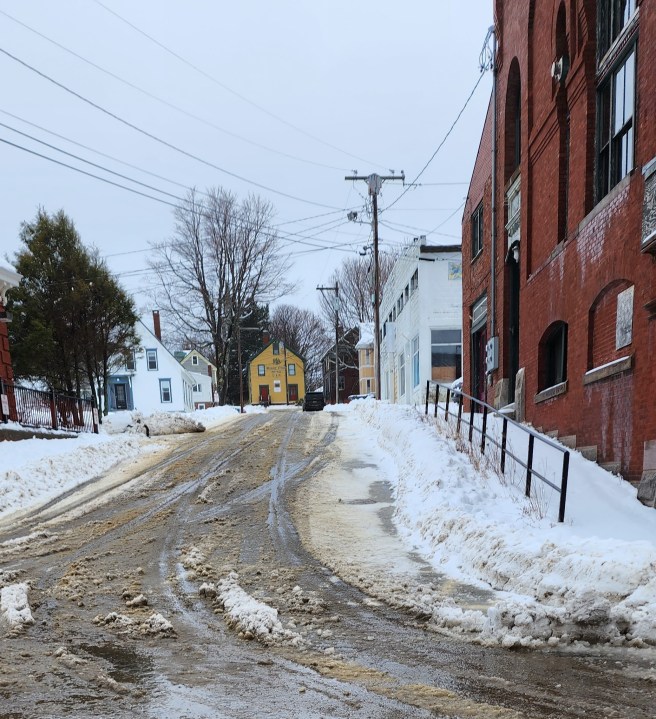
A lovely heavy snow turned to rain. More snow was on the way.

Most of the scallop draggers, having already caught their limit, were already back for the day.

