
Eastport was once the sardine capital of the world.
I’m wondering if I’m supposed to eat these with Raye’s mustard sauce.
You never know what we'll churn up in cleaning a stall
Eastport was once the sardine capital of the world.
I’m wondering if I’m supposed to eat these with Raye’s mustard sauce.
Although he is best known for his persecution of the three Quaker women missionaries and his mock war game that captured hundreds of Natives, which led in time to the devastating attacks on Cochecho Village and Oyster River as well as decades of violence ending in 1763 with the French and Indian War, Major Richard Waldron (or Walderne, in its alternative spelling) could easily be the subject of a fat biography of his own, if a very resourceful historian would rise to the challenge.
His influence and power ranged far beyond his mills at the great falls of the Cochecho River. He was Speaker of the Massachusetts General Court, or Assembly, for multiple terms and even owned a substantial house in Boston. His ships ranged the seas, where two of his children died doing commerce. And there are good reasons I call him a perfect villain in my book Quaking Dover.
Through him, though, I sense that Dover had some solid connections with the powers in Boston, rather than existing just an outpost on the frontier. It alters my perception of sparsely settled colonial New England.
Just how did he amass so much wealth, especially? Were his leadership skills mostly along the lines of a bully or did he have some sophisticated means of influence?
It’s fair to ask if anyone else cast such a long shadow over New Hampshire’s course or how he would stack up in comparison to better known Boston figures.
Let me be clearer, he could be the subject of a hot book or movie or maybe a mini-series.

Perhaps you recognize a negative result in a home Covid test.
My first-ever Zoom presentation is now available for streaming, thanks to the Whittier Birthplace Museum. The presentation on January 26, “Starting with a marriage certificate: Why Whittier was no stranger to Dover,” focused on the famed poet and abolitionist’s many connections to, well, my new book Quaking Dover.
For the full YouTube event, do take a look here.
John Greenleaf Whittier is hardly the central theme in the book, but for me, developing the topic for this show, along with the accompanying PowerPoint slideshow, another personal first, was fun.

If you’re a regular here at the Barn, you know I do lag behind on the tech front. One step at a time, right?
I didn’t expect an unusually itchy nose and scratchy throat resulting from our dry indoor air. So much for my up-in-the-corner-of-the-screen stage presence.
On top of that, with the PowerPoint up in front in me, I couldn’t see who was attending. Oh, well, I had my hands full anyway.
Earlier, behind the scenes, there was concern about a possible power outage on my end as unusually warm temperatures dropped below freezing amid heavy rain. We did have a contingency plan, just in case.
I’m so glad we didn’t need it.

They think they have me nailed.
I’m glad the erasers look good.
Even when I’m supposed to be 50 years ahead of everyone else while marching to my own drummer.
A GRAY DAY IN A GRAY DOWNTOWN where I’m apparently accepting a new job or making a big sale, establishing a relationship with a new client, a major newspaper. There are perks, including coupons or trade-outs for dining at fancy restaurants, where I’m encouraged to venture.
That afternoon, in one, the owner leads me to a happy alcove and introduces me to Colin Powell and his wife, both in matching Hawaiian shirts. Insisting I join them at their table for martinis, they then herald another couple, greeting them warmly. When the drinks arrive, we clink glasses merrily – so skillfully, in fact, we look out to see ourselves receiving a standing ovation. The retired general and secretary of state ars quite sociable and at ease, very warm and effusive. We don’t discuss politics.
In this episode, my name’s Luther.
WE’RE UNDER STADIUM BLEACHERS, assisting with a college graduation.
The girls walk two-by-two from the dark interior out across a bridge over a stream into the stands where they’ll sit. Only half wear white gowns (with mortar boards) – the rest, red shorts, yellow skirts, white patterned blouses, etc.
As for the boys, where presumable I am?
Somebody helps a girl in wheelchair to the bridge. I accompany a blind, partly blonde girl who carries a cane but can see enough to smile at me as she enters more sunlight.
Still under the stadium, I’m handed a paperclip set of credit card slips – my name hadn’t come out on some of the carbon copies after all – some of the others, just faintly.
So this is the reason I’m not graduating? Many of these charges had nothing to do with the college.
Coffee (ground?) war, the GIRL, her older brothers, and mother are graduating.
The soft package.
THE DOOR WON’T CLOSE RIGHT and he keeps opening it to wipe me out of business.
They finally blow it open in wind and spitting rain.
Kit’s a black-and-white coffee bag with a picture of me with a gorilla on the label urban grocery.
First see her in a movie or auditorium a row or two behind me and ask her to help me with this snake like a boa, and she does, admitting later she normally would have been afraid or inhibited and thus not spoken to a stranger.
WE’RE STAYING IN A MOTEL and look out. There’s a moose. No antlers yet. Leafy, forested. But also somehow urban, and somebody has to do something. Summon help. “That’s all right,” I say. Looking right, toward a swing set, when a fire truck comes into sight – emergency workers – but they crash into the swing set, can’t clear it. (I could see the collision coming.) When the truck hits, it’s no fire engine after all, but garbage. A Dumpster goes careening across and spills. A man – cowboy? – leaps from the truck cab, maybe, and lunges for the moose. Leaps through the back legs, grabs the front left – with a whoop and a holler from this truck companions. Pulls the moose over. It falls on top of him!
“Why, he’s OK,” I say to my companion.
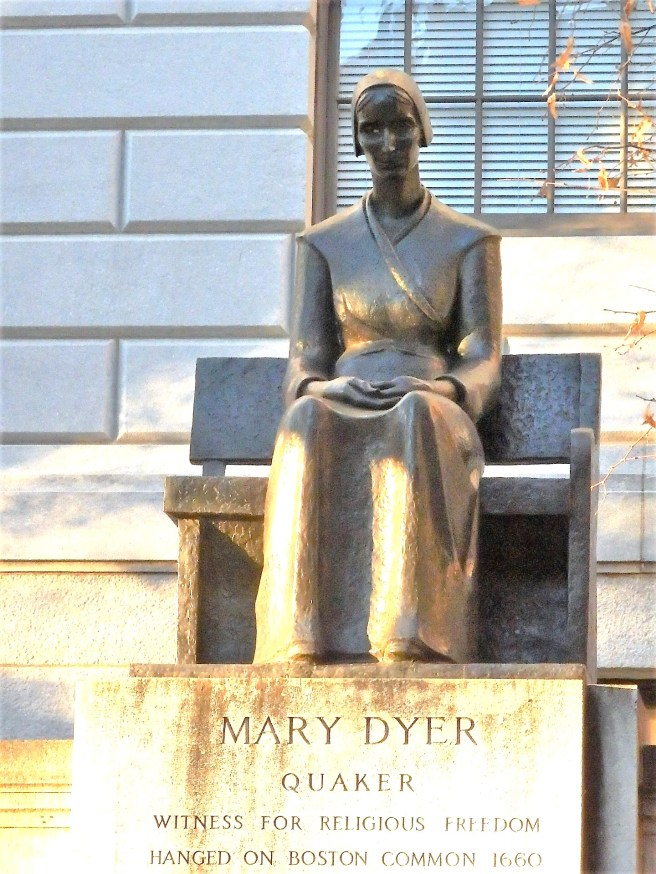
Readers of my new book are telling me how shocking they find the Puritans’ cruel persecution of the up-and-coming Quaker faith. That reaction is quickly followed with their disgust that the Puritans came to the New World for religious freedom but then refused it to others.
What we need to acknowledge, though, is how deeply our outlook is engrained with an expectation of freedom of speech and religion, something that would have been foreign to mindsets back in the 1600s. There, religion and politics were one, as in a one-party state. In England in the early 1600s, the king had the state church, what we know as Anglican or Episcopal, well under his thumb, while the Puritans had Parliament and its armies. It was a volatile mix, even before we get to New England, where my book is set.
I should emphasize that for us, as modern Americans, it’s all too easy to condemn Puritans as backwater bigots, when in fact they were radical progressives on many fronts. They were decidedly anti-monarchy and proto-democracy, and advanced a less feudal, more equitable economy and society. They championed education and literacy for men and women alike and founded Harvard College within their first six years in New England despite deep divisions within their attempt to establish a godly Utopia. Boston was even prepared to fire cannons at Royal Navy ships in the mid-1630s, had they arrived to revoke the colony’s charter, which the Puritans had obtained from the king in an end-run around the man who was responsible for New England’s development – Sir Ferdinando Gorges, the father of Maine and first cohead of New Hampshire, as you’ll find in my book. He definitely would have torpedoed their application. (Whew! The amassing details do thicken the plot, hard as they become to follow.) A Puritan wife could actually divorce her husband if he failed to fulfill her. And they loved their beer.
In other words, Puritans weren’t nearly as awful as we want to portray them today, even if they do come across as villains in my book, Quaking Dover.
Since its release, I’ve been coming to believe the Quakers pressed the Puritans simply for not going far enough in their reforms and intended Utopia. Historian Carla Gardina Pestana, in her wonderful “Quakers and Baptists in Colonial Massachusetts,” even came to the conclusion that the Quakers (or Friends, as we more often refer to ourselves) went out of their way to provoke the Puritan authorities. Ouch, I’m thinking that’s true.
More recently, in revisiting Kenneth Carroll’s book “Quakerism on the Eastern Shore,” meaning Maryland, I felt affirmed by his statement, “Quakerism was, in some ways, an extreme form of Puritanism,” followed by, “It is not surprising, therefore, to discover that Quakerism, in its opening days in Maryland, reached into the centers of Puritanism … for a great number of its converts.”
Well, that latter point was surprising to me. I do see Friends blending Mennonite strands via the English General Baptists into what emerged.
~*~
While my book is focuses on New Hampshire and its adjacent provinces, I’m finding that religious restraints in the southern American English colonies of the time were far harsher than those in New England. For instance, a provocative essay by Marilynne Robinson, “One Manner of Law, the Religious Origins of American Liberalism” in the November Harper’s Magazine, notes that the under the repressive laws in Virginia the penalty for missing church services three times or speaking ill of the king was death, along with the harshest penalties for minor infractions of other laws. She adds there was no mention of trial or appeal and much of what we consider Common Law was nebulous. The Carolinas were just as extreme.
Carroll, for his part, finds that in contrast to New England’s persecution of Quakers, “there may be a skeleton in the closet of the southern colonies also.” He remarks, “The intense persecution experienced by Friends in Virginia soon drove many of them into Maryland,” followed by a series of drastic laws that even kept Quakers from being allowed to enter the colony. “There was to be no challenge to the Established Church as the one religious institution in Virginia,” something that excluded Puritans, Presbyterians, Baptists, Quakers, and Roman Catholics alike. Carroll then states, “The full nature and extent of persecution suffered by Quakers in Virginia is not known. … We do know that William Cole, of Maryland, and George Wilson, of England, were imprisoned in a ‘nasty stinking, dirty’ dungeon in Jamestown where Wilson was whipped and heavily chained so that ‘his flesh rotted from his bones and he died.’” A number of Indian converts to Quaker faith may have also been sentenced to death because of their conversions. And Maryland for a while also imposed harsh persecution, including the banishment and whipping of Quaker “vagabonds” from constable to constable through the colony.
Among those in the South who had visited Dover were William Robinson, before his execution in Boston, and Alice Ambrose and Mary Tompkins, once they left the north.
~*~
To see how this played out in Dover, please turn to my book, Quaking Dover.
I, for one, would definitely like to see a fuller understanding of how religious liberty came about in the Southern colonies and also a presentation of how Puritans in New England evolved to emerge, in one strand, as Unitarians.
Since the Red Barn is excerpting from my personal Dreams Journal this year, we might as well also consider a few things about the phenomenon itself.

Learning of the length and bloodshed of border warfare between New England and New France comes as a surprise to many Americans.
One of the more startling facets is the tales of English hostages who were taken to Canada by Natives receiving payment for each person they brought north.
Some captives were ransomed by family and returned home, leaving the impression that the French were interested mostly in added revenue. You know, like legal piracy, or a landbound privateering. Maybe even as a kind of generous sympathy on behalf of the captors. Many, as I’m seeing, were wives.
Others, though, never returned, leaving the mysterious impression that they chose to remain, perhaps indulging in a more sensually rich culture than the Puritan world of their past. And perhaps some did.
The French were, however, at a distinct disadvantage in the colonial warfare and settlement. They were outnumbered by the British four to one, by many estimates. Or five to one, from another I’ve encountered.
One way for the French to build up their population was by immediately baptizing the Protestant captives into the Roman Catholic faith. For single women, this could soon be complicated by marriage and childbirth – she would not be allowed to take her children if she was “rescued” or “redeemed” and returned to New England, perhaps as a widow. Becoming a nun was another option.
Yes, further complicating the picture is the fact that some of the captives did in time become Catholic priests or monastics. As a consequence, there would be no place for them in New England without their renouncing that faith.
So far, I’ve come across no indications that the kidnapping ran in the other direction.
~*~
The definitive examination of the cases seems to be Emma Lewis Coleman’s two-volume New England Captives Carried to Canada between 1677 and 1760 during the French and Indian wars (published in 1925).
My book Quaking Dover presents two of the attacks, though there were other serious incidents in the town.
As I was saying about wanting to learn more?

