
Our feisty orchestra has played its last concert
Last weekend the Passamaquoddy Bay Symphony Orchestra ended its run on a wild note. Our 30-some member ensemble tackled Hector Berlioz’ sprawling, opium-inspired Symphonie Fantastique in a program that also included a world premiere and a Mozart piano concerto.
It was, as usual, a daring combination.
Our sprawling county has a tad over 30,000 residents, many of them seniors, mirrored by a similar demographic in neighboring Canada. And you’re going to draw sufficient skilled musicians from that as well as a supportive audience?
Yet that’s basically what happened.
The amateur band, augmented by professional freelance “ringers,” has largely been an extension of Norwegian virtuoso violinist Trond Saevurud, its highly-charged conductor. What we’ve enjoyed are bracingly refreshing performances where impulsiveness and driving passion overcome any shortcomings in perfection or “the” definitive interpretation. It’s vibrant music-making and thrilling.
But now, after a dozen years at the helm and as the orchestra’s godfather, he’s stepping down to spend more time back home in Scandinavia.
Add to that the lingering impact of Covid, which has impaired all the performing arts. Here, the border closing cut off players and supporters on the Canadian side of the line. So much for the slogan “two countries, one orchestra.” Some musicians refused to be vaccinated and instead declined rehearsals and performances. Some concertgoers avoided live events in the intimate spaces the ensemble called home. It hurt.
A resurgence of local virus outbreaks canceled two of the three performances of a recent set of concerts, and that undoubtedly hit the finances hard. (I really was looking forward to Tchaikovsky’s first symphony, which I’ve never heard live, unlike a dozen or so renditions of his last, but I couldn’t make the remaining slot.)
That leads the PBSO to a crisis. Officially, the full ensemble is going into hiatus. Perhaps the organization can regroup, rebuild, attract a new music director, perhaps redefine itself and its mission. More likely, it will dissolve.
Locally, it’s also emblematic of how fragile our communities are. Sunrise County has high poverty levels. We’re don’t have deep pockets, either, the kind based on global conglomerate headquarters or old money. Fewer people are available for public service, especially as volunteers on city councils, school committees, town select boards, or the like.
Churches, too, are stretched thin.
You can no doubt think of many other civic interactions where you live, too.
So that’s the score for now.
With some wild water scenes
SWIMMING IN AN ALKALI, ROCKY, heavy current river with Princess Di, a dead seal or otter on a sunny rock turns out to be Prince Charles.
Later, swimming downstream with her, toward a dam, a cry to get out of the current, come ashore on a sandy beach.
Snapping turtle sitting at the water sluice where the beaver had been in eerie, inviting, green river.
WHAT STARTS IN A 19TH CENTURY asylum atop Amoskeag Falls as part of an open house, except they’re trying to retain us, turns into escape as I go DOWN to the rushing water and somehow step out around the powerful whirlpool and cascades.
Aha! The unconscious: emotions!
EVERYTHING CRYSTALLINE. shoreline flowers in many shades and the greenest grass, the only clouds distant and low hugging the inland horizon.
Two halves of a partly open mussel rattle enclosing a pebble.
CLIMBING IN TROPICAL MOUNTAINS. Much water in pools and cascades. Other people. Flowers, too. An old mill or two. Quarries? Very beautiful, youthful – cool and sunny.
SWIMMING IN DEEP BLUE WATER, I suddenly panic before resigning myself. A strange kind of calm. Accepting survival as a gift, something inevitable for those who keep their wits first and let the shark decide.
I MOVE, LEAVE NO FORWARDING ADDRESS. There’s much water imagery.
I OVERFILL THE BATHTUB on Oakdale, 2 inches of water on the floor and Dad keeps getting in the way, trying to help … for some reason, he’s not angry. Hmm.
SWIMMING IN MOUNTAIN PONDS, looking down, even spying on other swimmers in ponds below surrounded by green forest, then, walking up from or even to those same pools and looking further up to where we had been which no longer appeared so lofty, again leaving me with a very warm feeling.
To those who say God wrote the Bible, let me reply as a writer
If He’s so perfect, why didn’t He do a better job of it? (See any masculine references here as traditional and object to them as you wish.)
Even in Hebrew, so I’m told, many key passages are unintelligible. As for the King James English, which many Protestant fundamentalists hold as inerrant (meaning flawless, perfect, unblemished), let me object. There’s a lot of clumsy translation – and outright mistranslation. Add to that the ways our own language has shifted in the centuries since. (To wit: I find myself having to retranslate many key Quaker writings from the mid-1600s on for modern readers, even those with PhD credentials. Those early Friends were conversant with the KJV lingo. Does thee understand?)
For perspective. When’s the last time you read Shakespeare? Without relying on footnotes?
More to the point. He (yes, He, in the current argument) certainly could have used a better editor, in any language. As for revisions? Let me contend that no work of language is ever perfect, it is ultimately a human artifact. Including the arcane collection known as The Bible.
For me, the best we have in those pages is all the more exalted because of that edge of imperfection and decay. It allows humanity to creep in. I’m thinking of some very cutting-edge contemporary poets, actually.
My fascination with that divine text has turned to the struggle to accurately record our own, very personal, experiences of the Holy One. Name it as best you can. And, from the other direction, the ways our own lives have reacted to the struggle from our own first-hand encounters with those haunting great mysteries.
I’ve come to see – and treasure – what we have in that book more as a set of deeply personal journals of individual and group experiences, including their failures, than as any set of how-to steps to eternity.
Sun’s on the way

Blogging isn’t your only life, is it?
Are any of you amused by fellow bloggers who apologize for not posting during a hiatus in their otherwise self-imposed publishing schedule?
I am. And remember, my career as a journalist was filled with pressing newspaper deadlines where missing by a few minutes could be costly.
Blogging, in contrast, has none of those pressures, at least for most of us. I doubt that any of our followers is drooling in anticipation while awaiting our next post on whatever schedule we follow. Like every Wednesday or Friday, who’s counting? The important thing is to have something to say, usually gleaned from real life.
That’s assuming you have a routine. You do, don’t you?
In the bigger picture, I can think of some voices I miss, unfortunately long gone from the scene. Ones who even erased their contributions when they closed up shop. But they always appeared when they had something to relate, and it didn’t matter what day or week we were in.
Still, we post and/or schedule as best we can. We’re our own boss here, right?
And for the more inquisitive of us, when we fall behind your postings, we’ll catch up when you show up next round.
This is, after all, ultimately about sharing the joy and wonder or challenges of life where we encounter it.
And yes, even that “do wish you were here.”
For the record, I still regard many of you as pen pals. Remember what that was?
Now, to try to catch up with all that’s been happening on this end. That’s one thing I’ll admit can be frustrating.
There’s more to the legacy of New Hampshire’s Hiltons
While Edward Hilton is hailed as the father of New Hampshire and was early on joined by his older brother William, both drifted away from my history Quaking Dover. Still, some points of interest remain.
Among them:
- His son, Edward Hilton Junior, married Anne Dudley, daughter of Puritan minister Samuel Dudley, allying his line with a prominent early New England family in Exeter. I sense there’s much more to this union that is presented.
- Edward’s grandson, Colonel Winthrop Hilton, was slain by Natives in 1710 while harvesting mast trees in Epping. He had succeeded Richard Waldron as head of the New Hampshire militia. His other grandfather was Massachusetts governor John Winthrop. So much for high connections.
- Winthrop Hilton’s brother Dudley was carried off in the attack and never heard from again.
- Edward’s nephew Captain William Hilton mapped an island in South Carolina in 1663, naming the location Hilton Head Island. He also mapped Cape Fear that year. He sailed out of Charlestown on Boston Harbor but acknowledged finishing the maps in the home of Nicholas Shapley in Maine – that is Shapleigh, a major figure in my book. Just look at Billy’s uncle’s second wife.
- That is, the elder Edward’s second wife, the widow Katherine Shapleigh Treworgy, who had a daughter marry into the equally prominent Gilman family.
- Into the late 1900s, one line continued to live on the farm settled in Newmarket around 1630. In fact, they claimed it was the oldest homestead in the state.
- Descendant Daniel Hilton, born in 1794, removed from Newmarket to Meredith, where he had 18 children and left an estate of 80,000 acres by the time of his death in 1867. His ancestry also included Thomas Wiggin, who had brought many of the first wave to settle in Dover after the Hiltons.
- Daniel’s son Charles became chief engineer of the New York Central railway, in charge of the building of bridges over the Hudson River and a viaduct in Albany in addition to Grand Central Station and grain elevators in New York City. So much for humble Granite State beginnings. He was also a high-ranking Free Mason.
- The Hilton family burial ground along State Route 108 in Newfields, just across the town line from Newmarket, rather thickens the plot.
- There’s no connection to Conrad Hilton and his hotel chain.
If it’s not gale conditions, it’s something like this
“The warm air temperatures in the upper 60s Saturday afternoon may cause people to underestimate the dangers of the cold water temperatures which are currently in the mid 40s.”
Not to speak of the strong currents.
Gee, we are surrounded by danger in all this beauty.
Department of misinformation, continued
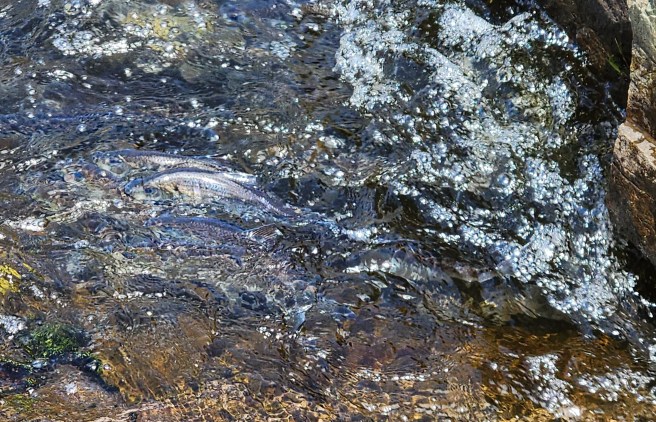
From Britannica: “alewife, also called sawbelly, grayback, gaspereau, or branch herring.”
Not so, sez my fish-scientist buddy. The wonderful voice next to me in Quoddy Voices as we sang a chant to the varieties of herring in Maine.
After talking to others, I’m siding with him.
They are a beautiful fish, usually less than a foot long. And amazingly strong and fast, migrating from the ocean to their freshwater breeding waters.
Now, to nail down the older pronunciation, as one former Cape Codder informed me was pronounced more like “el-wif.”
We have had an incredible spring run here, with 30,000 a day zipping up the small river where I photographed these..
Kinisi 160
REPTILE
DYSFUNCTION

