Black flies, little black flies

Spring in Maine can be a very short season, marked first by mud season and then the black flies that descend from late April into July.

My introduction came one year in a brief stop to investigate a stunning waterfall, interrupted by a large swarm of what I thought were mosquitos. The second enlightenment came at a stop along the Airline Highway en route to Eastport. A wall of flying insects would be a diluted version.

Also known as buffalo gnats, turkey gnats, or white socks (not of the Chicago baseball kind), black flies are more than the defenders of wilderness. Take a look.

  1. They don’t seem to be a problem on windy days or along the ocean.
  2. There are actually more than 2,200 species of them, not that the ones I’ve seen ever look black.
  3. Their bites are particularly nasty or, at the least, a nuisance. Some even spread the disease river blindness.
  4. They’re found far beyond Maine. Scotland, northern Ontario, and Minnesota weigh in heavily, though Pennsylvania has been active in the battle against them.
  5. The eggs are laid in running water and are extremely sensitive to pollution.
  6. Bites are most often found on the face, hairline, neck, and back, though the pests are attracted to breathing and, thus, can enter the nose or mouth. Don’t overlook the ankles, either.
  7. They’re attracted to dark colors.
  8. They stretch the skin and then make shallow cuts with blade-like sections of their mouth before sucking blood.
  9. They’re most active for a few hours after sunrise and a few hours before sunset but totally inactive through the night.
  10. Folksinger Bill Staines made a hit of the logging camp song written by Canadian Wade Hesmworth. The line, “I’ll die with a blackfly pickin’ my bones,” rings especially true.

Down at the dock

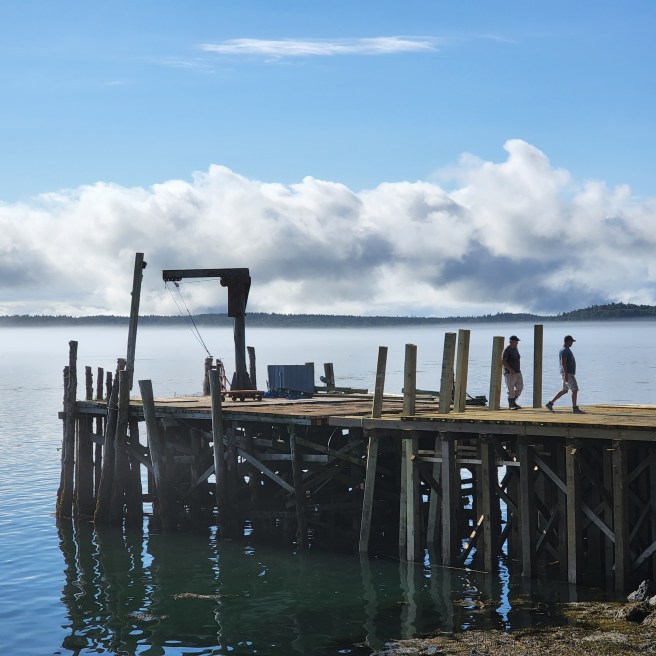
The Ocean Navigator, a 216-passenger cruise ship, has been docked at Eastport’s Breakwater pier while preparing for its sailing season, which starts Wednesday in Portland, Maine, and ventures north into the St. Lawrence River and Great Lakes for much of the summer.

You can get an idea of our local tides by comparing the photo above, at high tide, with the one below. Note the difference in the angle of the gangway for an idea of how much the elevation can rise or fall in four hours or so.

Or for a similar comparison, take the two shots below.


In the fall its itinerary shifts to Fundy Bay and New England.

Under its stern exterior, Puritan polity was fragile in nature

No, I didn’t expect to be feeling some sympathy for the Puritan authorities in America.

In fact, I had assumed they were a pretty formidable front.

But then, in researching my new book, Quaking Dover, I was rather amazed by the range of developments they faced in the 1630s, their first decade in the New World. It’s like they were being hit on all sides.

In addition, they had no direct representation in Parliament. And they didn’t necessarily represent the majority of the residents in their own towns.

In their tribulations with the Crown, the place was ripe for Revolution from the very beginning, rather than having to wait for Paul Revere’s midnight ride.

The Quaker challenge of the late 1650s hit at some intrinsic flaws in the Puritan mindset. As one challenge voiced it, the flaws were essentially theological rather than focusing on the unfolding news events. The title of the pamphlet?

An examination of the grounds or causes which are said to induce the Court of Boston in New England to make an order or law of banishment, upon pain of death, against the Quakers

As also

Of the grounds and considerations by them produced, to manifest the warrantableness and justness both by their making and executing the same; which they now stand deeply engaged to defend, having already put two of them to death

As also

Of some further grounds for justifying the same, in an appendix to John Norton’s book (which was printed after the book itself, yet part thereof); whereof he is said to be appointed by the General Court

And likewise the Arguments briefly hinted, in that which is called, “A true Relation of the Proceedings against the Quakers, &c.”

Whereunto somewhat is added about the Authority and Government Christ excluded out of his church; which occasioneth somewhat his true Church-Government

By Isaac Penington, the Younger

[1660]

~*~

It’s a remarkable document, actually, well worth reading, even in light of the headlines and news flashes we encounter. It argued, essentially, that the Puritans were falling far short of their true goals and potential.

As for the full title?

It would never sell today.

I hope this one nails it

As I’ve discussed in previous posts, book cover design is a challenging art form. It needs to convey a sense of what the volume is about, of course. Or, as one observer has said, it needs to make a promise to the reader. Or, as shaded by others, offer a mystery. But it also has to “read” accurately for a curious buyer, rather than leaving them scratching their head in bafflement.

Quite simply, it can’t be too subtle and must clearly state the title and author.

A memorable cover is a joy to have in your hands or even the screen in front of you, but I find that few meet up to that measure. I like clean, with a striking visual image and tasteful typography. I find most are cluttered and often fussy, trying to work some cliché genre clue into the background.

Frankly, I’m proud of many of the covers I’ve designed for my own books.

One of the problematic ones, though, has been for my novel What’s Left. The story spans nearly 20 years in Cassia’s life, from the time her father vanishes in a Himalayan avalanche into her thirties. She’s Greek-American in a Midwestern college town. And it’s about emotional recovery and growth. Beyond that, extended family is a major ongoing theme. How do you encapsulate all that in a two-dimensional object?

In the first cover, I went for a striking egg yolk being poured from a broken shell. I was reaching for the idea of being broken open to newness but despite its strong graphic impact wound up failing to convey the book’s contents. (Egg? Her family did run a restaurant. Too much of a reach, though.)

Turning instead for the sense of grief, I found hands covering tearful faces, but none of those wound up hitting the age right. Her real work comes about in her teen years, not the preteen who was openly tearful in the available images.

There’s the argument of whether to show a face at all. I generally side with the view that a face limits the reader’s imagination. Apart from an earlier cover of What’s Left, the only face on my novels is the blissful yogi on Nearly Canaan, and there the emphasis is on the aerial pose she’s manifesting. The face has to match any description in the text, of course. No curly blondes for a long-haired raven, for example.

Within a daughter’s own living Greek drama

Recently, while passing through one collection for another project, I chanced upon a portrait I feel captures much of what I’ve been seeking for What’s Left, so much so I’ve decided to run with it for the ebook at Smashwords.com and its affiliates like the Apple Store, Barnes & Noble’s Nook, Scribd, and Sony’s Kobo.

For technical reasons, I’m leaving the more troubled goth-girl image on the print and ebook editions at Amazon. It will be interesting to compare reactions to the two versions.

Having a very low budget, naturally, means that I’m not commissioning artwork but instead selecting from affordable stock collections. While that can mean going through thousands of images, finding the right one remains a challenge. Although I generally lean toward photographs, I still love the paintings I found for The Secret Side of Jaya, Daffodil Uprising, Subway Visions, and Yoga Bootcamp.


Also on my nocturnal plate

I’M INVOLVED WITH A VIETNAMESE OR Thai kitchen – likely a restaurant – and we’re dealing with a huge bowl of soup. It’s festive, everybody’s happy, there’s a lot of golden color in the room, rather rustic with a late-afternoon feel.

Out in the dining area, they insist I eat it – press the bowl (blue and white, by the way) to my chest and face – but I’m leery, given my inability to handle hot spices, yet I don’t want to offend anyone, even if they are kinda daring me. Especially the younger owner right in front of me. What becomes clear is that I’m also facing a deadline, this is for a food page centerpiece, one I’m producing, and Flash is there, smiling, encouraging, and lifting his camera devilishly.

Despite the underlying tension of the difficulties of the newspaper side (a recurring theme for me), this is communal, upbeat, joyous.


I’M BAKING SPECIAL COOKIES at the rear of a large cafeteria when I notice they’re using child labor, and mistreating them. Child slaves. I say something to an obese Eastern European supervisor – gray, ugly hair – “Mind your own business,” she grunts. In front of a large pizza oven, a child stands, waiting. He smiles but the bottom edge of his white kitchen-staff busboy’s jacket starts to smoke. An ace-student screams, “Look! His coat!” and I rush up, grab him away yelling “Charlie!” He’s still smiling. I tell her to run for water, but she doesn’t. Only after a second order, she does but not fast enough. I grab the child and place his head under running cold water, a faucet over a big washtub basin, careful not to get water in his mouth or nose. Just as he starts gasping for air (he’d passed out), B.B. rushes up in her white Chinese suit and asks, with a combination of maternal instinct and reportorial business, “What’s the matter?”


COOKING (WITH MY GODDAUGHTER? not my wife, at least at the beginning) and I’m given a large onion to cube and add to our large stainless-steel skillet to saute. (In fact, I do not use onions – this is purely for others.) But it’s uncommonly large, bigger than a cabbage, in fact. So I make long slices (what emerges looks like a purple cabbage) but keep getting stuck when trying to figure out which way to go with the emerging slabs. I never even begin on the second half … is it that I keep awakening myself?

She had gone off on a tirade around dinnertime and hadn’t let up. I really do feel I can’t do anything around here, especially not “their” way. 


I’M PUT IN CHARGE OF A CHARITY PANCAKE breakfast. Never participated in one before, and I have no idea where things are or exactly who to contact or rely on. Still, I plunge blithely ahead. We’re very inefficient and very slow and soon it’s 11 a.m. and nothing has been served.

When I awoke, 5 a.m., not really disturbed by this variation of the unmet deadline. I had, though, enjoyed cooking two dinners the day before, in addition to some heavy editing of a novel was pressing to have up next week for release a week later.


NEXT, AT A RATHER FORMAL DINNER (the couple’s still rather in-heat), they move their forks and spoons and find, among packets of mint and the like, a condom neatly wrapped … and iced! Seems everyone gets these at their setting.


CUTTING AND CLEANING A LOT of chicken parts in stainless steel bowls in our kitchen. Lots of them.