Pocket beach at low tide

It’s kind of a secret spot, actually, just north of Eastport’s downtown. The people who live overhead can’t even see it.
We’re supposed to be flush with improvements
Naturally, you must be curious about our new bathroom – what we’ve called our real bathroom, in contrast to the water closet on the first floor.
Well, for now, so are we.
As we considered our shrinking funding options, we admitted we didn’t have to finish the upstairs bathroom at this point, though having it done would deliver a definite quality of life improvement.
We wanted a tub that would be deep enough for a real soak – one that I could actually fit into without attempting hatha yoga with water. The tub also had to have a left-hand drain if we were to avoid having the pipe run against the outside wall, where it might freeze and burst in deep winter.
Our original choice, built-in or alcove, switched to a free-standing model after seeing one in a neighbor’s home during a party. We went back a week later to get a second look and measurements.
~*~
The toilet had to be a back-flushing model due to a shallow space in the flooring.
Having lighting above the sink and electrical outlets in the room would be huge advances over the water closet downstairs, as we learned in the 4½ years of its being our only option. Do note that having a carpenter who was also a licensed electrician meant that all of the lines and outlets would be in place before the drywall went up.
As for storage? A large medicine cabinet and a vanity for the sink are considered boffo additions, ones you probably take for granted in your own digs.
~*~
But once the bathroom and laundry room were plumbed, awaiting the next steps, we ran into complications.
First was actually ordering the tub and toilet and getting them delivered to our remote locale. Getting agreement on some of the selections added to our delay. Our plumber kept delaying, too, especially once in took a lucrative gig out in Indiana and then further out in Seattle. A potential replacement wasn’t interested in delivering what we wanted rather than the generic stuff they had it stock. All the while, our available money went to other parts of the renovation. So for, now, alas, this is moved over the next phase, whenever.
Look for the witness in the work, too
Cinema critic Roger Ebert was talking of the importance of the witness in every movie and pointing to the places where the character appeared in the film under discussion, mostly in a lower corner. The comment flashed me to the reality of how often the hardest thing to see is what should be the most obvious. It’s not just the elephant in the room, but also smaller things we take for granted.
One way or another, all fiction is built on the observer, who is also to some degree an outsider or misfit, too. (If there are any exceptions, I’d love to hear them.) Four of my novels, for instance, were intuitively built around a photographer, a profession that makes Cassia’s father a well-trained witness. In turn, as she investigates his archives, she, too, becomes a witness, even before she starts commenting on his earlier life.
Of course, as a reader, you also become a witness. Or even a voyeur, as Camille Paglia has contended. It’s almost like every page is a microscope slide to be interpreted.
Curiously, I now see this also at play in a long-term non-fiction project in my life. Forty 40 years ago, seemingly by accident, I became involved in trying to uncover my father’s ancestry. I thought we were simply homogenous Midwesterners who had always been in Ohio from its beginning. What I discovered, though, was that one branch was – but German-speaking and largely akin to Amish. My name-line, however, was Quaker by way of North Carolina and its slaveholding culture. Both strands were outsiders to the larger society and also pacifist. It opened my eyes to alternative histories and to a recognition that stories don’t always have to resolve nicely – three people may record their memories quite differently, and maybe all three are true, if not factually accurate.
Oh yes, the research was often collaborative, with correspondence going and coming from others working on parts of the puzzle. It wasn’t always quite as lonely as drafting fiction or poetry.
To my surprise, as my novel What’s Left was taking shape, Cassia started assembling bits about her Greek-American grandparents, who had died before her birth, and then beyond to her great-grandparents, who brought the family to the New World. Like me, she found valuable clues in the surviving snapshots and formal portraits regarding their personalities, as she also did in the letters and other documents.
None of my ancestors came by way of Ellis Island, and on Dad’s side they were all in this country by the time of the Revolutionary War. I once pondered doing a series of novels on them, but I’m still intimidated by the technical challenges – a realistic language they can speak and we can understand being high among them.
Witness, I might add, has an extra dimension in Quaker thinking. It’s not just what one sees or hears but how one lives. The goal is integrity, as in wholeness or consistency. Is that what others see in us or our lives and work? Or even as our goal and ideal, even when we fall short reaching for it?
And, as a final twist, I’m realizing that the Indigenous perspective of looking back seven generations when making decisions for the future would take me back to the birth of Orphan George in 1701.
I do find that mindboggling.
~*~
You can find my genealogical gleanings on my Orphan George blog.
The novels, meanwhile, are available in the digital platform of your choice at Smashwords, the Apple Store, Barnes & Noble’s Nook, Scribd, Sony’s Kobo, and other fine ebook retailers. They’re also available in paper and Kindle at Amazon, or you can ask your local library to obtain them.
On a downtown Belfast street
A shaved-head man
in a very dark navy-blue suit
resembled an undertaker
as he carried a deposit bag
to the bank.
Turned out to be an attorney.
Fallen eagle
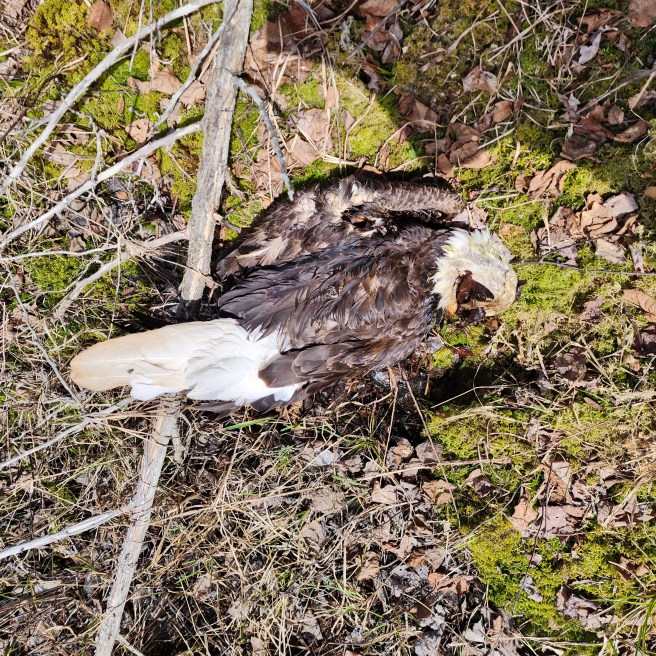
Chanced upon in a culvert in Edmunds Township. Those feathers, by the way, are both protected by federal law and valued in Native American culture.
Glories and quirks of AM radio, back in the day
My kids don’t even know what it is. How shocking!
Let’s look at a few based on their call letters.
- WLW, Cincinnati, the Nation’s Station, with ten times the wattage than permitted today. It lighted a barn a mile away. Back in those days, it had its own staff musicians.
- WOR, New York, with comedians Bob and Ray as the drivetime crew and storyteller Jean Shepherd in the evening. They originated on WHDH in Boston.
- WSN, Nashville, home of the Grand Ol’ Opry.
- WWVA, Wheeling, West Virginia, Country Jamboree.
- WCKY, Cincinnati, with a very directional nighttime signal that plastered the South with its WCKY Jamboree country programming. It also made Reds baseball highly followed far into Dixie.
- WNOP, Radio Free Newport, an eclectic daytime jazz station broadcasting from Kentucky to the captive peoples across the Ohio River, or so they proclaimed.
- WAVI, the daytime big-band station in Dayton revolving around retired trumpeter BJ, who always signed off decrying the “arcane rules of the FCC in Washington that make us give way to a station in Philadelphia that can in no way serve the Greater Dayton area.”
- WJR, Detroit, with a full mix of original programming, including Adventures in Good Music with Karl Haas, the Redwings, and the Metropolitan Opera on Saturdays.
- WBZ, Boston, with its all-news format when I arrived in New England.
- If you’re of a certain age, you can add your own fond memories of a local station’s wild rock ‘n’ roll DJ or two who fed your adolescent rollercoaster with machine-gun delivery and often took requests in addition to a Top 40 countdown. Sometimes he even mentioned you by name. In my hometown, that was WING.
How many ‘lasts’ of the season?
It’s been a month of “last” tomato sandwiches, each day a surprise blessing.
There have even been at least two “final” rounds with a lawn mower, not that I’m complaining.
And now I’m out on the last cruise of the schooner season.
Kinisi 282
Cruel
Duel
Doctor T at sea

The world of wooden sailing vessels has many devotees, and they have a trove of stories linking captains, ships, first mates, cooks, builders, designers, and much more.
Dr. T, as Garth Wells dubs him, is a passionate Penobscot Bay habitue each year from San Francisco. He has a sharp eye for the waters, too, as well as some strong opinions.
Sailing with him aboard the historic schooner Louis R. French has been a delight.
For more schooner sailing experiences, take a look at my Under Sail photo album at Thistle Finch editions.
 Jnana's Red Barn