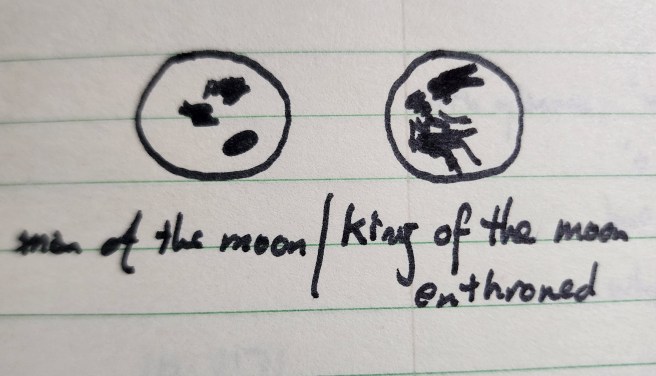
As a stab at transplanting a sensibility

The Four Noble Plants [and a quest for American equivalents]

  • Bamboo, bends but never breaks in a storm = Oak, with its acorns
  • Plum blossom = Apple
  • Orchids = Sunflowers
  • Chrysanthemums = Dandelions
  • Now, to play with those starting with classic Japanese or even Chinese poems and substituting the equivalents. This could be weird.

Too bad those book collections are still in storage.

As for “noble,” in America? Even that needs an equivalent.


The past doesn’t have to be haunting

It’s a good thing I backed off from my nearly impetuous move last June to simply burn the spiralbound notebooks unread in the face of so much dross. Instead, I plodded onward, surprised by a few gems as well as how little I had gleaned from these pages in drafting my poetry and, especially, fiction. Perhaps I had much more than I thought in my long-vanished correspondence.

Do we ever, truly, escape our past?

~*~

One thing I’m noticing is how often my journals review corrects timelines from the way I’ve constructed them in memory.

As do the facts I recorded versus details as I’ve recalled them.

It’s like seeing a photo in full color rather than out-of-focus black-and-white.

Or, as I find, God exists in the details. As does the devil. Knowing the difference can be crucial.

~*~

One thing I’ve learned in the years since is the importance of composting as a gardener.

Combine that with the joy of tasting fresh food – say, strawberries – when the season rolls around again.

The past can enrich the present.

Maybe even turn grief into gratitude.

Why we really dig Fedco seeds

In my household, like many others in northern New England, the Fedco seed catalogue and ordering from it are something of a fond ritual this time of year, even a devotion.

Here’s some background.

  1. The company is a co-op founded in 1978 by back-to-the-earth followers of self-sufficiency gurus Scott and Helen Nearing, who had moved to Maine from Vermont in the mid-‘50s.
  2. At first, it functioned as a resource for food coops and sold to no one else.
  3. Heirloom apple trees were added in 1983 and autumn bulbs the following year. Seed potatoes came next,, and in 1988 Fedco took over the organic supplier role of the Maine Organic Farmers and Gardeners Association. (Many people know MOFGA for its big, hippie-infused Common Ground Fair every September. You may have read about that here.)
  4. In its first year, with a one-page mail-order page in a food-coop newspaper, Fedco and its part-time staff handled 98 customer requests. The initial list had 81 items, mostly vegetables, some herbs, liquid seaweed fertilizer, and no flowers. These days it handles more than 38,000 orders from all 50 states for an estimated $4 million revenue.
  5. The catalogue is funky, black-and-white on newsprint or similar stock, rather than the glossy photos of big commercial garden retailers. The illustrations lean toward sketches and 19th century printers’ images. It carries more than a thousand seed listings alone, along with a host of other things gardeners and small-farm operators find useful. The descriptions reflect careful study, helping buyers make reasoned decisions, especially regarding what’s new. It’s inspirational. You can also order online, using a catalogue that does have color photos and is easy to navigate.
  6. Legalization of cannabis has generated new business, even though Fedco has so far resisted selling its plants or seeds. Much of the business is in organic fertilizer, especially for home growers.
  7. Rather than growing the seeds itself, Fedco repackages from 100 to 150 seed growers, and other suppliers, mostly in Maine. Other products are more widely sourced.
  8. Fedco concentrates on a unique niche, mostly in the Northeast, and deliberately stays small, out of direct competition with large corporations.
  9. Its 60 full- and part-time employees own 40 percent of the company, while the consumers own the remaining 60 percent and get small discounts on their orders.
  10. The company’s charter aims at pay-level equity, preventing wage extremes between high and low.

Details from the company’s website and from Jeffrey B. Roth in Lancaster Farming.

Let’s start with ‘my problem,’ meaning love

My journaling erupted as an attempt to record my failings in attempting to connect romantically after the flight of my college lover, the one you’ll know as Nicki.

As I’ve learned since, the difficulties ran much deeper than just her. It would involve questions of how I saw females, or didn’t, in looking for a lifetime mate. As I’ve come to see, that’s not necessarily “partner.” Candidly, I was looking for an accessory more than a fitting true equal.

Instead, I had a morbid desire for Nikki and previously Fay, who was a passionate girlfriend. As I see now, I’ve been prone to a pathological loyalty for good times together.

~*~

The sweep though the post-college great dark period when I started journaling greatly revises my perception of that time. I was meeting young women, sizing them up, but not connecting sexually because, as I now sense, I was so morbidly hung up on Nikki and, to my surprise, Fay from two years earlier. Fact was I didn’t see any of them deeply, as feeling and emotions: only as factoids: that’s how I spoke too! Fact, fact, fact. Not passions.

~*~

Another part of “my problem” was simply in not fitting in easily with so much around me. So the entries become an exploration of developing a better sense of myself, often through the reflections of people close to me.

There will even be some astrological perspectives I encountered along the way.

~*~

Leap ahead a bit more than a half century. To set upon this review, I had to extract 20 or so milk crates from the storage confines in a former chimney cavity in our new (though historic) home. In my previous settings, those crates were set up on their sides and stacked as impromptu bookcases. We really didn’t have the luxury of doing that here. As I was saying about downsizing?

In revisiting the earliest notebooks, expecting to find hidden gems, an immense heaviness engulfed me. These were conditions I had left, for good reason. These were individuals and groups who long ago went in other directions than mine. Do I even know their names – full names – anymore?

Most of the volumes had been heavily dredged in my writing sabbatical of 1986-87 for details to distill into my novels. Others had been mined for poems. These journals were mostly spiralbound notebooks – some in my favored 8½-by-14 dimension.

By late spring last year, I was leaning toward disposing them without further examination. They cover the years from my college graduation through Upstate New York and then the yoga ashram in the Poconos of Pennsylvania, small-town Ohio, Indiana University as a social sciences editor, and the interior Pacific Northwest – and that’s just the first decade. Next came a river city in Iowa, Rust Belt, Baltimore, and New Hampshire.

~*~

The volumes do provide of trove of my interactions in my post-Nikki round of lovers in Binghamton, and then my first marriage and divorce, as well as the subsequent engagement and later relationships leading up to my remarriage in 2000.

Curiously, beyond my sabbatical, meaning the second half of my life, i.e. New England? I see nothing that promises fiction. What I had assumed the great passion of that broken engagement would have inspired now appears banal, even tawdry.

For now, I’m finding enough gleanings to do something along the lines of Rorem’s Paris Journals, though maybe mine become Spiralbound Binghamton, Spiralbound Yoga, and so on, acknowledging the earliest volumes. I didn’t splurge on hardbound pages until Clara was no longer sleeping with me – volume 77. Clara? She’s a dozen years ahead. Still, there would be a few more spiralbound notebooks – six – plus 13 spiralbound sketchbooks and softcover sketchbooks to come.

Back to the Baskervilles

Working downward in time for our old house history meant starting with Anna M. Baskerville, the subject of a Dec. 4, 2002, post here.

We finally met her son, Reggie, and learned much more than we had already gleaned.

He and his mother came from Yeadon in Delaware County, Pennsylvania — suburban Philadelphia. Landing in Eastport was nearly accidental. His first wife had a friend who skied in Maine, and on a lark, they visited the coast, including Eastport.

That led to buying the property in rundown condition, as he says, in November 1996 to use as a vacation house. As he notes, the house wasn’t habitable beyond that but you could buy homes in town dirt cheap. His words.

Somewhat of a handyman, he set to work. The cellar was prone to flooding, two to three feet, and its sump pump, like many in the neighborhood, fed into a line that had been cemented shut on the other end. The city finally corrected that. So it wasn’t a septic problem, exactly, but definitely storm infiltration, with water shooting dramatically through the cellar walls. Somebody definitely curbed that problem before we took over. Reggie also installed covered the cellar floor with plastic sheeting topped by gravel to reduce water infiltration and make walking easier. By 1999, the house was improved enough that his mother could move in. He and his wife and their two small children also lived here a few months before moving to their own home nearby. Like ours, it was old and needed lots of work. Credit Reggie for learning to do better work than many of the local tradesmen.

As he tells it, Anna had worked hard from age six in the South, where a Black child could be hired out. From that point on, she was always at the service of others, including a large family. Once Eastport came on her horizon, she declared this would be her house. For once in her life, she could sleep as late as she liked, eat whenever she wanted, and come and go as she willed. And she pretty much did.

Eastport’s the kind of small-town community where people know where you live not by your address but by the last name of a previous owner. Give them a street and a number and they take a moment to try to determine which house you’re in., even when you tell them it’s on the corner and briefly describe the exterior. Give them the family name, though, and they immediately light up.

To everyone we’ve met, ours is the Baskerville House and likely to remain so.

I love the literary allusion, of course, to Sherlock Holmes and The Hound of the Baskervilles (and the fact it takes place largely in Devonshire, which plays into so much of my history of Dover, New Hampshire, where we previously lived.). Hound/house are, of course, nearly homonyms. Beyond that, there’s also the fact that Baskerville was a basic serif typeface back in the letterpress days when I entered journalism. The high school newspaper I edited used it for the body type. It’s an old style that largely didn’t make the leap to digital, though I see it has recently joined my Windows options. (Not so for my beloved Caslon of the same era.)

What we liked about the place, besides its location and TLC potential, was the fact it felt good inside. Close-your-eyes good, even when the room’s chilly. I’ve certainly felt comfortable in extended solitude and all the writing that’s come within it.

Something that struck me after moving to New England was how often people — even highly rational professionals — calmly asked new homeowners if their place had ghosts. I’m not kidding. And Maine seemed especially prone to that.

Nobody’s asked us, though. Instead, they confirmed that ours always felt good to them, too.

The Baskerville at the heart of this period of ownership was Anna, arriving in Eastport as a retired Black nurse.

From what I’m told, she was stout, had red hair, and loved to sing — especially in all of the churches, where she was always welcome. And she, too, found this place hard to heat but stayed in it and loved it.

When I said we’ve sensed no ghosts but the place feels good, others piped up that’s likely Anna’s presence or spirit. I’ve known similar imprints elsewhere, especially in old Quaker meetinghouses.

Naturally, we want to know more about her.

~*~

One story I heard was about her introduction to the town. She had a longstanding fear of deep water, and because her new residence was only a block from the ocean, the family arranged for her to arrive after dark and get used to the house first. Maybe they figured they could deal with any distress better in the morning.

So, as I’m told, when Anna M. Baskerville awoke and opened the blinds and saw the expanse of water, she inhaled and, as she proclaimed later, “I knew I was home.”

Yes, we know the feeling, too. And we still want to know more.

She was fond of sitting in front of the wood fire in the kitchen cook stove and singing gospel songs and spirituals. In warmer weather, she’d open the front door and sit behind the storm door, basking in the sun.

She had raised a large brood, ruling with what Reggie calls a firm hand and a low tolerance of nonsense. She was also a woman of few words. Typical was the time the Commons gallery was opening. During an open house, when the guests were conversing and eating, she began singing without any preamble. The room fell silent as she delivered “Bless This House” in her rich, deep voice. She was described as warm and supportive.

She was also a very devout member of the Congregational church in Eastport, as a fellow parishioner told me.

Everybody we’ve met who knew her has had only positive things to say. That in itself is a rarity.

In the meantime, we’re trying to keep our renovations in line with what we hope she would have approved. There are good reasons to respect the past.

~*~

So, at Registry of Deeds in Machias, I found the most recent entry by using the property plot number, the one to us in December 2020. No surprise there.

It led to the Baskervilles, of course, but before them, the Tennesseans.

Hello, campers!

Some of my notebooks predated the start of my journaling. One, for instance, covered day camp policies, program guidelines, songs, good storytelling guidelines.

All of these song titles, the words and tunes I’ve long forgotten.

We had so much responsibility! (And life itself was still so fuzzy. Largely a blur, I’d say now.)

“Any injury multiplied 10x by the time it reaches mother or father. Injury may be word or action.”

Taste buds: sweet, salt, sour, bitter … just four.

“All right, kiddies. If you get lost, stay there. I’ll come and find you (I hope).”

The most innocent looking kid bit another in the eye, tried opening the emergency door on the bus, hit kids over the head with a tote bag, waits for the counselors to look away, lies, swimming (?)

(Last time I was “home,” meaning my father’s funeral, I tried locating the camp along country roads, to no avail. No clue to its site on satellite maps, either. Summer camp as one more victim of shortened summers off for kids, as well as economic realities facing families.)

Those were two summers I had a remarkable tan. My hair turned nearly blond, too.

~*~

From Spiralbound Years with commentary from now.

As my poetic voice took shape

The odd syllable counts of my poetry lines: quite female! And quite flexible. Contrast to “maleness” of iambic pentameter or other club-feet.

The luxury of wasting a whole notebook, an entire sketchbook. [Oh? Did I pitch that out already?]

Good poetry takes leave of tight meaning … pointing to “lunatics” as “originals” … the way flames do.


Let’s not get nostalgic, OK?

A while back, revisiting my high school yearbooks in a search for additional first names befitting the times of a story I was revising, I was shocked even appalled to admit how physically ugly so many of my classmates were, not that I was a prime example of emerging manhood. Some even had aspirational birth names, yet our uptight upbringing would be difficult to escape, as I was perceiving. Even those I considered alluring typically fell short in the longer haul.

Physically, at least, some people appear doomed from birth. And just what were their parents thinking when it came to first names like Jethro or Candy?

What if my fiction had delved into that darkness, rather than my idealized escape?

At the least, it was something I might have engaged in my psychological therapy sessions but didn’t. Add to that, my scope of ministry since.


WITHOUT MUCH HARD EVIDENCE (meaning journals or perhaps snide notes) to fall back on, my high school years are blurry. As I posted last May, I didn’t start journaling until I graduated from college, even though when I was winding down a summer internship a few weeks before the beginning of my junior year, the editor-in-chief of the newspaper where I was working a pivotal internship called me into his office for a parting chat. He strongly suggested, make that urged, I begin keeping a journal, a practice he found invaluable in life. He also counseled me to change my major from journalism to “something that will expand your mind – we can teach you to write news stories and headlines as part of the job.”

On my return to campus, I did change my major, to political science, along with sizable chunks of literature (Indiana University had both comparative literature and traditional English programs) along with economics. Maybe I should blame Glenn Thompson for much of my wide, maybe overly wide, range of focus since.

My journaling, though, didn’t begin until nearly two years later, after graduation, and then somehow not quite by intention. I just started scribbling during a tempestuous, unanticipated week’s trek in Montana and Utah, which was also my introduction to the Far West.

Now, as I delve into the pages, some of the general impressions I presented in that post need refinement. For one thing, contrary to many of the later years, I had periods in that first decade of making detailed entries daily, rather than week-to-week or so that became common later.

Candidly, as you’ll see, those were some rough times for me.

~*~

Here are the covers for three of the four high school yearbooks from my time there. I do admire the intense draftsmanship of the first, and will admit the last one was mine, pretty much on the fly when the original concept fell apart.


~*~

I HAD EXPECTED TO FIND my journaling volumes had been pretty well picked over in the drafting of my novels and poems but instead found many entries that remained untouched.

That led to keyboarding entries of flashes and insights before discarding the volumes one-by-one in ceremonial flames. The gleanings will get one final airing as I let go.

Quite simply, I see this as one less burden on my “survivors” after I pass but I do expect to draw heavily on the selected entries in my postings at the Barn this year.

Consider them Spiralbound Memories. Do note that I will be changing the names of some of the characters, in part to respect a bit of their privacy and in part to recognize that they likely saw the events quite differently.

There were some positive steps for our City in the Bay last year

For a small community like ours, with just 1,300 year-round residents, though that swells in summer when the owners of second homes return, our shop owners and restaurateurs have to hustle to make their income during the summer season, long before the notorious Black Friday after Thanksgiving that other retailers rely on.

Our port’s growing popularity with the passengers of cruise ships, especially in the autumn, has provided a definite economic boost and essentially doubled our retailing season.

With that background, here are ten positive steps we saw in our local economy in 2025.

  1. Fiber optic cable came to Eastport and much of Way Downeast, providing both faster broadband connectivity as well as some healthy competition for dominant Spectrum. It’s especially important for many who work from home.
  2. The last leg of the I-395 bypass around Bangor finally opened, in time for the Fourth of July, even. (Officially, the new stretch is State Route 9 and only two lanes, but it is limited-access.) This eliminated a narrow country road link that fed into a typically congested stop-and-go suburban jag between Way Downeast Maine and the rest of the United States. It also shortened the driving time for us to get to major services in metropolitan Bangor, things that the rest of you take for granted, or for deliveries to get to us way out here.
  3. A savvy, local-oriented new and used bookstore opened downtown. It’s an inviting place to sit and read the latest. She knows her stuff and what makes our region tick. As an author, I can say how wonderful it is to be represented on her shelves.
  4. We gained a six-day-a-week bakery, the kind that makes real croissants and yummy breakfast sandwiches. Its opening overcomes the loss of our bagel shop a few years earlier, after its founders realized it was too much to tackle while still having full-time jobs elsewhere. Maybe folks will even stop lamenting a dedicated bakery that closed before the Covid shutdowns.
  5. There are solid choices for great coffee seven-days-a-week now. In addition to the bakery and the bookstore (yes!), an established gourmet coffee roaster has moved into the earlier espresso joint, this time six mornings a week instead of hit-or-miss hours. If you’re up here for a week, this will definitely brighten your day.
  6. Our fine dining options on Water Street have certainly improved. The wine bar now has a full kitchen and a masterful chef who curates a new menu weekly, featuring local sourcing while keeping the price-point in reach of us locals. Ye Ole Hookers, an upgraded incarnation of a legendary waterfront bar, also added a talented cook in the evenings, and we confidently recommend both locations for those who want something more memorable than average diner fare at the other end of the downtown. (In fairness, the Waco has stepped up its game by opening its Schooner Room with evening specials many nights of the week, too.) Gone is the motto many of us repeated a few years ago, “Don’t get hungry in Eastport on Monday.”
  7. The lobster pound returned to outdoor, next-to-the-tides seafood service after a multi-year hiatus. It doesn’t get any more iconic than this. And it is a relief to give an affirmative answer to the common question, “Where can I find a lobster dinner (or lobster roll) around here?”
  8. Ten years after the resident schooner in our harbor went down in the collapse of a section of the Breakwater pier, Eastport Windjammers (our whale watch service) once again has a schooner in its fleet. The Halie & Matthew’s day-sailing cruises are one more attraction for visitors. As an added twist, the two-masted ship was built in Eastport in 2006, so it’s also a homecoming.
  9. Passenger ferry service between Eastport and Lubec resumed on weekends. It’s a great way for tourists to view our waters and mosey around another town.
  10. Our volunteer airport opened a spacious terminal, something that can greet private pilots to our neck of the woods and assist locals who are being flown (gratis) to medical specialists in Boston, 352 miles or a six-hour-drive away. It even brings us a step closer to getting puddle-jumper commercial airline service.

Cheers to all!