full moon of ghostly snow
glowing, expansive
icicles thick at the window
no warden tonight walks by
You never know what we'll churn up in cleaning a stall
full moon of ghostly snow
glowing, expansive
icicles thick at the window
no warden tonight walks by
My choir has been singing a joyous Renaissance piece that translates, in Allen M. Simon’s rendering, as:
Today Christ is born:
Today the Savior appeared:
Today on Earth the Angels sing,
Archangels rejoice:
Today the righteous rejoice, saying:
Glory to God in the highest.
Alleluia.
I first heard it in the second classical concert I ever attended, around age 12, with the velvety Roger Wagner Chorale on tour. Never, ever, did I imagine I’d be part of presenting it myself.
Still blows me away, all around.

Construction by Rachel A. Wllliams.
TISSUES
ISSUES
Woman: “I’m pregnant.”
Man: “I’m leaving.”
I’ll even nominate it for best flash fiction.
Now, let’s contrast that to today, the Nativity narrative.
As well as all the merry, merry, plus gratitude.
I’m sticking around. How about you?
Now that our house renovation has begun in earnest (you’ll be reading about that in upcoming posts), the delivery order invoices are creating a file.
I do wonder if I’ll be able to make sense of them at some future time. They’re more cryptic than many of my poems.
Consider “¾ T&G Advantech 4×8.” What? That’s tongue-and-groove plywood. Forget the price, per unit or all together. They do make those martinis in Manhattan look cheap. Not that I’m going there.
I have to wonder whether my book Quaking Dover is my way of saying farewell to my Friends and congregation in Dover – or of staying in touch, now that I’ve moved further east.
Only time, of course, will tell.
That is, PFAs, as we’re known among the locals.
I haven’t encountered the negative reaction some report, but feel myself among those warmly welcomed.
Part of it is, I believe, an openness to approach what’s here without wanting to totally “improve” it. I mean, if you can’t stand the smell of cow manure, you shouldn’t move into farm country. Or, for much of Maine, the stench of a paper mill.
That doesn’t mean we don’t have a lot to contribute, but we need to be respectful in acknowledging what’s attracted us as well as the dirty work that needs to be done. You know, the equivalent of washing dishes.
Or loving someone warts and all.
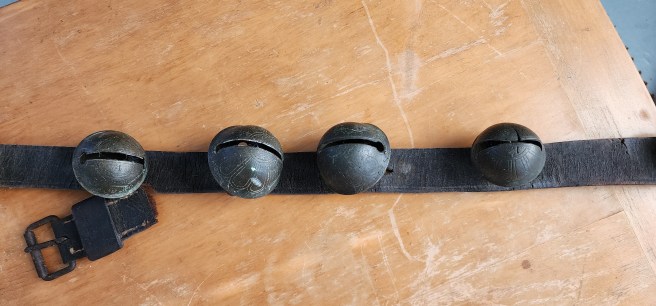
These belonged to the wonder horse Prince, who appears in my genealogical blog Orphan George. As a figure in our family, he was owned by my grandfather, who picked him up from two older brothers in succession. And now they’re going on to my daughters. Bet they cost a pretty penny, back in the day.

