do Fresnel lenses ratings run
up (from lowest)
to top, five (for highest)
or the other way around?
Turn’s out 1 is the strongest
5, the least
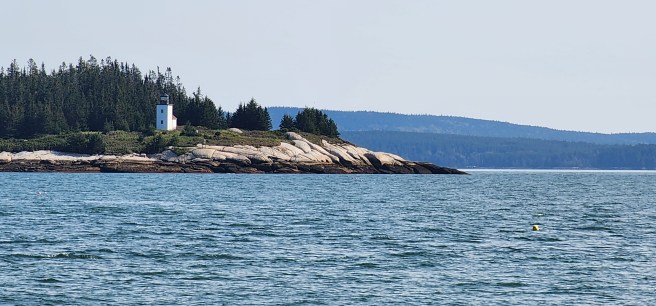
what are the others really thinking
or observing under their cheerful banter?
You never know what we'll churn up in cleaning a stall
do Fresnel lenses ratings run
up (from lowest)
to top, five (for highest)
or the other way around?
Turn’s out 1 is the strongest
5, the least
what are the others really thinking
or observing under their cheerful banter?

Those are salmon pen farms, should you be interested.

And that’s the point, in Cobscook Bay.
The new year introduced what seemed like slow-motion forever, a superficially sluggish pace that lasted all winter.
The reality was that there were a lot more parts and details to attend to in a project like this than met the eye. As for patience? It’s a skill, as I’m observing.
Cutting the openings in the exterior for the new windows and then framing them inside and out was one example. One step required each window to be perfectly leveled and then sealed into place. It wasn’t nearly as smooth-going as you’d imagine. And that was even before Adam uncovered the rot under the north gable window. One more delay for repair.
I have to admit the varied sizes I’d chosen and their emerging views did give me a sense of confirmation and satisfaction, as did looking at the scope of the full back half of the upstairs.

Pulling up flooring to permit rough fitting for the piping in the bathroom and adjoining laundry room was another example, one we’ll cover in an upcoming post.
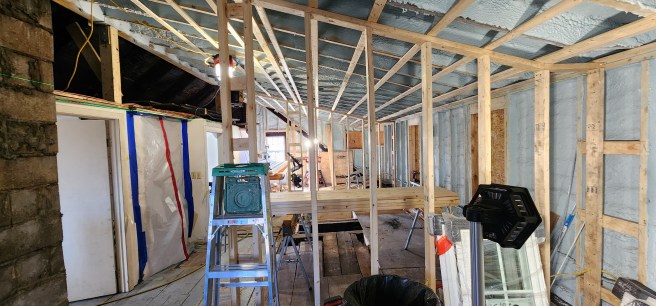
An unexpected discovery was a spider’s nest of tangled electrical wires, itself a violation of building code, but something that then led to the shock that none of our “modern” wiring on the first floor was grounded. Among other problems. Addressing that situation detoured Adam for more than a week, but it included a redesign of the wiring in the cellar, too.
That project was on our longer agenda, but it wasn’t something to ignore. I am delighted that we can now plug in three-prong wires without having to resort to those crazy converters for the two-prong sockets. As it turned out, none of our surge protectors would have worked when plugged into the old system.
It’s a huge relief knowing that’s all in our past now.
You’ve already seen photos of the knob-and-tube lines we found in the rafters. Some of those then led back to outlets on the first floor – connected by nothing more than stripping the main line and taping over the new wrapping. We already knew from experience that most of the first floor, plus the cellar lights, were on one circuit. Running the bread toaster and another energy hog could easily overload that, sending me flashlight in hand to reset the circuit-breaker in the cellar.
Our carpenter also found a junction box set in the upstairs floor – another violation of today’s building codes.
And here I’d been concerned about our lack of three-prong grounded outlets? Oy vey.
Of course, we’re looking to correct all that. My, are we.

Framing for the two bedrooms and the bathroom and laundry room also took time and care, as did the strapping for the drywall on the ceiling to come. For now, there were the electrical lines, outlets, and switches to install, once the holes were routed in the future walls.

Outdoors, the back half of the house was surrounded by scaffolding. Although the first cedar shakes were applied to the new exterior early on, continuing was a random activity based on fair weather. The exterior work had to do more with flashing and the underside of the roof overhang. More details, as you’ll see in coming posts.
How much would have to be more or less finished before tackling the front half of the upstairs? Instead, we were trying to find crannies downstairs to move our possessions still parked overhead, but Adam also needed more workspace. It was amazing how many tools and related equipment he had there. Even his construction lighting was impressive, before we considered the permanent fixtures.
If I was looking for a halfway point, I was sensing the path ahead was more complicated. We still had plans for downstairs, too, if any of our nest egg remained.
Welcome to our learning curve and money jitters.
~*~
One thing we were discovering was that there are far more parts to house than you’d imagine.
All along, we kept hearing mysterious pounding and shaking overhead, the whine of power saws and the thumping of an air compressor, along with falling timber or worse. I learned not to anticipate taking a nap during what other’s consider normal working hours.
My newest book, Light Seed Truth, challenges traditional religious teaching, the kind that results in “thou shalt not” combined with a fear of eternal suffering or some equivalent.
My book outlines an alternative to the legalistic framework found across religious traditions with their institutions and rituals grounded in second-hand retelling of mystical encounters. As you’ll see in the book, it’s not just religion, either.
Do note, though, the price will more than double shortly after the official release on June 7. So buying now helps you.
Preorders are one way of boosting the algorithm of first-week sales, and that can increase the title’s visibility on those ebook retailers’ bookshelves. So that helps me.
You can find it in the digital platform of your choice at Smashwords prior to the official release.

Be among the first to check it out. Thanks!
Let me confess to the allure of having an author’s photo and bio blip on the back dust jacket of a hardback volume. That’s always carried so much more gravitas than a mere newspaper byline – in my early days reserved only for major stories rather than distributed to just about every headlined item, in part to shift the blame for errors – or, one step up, the columnist’s thumbnail mug shots, for the truly honored writers. A magazine’s contributors page was a step up, especially when they included a full-color photo.
It’s not that being honored was essential – I was an anonymous, behind-the-scenes copy editor, after all – but more an acknowledgment of success, especially when it signified not being a hack. It’s just that everyone harbors a desire to be important, at least to someone, right?
~*~
For me, having the manuscripts but working on them part-time, I sensed myself racing a ticking clock. Would time run out on me?
The book publishing world was shrinking, as was daily newspaper journalism that provided my paychecks. Fewer houses were publishing fiction, and even those were in turmoil. They wanted blockbusters rather than the cottage-industry lines that previously prevailed.
Literary agents were struggling to support the writers they had and were less likely to take on new clients who would require more time and effort to promote. One, who had been considered hot just the previous year, replied to my query – a rarity, by the way – saying my proposal was an important book but not “commercially viable.” Another, equally acclaimed, vented her frustration with the changing publishing world and her struggles to cope within it.
Well, it did remind me of a letter I received from a newspaper editor I greatly admired during one of my job-hunting interludes. He was warm and welcoming, but confessed his career had turned into heading papers through their final days. From what I saw, he did manage some glorious sunsets.
My personal writing turned to several nonfiction projects that had commercial potential, but they, too, failed to break through the brick wall. One problem was that I was only a writer rather than an expert with academic or other highly placed credits.
It was a vicious circle. To get published, you had to have been published to some success.
~*~
It paralleled my earlier efforts to land a position on a major metropolitan newspaper. There had been some near misses, but the Union Leader proved to be a better fit for my remaining career. I even made it to the finishing line in a rapidly shrinking field.
In addition, “making it” as a poet was looking more and more like a dead end. Who can even name a living poet?
You know the one I’m talking about. Even before getting to the others just ahead.
Let’s just say I’ve been watching this building up, step by step, for decades. The corruption by big money and trickery, the erosion of the middle class, the polarization, the sleaze, the breakdown of the checks and balances or a loyal opposition.
Working in the newsroom, I was bound to give both sides their voice, though one was doing everything it could to discredit us and those distortions went unchallenged. There was more, of course, going on in the dark, things we sensed but couldn’t prove outright.
Let’s just say I was outraged but had to keep it bottled up. But then, after retiring, I let it out by indulging in a stream of poetry I usually steered clear of – the polemic rant akin to Dr. Bronner’s Moral ABC or Allen Ginsberg’s The Fall of America collection or Phil Ochs’ protest folksongs.
The result is Trumpet of the Coming Storm.

While the pieces that spewed forth in my collection may look like history from the Reagan years through the Bushes, they do reflect the origins of what’s coming to a head today. Even the poems that can be considered sophomoric seem prescient.
There are good reasons I subtitled it Blasts of Alarm and Rage, 1976-2008.
Do take a look.
It’s available in the digital platform of your choice at Smashwords, the Apple Store, Barnes & Noble’s Nook, Scribd, Sony’s Kobo, and other fine ebook retailers. You can also ask your public library to obtain it.
… the federal senate will never be able to transform itself, by gradual usurpation, into an independent and aristocratic body; we are warranted in believing that if such a revolution should ever happen from causes which the foresight of man cannot guard against, the house of representatives with the people on their side will at all times be able to bring back the constitution to its primitive form and principles.
James Madison in Federalist No. 63

Cedar in Whiting, Maine
News reports of protesting students seizing administration buildings on college campuses do bring back memories, and I know I’m not alone.
While there had been earlier seizures of campus facilities in the late ‘60s at schools like Berkeley, Columbia, and Ann Arbor, Michigan, the killing of four protesters at Kent State on May 4, 1970, and two more at Jackson State on May 14 triggered student strikes across the country.
The causes ran deeper than just the ongoing warfare in Vietnam and surrounding countries, do note. My novel, Daffodil Uprising, reflects my experiences in Indiana.
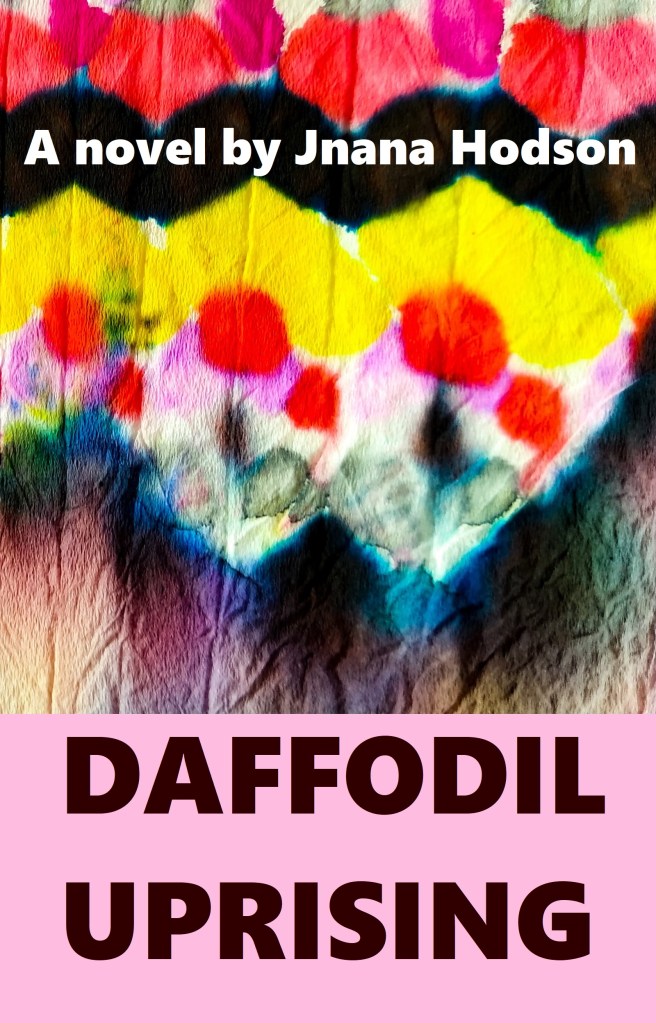
While I’m not about to engage in comparisons of today and back then, I am fascinated in the focus on university funding in the current protests. My novel saw that as a crucial factor back then, too – it wasn’t just Dow Chemical, either.
Of special concern, now and back then, is the depth of frustration that finally erupts as rage and revolt. We can assume there are elements in the current actions that go back well before the current Gaza crisis, and not just in the Middle East. They need to be addressed.
I believe that many of the problems in contemporary America can be traced back to unresolved issues from the late ‘60s For now, I’ll leave it at that.
For any of you interested, my book is available at the Apple Store, Barnes & Noble’s Nook, Scribd, Smashwords, Sony’s Kobo, and other fine ebook retailers, and at Amazon in both Kindle and paperback.
Geographically, Maine is the biggest state in New England – almost as large as the other five combined. That still ranks it 39th in size in the USA.
We’re also famed for some very dry humorists and fresh-from-the-sea lobsters the way Vermont’s stuck with maple syrup and a red leaves identity.
Beyond that, here are some other things that are unique to the place.

