
This was our smaller dinghy, agile enough to be managed by one person.
For more schooner cruise experiences, take a look at my Under Sail photo album at Thistle Finch editions.
You never know what we'll churn up in cleaning a stall
This was our smaller dinghy, agile enough to be managed by one person.
For more schooner cruise experiences, take a look at my Under Sail photo album at Thistle Finch editions.
Love, if you haven’t noticed, can be very hard to define. Really define.
Here are some examples. Add “Be Mine” at your own risk.
As a postscript, let me add this: “If I love you, what business is it of yours?” – Johann Wolfgang von Goethe
So how do you define love?
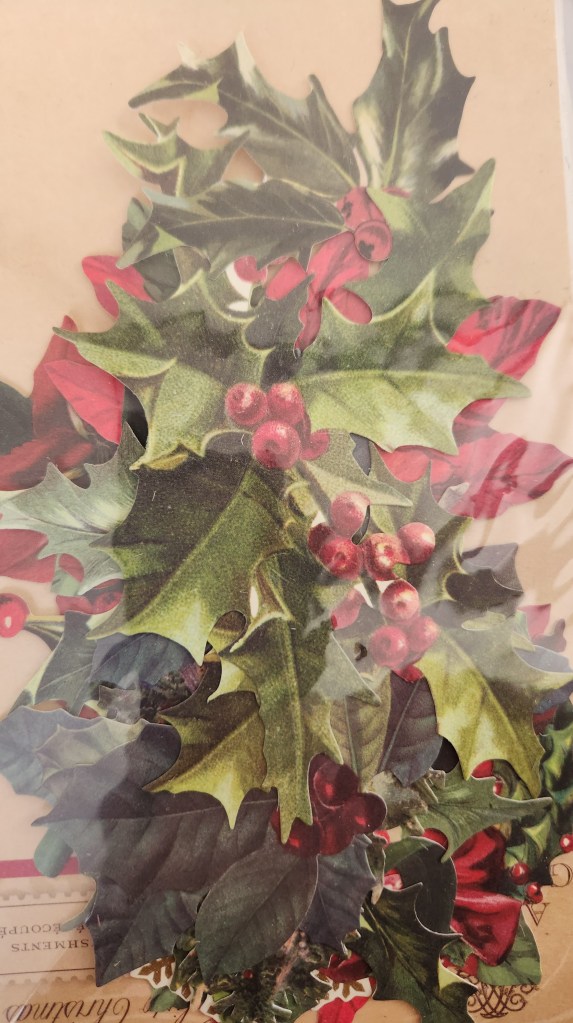
Some things are timeless.

Maybe it was another example of small-town living:
“Please note that trash pickups on Monday mornings … will now begin at 6:30 a.m. Shane & Alice Curtis, Ohio Brook Disposal.”
The envelope was addressed by hand.
After all, my college degree is in political science and I spent a career in community journalism, meaning I had to stay bottled up and objectively neutral, but what’s been happening in national politics in the Trump era is so appalling that when I sit down to create new blog posts, so many are snide comments along the lines of bumper stickers of a FU nature directed at the idiots.
Not that you’d want to display one on your car without the risk of being shot in the neck. Yes, that’s where the level of civility has sunk in this country.
And then there’s the sense of the futility of building sand castles in the beach in advance of tides that will overrun them.
It ain’t been easy.
So for now, I keep holding my thoughts on all of it in reserve, not that I’ve found any of it easy. As I did in my last decade or so of editing the news.
A recent study suggesting that the party divide is ultimately about males, as in the white male, and everything else. Seriously, I read it in the New York Times.
Like Donald Trump is any role model to emulate in a meaningful relationship?
That’s how low we’ve fallen, friends.
Or is that “in” or rather “on”?
The revival of the Passamaquoddy language has stirred a renewed interest in tribal place names in the easternmost corner of Maine, as we heard in an insightful Sunday afternoon talk by historian Donald Sacotomah last winter at the Eastport Arts Center. Many of those names, I should add, convey first-hand observations of conditions that would get lost in translation. Not that many non-Natives would be so observant of the waters or perhaps even their own emotions.
Concurrently, the Tides Institute and Museum of Art here has updated its free map of the region to include some of those place names, including Muselenk for Eastport, which is largely on Moose Island and where I live.
In trying to land on the its proper pronunciation, I was pointed to a most remarkable website, the Passamaquoddy-Maliseet Language Portal, which has a dictionary that includes recorded examples of pronunciation.
There, I learned that “Muselenk” is an example of a word that was imported from the English, in this case Moose Island.
Which leaves me wondering what this place was called before that. As well as curious about so much more, such as nuances of personal anger in entries a few pages away.
My favorite time in my public presentations for my book Quaking Dover have come in the question-and-answer period at the end.
Still, a few questions have caught me off-guard, stimulating my thinking in the days after. Here are a few to date, along with a few more points I’d like to develop in public conversation.
~*~
Why did the Puritans go so viciously after the Quakers? Or was that the other way around? Carla Gardina Pestana in her Quakers and Baptists in Colonial Massachusetts did remark that the Quakers seemed to go out of their way to make trouble, even after they had achieved some concession from the Puritans. I’m left agreeing that Friends were so critical of the Puritans because they felt the Puritans hadn’t gone far enough in their revolution. A description of Quakers as a radical fringe of the Puritan movement further suggests that connection.
How could you sleep at night after writing about some of the horrendous things that happen in the book? At the time I glibly replied a martini before going to bed helped. For a more meaningful answer, I would go back to the experience of dissecting a frog in high school biology, the way I learned to bring an imaginary Plexiglas screen down between me and the formaldehyde amphibian before I gagged and puked. It was a skill I found useful working as a newspaper editor – the emotional distancing that many other professionals find essential. You know, like a mask. I think of one surgical nurse I knew who had no problem with open-heart surgery, for instance, but when she saw the movie All That Jazz and the retractors went to work on the big screen of the theater, she vomited.
The Puritans in context. While they come off as villains in my book, they were far less hostile than the Virginians. There you could be executed if you missed three public worship services. At least one Quaker died after being severely whipped and thrown in a prison cell. There may have been further atrocities per Kenneth Carroll.
Richard Waldron in context. What were his redeeming qualities? He is a complex and largely unexplored figure in early American history.
I don’t intend this to be the “final word” on the topic but rather a starting point for some deeper discussion and inquiry. Inclusion of the ways faith i.e. religion is a core but often neglected/overlooked aspect of personal and public life can add to our comprehension. In the colonial era, especially, religious identity and political affiliation were practically one.
Working against a deadline. If it weren’t for the Dover400 anniversary opportunities, I’d still be researching. The big book remains to be written, if anyone wants to pursue it.
~*~
I am interested in other provocative questions, so fire away if you wish.
All but one of the state’s daily newspapers recently came under new ownership, but the surprise is that it’s not a mass-media corporation run by profit-squeezing accountants or, worse yet, investment brokers.
Instead, they now come under a non-profit committed to maintaining community journalism.
I’m hoping this is a wave of the future.
Curiously, it’s also something my last employer, the conservative New Hampshire Union Leader, turned to for continuation.
It will be vital to see how this plays out.
Something I’m deeply appreciating in my new community is how much depends on people who step up in public service. One person can truly make a difference. What’s amazing us is that some individuals seem to be everywhere we turn.
Some are born and bred here. Others are high-spirited “people from away” who transform the town in unique ways while respecting is core character.
One of the newer arrivals is Joan Lowden, better known as the Bass Lady jazz host on our community radio station. She loves to give shout-outs to others, so here’s one for her.
The former Silicon Valley ventures whiz is much more than a voice. She’s an organizer, fundraiser, website consultant, active volunteer, and cheerful doer who makes things happen, often behind the scenes.
This weekend’s ArtWalk offers some fine examples.
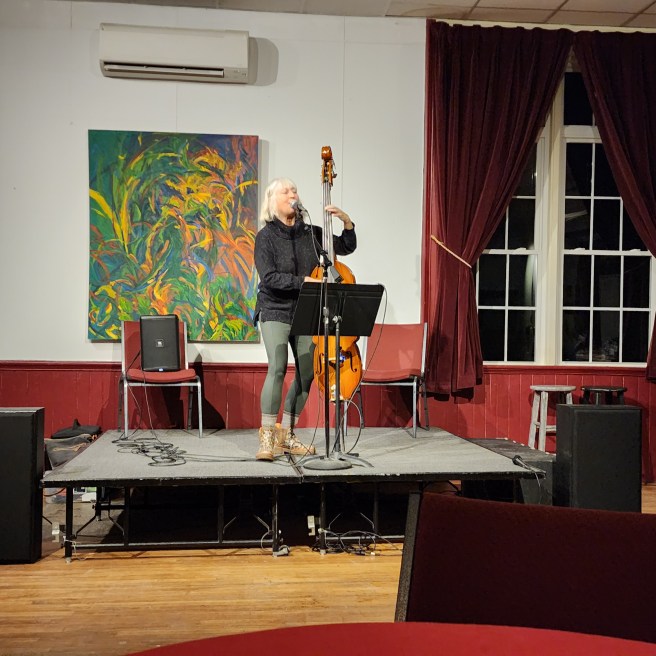
Here Joan is at our monthly open mic event, both singing and playing bass. She’s also a key player in MICE, the Moose Island contradance band, and a welcome member of varied combos. She even starred at our Mardi Gras night at the senior center while definitely lowering the median age.
 Jnana's Red Barn