I write to think through my life, one conundrum or experience at a time.
First, collect bits. Evidence or insights or confounding experience.
And then see where these go. Or even what sticks and what slips away.
You never know what we'll churn up in cleaning a stall
I write to think through my life, one conundrum or experience at a time.
First, collect bits. Evidence or insights or confounding experience.
And then see where these go. Or even what sticks and what slips away.
I was enjoying a leisurely trip back through Vermont, taking many breaks with my camera. All was well until approaching the New Hampshire line, I stopped to capture pictures of a Mennonite church – one of a few in New England – and was about to walk a block or two to take shots of a long covered bridge across the Ottauquechee River. Alas, my camera stopped working.
I assumed the battery simply ran out of juice, though back home I remembered (too late) sometimes you just need to remove it and put it back in – have no idea why that works, but it did on my old Kodak. Well, I’m still getting acquainted with my new Olympus from Christmas.
There would no doubt have also been additional shots of the “quintessential Vermont” general store, a bed and breakfast, and other quaint buildings clustered around the green – this was Taftsville, after all, which turns out to be a neighborhood in the iconic town of Woodstock.
The 189-foot-long span built in 1836 along what’s now U.S. 4 was severely damaged by the remains of Hurricane Irene in late August 2011 and for several years was left dangling precariously from a middle pier. (It’s listed as a Multiple King post and arch design, by the way.) Now, including a fresh coat of red paint, it looks dazzling. Alas, you’ll have to take my word for it.
More missed photo ops took place an hour later, when I stopped for lunch in Lebanon, New Hampshire – not down by the busy interchange along the Connecticut River but up on the hill, around the old green. It’s one of those New England towns that has an opera house as part of city hall, and this one has an actual opera season each summer. This year’s bill includes not just Mozart’s Abduction from the Seraglio and Bernstein’s West Side Story but also Aaron Copland’s rarely performed Tender Land. What I saw and heard of that, by spying through a crack in double doors from the lobby, was gorgeous. Well, again you’ll have to take my word for it. You would have seen the exterior of the hall from the common.
Finally, much closer to home, as I was stuck in a construction delay at the Lee traffic circle, I looked out my car window and saw three fawns grazing placidly at roadside. If my camera were working, it would have been a classic shot. They’re such small, fragile critters with such big pointy ears!
Well, even with the missed opportunities, I am happy with what I got that day. Now, to plan ahead to scheduling them for this blogging!
Many of these Red Barn postings have illustrated the historic seacoast region of New Hampshire where I live. While our downtown is 16 or 17 miles inland from the Atlantic, the tides roll in all the way up to the waterfalls and mill dam at the heart of our city, and then roll out, usually twice a day. In fact, Dover was an active seaport until floods and silting took their toll early in the 20th century.
Situated on the Cocheco River, as well as the Bellamy and a stretch of the Salmon Falls, Dover was once a major textiles manufacturer and railroad center. It’s part of a cluster of small cities and adjacent towns, each with its own character, that drain into the Piscataqua River before it, in turn, pours into the ocean.
In contrast, downstream on the full Piscataqua, Portsmouth boasts of an active port – one with iconic red tugboats, oceanic freighters, and active passenger cruises around the harbor, its islands, and coastal sights – stretches familiar to us from both the shoreline and ventures out on water. On the Maine side of the river, the Portsmouth Naval Shipyard builds and repairs nuclear submarines.
Upstream, however, has remained far more mysterious. Since it’s hard to glimpse much of the waterway from public roads, we’ve long wondered how the route would appear. Long ago I discovered how different a shoreline fits together when viewed from a boat rather than the lands around it. This is, after all, a major part of where we live.

At last, hearing of the Inland River Fall Foliage Cruise offered each September and October aboard the 49-passenger MV Heritage, my wife and I got a chance to see for ourselves. Depending on the timing of high tide, its daily two-and-a-half hour trip ventures from downtown Portsmouth to downtown Dover 11 or 12 miles upriver or, as an alternative, into Great Bay, itself a remarkable estuary.
It was an eye-opener. Once we left the familiar, picturesque Colonial-era Portsmouth Harbor, we began passing all of New Hampshire’s industrial waterfront, which includes three electrical power plants, the world’s largest lobster operation, an oceanic underwater cable producer, oil tank farms, and the like – each with major docking facilities for oceanic freighters or other vessels. I hadn’t envisioned the extent of this activity. Nor had we anticipated the width of the passageway, in many places approaching three-quarters of a mile. Not what most folks would call beautiful, but it was impressive, even if we were grateful Aristotle Onassis failed in his attempt to put an oil refinery a bit upstream.
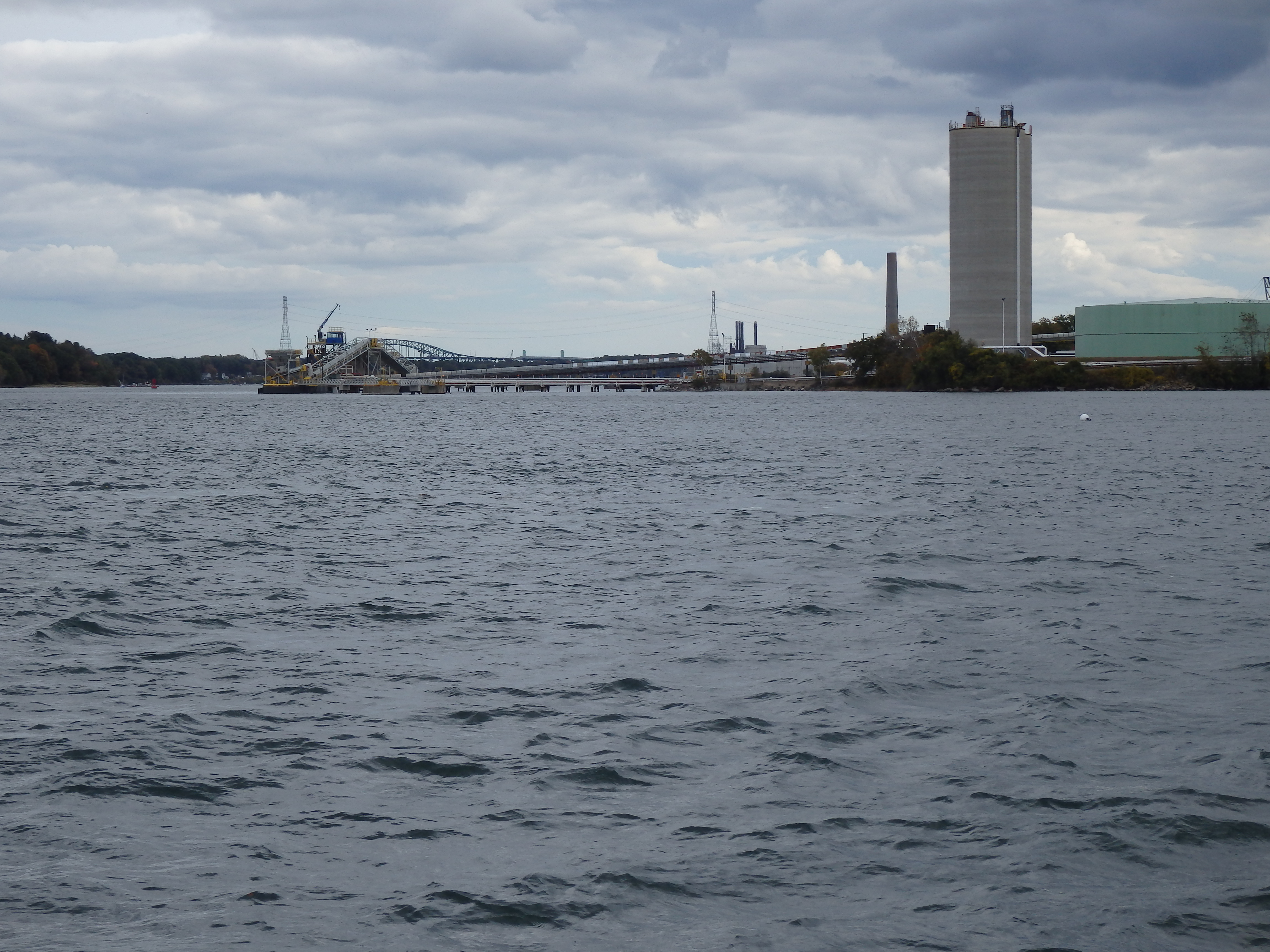
Once we’d passed the mouth to Great Bay, we were surprised by how much of Dover itself sits on the Piscataqua – and how much very expensive waterfront housing with expensive docks to match have been built there, mostly, as we were told, in the past two decades, now that the river’s been cleaned up from its earlier industrial pollution. In fact, looking at this and at the Maine side of the river gave the impression of passing high-profile lake shores with their ever more imposing year-round mansions. To be frank, we were a bit stunned by the wealth we were witnessing – where are these people in our otherwise modest city and what’s their source of income? Theirs is a different world, we’d say.
That’s not to say there weren’t stretches of colorful foliage or fascinating wildlife. In addition to a host of herons, gulls, and cormorants (we most loved the ones who stood atop mooring buoys marked “private,” as if the birds defiantly owned them), we viewed a soaring osprey and then a bald eagle in flight, an impressive hawk high in a pine overlooking the river, and a seal or two – all close to home.
The Pisacataqua originates at the fork of the Salmon Falls and Cocheco River, which we then followed as it narrowed on its way to downtown Dover.
What a contrast!
At one broad pool, we were told that tall-mast ships turned around here before reaching the mills by being poled by hand on high tide or pulled by oxen the final few miles. And, at the upper narrows, we appreciated a friend’s work with the Army Corps of Engineers in dredging power-plant tar from the river to reopen the passage. (That could be another posting in its own right.)
We passed the marina at the edge of downtown and circled, to retrace our journey.
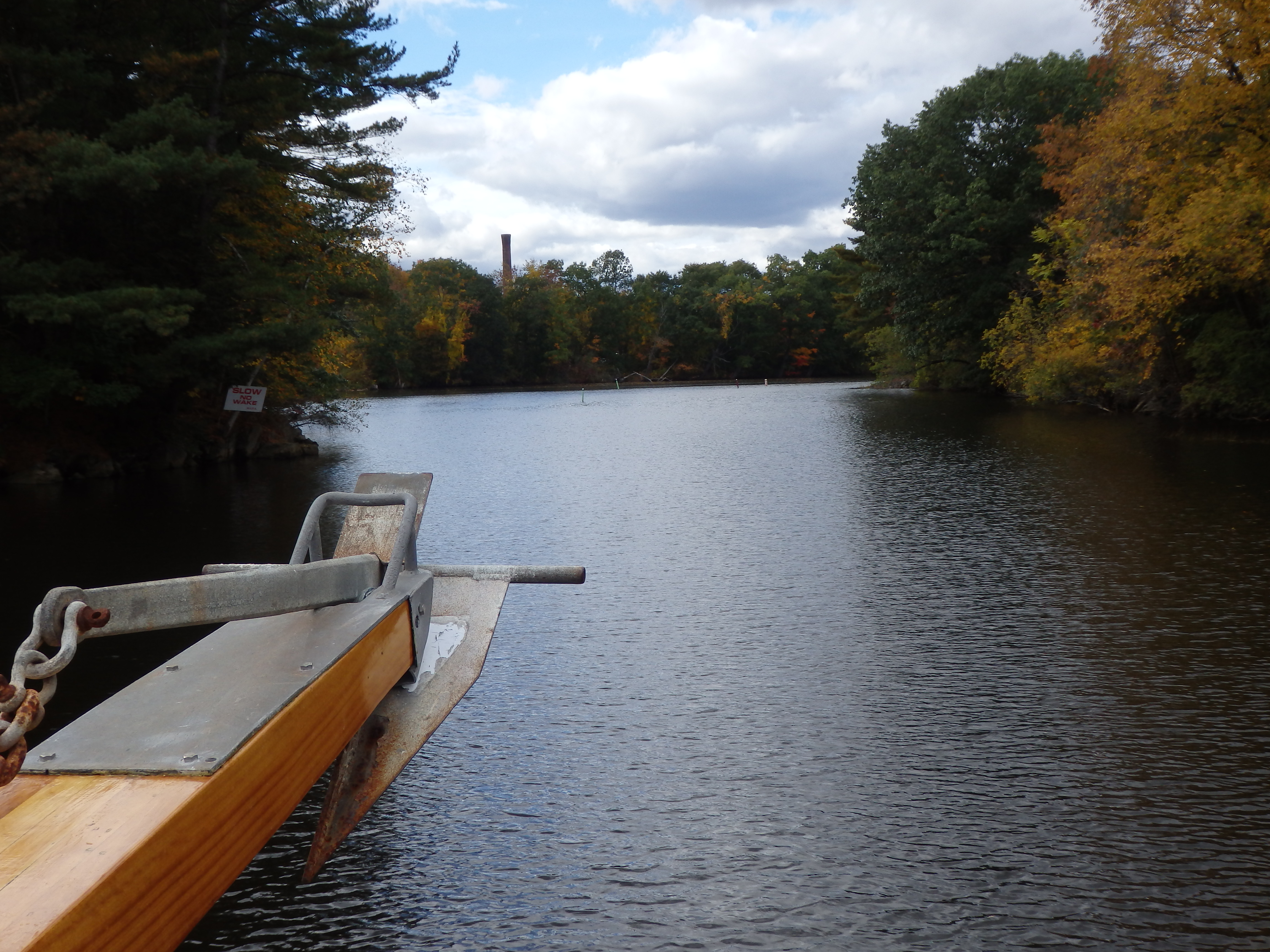
Why is it, the return always seems to go faster than the first part, outward?
On our drive home after debarking, we stayed close to the rivers. Surprising how discrete the lanes to the big houses! You’d never, ever, suspect they were there if you hadn’t taken the cruise. Makes us wonder how much more is hidden just out of view.
My wife is big on “quality of life” touches that affect our sense of living. They don’t have to be big expenses, either, as many of her yard-sale finds demonstrate.
The concept hit me while changing the bed the other day in my gratitude regarding a new set of striped flannel sheets, unlike the old floral patterns.
Just wait till we slip in, I thought. Oh, the sweet anticipation!
Any scholar of language will be struck by the ways some words drift from one meaning to something quite different. At the time of the King James Bible, for instance, “to prevent” meant “to precede,” from the root “to come before,” rather than “to hinder.” In our own time, we’ve seen “enormity” go from meaning “great evil” to simple “immensity,” and we’ve lost a powerful word in the process. Both “gay” and “queer” have lost timeless, innocent concepts. There are countless other examples where an author from the past tries to tell us something quite different from our current interpretation.
I’ve come to call these shifts “displacements,” especially when they happen by degrees over time and particularly as they relate to religious practice. For example, a cousin who was also a pastor in the Church of the Brethren likes to point out how the “Holy Sabbath” changed over generations to “the Sabbath” and then just “Sunday” before becoming what we know as “the weekend,” preferably of the three-day kind – each stage losing something along the way. I could argue how “my perception of the Truth” is quite distinct from “my truth,” one embracing the ideal of a single verity while the other presents an infinite array of conflicting, what, sensations or tenets, maybe? The “Inward Light” that early Friends proclaimed was quite different from the “Inner Light” version appearing two centuries later. Or “that of God in each person” is quite distinct from each person being a god unto himself or herself. Or even the way the quest for fun has displaced a work ethic and social consciousness. As for “Christmas” turning into “Holiday Season,” remember, it’s not far from becoming a more candid “Shopping Season” altogether. Keep your eyes open; these shifts are all around us, probably in every field of endeavor.
Returning to root meanings can be empowering. “Radical,” after all, comes from the word “root,” and Native American culture tells us, “roots are strong medicine.” Good roots, as gardeners know, are essential for healthy plants. In the world of thought and action, examining the roots can also restore the original vision. Hmm. “Look” and “see” aren’t exactly identical, are they?
Pointing my cursor to the WordPress icon on my desktop, I once again read the rest of the slogan as “Get a free hug here.”
Hug? Not blog? Does anyone else ever misread it that way? Or am I the only one?
I have to admit, some days your comments and postings feel like hugs from afar.
Somewhere along the way of drafting Big Inca Versus a New Pony Express Rider, I began imagining living in the top of a traditional textiles mill tower. Once I moved to New England, where the 19th century mills had proliferated, I soon discovered that the towers basically housed worker stairwells, even when topped with a big bell, elaborate clocks, or impressive weather vanes. Even so, my fantasy of dwelling with a view over the millyard and its surroundings kept growing.

You should realize I’m something of an ascetic – and I like open views, rather than curtains – so the idea of living in a small space such as that holds a romantic appeal. It’s rather like a forest lookout, actually – the kind Kerouac, Ginsberg, Snyder, Whalen, Welch, and other writers once occupied. Naturally, it’s not the kind of bedroom where you’d do elaborate entertaining, either. Anything would have to be intimate.
But what happens through the nights in the empty rooms below? To follow the developments, click here.

I look at the covers assembled and think, This is my life.
Turn by twist by turn, introduction by introduction.
All that didn’t happen, too, or was cut short.
Do I cry? Or laugh?
Are you with me?
~*~
See what’s available at Smashwords and Thistle/Flinch.
One late October afternoon, after most of the foliage had fallen, Randy Kezar and I simultaneously looked up from our pathway and beheld a large red maple fully aflame in sunlight as we strolled through the burial ground behind our Quaker meetinghouse. It was the embodiment of the single detail that says everything, the flash of perfection; this individual tree expressed the season as much as all of the previous color change and shifting light we had savored in the previous weeks. “I suppose if we were Japanese, we’d sit down and write a haiku on the spot, in celebration,” he said. Later, I took up the challenge and came up with a few lines I hope come close:
Somehow each New England autumn
comes down to boughs in a graveyard
– a common of stone and bone –
But my provocation and observations kept ranging wider, invoking a calendar not just of the place across a year but also the epochs that fill what went from a boneyard and burial ground to a Victorian cemetery to the present, as well.
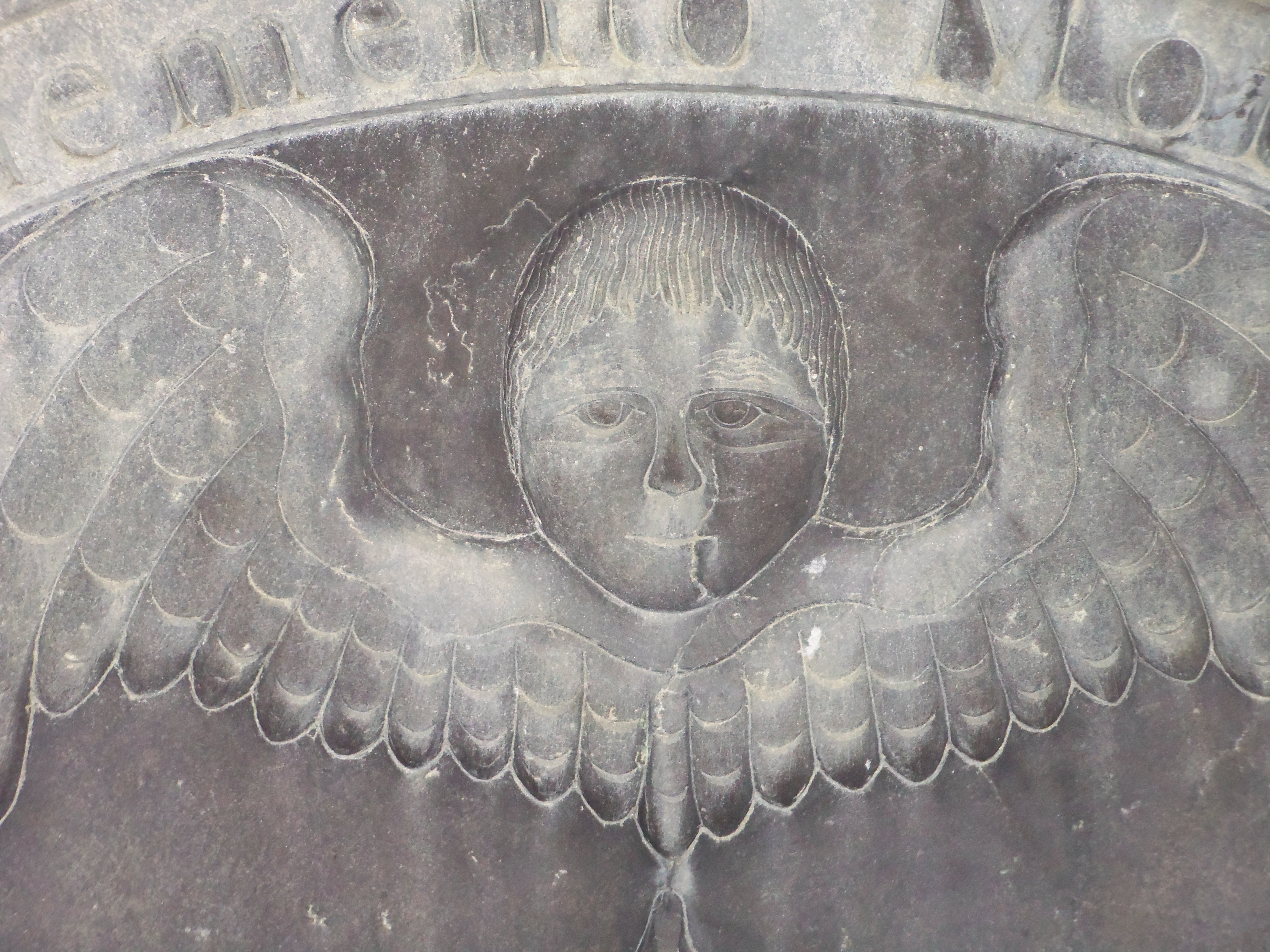
The poems that resulted have one foot in Portsmouth and Dover, New Hampshire, and another in Portsmouth and Newport, Rhode Island, where I quote from the 1664 will of Alice Shotten Cowland and some of the activities of her son-in-law, Robert Hodgson – sometimes spelled Hodson, as well as Hutchin. (I detail what is known of their lives in my genealogy blog, The Orphan George Chronicles.) She was part of the early dissent against Puritan authority, first with Samuel Gorton and then as one of the first Quakers in the New World. I love Robert’s memorial minute, which calls him “an ancient traveler in the Truth.” He arrived in America on the historic voyage of the tiny Woodhouse, causing turmoil in Manhattan and Long Island before heading on to Boston. As far as I can determine, he was no relation to my line, no matter how much many have tried to find the link.
~*~
 To see more, click here.
In many communities across the Northeast, the once neglected mills along the running waters have found new life as commercial real estate. Often, high-tech firms and other startups find them to be flexible incubators. Other times, floors are occupied by stylish residential condos or office suites.
The small city where I live proves that, three decades after the boarded up windows were once again open the light and the spaces within refurbished. The new tenants were the key to a revitalized downtown, especially.
Before relocating to New Hampshire, though, I envisioned something similar while drafting my novel, Big Inca Versus a New Pony Express Rider. Actually, I had no idea that was about the same time the mills were being restored one by one by developers like Joseph Sawtelle. Not that he was anything like Bill’s mysterious Boss.
Oh, how I love the mills – even before we get to the intrigue in my novel.
 Jnana's Red Barn