wouldja guess Maryland’s official sport is? jousting! (no, I wasn’t jesting, ’tis truly) these tabs from Fitzwilly’s and the Whitby Winery Uncle Charlie! what on earth’s on the radio? maps of New Haven and Providence sorry, such minutia, leisurely spans the Eastern Seaboard only to realize what had been removed to Tampa whoa! Prairie Home Companion it ain’t present background noise, roll the dial this rumbling would appreciate new Verdi’s Falstaff any better? reminded to pay bills, catch up hardly boring and ask how many of them practice, whatever . blessings, stick to it
Category: Arts & Letters
A musician’s insight on leadership
The question of just what a symphony orchestra maestro actually does led to an unexpected answer about leadership on a YouTube interview. According to the 59-year-old Paavo Jarvi, a conductor is essentially a teacher, regardless of the quality of the players. That, more than his artistic vision or temperament or divine inspiration or managerial skills.
It had me thinking about the best bosses I’ve had and realizing their excellence was as teachers.
How about you? What do you look for in a leader?
~*~
By the way, I was rather startled when I came across Paavo’s age. I still think of him as a “young” conductor, one of Max Rudolf’s last students.
He’s now the age Dr. Rudolf was as music director of the Cincinnati Symphony orchestra, a fine ensemble Paavo later directed for a decade before turning his attention to Europe.
Confessions of a booklover
Looking at my book purchases over the past few years, I’m finding that most of them are ebooks. The new paperbooks in my collection are mostly gifts, gratefully received, augmented by a few used volumes purchased online.
Cost is a factor, admittedly, but so is shelf space. We still have a thousand or more titles to cull from our collections before moving the remainder up here, and keeping them in storage ain’t cheap. My own practice of the past decade requires me to say adios to one copy every time I get a new one, and I find the swapping to be heart-rending. Books really are personal, and who ever wants to let go of a friend?
Among the harder aspects of putting our old house on the market was one we hadn’t anticipated. Our Realtor told us the bookshelves couldn’t be jammed, as ours were, but that buyers were entranced when shelves were only half full. We didn’t want to repulse them but, well, we had several walls to go through on that point.
That meant buying a lot of boxes from U-Haul to pack. Buy boxes? They stack better, for both transport and storage. Worth the price.
~*~
When it comes to how I’m now reading, I do find a distinction between ebooks and paper.
If it’s a page-turner being devoured quickly for pleasure or else an authority I’m using for background reference, I prefer digital. The digital search function’s very helpful, believe me – much better than relying on an index – and if I’m quoting something in a writing project, cut-and-paste beats keyboarding any day and is less likely to include typos. On the other hand, if the text requires slow reflection and digestion, traditional paper moves to the fore. Krista Tippett’s Becoming Wise: An Inquiry into the Mystery and Art of Living is a prime example, along with Robert Alter’s The Art of Biblical Poetry and The Art of Biblical Narrative.
Maybe the divide even comes down to whether it’s something I want to read hands-free or hands-on.
~*~
These also play into my considerations in my own publishing strategies.
As I looked to outlets for my big nonfiction project, Quaking Dover, I realized it was the kind of volume most readers would want to have in their hands or even wrap as a present.
It was one I’d want to place in bookstores and libraries, but that became a big hurdle.
If I put it the book up at Amazon’s KDP, the bookstores would back off. As for libraries? Dunno.
The alternatives I saw were prohibitively expensive for what would be a niche item, unless it magically took off on the charts, even as print-on-demand.
The plot thickened when my ebook haven, Smashwords, announced it was being absorbed by Draft2Digital. Yeah, the promises of no changes were there, but really?
Yet from what I’m seeing, maybe not. Maybe this is the big challenge to the Amazon juggernaut.
Upshot is, that’s where I’m planning to place my print version.
Here comes the paperbook edition!
A history book seems like a natural for a print edition, but it can be a risky deal for a publisher.
After all, few titles are of the bestseller scope aimed at a nationwide readership.
My Quaking Dover is a prime example of the niche appeal that can arise when you zero in on a small community and then further refine it to a crucial minority. Even when it becomes a microcosm of a much bigger picture, as I believe mine does, the hard reality is that it’s hard to break even in traditionally publishing such a work.
~*~
Independently producing at Kindle Direct Publishing was one alternative, but it wouldn’t get copies into brick-and-mortar bookstores, which would have to buy the books at full price from Amazon and then add an additional fee, or into many public libraries – and I do see those as essential outlets for this work.
I looked into several other services but concluded that the costs to me would have been prohibitive, no matter how attractive the result.
Now, however, I have good news to share.
Quaking Dover is appearing as a print-on-demand edition from Draft2Digital, available through its affiliated traditional retailers, including Barnes & Noble.
D2D first came to my attention when it acquired Smashwords.com, the pioneering ebook enterprise that’s been my literary haven for nearly a decade now. The more I learned of it, the more I sensed that releasing my print editions there was no-brainer.
~*~
See what you think. Like the ebook edition I’ve previously announced, the paperbook is being offered at a reduced price in a pre-release – in this case up till its October 8 release.
You can help me prime the pump by requesting your own physical copy at your favorite bookstore or library.
Check out my author page at Books2Read for details.
Let’s shake things up!
Look out, Curtis
Shakespeare or Shaw she was almost finished except for a chem’stry exam see how many of those medievalists still know what shapes up too content on minor correspondence, talking to yourself in equal measure
Is bassist Ron Carter the most recorded jazz musician of all time?
I found myself asking that several times after hearing radio announcers rattle off the performers’ names on jazz recordings and thought, “Carter again? Isn’t he everywhere?” And I’ve finally looked it up.
The answer? Yes! Though usually as a side man. He started recording in 1960 and by 2015, at last count, he had 2,221 issues on that instrument. There were others on cello. And he’s still plucking away.
While we’re at it, we should acknowledge the Wrecking Company, a loose affiliation of studio musicians in Los Angeles who are credited with being the most recorded, though not all at the same time.
As for most recorded, period? That honor goes to two sisters in India, Lata Mangeshkar and Asha Bhosle, who turned out more than 25,000 songs for Bollywood.
Now, how does a song compare to an LP or CD?
Comparisons do get tricky.
Where creativity and community meet
That’s the slogan of the Eastport Arts Center, housed in the 1837 Washington Street Baptist church after that congregation moved up the road and renamed itself Cornerstone Baptist in 2005.
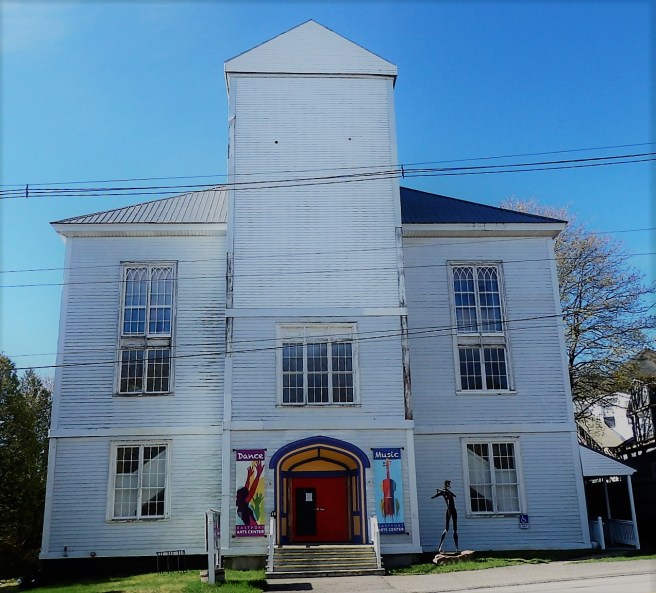
Only two blocks from the waterfront downtown, the center is the home of the Stage East theater company, Northern Lights Film Society (how I’m awaiting its reawakening from its Covid hiatus), Quoddy Voices, Passamaquoddy Bay Symphony, a series of visiting musicians in many genres, lectures of all stripes, and even yoga and New England contradances. Its activities range from performances and rehearsals to exhibitions and workshops, physical fitness and dance, open mics and communal meals. It’s also available for rental.
Upstairs features a 106-seat theater/concert hall, while downstairs has an open community gathering space, gallery, and commercial kitchen.
The venture itself was spearheaded by the eight artists who cofounded the Eastport Gallery on Water Street, which by 1990 had become a hub and magnet for creative spirits in town. The gallery remains a constituent organization member of the center.
I’m especially glad it’s all just a short walk from my doorstep.
Quite simply, I see it as the heart of the community, something that makes Eastport unique. Recent Sunday afternoons have hosted a delightful cycle of music, discussions of visual arts and local businesses, historical insights, and even free mustard.
Across the country, one institution often dominates the culture life of the wider community. In Cincinnati or Cleveland, for instance, I’d say it was the symphony orchestra.
In New Hampshire, was the New Hampshire Symphony, before its demise, or the Currier Gallery of Art.
What’s the biggest cultural influence where you live?
Ah, yes, it’s orgy season again!
Not to disappoint you, but I’m referring to Harvard University’s radio station WHRB-FM, which does stream online, should you be interested.
Its orgy season is a tradition that occurs during finals exams’ week (plus), originating when one student who was so elated at surviving the tests that when he went into the studio, he celebrated its end by playing all of Beethoven’s symphonies, on 78s, in order.
How modest that seems now. A year and a half ago, the station played everything Ludwig ever wrote in honor of an anniversary.
Bob Dylan received a similar accolade a few years ago.
This year Franz Schubert’s in the focus, more than 120 hours, by the way, which creates a smaller orgy of its own for the baritone Dietrich Fischer-Dieskau, who was acclaimed for his many, many recordings of the many lieder, or songs.
In fact, when his daughter was asked what her daddy did, she quipped, He makes records. So many, in fact, he’s among the most recorded artists ever.
My late German mother-in-law would have been out of this world over this orgy.
Well, as I post this, the station’s just getting going.
Just made my unanticipated theater debut
Eastport may be small, but its lively arts scene includes the Stage East company, with some rather lively programming.
At the moment, for example, they’re preparing a world-premiere musical for performances next month.
It’s the kind of place where you quickly get to know half of the town, too, so I wasn’t surprised to get an email from the director Thursday morning, even if its contents were unexpected. Could I participate in a play reading that evening and the next two nights?
An original work, the winner of the company’s inaugural playwriting competition?
I’d never done anything like that before, but in a pitch-in kind of community like ours, you learn to step up when asked, and so I replied fine. Honestly, I felt honored, and it couldn’t be too different from a poetry reading, right?
The initial reading was fun, both times through the one-act play. Better yet, my part was the shortest of the four and the least complicated. And then I learned we’d be doing it in front of a live audience the next night, meaning last night, and again tonight.
The playwright is Wilder Fray Short, a Bowdoin College senior and soccer fan, and the one-act play is In the 45th, about sibling rivalry and a lot more.
The competition, open to young full-time Maine residents and including a week-long residency and $1,000 prize, itself honors the late Jay Skriletz, the company founder, prolific playwright, and believer in social change.
To which I’ll add, it was an amazing experience and if you’re anywhere nearby, show up tonight!
The first and most learned
pattern of fern shadows cast by candles playing into snug culmination rented theaters where hillsides tottered in the unspoken gamble of her slightest motion, some indication if anyone commenced singing against the walls and ceiling of an unclothed expanse of potential a warm hand broaches, scratching its initials on frosted windows and then a lower back arched for precision a cappella with the choir we clocked a blizzard of treetop squirrels far below whatever our season and there you have it . tenderly

