does he ever have a name other than “the handsome young prince” or is he merely an anonymous provider of wealth, comfort, and status, a male figure, nonetheless, out of range of any rival, consequential to fallopian tube roulette which is, of course, a fate we all share besides, to say “they lived happily ever after” is the greatest irony in all literature so read the story over again and again to those in the throes of childhood as our own cruel joke or empty promise awaiting our own crown or at least an electric guitar with the drums, bang, bang, bang
Category: Arts & Letters
On relating to some special place you’ve explored in depth
Tourists may get a taste of a distinctive natural wonder in a particular landscape during their brief stay, usually in prime season, but it’s not the same as dwelling there through an entire year. A winter night or storm, for example, is a much different cosmos than a summer day.
I’ve been fortunate to have experienced some remarkable destinations through all their varying weather, thanks to my career moves, but never to the degree of living largely alone, as Henry David Thoreau did at Walden Pond or Henry Beston along the dunes on Cape Cod.
I’ve come to know both places firsthand over the rotating years, and so reading the two classic books that emerged from them evoked personal awareness of scenes that likely struck the general reader as exotic or even confounding. I never would have appreciated them the same way had I still been in the Midwest or Pacific Northwest, for certain. Quite simply, the encounters provided a stronger foundation for revelation of so much I had missed.
One of the fringe benefits of my second marriage was that my stepdaughters’ Grandpa Jim lived in Wellfleet on the Lower Cape, or what Beston more clearly calls the Outer Cape. (Understand that the Upper Cape is south of the Lower Cape, much the way Downeast Maine is really up the coast. Welcome to New England.) So we got to visit throughout the year, making me a big advocate of visiting popular travel sites in the shoulder season. There’s no way to describe walking several miles along the surf below the bluffs and having the expanse totally to myself – in perfect weather the week after the normally crowded Labor Day.
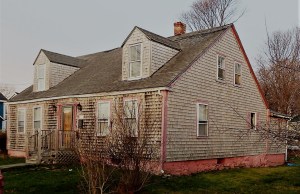
My wife used to gaze on the few remaining gray cabins atop the bluffs and voice a dream of living in one of them – the National Parks Service has been removing them piecemeal – noting that you wouldn’t want to have anything there you wouldn’t mind losing to a hurricane or nor’easter.
Beston’s 1928 The Outermost House tells of spending a year in just such a house only one town south of Grandpa Jim’s, and so I could envision and even smell much of what he describes.
At first, I was put off by the feathery, slightly Victorian language, as well as the affectatious British spellings rather than American, but once Beston presented some sharp, detailed observations of wave and wind motion and sound, I was captivated. His examination of waterfowl and other birds, especially, is admirable, but the range of shore and sea life he portrays is also encyclopedic.
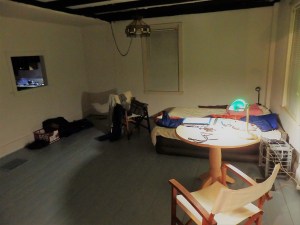
He writes from a time when the Cape still retained an older character that was being overlapped by newer ways that included telephones and flashlights, both unlike today’s suburban feel, and his book is credited with inspiring the creation of the Cape Cod National Seashore to protect the wildlife and geology he treasured – as many of us do today, thanks to the protections.
My reading came a few months after moving into my own equivalent of Beston’s cabin, albeit it much further up the coast and in a fishing village – still in view of the ocean.
You’ll be hearing a great deal about it through the coming year.
Are there books you’ve especially enjoyed because they’re rooted in places you know?
With pigeons
such gain, left to carry the rubbish after this unsettling and upheaval, all crashing down, the lonely conflagration increasingly desperate for a phoenix in some dawning how often one begins over, take the bookshelves, reorganize religious literature, find that ten-year-old letter initially appearing unopened sent just before the marriage with its Far West a nebulous daydream now I continue in the opposite direction rebounding perhaps keeping time as pigeons return quietly that’s all Thanks and g’day
My wife has long insisted I have a face made for the 19th century
Among the artists-in-residence the Tides Institute invited to town last year was tintype photographer John DiMartino from Brooklyn.
He was certainly the most visible, with his big camera and tripod everywhere and his workaholic hours. He was enthralled with the place, its light, and its people.
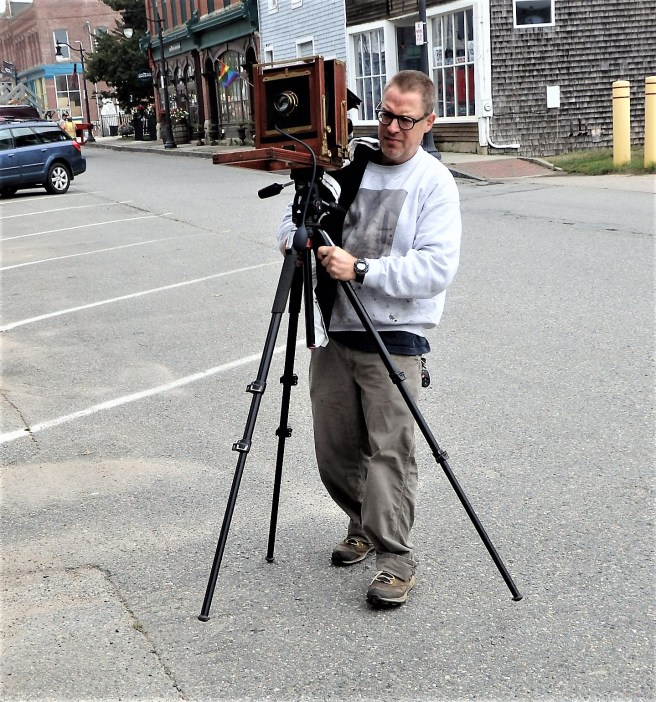
Curiously, his medium gave everything he shot a back-in-history quality, as well as reversing the subject before him.
Here’s what he did to me.
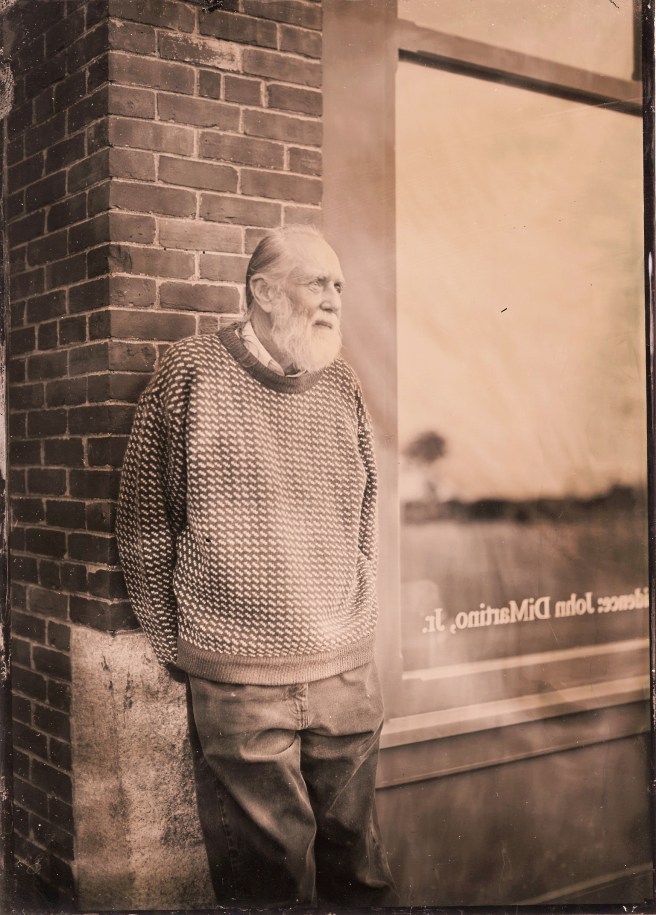

For more of his portfolios and other characters he captured in town, check out his website, johndimartinojr.com.
Hey, there, Dexter
ream the medicine cabinet, fill penny rolls for the coffee exchange, throw out old prescriptions and that old slide rule, already obsolete, then it’s off to the office supply store for carbon paper and metal bookends, return editions and LPs to the public library before the art stack goes to my ex-wife’s aunt where I’ll hear how her latest opening went screwy . back home, have a beer, phone my lover, take a call from the watch repairman warning if I don’t pick up her metronome they’ll sell it off, so once more out I go, how ’bout you?
Rather than
thinking the cleaner bag full I discovered the rubber drive belt had snapped meaning a trip to the shop and the next day was Sunday as she had left it all the same, dust and sweep, wet mop, and rinse, move tall stacks about, sort items but what if we don’t? refill the trash can, love, after all, would expose this . honestly I won’t quit so simply whatever past is mine . pay dearly, of course, for these revelations. so make room for more labor . brush and chop, returning to the same spot rather than scurry onward
It’s the book I didn’t want to write, but it wouldn’t let go
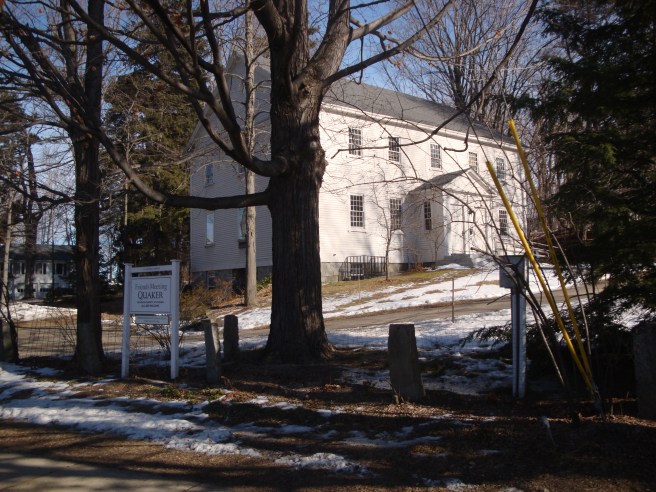
I thought we Dover Quakers – or more formally Friends – had our long history covered. I had even helped Silas Weeks, way back, in some of his research for his definitive volume on New England Quaker meetinghouses and burial grounds.
Frankly, after revising and republishing seven novels after the appearance of my eighth, I wanted a break.
A big break.
These are supposed to be my retirement years, OK? Admittedly, I had long imagined devoting myself to the writing as a big part of that dream, but really!
But then a casual request for an overview of Dover Friends history changed everything. It came indirectly, through someone in another denomination who was active in our Sanctuary movement. But then, going back through my filing drawers, I came up empty – couldn’t even find my folders of notes. What we did have was mostly about our three meetinghouses over the years – especially the structure where we’ve worshiped since 1768 – along with a few prominent events.
This left me unsettled.
Unlike many other denominations, the Society of Friends, or Quakers, is first and foremost about its members. Our definition of church is the body of believers – not the building or the polity and definitely not the ordained clergy. It’s why we call our building a meetinghouse and why we organize as Meetings, reflecting the times and ways our church-people come together. Church can happen whenever and wherever we are, even over dinner in our homes or chance encounters on the street or in the midst of social activism. And vitally it’s not just us – we’re meeting God, too.
~*~
WHAT NEEDED TO BE TOLD was the lives of the individuals and families who were the essence of one of the oldest Quaker Meetings in the world.
I resisted as long as I could but finally succumbed. Who were they? Why were they so willing to risk severe punishment and persecution imposed by the Puritan authorities? And in the face of that, how and why did a third of Dover’s population quickly become Quaker? And several generations later, start fading away?
With the 400th anniversary of the settling of Dover – and thus New Hampshire, too – coming up next year, the timing for our side of the history felt right.
Now that the book’s written and revised, I’ll be sharing some of my findings with you as well as news of publication itself as that nears.
~*~
WHAT EMERGED IS A PARTIAL HISTORY, as in partisan, with my focus on a radical religious subculture that thrived in a unique, out-of-the-way, locale. Partial, as well, to the independent streak of New Hampshire against more powerful Massachusetts authorities to the south. Partial even in being incomplete as well as lacking footnotes, and not even the work of a professionally trained historian.
The story is also partial in being biased toward a sequence of unusual, sometimes roughhewn, figures and their families – not all of them Quaker – and inclined especially toward the narrative they shape.
The roots, as you’ll see, arise in the very beginning of English settlement. Forget what you’ve assumed about New England before Paul Revere and Sam Adams and the American Revolution and Boston as the Hub of the Universe.
A lot had already happened before the first Puritans sailed into Boston Harbor. Let’s look instead to Dover, which lays claim to being the seventh-oldest continually inhabited European settlement in the United States.
In the standard telling of the founding of today’s city of Dover, New Hampshire, two brothers arrived from England in the spring of 1623 and settled at the mouth of Great Bay on the Piscataqua River, upstream from the Atlantic Ocean. The brothers were fishmongers, members of one of the oldest and wealthiest guilds, or great companies, of London.
Except, as it turns out, one of the brothers didn’t arrive until a few years later.
Instead, the cofounder of the new settlement was a fishmonger apprentice who would be an important figure in the early years of the colony.
~*~
YOU’LL PROBABLY BY AS SURPRISED by this alternative take on New England history as I’ve been. It’s not just Quakers. There’s much more to New England’s past than a Thanksgiving dinner and a riotous tea party followed by a midnight ride and the shot heard ’round the world or even the notorious witch trials.
Here at the Barn, you’ll definitely be hearing a lot more about this big project through the coming year. Believe me, some of the findings will be startling.
My work, as I see it
highly compressed
economy of expression
vivid imagery
an acknowledgement of mystery of the universal seed in the particular
if only I’d been able to uphold it in the newsroom
~*~
Yes, clean lines, stripped-down materials, and elegant craftsmanship meeting a love of the baroque in a quirky, inimitable style
Which way, the music or dance?
at last, reducing the list drawn into this homestead with the ash of that upbeat tone of previous years, a forced smile, wishful thinking, or pure resolve no longer the Yule Letter, high school classmates, even college . ashram . Binghamton or teachers . other writers . Iowa. Western Reserve . Baltimore . former loves . Old Order elders . what do these people mean now in context? So, sincerely
Not to get too sentimental, but …
What is life without memories?
The most tragic part of Alzheimer’s is what happens when one crosses that threshold and leaves the connecting memories behind.
Quite simply, stories – and storytelling, one way or another – are essential. Stories are, after all, ultimately memories within human existence, no matter how fanciful or mythical.
How else do we remember where we are in the universe? Or even why?
There are good reasons we swap stories, from pillow talk on.
 Jnana's Red Barn