Writing versus real life

There are many reasons I spend so much butt time at the keyboard, as poet/novelist Charles Bukowski once compressed the practice.

I’ve examined some of them elsewhere, but what I’m circling back to today is the necessity of bringing some kind of order to the seeming chaos of what happens to each of us in “everyday life,” at least through the lenses of my own encounters.

What emerges is hardly objective, no matter my training in objective journalism. If anything, I lean on the hopeful side of history. The side we see as progress, even in the face of the clouds of doom.

Long ago I crossed a threshold where I couldn’t move forward without drawing on so much that had accumulated before then. I think of it as turning the compost, to give it air and enrichen future crops, worms and all. Yes, those blessed red wigglers. Or wrigglers, depending on your spelling.

Am I self-deluded? Or is my practice of writing one of prayer, even in the face of so much hopelessness?

What is life, anyway, apart from what we experience subjectively?

So here we are, all the same.

Keep writing, those of you in this vein. No matter the outcome.
 

Beloved saintly Tess hear my confession

because I haven’t really known how to shop for myself expertly I’ve hated selecting birthday or Christmas that is, excepting books and records and a few groceries I’d like for myself you’d think spending would be a simple if you had enough cash and my dependable depression reflected insufficient variety or sassy style on the racks here but price tags on anything I desired conveyed, As I learned, kid, look, you aren’t worth anything as far as your job and life are concerned and maybe if you stole from dying widows or threw single-parent kids into the street, you’d be rich and then honestly, most men still dread shopping so what do you really want in gift wrapping?

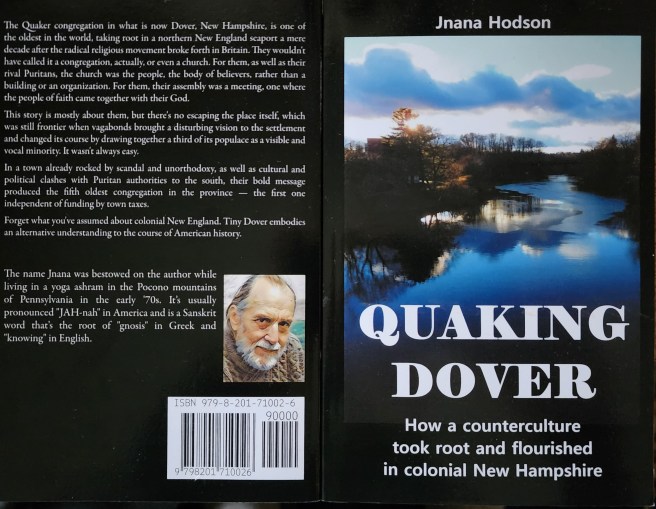
Cutting the book’s trim size cut my royalty

You might think it’s a minor thing, deciding whether your new book should be 9-by-6 inches or the usual trade paperback 8½-by-5½ inch dimension, but the smaller trim size does look and feel more professional, even elegant.

It’s easier to retrieve from some of my bookshelves, too.

It comes at an added cost, though – an additional $1.40 or so, out of my royalty.

You wouldn’t expect that for the smaller size, would you?

At some point, that might be the swing factor in raising the cover price.

For now, I simply want this one to be just right. Besides, it will still take a lot of sales for that difference to add up, and we are dealing with the story of a small faith community which just might not have that much interest for anyone else unless this takes off like, well, something about covered bridges in Iowa.


Reflecting on the upcoming Met broadcast season

Each fall, donors to the Support the Met Broadcasts campaign receive a handsome program guide to the upcoming opera season.

I’ve kept mine, going back to 2005, and find they make a fine reference collection regarding both the plots and performers.

My own listening experience goes back to Joan Sutherland’s first role there in late 1961 or ’62. It was exciting, even through all of the AM radio static of the day.

While much of the core repertoire remains the same, there are also new productions and new or rare works, and it’s interesting to see how these are lined up.

What struck me in the new booklet is how few of the singers’ names I recognized.

When I first started listening, the leading performers were celebrities, often household names and gossip column fodder.

It was a tight circle at the top, in this country and in Europe, enhanced by handsome multidisc LP albums.

Think Pavarotti or Callas.

Well, times have changed, as has the focus. The singers are often more musically informed, and they’re required to physically to act and project their roles in sometimes demanding stagecraft. As for the sets and costumes? This is the height of theater.

The amazing thing is how many fine performers there are now, and they’re active far beyond the confines of the Met and its elite sisters.

There’s a similar shift in the conductors. I recognized only six who will be in the pit. The biggest surprise was seeing the Pittsburgh Symphony’s maestro among them, and he’s considered solid but hardly superstar. (Consider that a compliment, by the way.)

What’s significant is that one-fifth of them are women, one leading two separate operas. The cadre is growing.

What’s missing, though, is American-born conductors. They are active on the symphonic scene globally.

Querido Pedro

what should imbibe a tone of its own at least the dialogue you know back to the earth or center city I’d say boho was largely suburban youths trying to head simultaneously in opposite directions ill equipped for either but rife with contradictions of youthful rebellion, colorful partying, prankster mentality as well as individuals in search of authentic and lasting values as the whole outbreak proves you know how much I still miss it

Too many zeroes for zero

as I repeated through hazy defaced New Jersey and New York via Fort McHenry Tunnel just before afternoon traffic congealed, Singing along, too, just see what you’ve done? all your fault, baby  (ask me about the Greek who got a banker’s check from France with a few too many zeros which the local bank cashed so he abandoned his Dairy Queen and fled home with several million in his pocket and the FBI on his tail . they couldn’t find him but our reporter did . good old Gus.) Carnally encased desiring a conjunction of such calculations

Having a back cover, too

One big difference between paper books and ebooks is the back cover. The digital versions simply don’t have one – the blurb has to go on the retailer’s website instead.

Yes, the two formats have their differences. An ebook is more like a scroll, but one that can be easily searched and rewound.

A paper book, on the other hand, is more like a box, with the covers working like the wrapping on a present, full of enticement. Even the lettering on the spine can work that way.

Better yet, the back cover can start talking to you even before you open the pages. “Come on in,” you can hear it address you, even in a crowded bookstore.