How about a few more readers’ candid responses to my new book?

In case you’re wondering how things are going with Quaking Dover, here are some early reactions:

“The book purports to be merely a history of the Quakers at Dover, New Hampshire, but it is much more than that. It is a history of the beginning and spread of the Religious Society of Friends (aka Quakers) in the USA, the best exposition of their faith that I have read so far, a history of their persecution by the Puritans, and of the bloody conflicts between the Puritans and the native peoples. …

“Most of all, I had not previously been exposed to the reality of the Quakers’ faith, revealed in their own words. Jnana Hodson, himself a Quaker, has done extensive research in old records and journals and includes extensive quotations that bring the faith to life. Including their peaceful acceptance of persecution, their prudent approach to courtship and marriage and their belief in the work of the Holy Spirit in the heart.” – Bob Goodnough, Saskatchewan

(For his full review, visit his Flatlander Faith blog post of Dec. 12, 1922.)

~*~

“I enjoyed your conversational writing style – sharing the research that you did — and confidentially whispering (in your writing style), ‘This is what this finding means and how it should be interpreted.’ … To ascertain what really happened you checked primary documents, read previous accounts of Dover, New Hampshire – triangulated your sources and showed us readers how you reached your conclusion. A very enlightening read – well researched, well written.” – Joe Clabby, author of A History of Eastport, Passamaquoddy Bay, and Vicinity

~*~

“Love it!” – Susan Wiley, Sandwich, New Hampshire

~*~

“Deftly told. I really like your voice. It’s engaging, light, and easy to read.” – Jim Mastro, science fiction novelist

~*~

“An enjoyable book!” – Arnie Alpert, longtime peace activist

~*~

“A rich feast of a book.” – one of my favorite authors and fellow Maine resident

~*~

“I truly appreciate all the work and careful thought and interpretations you put into it.” – Canyon Woman, New Mexico

~*~

“I enjoyed your book very much. I particularly liked relearning about early life in Dover and surroundings, and was impressed by how much research you did to fill in details. Not only about the life of early Quakers and their trials and tribulations, but the connection they had to the rest of New and Old England. I did not understand how important the settlement of Dover was compared to Portsmouth, Exeter, and other towns.” – John Dawson, Lee, New Hampshire

~*~

“Thank you for writing this record of Dover Friends Meeting. The ‘Children of the Light’ had me on the verge of tears as I read it to Andrea.” – Harvin Groft, Berwick, Maine

~*~

With another new calendar year, here we go again

Hard to believe this blog is now in its second decade.

With the Barn, a new year usually signals a slight shift in focus and content.

2023, for instance, will see a series excerpting dreams I’ve had over the years. Mine can be surreal and inexplicable and yet, I feel, illuminating. They’ll likely give you unexpected glimpses into my psyche even though I’m thinking of it as literature. Meanwhile, the prose poems that have been appearing on Saturdays have run their course. Hope you’ve enjoyed their compressed impressions of my earlier life and feelings, especially when they’ve reflected your own, too.

Dover’s 400th anniversary will continue to be a major theme, including things I’ve learned since the release of my book based on the town’s Quaker heritage. And there will be announcements of presentations based on the book as they come up through the year. The ones I’ve done so far have been a blast.

Now that you’ve been introduced to Eastport and its ways, the tone of those posts will also turn, shall we say, more casual? Or at least more of the everyday experience around here rather than a record of the connections I’ve discovered. Besides, living on an island in Maine is some people’s fantasy, at least through the summer. I’m hoping to add a streak of reality to that vision.

Kinisi will continue with their off-the-wall, quirky, flash slashes. Some fall into the realm of concrete poems, a la Aram Saroyan, and others take the trippy flashes of the sort Richard Brautigan produced. Others can be seen as prompts for others to build on. These minimalist notations do reflect the way I’ve often heard and seen the world, slightly askew, even though I have to admit I don’t “understand” many of them. They’re intended to dance to their own beat, OK?

And I have to admit my Tendrils on Tuesday are great fun to investigate and offer. I never thought of top ten lists as entertaining, forget the factual dimension. They definitely have much more to dig up as we go.

One big shift will likely be in photography, from my Olympus camera to my S-22 Ultra cell phone. We’ll see what you think. Eastport and the surrounding environment are certainly visually rich subjects. Click, click, everywhere you turn.

Overall, though, I’m intending to have fewer posts this time around, yet it still looks like that still means at least one posting each day. Or, as one renowned writing teacher taught his classes, “Write 300 good words a day.” Not that I’m keeping count, even as I keep hoping to cut back. Does keyboarding really become compulsive?

My life and outlook have certainly changed over the course after signing up for a WordPress blog, which then led to four related lines. Thanks for sharing so much of it here.

What are you looking forward to on your end in the new year?

There’s plenty for other researchers to expand on

My Dover history project has taught me how slippery much of the material – especially the early parts – can be. What comes through is often fragmentary.

Did Edward Hilton actually look like this?

There’s the very enigma of Edward Hilton, for starters, just trying to prove he was here from 1623. From the circumstantial evidence, I’m convinced that he and Thomas Roberts definitely were, and besides, there are no rival hypotheses regarding their arrival. But that’s not rock-solid documentation doesn’t appear until retroactively. Maybe some of it, taken to London, survived the big fires and plagues and will resurface. Don’t hold your breath.

I’ve seen some of the early charters and patents and, for all of their descriptive prose, find them baffling. The layers of landholding are just the beginning.

What, for instance, did William Fiennes – the eighth Baron Saye-and-Sele – and Robert Greville, the second Baron Brooke, receive in compensation when they relinquished their proprietorship of the New Hampshire province to Massachusetts? And for that matter, how did the Massachusetts Bay colony arrange the transaction?

I would even like to see the details on what Edward Hilton had received when he earlier sold his proprietorship – again, just what did he possess? – to Lords Saye and Brooke. His reason, according to one source, was a sense that the Massachusetts authorities were preparing to seize the Piscataqua and his defense would have been inadequate. Saye and Brooke had clout, as well as a colony in Connecticut named after themselves: Saybrook.

There are also questions of how the “governors” and ministers of the province were selected prior to Massachusetts’ control of New Hampshire.

Just trying to decipher the script and text requires an expert, perhaps even an antiquarian lawyer. And how many of the documents remain, anyway, in the mother country or the New World?

Fellow blogger Mark Everett Miner touches on some of this when he remarks, “It is thought that William Hilton was somewhat educated as he wrote several competent, if poorly spelled, letters.” They are, however, quite convoluted. Here’s an excerpt from a 1633 letter to John Winthrop:

“There arived a ffishing shipe at Pascataque about the 15th of this p’sant moneth where in is one Richard ffoxwell whoe hath fformerly lived in this cuntery he bringeth nuse yt there were tow shipes making ready at Barstaple whoe are to bring passingers & catell ffor to plant in the bay he hath leters ffor mr wearom & divers others at dorchester wch hee intends to bring hr to the bay so soone as posible he can like wise he heard ffrom mr Alerton whoe was making ready at Bristole ffor to come ffor this cuntery other nuse he bringeth not that I can heare of onely mr Borowes purposeth to come ffor this cuntery ffrom london & soe desighring you to convey thes leters in to the bay wth what conveniency you can desighring the lord to blesse you in your lawffull designes I humbly rest …”

How do you make sense of such surviving documents?

In Dover, First Parish records don’t pick up until John Pike set down his memories, beginning with his arrival as minister in 1677. Still, as later minister and historian A.H. Quint observed, “There are no extant Dover church records before Dr. Jeremy Belknap’s ministry,” beginning in 1767, “except that he copied into a record book a list of baptisms and of members, commencing in 1717. The town records are also very defective during the period of Mr. Pike’s residence.” He adds, “This is due partly to the Indian troubles, and partly to the Masonian difficulties.”

By the time Samuel Bownas first visited Dover, the Meeting’s earliest minutes had already been lost – in a barn fire, according to oral lore.

Old volumes in the Dover Friends library tell mostly about Quakers elsewhere. These rare books do not circulate.

In Quakers in the Colonial Northeast, Arthur J. Worrall notes, “The clerk was the most important of the persons active in meeting affairs.” While his examination focused on the yearly meeting level, he remarks, “Clerks had been appointed before 1700, but we know little about their activities. Their note-keeping was careless at best, and … it was not unusual for a clerk of many years’ standing to lose his copy of the minutes.”

One consequence is that we are unlikely to learn much of Dover Quaker life in the early years from the Yearly Meeting books.

Dover’s surviving records begin with the women’s minutes in 1701, with a gap from 1785 to 1814, and the men’s minutes, from 1703. Its vital records stretch back to 1678 but, curiously, were not begun until 1787.

Missing, of course, are the accounts of the early persecutions by the Puritan authorities, the reactions to the Waldron incarceration of Natives or their later attack on the village, or even the early leadership of the faith community.

For family genealogists, the Quaker sources are among the best available family records in America before the 1850 Census, the first to name everyone in a household. The Friends minutes, however, name only those families in good standing as members. Even so, they can be very useful in framing a family overall.

New England records were never comprehensively indexed along the lines of William Wade Hinshaw’s six-volume Encyclopedia of American Quaker Genealogy, covering Pennsylvania and New Jersey, New York, North Carolina, Virginia, and Ohio, or its seven-volume companion by Willard Heiss, Abstracts of the Records of the Society of Friends in Indiana. But Dover Meeting’s surviving family records were serialized from 1903 to 1909 in the New Hampshire Genealogical Record, the Official Organ of the New Hampshire Genealogical Society. Its editor and publisher was Charles Wesley Tibbetts, an attorney. I haven’t been able to determine if he is a direct Quaker descendant, but his kin were prominent in the Meeting.

Dover’s surviving records are preserved in the New England Yearly Meeting archives in the special collections at the University of Massachusetts Amherst, where they can be accessed by researchers and readers. As I already mentioned in an earlier post, a truly close examination of them would add much to a more thorough history of Dover Friends – a list of clerks, for instance, or the Revolutionary War volumes of discipline – but the results would likely be too arcane for my intended audience.

Still, if opportunity ever presents itself, hunkering down for several weeks in Amherst might be revealing.

Other things I would also like to see:

  • A fuller presentation of the Devon folkways, without the Virginia overlay in David Hackett Fischer’s Albion’s Seed.
  • A history of Salem, Massachusetts, drawing on the culture clash that runs through my own book. I suspect that much of the witch trial hysteria originates in those differences, abetted by a “perfect storm” of related factors. Likewise, the Salem Friends Meeting and its successor at Lynn need a bigger profile.
  • Ditto for Hampton Friends, morphing into today’s Amesbury Monthly Meeting.
  • A major overview of Quakers in Maine. Again, the fragmentary nature of the surviving minutes would require amplification from court records, deeds, and genealogies.

~*~

Welcome to Dover’s upcoming 400th anniversary.


Not a bad way to spend a dark Saturday afternoon

This has the makings of a fine Saturday afternoon tradition through gloomy winter around here. Not that it won’t work on a sparkling day, either.

Moose Island Contradance Band. Photo by Rachel A. Williams.

The local contradance band has another monthly performance at the Old Sow grill coming up, and the previous one, as you can see, was a hoot.

It attracted a handful of sit-in musicians in addition to an appreciative audience that packed the house.

Plus, monthly dances at the arts center are set to resume at the end of January after a long Covid hiatus.

A special kind of humor

Vermont may be renowned for maple syrup and skiing, but Maine lays claim to a very dry humor as well as lobsters. Maybe they’re somehow connected.

When I first moved in New Hampshire, I learned much about the region through the Humble Farmer, Robert Skogland’s weekly hour on Maine Public Radio. But his comedy act wasn’t the only one in the Pine Tree State.

Tim Sample remains the epitome, even though his time was cut unfortunately short.

Another now classic run was “Men from Maine,” a one- to two-minute comedy segment that opened with soap opera organ music and something varying along the lines of, “And now for another thrilling episode of the exciting adventures of Men from Maine. As today’s action-packed drama begins,” which aired on a morning radio show in Boston.

The episodes typically revolved around Lem and Ephus and others in backwoods Maine. While the humor was essentially redneck, it was opposed to that of the American South. Episodes ran all the way from industrial accidents handled in incompetent ways (many residents, including Lem and Ephus, worked in the local sawmill, though the canneries could be equally hazardous), to bestiality, but, as observers noted, the humor always came from the stupidity of the characters and their obliviousness.

After I’d been introduced to the men via Clackity Jane’s show on Eastport’s little FM station, I discovered how much they’re stilled treasured in these parts, maybe because they struck something true.

Laugh on, dude … and dudette.


Reflections from the stage of the Quoddy Voices concert

Singing in front of an audience is a relatively new experience for me, one arising in my retirement years, mostly through Boston Revels’ top-caliber community chorus and related events.

What I can say is that from the stage, each performance has been thrilling and transcendental, even when not necessarily perfect. Most remarkable is the oneness we sense as a company making melody and harmony.

Before the Covid restrictions and my relocating to Downeast Maine, I was commuting from New Hampshire to Boston as a baritone in the Revels Singers, first under George Emlen and then Megan Henderson. The ensemble ranged from 40 or so to maybe 80 members, depending on the season. Its classical and world folk repertoire was drawn largely from the shows the organization had produced in its more than a half century, with music in nearly 30 languages and spanning a good millennium of history. Many of the arrangements, editions, and original compositions were by our conductors or others affiliated with Revels.

~*~

These days I’m with a much smaller group, Quoddy Voices, which is also led by a fine conductor, pianist, and composer, John Newell, and I’ll proclaim that its standards and abilities are just as high.

We just concluded the second pair of programs with me as a member, and once again I must admit moments of listening to the others in amazement and then wondering how on earth I ever managed to be included. Yes, it’s humbling and challenging.

Technically, we’re a chamber choir – for the concert, 20 singers. Among other things, it means any slipups are more exposed.

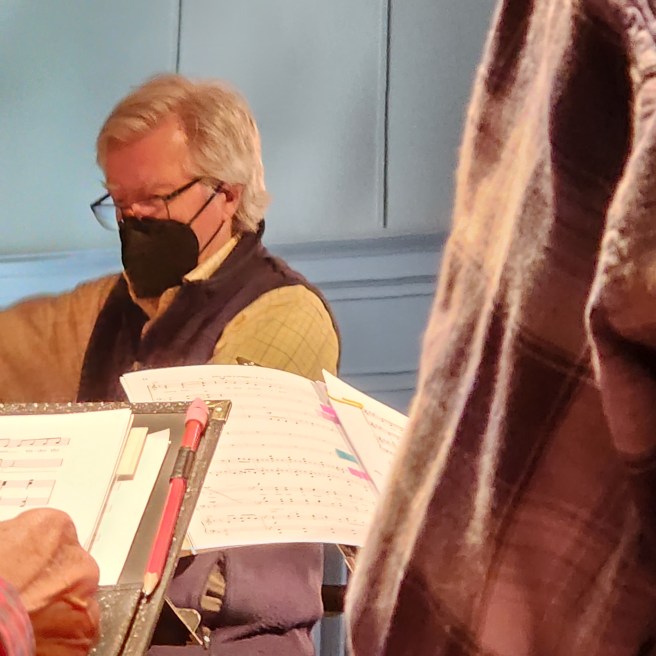
(Photo by Jessica J. Williams)

Our program, a Harvest of Song, put us ahead of Thanksgiving and the crowded holiday schedule at the arts center. That meant a shortened rehearsal schedule, but online practice scores of our parts definitely made a difference.

Compared to Revels Singers, our repertoire engages more in works other choirs are also exploring, which led us to three pieces by Florence Price, the first Black American woman to have a symphony performed by a major orchestra. She’s finally being widely discovered, nearly 70 years after her death. From our point of view, her writing is deft, with touches of jazz and flashes of difficulty. The bass line in one score movingly upheld the axiom of less is more.

From living composers we had two widely performed works by Englishman John Rutter, who is admired for pieces that fit the voice like a latex body suit; Californian Frank Ticheli’s masterpiece, “Earth Song”; a lively Calypso in 5-4 time by the now 95-year-old Harry Belafonte; and a haunting 35-year-old Dan Forrest’s setting of a Ralph Waldo Emerson poem.

From old masters we had a deeply reverential motet from Romantic-era Anton Bruckner and sections of Baroque brilliance from Henry Purcell’s 1692 “Ode to Saint Cecilia’s Day,” which foreshadows Handel and his Messiah but with sides of pagan homage, as English poets of the time were wont to do.

We concluded with Randall Thompson’s classic 1940 “Alleluia,” drenched in sadness, as the composer admitted, but becoming quite polyphonic and agitated before introducing a single second word at the end, a seven-part, two-note amen.

While all of these works are widely known in choral circles, all but the Thompson were new to me. I had heard the Thompson only in a broadcast just a year ago and earlier from an old buddy who raved about singing it with his chorus.

Our audiences, as usual, were attentive and enthusiastic.

~*~

So now some of us are scheduled to do some informal caroling before Christmas.

And then, come February, we get to see what our director has in store for us next.

Praying the breaking news

latest dispatch, the first in nearly a year, tells of her decision to return to wearing a covering  but Mennonite-style rather than her mother’s Quaker so what’s this about more hot wheels, eh, or clicking those heels, ah, to prefer dwelling in New England as I recall our discussion comes back, so I learned last night nothing else new comes to mind to report look forward to the next mailing, of course I’m not always a sterling example of what some embrace as Christian Love with or without the olives, yes, definitely, stay securely on your feet or knees the heartbreaking headlines demand attention regardless of the deadline every small detail adds up

In case you’re wondering what others are saying

Listen to this from a five-star review Beth Collea posted at Smashwords.com’s Quaking Dover page:

Jnana Hodson combines solid historical research with his engaging writing style. Light touches along the way keep the text moving. His own historical wonderings give us the feeling of personal involvement in the quest for insights and answers.

Drawing on the work of David Hackett Fischer, he contrasts the local folkways and customs of the area of England where the Puritans came from and the Devon region where the settlers to the Piscataqua area originated. Spoiler alert: the English in the Devon region so highly valued hospitality and welcome that they dared to host and harbor traveling Quaker ministers, especially if they were in need.

Hodson gives us a wonderful historical lens to use as a framework for general understanding and especially for exploring Quaker history in the U.S. The timing is perfect as the City of Dover prepares for the 400th anniversary of European settlement in 2023.

~*~

Photo by Jessica J. Williams.