Vermont may be renowned for maple syrup and skiing, but Maine lays claim to a very dry humor as well as lobsters. Maybe they’re somehow connected.
When I first moved in New Hampshire, I learned much about the region through the Humble Farmer, Robert Skogland’s weekly hour on Maine Public Radio. But his comedy act wasn’t the only one in the Pine Tree State.
Tim Sample remains the epitome, even though his time was cut unfortunately short.
Another now classic run was “Men from Maine,” a one- to two-minute comedy segment that opened with soap opera organ music and something varying along the lines of, “And now for another thrilling episode of the exciting adventures of Men from Maine. As today’s action-packed drama begins,” which aired on a morning radio show in Boston.
The episodes typically revolved around Lem and Ephus and others in backwoods Maine. While the humor was essentially redneck, it was opposed to that of the American South. Episodes ran all the way from industrial accidents handled in incompetent ways (many residents, including Lem and Ephus, worked in the local sawmill, though the canneries could be equally hazardous), to bestiality, but, as observers noted, the humor always came from the stupidity of the characters and their obliviousness.
After I’d been introduced to the men via Clackity Jane’s show on Eastport’s little FM station, I discovered how much they’re stilled treasured in these parts, maybe because they struck something true.
Singing in front of an audience is a relatively new experience for me, one arising in my retirement years, mostly through Boston Revels’ top-caliber community chorus and related events.
What I can say is that from the stage, each performance has been thrilling and transcendental, even when not necessarily perfect. Most remarkable is the oneness we sense as a company making melody and harmony.
Before the Covid restrictions and my relocating to Downeast Maine, I was commuting from New Hampshire to Boston as a baritone in the Revels Singers, first under George Emlen and then Megan Henderson. The ensemble ranged from 40 or so to maybe 80 members, depending on the season. Its classical and world folk repertoire was drawn largely from the shows the organization had produced in its more than a half century, with music in nearly 30 languages and spanning a good millennium of history. Many of the arrangements, editions, and original compositions were by our conductors or others affiliated with Revels.
~*~
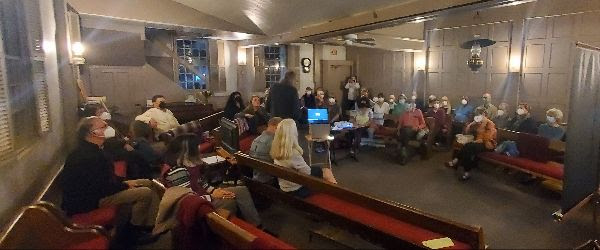
These days I’m with a much smaller group, Quoddy Voices, which is also led by a fine conductor, pianist, and composer, John Newell, and I’ll proclaim that its standards and abilities are just as high.
We just concluded the second pair of programs with me as a member, and once again I must admit moments of listening to the others in amazement and then wondering how on earth I ever managed to be included. Yes, it’s humbling and challenging.
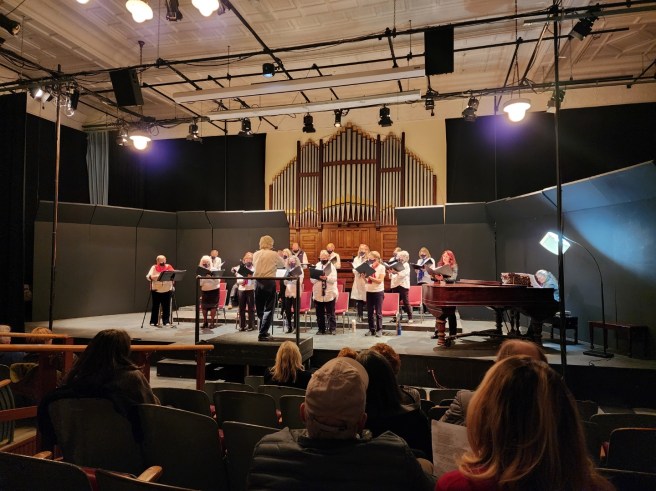
Technically, we’re a chamber choir – for the concert, 20 singers. Among other things, it means any slipups are more exposed.
(Photo by Jessica J. Williams)
Our program, a Harvest of Song, put us ahead of Thanksgiving and the crowded holiday schedule at the arts center. That meant a shortened rehearsal schedule, but online practice scores of our parts definitely made a difference.
Compared to Revels Singers, our repertoire engages more in works other choirs are also exploring, which led us to three pieces by Florence Price, the first Black American woman to have a symphony performed by a major orchestra. She’s finally being widely discovered, nearly 70 years after her death. From our point of view, her writing is deft, with touches of jazz and flashes of difficulty. The bass line in one score movingly upheld the axiom of less is more.
From living composers we had two widely performed works by Englishman John Rutter, who is admired for pieces that fit the voice like a latex body suit; Californian Frank Ticheli’s masterpiece, “Earth Song”; a lively Calypso in 5-4 time by the now 95-year-old Harry Belafonte; and a haunting 35-year-old Dan Forrest’s setting of a Ralph Waldo Emerson poem.
From old masters we had a deeply reverential motet from Romantic-era Anton Bruckner and sections of Baroque brilliance from Henry Purcell’s 1692 “Ode to Saint Cecilia’s Day,” which foreshadows Handel and his Messiah but with sides of pagan homage, as English poets of the time were wont to do.
We concluded with Randall Thompson’s classic 1940 “Alleluia,” drenched in sadness, as the composer admitted, but becoming quite polyphonic and agitated before introducing a single second word at the end, a seven-part, two-note amen.
While all of these works are widely known in choral circles, all but the Thompson were new to me. I had heard the Thompson only in a broadcast just a year ago and earlier from an old buddy who raved about singing it with his chorus.
Our audiences, as usual, were attentive and enthusiastic.
~*~
So now some of us are scheduled to do some informal caroling before Christmas.
And then, come February, we get to see what our director has in store for us next.
latest dispatch, the first in nearly a year, tells of her decision to return to wearing a covering but Mennonite-style rather than her mother’s Quaker so what’s this about more hot wheels, eh, or clicking those heels, ah, to prefer dwelling in New England as I recall our discussion comes back, so I learned last night nothing else new comes to mind to report look forward to the next mailing, of course I’m not always a sterling example of what some embrace as Christian Love with or without the olives, yes, definitely, stay securely on your feet or knees the heartbreaking headlines demand attention regardless of the deadline every small detail adds up
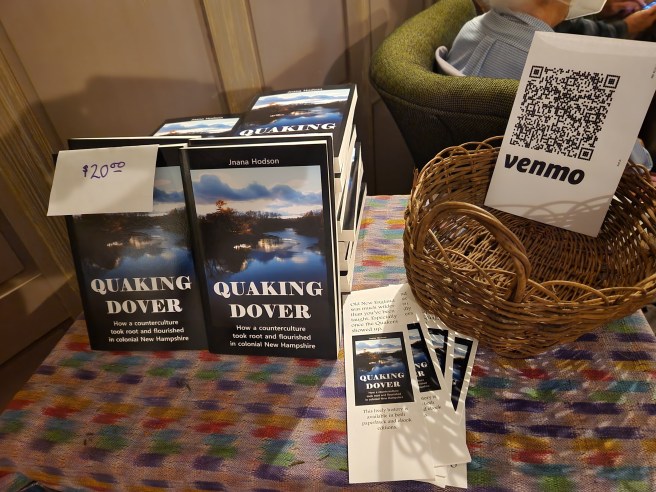
Listen to this from a five-star review Beth Collea posted at Smashwords.com’s Quaking Dover page:
Jnana Hodson combines solid historical research with his engaging writing style. Light touches along the way keep the text moving. His own historical wonderings give us the feeling of personal involvement in the quest for insights and answers.
Drawing on the work of David Hackett Fischer, he contrasts the local folkways and customs of the area of England where the Puritans came from and the Devon region where the settlers to the Piscataqua area originated. Spoiler alert: the English in the Devon region so highly valued hospitality and welcome that they dared to host and harbor traveling Quaker ministers, especially if they were in need.
Hodson gives us a wonderful historical lens to use as a framework for general understanding and especially for exploring Quaker history in the U.S. The timing is perfect as the City of Dover prepares for the 400th anniversary of European settlement in 2023.
in the Quaker circles, how many in their sixties and seventies are still quite bustling well on into their eighties and nineties, I would add compared to so many on respirators and walkers the problem is we need a lot more half that age moving forward yes toward New Jerusalem where are all welcome and made anew whole
my list: Desert Boots so I’ll have a very comfortable pair of shoes at the office, but it turns out that the original kind are impossible to find, and pricey but rather than being upset by that fact today, I found myself intrigued by the hunt, I’ll just keep watching and waiting a jaunty rain-repellant windbreaker to replace the decade-old one my now ex-wife gave me which I’ve never really liked, color or cut, even when it drew favorable comments, it just wasn’t me or a dressy raincoat as in a London Fog, I still wound up buying some nice, and essential, overdue items, including winter boots the old L.L. Bean muck-luck style, but fun and necessary for a New England winter now I can mud it up with the best of the locals and keep my head up and a new wallet as for the Japanese robe or pea jacket very nice cut but still more than the one at the sporting goods store), not yet a consumerist, yrs truly in comfy new wraps
 Jnana's Red Barn