My first-ever Zoom presentation is now available for streaming, thanks to the Whittier Birthplace Museum. The presentation on January 26, “Starting with a marriage certificate: Why Whittier was no stranger to Dover,” focused on the famed poet and abolitionist’s many connections to, well, my new book Quaking Dover.
John Greenleaf Whittier is hardly the central theme in the book, but for me, developing the topic for this show, along with the accompanying PowerPoint slideshow, another personal first, was fun.
If you’re a regular here at the Barn, you know I do lag behind on the tech front. One step at a time, right?
I didn’t expect an unusually itchy nose and scratchy throat resulting from our dry indoor air. So much for my up-in-the-corner-of-the-screen stage presence.
On top of that, with the PowerPoint up in front in me, I couldn’t see who was attending. Oh, well, I had my hands full anyway.
Earlier, behind the scenes, there was concern about a possible power outage on my end as unusually warm temperatures dropped below freezing amid heavy rain. We did have a contingency plan, just in case.
Don’t know if this is still in the Wikipedia bio page, but it is revealing:
“This man has a very large ego and has hurt the feelings of a choral singer I know. He can be insensitive. Please proceed with caution. This is the ‘kind version’ of what I actually want to say. Thank you.”
Well, the subject did survive seven years as an assistant to a stellar conductor who, according to what I’ve heard from insiders, bordered on sadistic, despite the heavenly perfection of performances under his baton or the public mask of his celebrity.
As I’ve heard said of surgeons, they tend to adopt the operating room mannerisms of their mentors, however tyrannical, outrageous, or circumspect.
Two people I know who have worked under the entry’s subject have only admirable things to say about him.
For now, I’d like to know more about the anonymous person who posted the entry and why. Perhaps as a cautionary tale for all of us in our leadership roles.
More accurately, I’ve become acutely aware of how much I still don’t know. Or even, does anyone see this fully?
The adage, “Write about what you know,” had me starting with my Quaker experience. But the adage should add, “Write about what you don’t know.” Frankly, that’s the part that’s exciting.
Think of it as working a puzzle, trying to figure out what goes in the gaps. You just don’t know without some hands-on trial and error. And perhaps a few friends or family members’ help.
From the other direction, I know a professional historian who quotes his mentor saying that if you think you have an answer nailed down, you’re badly mistaken.
I’ll spare you my list regarding the Quaking Dover project, for now.
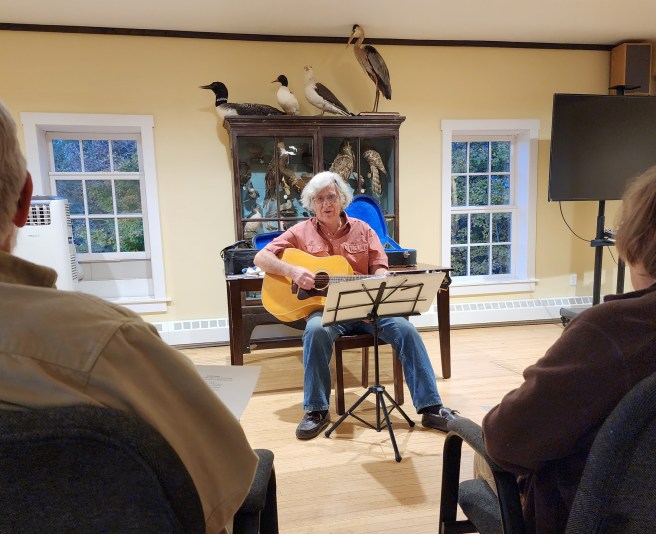
Stephen Sanfilippo is both a wonderful folk musician and a professional historian, two strands that weave together delightfully in his performances and recordings of maritime songs.
He’s a master of the sea chantey repertoire as well as many other seafaring tunes and lyrics – many of which, as he’ll explain, traveled far and wide into the American hinterlands but not back. He does prefer the spelling “chantey” and “chantey man,” for reasons I’ll leave to him to explain. And there are plenty of opportunities to sing along.
Here’s an invitation to his free appearance on Wednesday, January 25, at 6 pm at the Pembroke, Maine, public library, itself an appropriate venue. (I do love the stuffed birds displayed behind him.) The event will be followed by a series of more monthly concerts. Yay!
From his previous appearances here, I can acclaim this is one more facet of what makes living Way Downeast Maine so special to me.
I’ve posted previously on the outstanding and often original finals’ week programming on Harvard’s student-run FM radio station. Each December and May, the regular schedule shifts to a few weeks of special blocks of classical, jazz, rock, folk, world, and many other strands of music I hadn’t even heard of for something the station has trademarked as Orgy, as in “Donizetti Orgy,” which I’ll explain. For accuracy, we should note that final exams really cover closer to two weeks or a tad more.
One year, for instance, they played everything Bob Dylan had recorded. A few years later, a much shorter sequence introduced many of us to Florence Price, a significant Black American woman composer who has since been receiving a posthumous flowering. The decisions are often based on anniversaries, as happened a few years ago when we got to hear everything Beethoven had ever written, in chronological order. Musically speaking, of course. I have no idea about his letters. A year ago, Schubert got the same treatment, meaning a lot of art songs in German, especially. That one nearly became an Orgy of its own for the baritone Dietrich Fischer-Dieskau, whose son once told classmates what his dad did for a living was make records. Let’s just say that many of these Orgies are highly eclectic.
I did raise my eyebrows in the last round when well over a hundred hours of airtime were devoted to the 225th anniversary of the birth of Domenico Gaetano Maria Donizetti, known largely for a dozen or so marvelously florid operas. Turns out he created nearly 70 operas plus symphonies, string quartets, concertos, piano scores, songs, and so on, which were presented, again chronologically, in big blocks over two weeks. Where do the programmers dig up all of the recordings? Is this really some Harvard grad student’s thesis project?
Donizetti (1797-1848) is renowned, along with Rossini and Bellini, for a specialized style of opera called bel canto, “beautiful singing,” which has had a major revival in the past half-century. Today its embellishments, soaring lines, and vocal athletics have become widely embraced, but back when I was first listening, it was all revolutionary. And, among the three, Donizetti was far and away the most prolific.
What made the series significant to me was the way it revealed an evolution over his 29-year career from formulaic provincial stage comedies to what we recognize as Romantic opera. It filled in a gap in operatic history for me, getting from us classical Mozart to gripping dramatic Verdi and beyond. Composing at fever pitch, Donizetti often churned out four new operas a year, many of them in one-act pieces plus others that recycled earlier material before he reached a more sustainable stride. Think of a rock band or pop artist turning out an album, which is only an hour or so compared to a three-hour opera. Or a movie composer, for that matter, who has to create a similar amount of music. Nobody does four a year, right?
In the broadcasts, Donizetti’s early works sounded serviceable but not memorable. They were built on strings of solo arias, choruses, and recitative, which I streamed while working on my own life. That would mean one character in the spotlight, exit stage, and then another. Laundry, cooking, vacuuming, or washing dishes anyone? You know, everyday stuff, with music in the background. Midway into the series and his career, though, the dramatic level rose immensely and caught me in my tracks, especially with the appearance of ensembles of simultaneous conflicting emotions and motivations. Yes, there were hints of things ahead, like the flash connecting one faintly familiar tenor aria with what would emerge later, with nine high C pings inserted as “Ah! Mes mis,” and eventually launch Luciano Pavarotti into international household fame in 1972. (We did hear him in that role around 6 am the final day, when “La Fille du Regiment” aired from a recording of London’s Covent Garden production with Joan Sutherland and Richard Bonynge costarring.)
Quite simply, those were the flashes when I recognized we had crossed over into everything today’s operagoer anticipates, even with Mozart, Gluck, and Handel remaining glorious within their earlier realms.
Many of the Orgies really are once-in-a-lifetime events. With Donizetti, for example, it’s unlikely that I’ll ever again hear most of what was introduced. Simply tracking down rare pieces would be an overwhelming challenge.
Let’s see what May brings. Those kids at WHRB really do deliver.
In case you’re wondering how things are going with Quaking Dover, here are some early reactions:
“The book purports to be merely a history of the Quakers at Dover, New Hampshire, but it is much more than that. It is a history of the beginning and spread of the Religious Society of Friends (aka Quakers) in the USA, the best exposition of their faith that I have read so far, a history of their persecution by the Puritans, and of the bloody conflicts between the Puritans and the native peoples. …
“Most of all, I had not previously been exposed to the reality of the Quakers’ faith, revealed in their own words. Jnana Hodson, himself a Quaker, has done extensive research in old records and journals and includes extensive quotations that bring the faith to life. Including their peaceful acceptance of persecution, their prudent approach to courtship and marriage and their belief in the work of the Holy Spirit in the heart.” – Bob Goodnough, Saskatchewan
(For his full review, visit his Flatlander Faith blog post of Dec. 12, 1922.)
~*~
“I enjoyed your conversational writing style – sharing the research that you did — and confidentially whispering (in your writing style), ‘This is what this finding means and how it should be interpreted.’ … To ascertain what really happened you checked primary documents, read previous accounts of Dover, New Hampshire – triangulated your sources and showed us readers how you reached your conclusion. A very enlightening read – well researched, well written.” – Joe Clabby, author of A History of Eastport, Passamaquoddy Bay, and Vicinity
~*~
“Love it!” – Susan Wiley, Sandwich, New Hampshire
~*~
“Deftly told. I really like your voice. It’s engaging, light, and easy to read.” – Jim Mastro, science fiction novelist
“A rich feast of a book.” – one of my favorite authors and fellow Maine resident
~*~
“I truly appreciate all the work and careful thought and interpretations you put into it.” – Canyon Woman, New Mexico
~*~
“I enjoyed your book very much. I particularly liked relearning about early life in Dover and surroundings, and was impressed by how much research you did to fill in details. Not only about the life of early Quakers and their trials and tribulations, but the connection they had to the rest of New and Old England. I did not understand how important the settlement of Dover was compared to Portsmouth, Exeter, and other towns.” – John Dawson, Lee, New Hampshire
~*~
“Thank you for writing this record of Dover Friends Meeting. The ‘Children of the Light’ had me on the verge of tears as I read it to Andrea.” – Harvin Groft, Berwick, Maine
Hard to believe this blog is now in its second decade.
With the Barn, a new year usually signals a slight shift in focus and content.
2023, for instance, will see a series excerpting dreams I’ve had over the years. Mine can be surreal and inexplicable and yet, I feel, illuminating. They’ll likely give you unexpected glimpses into my psyche even though I’m thinking of it as literature. Meanwhile, the prose poems that have been appearing on Saturdays have run their course. Hope you’ve enjoyed their compressed impressions of my earlier life and feelings, especially when they’ve reflected your own, too.
Dover’s 400th anniversary will continue to be a major theme, including things I’ve learned since the release of my book based on the town’s Quaker heritage. And there will be announcements of presentations based on the book as they come up through the year. The ones I’ve done so far have been a blast.
Now that you’ve been introduced to Eastport and its ways, the tone of those posts will also turn, shall we say, more casual? Or at least more of the everyday experience around here rather than a record of the connections I’ve discovered. Besides, living on an island in Maine is some people’s fantasy, at least through the summer. I’m hoping to add a streak of reality to that vision.
Kinisi will continue with their off-the-wall, quirky, flash slashes. Some fall into the realm of concrete poems, a la Aram Saroyan, and others take the trippy flashes of the sort Richard Brautigan produced. Others can be seen as prompts for others to build on. These minimalist notations do reflect the way I’ve often heard and seen the world, slightly askew, even though I have to admit I don’t “understand” many of them. They’re intended to dance to their own beat, OK?
And I have to admit my Tendrils on Tuesday are great fun to investigate and offer. I never thought of top ten lists as entertaining, forget the factual dimension. They definitely have much more to dig up as we go.
One big shift will likely be in photography, from my Olympus camera to my S-22 Ultra cell phone. We’ll see what you think. Eastport and the surrounding environment are certainly visually rich subjects. Click, click, everywhere you turn.
Overall, though, I’m intending to have fewer posts this time around, yet it still looks like that still means at least one posting each day. Or, as one renowned writing teacher taught his classes, “Write 300 good words a day.” Not that I’m keeping count, even as I keep hoping to cut back. Does keyboarding really become compulsive?
My life and outlook have certainly changed over the course after signing up for a WordPress blog, which then led to four related lines. Thanks for sharing so much of it here.
What are you looking forward to on your end in the new year?
My Dover history project has taught me how slippery much of the material – especially the early parts – can be. What comes through is often fragmentary.
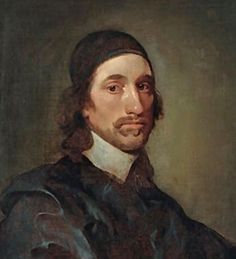
Did Edward Hilton actually look like this?
There’s the very enigma of Edward Hilton, for starters, just trying to prove he was here from 1623. From the circumstantial evidence, I’m convinced that he and Thomas Roberts definitely were, and besides, there are no rival hypotheses regarding their arrival. But that’s not rock-solid documentation doesn’t appear until retroactively. Maybe some of it, taken to London, survived the big fires and plagues and will resurface. Don’t hold your breath.
I’ve seen some of the early charters and patents and, for all of their descriptive prose, find them baffling. The layers of landholding are just the beginning.
What, for instance, did William Fiennes – the eighth Baron Saye-and-Sele – and Robert Greville, the second Baron Brooke, receive in compensation when they relinquished their proprietorship of the New Hampshire province to Massachusetts? And for that matter, how did the Massachusetts Bay colony arrange the transaction?
I would even like to see the details on what Edward Hilton had received when he earlier sold his proprietorship – again, just what did he possess? – to Lords Saye and Brooke. His reason, according to one source, was a sense that the Massachusetts authorities were preparing to seize the Piscataqua and his defense would have been inadequate. Saye and Brooke had clout, as well as a colony in Connecticut named after themselves: Saybrook.
There are also questions of how the “governors” and ministers of the province were selected prior to Massachusetts’ control of New Hampshire.
Just trying to decipher the script and text requires an expert, perhaps even an antiquarian lawyer. And how many of the documents remain, anyway, in the mother country or the New World?
Fellow blogger Mark Everett Miner touches on some of this when he remarks, “It is thought that William Hilton was somewhat educated as he wrote several competent, if poorly spelled, letters.” They are, however, quite convoluted. Here’s an excerpt from a 1633 letter to John Winthrop:
“There arived a ffishing shipe at Pascataque about the 15th of this p’sant moneth where in is one Richard ffoxwell whoe hath fformerly lived in this cuntery he bringeth nuse yt there were tow shipes making ready at Barstaple whoe are to bring passingers & catell ffor to plant in the bay he hath leters ffor mr wearom & divers others at dorchester wch hee intends to bring hr to the bay so soone as posible he can like wise he heard ffrom mr Alerton whoe was making ready at Bristole ffor to come ffor this cuntery other nuse he bringeth not that I can heare of onely mr Borowes purposeth to come ffor this cuntery ffrom london & soe desighring you to convey thes leters in to the bay wth what conveniency you can desighring the lord to blesse you in your lawffull designes I humbly rest …”
How do you make sense of such surviving documents?
In Dover, First Parish records don’t pick up until John Pike set down his memories, beginning with his arrival as minister in 1677. Still, as later minister and historian A.H. Quint observed, “There are no extant Dover church records before Dr. Jeremy Belknap’s ministry,” beginning in 1767, “except that he copied into a record book a list of baptisms and of members, commencing in 1717. The town records are also very defective during the period of Mr. Pike’s residence.” He adds, “This is due partly to the Indian troubles, and partly to the Masonian difficulties.”
By the time Samuel Bownas first visited Dover, the Meeting’s earliest minutes had already been lost – in a barn fire, according to oral lore.
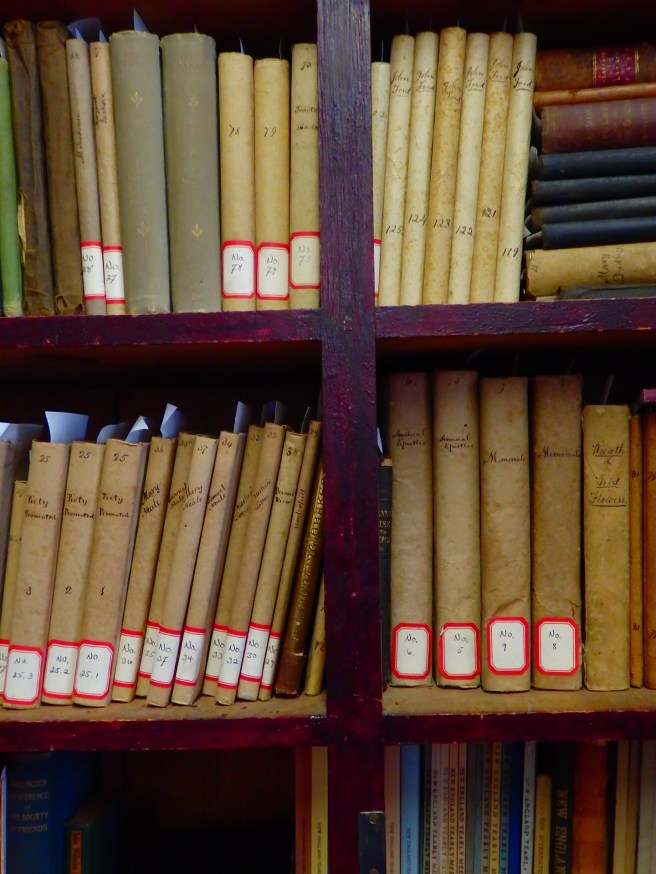
Old volumes in the Dover Friends library tell mostly about Quakers elsewhere. These rare books do not circulate.
In Quakers in the Colonial Northeast, Arthur J. Worrall notes, “The clerk was the most important of the persons active in meeting affairs.” While his examination focused on the yearly meeting level, he remarks, “Clerks had been appointed before 1700, but we know little about their activities. Their note-keeping was careless at best, and … it was not unusual for a clerk of many years’ standing to lose his copy of the minutes.”
One consequence is that we are unlikely to learn much of Dover Quaker life in the early years from the Yearly Meeting books.
Dover’s surviving records begin with the women’s minutes in 1701, with a gap from 1785 to 1814, and the men’s minutes, from 1703. Its vital records stretch back to 1678 but, curiously, were not begun until 1787.
Missing, of course, are the accounts of the early persecutions by the Puritan authorities, the reactions to the Waldron incarceration of Natives or their later attack on the village, or even the early leadership of the faith community.
For family genealogists, the Quaker sources are among the best available family records in America before the 1850 Census, the first to name everyone in a household. The Friends minutes, however, name only those families in good standing as members. Even so, they can be very useful in framing a family overall.
New England records were never comprehensively indexed along the lines of William Wade Hinshaw’s six-volume Encyclopedia of American Quaker Genealogy, covering Pennsylvania and New Jersey, New York, North Carolina, Virginia, and Ohio, or its seven-volume companion by Willard Heiss, Abstracts of the Records of the Society of Friends in Indiana. But Dover Meeting’s surviving family records were serialized from 1903 to 1909 in the New Hampshire Genealogical Record, the Official Organ of the New Hampshire Genealogical Society. Its editor and publisher was Charles Wesley Tibbetts, an attorney. I haven’t been able to determine if he is a direct Quaker descendant, but his kin were prominent in the Meeting.
Dover’s surviving records are preserved in the New England Yearly Meeting archives in the special collections at the University of Massachusetts Amherst, where they can be accessed by researchers and readers. As I already mentioned in an earlier post, a truly close examination of them would add much to a more thorough history of Dover Friends – a list of clerks, for instance, or the Revolutionary War volumes of discipline – but the results would likely be too arcane for my intended audience.
Still, if opportunity ever presents itself, hunkering down for several weeks in Amherst might be revealing.
Other things I would also like to see:
A fuller presentation of the Devon folkways, without the Virginia overlay in David Hackett Fischer’s Albion’s Seed.
A history of Salem, Massachusetts, drawing on the culture clash that runs through my own book. I suspect that much of the witch trial hysteria originates in those differences, abetted by a “perfect storm” of related factors. Likewise, the Salem Friends Meeting and its successor at Lynn need a bigger profile.
Ditto for Hampton Friends, morphing into today’s Amesbury Monthly Meeting.
A major overview of Quakers in Maine. Again, the fragmentary nature of the surviving minutes would require amplification from court records, deeds, and genealogies.

 Jnana's Red Barn