Off into the wild

An aspect of modern art, in sensing it as unstructured, unpredictable, chaotic, is its freedom, a realm where awareness expands beyond the bounds of context.

At least, that’s how I saw it then.

~*~

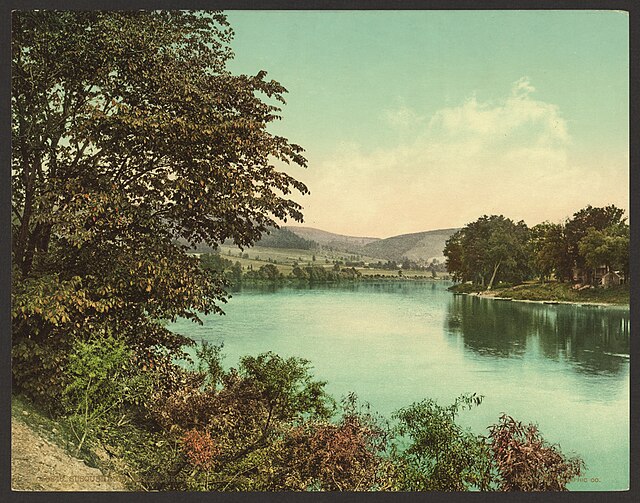
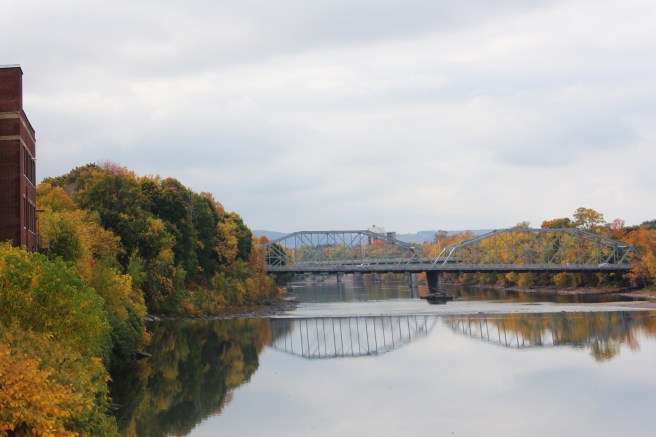
Well, my life was a clash of dulling employment and conflicted emotions of my personal life beyond the office. Curiously, it was also a time of close observation of the Susquehanna.

Susquehanna River seen from the Southside above Rockbottom Dam in Binghamton. Photo by BJ Doolittle Tuininga at Shutterstock.
Don’t be duped by the Susquehanna’s tranquil appearance. The river could be fierce, including the rage when an ice jam broke free. Historic image via Wikimedia Commons.

Who are they besides their latest book?

Contributors’ notes at the back of a literary quarterly or toward the beginning of a glossy magazine can sometimes be among the most entertaining reading in the entire volume.

Or they can be among the most deadly, as I’ve been thinking while scanning those in the Paris Review, where they run along the line of so-and-so is the author of the new insert-title-here book of poetry or fiction. It’s so one-dimensional.

Don’t know about you, but I definitely want to know what makes a writer tick – unique details help. Hopefully, something more than where they’re also teaching.

Yes, I know as writers we’re all hustling our books, but ultimately, we’re the brand, like it or not. (God, it hurts to admit that, but it’s true.)

The celebrity Proust Questionnaire at the closing of Vanity Fair magazine issues is a great prompt.

So here I am, pushing a whole lineup of volumes while hoping at least one of them jumps out at you and makes you get it, free or at a price – yes, I’m shy about asking for money – but still!

This matter of self-identity came into play with my poetry collection Hamlet, a village of gargoyles, which built on exercises where I found it much easier to say who I’m not than who I am.

So here I am, with a few potential contributor notes I may have sent out:

  • As a youth, Jnana admired crystals grown from supersaturated solutions. Deep blue copper sulfate was his favorite.
  • Jnana has found landscapes evolving into an awareness of spirituality and space, as well as settlement and wildlife.
  • In addition to reading and writing, Jnana enjoys hiking and camping, birding, New England contradancing, classical music, opera, jazz, visual arts, genealogy and history, theology, Quaker practice, homebrewing, and a cappella part-singing. If there were only more time, he contemplates.
  • Jnana Hodson never expected a film literature course under Harry Geduld would influence his poetry as much as college writing class under poet Dick Allen. But it did: the clash of thesis and antithesis producing an unanticipated synthesis in reaction.
  • When Jnana first began reading contemporary poetry (for pleasure, independent of classroom assignment), he sensed that often the poem existed as a single line or two, with the rest of the work as window dressing. Now he reads the Psalms much the same way, for the poem within the poem, or at least the nugget he is to wrestle with on this occasion. Psalm 81, for instance, has both “voice in thunder” and “honey from rock.”
  • Elk move through Jnana’s mind, its memory, more as emblem and ideal than creature. He has not tasted elk flesh or stroked the fur. What he’s known has appeared only on the forest floor as track and scat – no ticks on the neck or patchy summer skin. That, and the winter encounters viewed from a distance.

While we’re at it, let’s ponder the faces on back dust jacket or cover.

How few seem like people I’d like to meet. How much anger, hatred, envy, darkness – brooding – comes through? How little serenity, how little joy? Multiplicity of personality. Just who am I? Who are you?  Empathy. Discomfort. All the rest.

Who are you in relation to all this?
As a stab at transplanting a sensibility

The Four Noble Plants [and a quest for American equivalents]

  • Bamboo, bends but never breaks in a storm = Oak, with its acorns
  • Plum blossom = Apple
  • Orchids = Sunflowers
  • Chrysanthemums = Dandelions
  • Now, to play with those starting with classic Japanese or even Chinese poems and substituting the equivalents. This could be weird.

Too bad those book collections are still in storage.

As for “noble,” in America? Even that needs an equivalent.


As my poetic voice took shape

The odd syllable counts of my poetry lines: quite female! And quite flexible. Contrast to “maleness” of iambic pentameter or other club-feet.

The luxury of wasting a whole notebook, an entire sketchbook. [Oh? Did I pitch that out already?]

Good poetry takes leave of tight meaning … pointing to “lunatics” as “originals” … the way flames do.


Some final shots for the year in my writing life

Sometimes my own writing goes beyond anything I can explain. For instance:

  • My Kinisi here at the Barn? Prompts, yes, if you want.
  • But firing them into full blast?
  • Much less igniting a conflagration?
  • We do what we can, each one on the edge.
  • I keep shooting what I think are some good ones at you, hoping someone will take it the next step.

Meanwhile, over the years:

  • I’ve attempted to walk in the Light daily, though fallen far short.
  • Ridden the uprising Spirit.
  • Found silent meditation crucial to writing poetry.
  • Uncovered 12 generations of my Hodgson ancestors.
  • Returned unknowingly to the faith of those ancestors.
  • Survived a shrinking profession to reach retirement.
  • Sought an incandescent language.
  • Still need a champion.
  • Never taught creative writing.
  • Found literary writing can resemble prayer.
  • Am perhaps best known for my Mixmaster approach to poetry and fiction. Or maybe it was my radical history of Dover along with uncovering an alternative Christianity in the Quaker metaphors of Light and Seed
  • Prefer a religion that relies on questions more than answers
  • Think we’re confused enough, already.
  • Store bath towels in a basket.
  • Wear reading glasses, more and more.
  • Have become uncomfortable around smokers.
  • Had hoped to reclaim my social activist witness, after years of journalistic neutrality.

Remember, you can find my works in the digital platform of your choice at Smashwords, the Apple Store, Barnes & Noble’s Nook, Scribd, Sony’s Kobo, and other fine ebook retailers. You can also ask your public library to obtain them.

Religion turns off readers, and yet …

That’s an advice given to authors, though it’s something I cannot avoid in my own novels and even poetry. Where else can we fully address the deepest values we hold?

Politics doesn’t seem to be working that way, for sure.

Is science fiction the best we can do for now when it comes to grappling with philosophical issues?

Still, I’ve dug in, ranging from the spirituality of yoga and Buddhism in Zen and Tibetan traditions to Quaker and Mennonite Christianity to Greek Orthodoxy as well as Indigenous strands.

I tackle this most directly in Light Seed Truth, an ebook that includes four earlier booklets investigating the revolutionary impact early Quakers found in applying the metaphors of Light, Seed, and Truth. To that I add examples of the power of metaphor in modern secular society, just for balance.

My goal is to raise readers’ awareness and sensitivity rather than convert anyway to a particular faith.

With religion, I want to hear how faith is experienced by different individuals, rather than what they speculate they should be experiencing.

The best mystics I’ve known have surprisingly practical and humorous.

~*~

You can find it and more in the digital platform of your choice at Smashwords, the Apple Store, Barnes & Noble’s Nook, Scribd, Sony’s Kobo, and other fine ebook retailers. You can also ask your public library to obtain it.

Avoiding the G-word while examining faith

One of the things I’ve learned over the years is that turning any discussion of religion away from the doctrinaire formulas and instead to direct feelings and experiences can be quite refreshing, even inspiring.

Essentially, that boils down to shifting from “head” speculation and instead to personal encounters, “heart,” if you will. It moves the focus from the abstract to something more concrete.

In my book, Light Seed Truth, I try to take that a step further by avoiding the G-word altogether except in direct quotation. Part of that stems from a Jewish tradition that considers the name of the Holy One to be too sacred to be uttered, leading instead to substitutes that include the all-cap LORD in English translations, meaning The Name. And part stems from just how different our individual perceptions of the word can be, often defaulting into an old bearded male of some sort, despite other options. Even Adonai and Elohim carry different connotations, not that I go into them. Just be aware.

Besides, the G-word can too easily create a wall between those who “believe” and those who don’t.

Add to that the surveys that find atheists, overall, are more familiar with the Bible than are members of varying denominations, and I do want to include them in the discussion.

In my ebook, I do hope to encourage an appreciation for wonder itself in our lives.

Not a bad place to start, is it?

You can find the volume in the digital platform of your choice at Smashwords, the Apple Store, Barnes & Noble’s Nook, Scribd, Sony’s Kobo, and other fine ebook retailers. You can also ask your public library to obtain it.

Where is today’s local communication and shared identity?

Unlike many localities, Eastport has a fine newspaper, one that appears twice each month. It covers much of Washington County in Maine and Charlotte County in neighboring New Brunswick, Canada.

You get a good sense of the place from its pages. I can’t say that for many of the newspapers I’ve seen across the country, even when they were big moneymakers.

Living in out-of-the-spotlight localities, I’ve been sensitive to the nuances of each landscape and the people who inhabit there, not that I’ve often found them reflected in mass media outlets.

It’s not just newspapers or, for the most part, TV, though Northern Exposure did create the sense of one, especially with Chris Stevens as the disc jockey on KBHR radio.

I do sense that the lessening of local identity reflects the loss of local economic power centers, largely through corporate buyouts. The pharmacist no longer owns the drug store, nor does the local bank have its own president. The newspaper is part of a chain, as are most hospitals these days. The list goes on.

As I’ve explained, for many years, despite the arcane business structure in which advertising rather than sales of copies provided the bulk of the income, hometown newspapers were cash cows for their owners – who, in turn, paid their reporters and editors minimal wages.

The resulting management practices – reflecting those of surrounding corporate retailers and manufacturers – have put news coverage at risk, endangering both the communities and democracy itself. How will they, like the reporters and editors, survive?

Oh, yes, the big box stores – especially Walmart – rarely bought advertising space in the local paper, even while they squeezed the smaller retailers out of business. I remember one year when an economic downturn put five of our ten largest advertisers out of business.

~*~

Social media posts by amateurs may fill some of the gap, but there’s no substitute for fact-checking and other accuracy. Reporting and writing take time and devotion, not a given when you have a real job and family vying for attention.

And if you’re out there solo, who’s going to back you up when the topic at hand gets nasty? As it does, when corruption seeps in.

Anybody else feeling crushed?

From a Scroll of Improvisation

The premise: So much of my writing has resulted from distillation, revision, compression, and concision, often as a matter of collage or thesis/antithesis/ synthesis opposition and release.

The pieces of this scroll, in contrast, are envisioned as longer, free-flowing outbursts without structure or topic, a matter of simply letting the writing stream where and how it will. Perhaps my Dialogues are my closest antecedent, although I could throw in Ned Rorem’s journals or John Cage’s diary or Keith Jarrett’s solo improv concerts. I like the story about one of those performances, where Jarrett came out and sat for some time, unable to begin. As the audience grew restless, someone called out to the stage, “D sharp!” or some such; the pianist turned, said “Thank you,” and began.

While I anticipate these to emerge as prose, their spirit should be poetry. Whatever the key or time signature.

~*~

To start slowly, or even slow, with a single note. Not even a chord. A word or two, cryptically without context. Sit in place, melting.

Where was I, then? Or you?

De Tocqueville set out to define America, that is the United States, as some overriding commonalities. What conceit, though I suppose we might do the same regarding Europeans, as if Italians and Danes resemble each other in many ways. Yes, I boldly spent a week on the Olympic Peninsula followed by a couple of years digesting the place and its peoples. More recently, the decades of investigating New England have proved more elusive. Even my native Midwest is far more varied and nuanced than I would have suspected. Explore the world? My focus becomes more and more this place I inhabit along the Cocheco.

The falling water, splaying on rock below. The mills. My own small tract, now covered with new snow. Birds at the feeder. Skittering.

What do I know of anything? Of anyone? Just who am I, and how did I ever arrive here, with this woman and her daughters? All these squirrels and buried black walnuts.

Each shell, a note. Each snowflake, another. Cry out, unheard against the wind.