While my novels Nearly Canaan and Secret Side of Jaya contain many details from my Yakima Valley years, the experience also prompted a proliferation of poetry.
In the Far East there is a vital, well-read proletariat literature – speaking for a people.
Here, we have intellectuals playing games. Along with populist idiots.
Still, how much of the Far West book scene I knew revolved around poetry-conscious, well-stocked bookstores that were also patrons to readings, broadsides, and small private volumes.
Suppose, now, a poetry journal allied with a bookstore where its authors’ books could be purchased …
This was pre-Internet, which has opened new opportunities, or before I knew of radical publisher and bookseller Giles Calvert and his Black Spread Eagle on Ludgate Hill near St. Paul Cathedral in London, the voice of many early Quaker tracts and volumes.
Previous posts this year have presented my curiosity in petroglyphs and petrographs even before I relocated to the Pacific Northwest and saw them in the wild. That time in my life was accompanied by a growing appreciation of tribal mythologies, which I believe enhances an understanding of the region’s unique biosphere. Living at the edge of the Yakama reservation meant the ancient stories I was reading were local news.
The Indigenous spirit was something I missed in my dwelling-places since in my moves eastward across the Midwest, Baltimore, and then New Hampshire.
Eastport, however, with its Passamaquoddy legacy and presence, has revived that. The tribe somehow survived oppression and is rediscovering and reclaiming much of its culture, thanks to the pioneering efforts of individuals like the late Wayne A. Newell, who wrote more than 40 books in the supposedly dying Passamaquoddy language before his first book in English in 2021, Kuhkomossonuk Akonutomuwinokot, Stories Our Grandmothers Told Us.
The late Fredda Paul was doing something similar within herbal medicine and healing lore, while also continuing the storytelling tradition. They are both deeply missed.
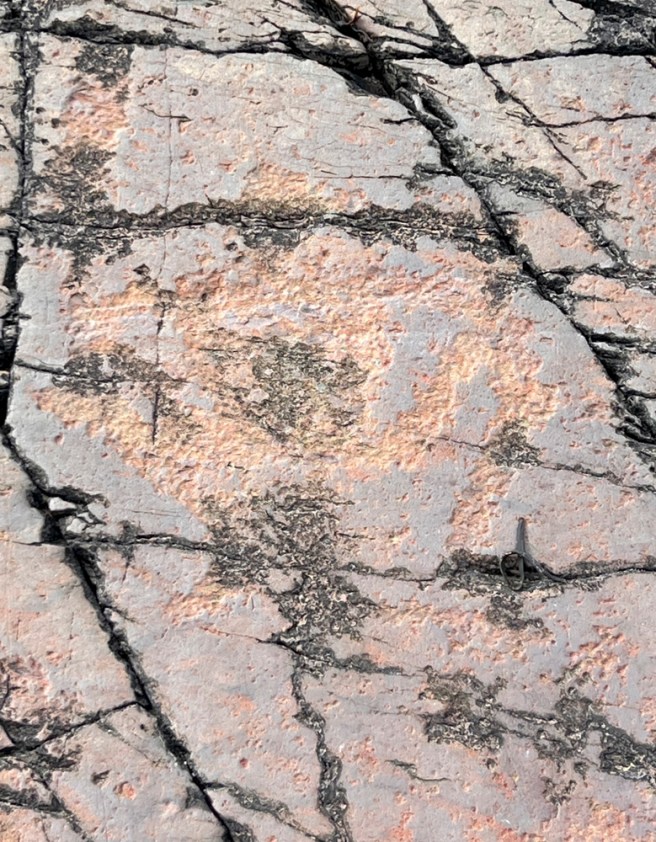
Tribal historian Donald Soctomah has furthered their work. These days, he’s part of a circle documenting and preserving the local petroglyphs in the face of rising sea levels. His online presentation earlier this year with the Border Historical Society in Eastport had me realizing I may have been overlooking impressions here – many are stippled into the rock surface in a way that they’re visible only early in the morning or late afternoon, especially if the stone is wetted. A video, A Song of the Drum, and several short YouTube videos from Machiasport can be found for free online.
This petroglyph depicts a woman giving birth. It was chipped into rock using smaller stones, a style different than the long incisions made by sharper instruments.
Another wonderful video, Rhythm of the Heart, on the life of birch-bark canoe maker David Moses Bridges, is also available for free online. It’s a moving testimony. He passed way too early.
In revising my novels Nearly Canaan and Secret Side of Jaya, I created several lookbooks slash storyboards from images found online to sharpen details in some of the passages. It’s a great writer’s hack, by the way. You pick up bits you overlook at the scene.
I do wish I had my own photographs from the decade of journals we’re sampling, but often I had no camera, much less training in how to use anything except the simplest point-and-shoot.. I did, however, work with some of the best photojournalists and knew some outstanding fine arts photographers as well. It would have been wonderful to work with them on these posts, but time has intervened. Well, I still have memories, faded as many are. And with a camera, I wouldn’t have worked so devotedly on writing, no doubt. There’s only so much time in a day, even without a paying job to attend to.
The first three cuts on my first Joan Baez album (acquired in ’62 or ’63) were classic folksongs – “Silver Daggers,” “East Virginia,” and “Fare Thee Well.” Along with a few others, like “Wildwood Flower,” they exhibit a very moving quality that comes not so much from directed words (as in “calf with a mournful eye”) but from a sum that arises outside of the text.
The lyrics themselves are dry, compressed. The songs are best sung emotionally flat, with a childlike beauty and comprehension (or lack of it). Above all, there is a kind of detachment that makes the whole thing even more touching or eternal.
From Maynard Solomon’s album liner notes: “A remarkably compressed love story. … In its four short verses loom enough tragic characters to populate an 18th century novel … the haunting and mysterious opening verse, with its claim of historical authenticity and its foreboding of personal bereavement. … Perhaps its beauty comes from its biblical connotations, for the imagery of the closing verses is related to New Testament descriptions of the Last Judgment, and the song ends with a quotation from Mark (XII,20) – ‘Till all these things be done.’ … The seemingly obscure and disconnected text is emotionally fused. … Like many another favorite from North Carolina and its neighboring states, [it] has the strange quality of rejoicing as it laments, exulting as it weeps …”
I did not yet know my family roots in North Carolina, but I have taken this, internalized, as an ideal in my own writing that has followed, not that what’s followed has manifested that way over the years. Think, too, of how her material changed.
As my journals record, my return to southern Indiana took me well beyond the college campus. I’ve already mentioned my explorations of the wooded Leonard Springs and its cave system just beyond our house at what was then the fringe of the college town. Let me remind you that my Thistle Finch editions blog has free PDF downloads of the related chapbook of my resulting poems as well as a photo album I put together from online gleanings to refresh my memory.
I did encounter a lot in a short year-and-a-half, even beyond my paying employment. I do would how my writing would have evolved if I had been able to remain in place.
A recent post here told you of my early encounters with the Leonard Springs. The then largely unknown wooded ravine soon served as a kind of personal refuge for me just beyond our house. It became a microcosm of something much larger in my emerging awareness.
For the chapbook of poems originating in those explorations as well as a supporting photo album, go to my Thistle Finch editions free digital bookstore. Do take a look.
While much of my Great Black Swamp residency has been distilled into my novels Nearly Canaan and Secret Side of Jaya, it also infused an outpouring of poetry. By the time I arrived, the land had long been drained and turned into some incredibly rich farmland. Something, apparently, had been drained from the people as well.
Among the free PDF poetry broadsides available at my Thistle Finch blog are Toward Tiffin, Farmer Disking His Fields, and Prairie Wind. Once again, I must confess to being quite fond of micropoems as well as “found” poems. Poetry can be a state of mind as well as craft, wherever you are.
In addition, you’ll also find a free poetry chapbook, Furrow, and two photo albums, Prairie Depot and Vast Plains. It is hard to envision such a landscape if you haven’t traveled across the American Midwest of Great Plains.
Perhaps you never thought I’d meet President Ford or movie legend Marilyn Monroe, but I’m finally revealing what happened. Take a look at Night Visions. It’s free at my Thistle Finch free digital bookstore.