HOW HUMBLING

Even though I’ve never asked previous clerks how they experienced sitting at the head of an institution founded in the 1660s, I found it humbling. The mere thought of superintending the construction of our present meetinghouse (1768) is overwhelming, as is the faithfulness that led the congregation through the Revolutionary and Civil wars. To think of the succession of mighty Quakers who came here in traveling ministry reflects the history of the movement itself, beginning with Elizabeth Hooton, who first nurtured George Fox in the emerging faith. Dover Friends sat down to worship originally in homes and barns, then in our first two meetinghouses, and finally in the room we know so well.

Visit historic Plimoth Plantation, and you get a taste of what Dover must have been like – already four years old at the time those enactors portray. It’s probably not that different from what the first Friends encountered just 3½ decades later when they stirred up what would become our Meeting. Just think of the differences in dialects and vocabulary. (Plimouth, to represent a population of slightly more than a hundred people, employs seventeen dialects, moderating them enough to make them understandable to modern visitors; Dover was likely no less divergent.) From all the evidence of smoke-filled houses, bitter winters, mosquito-infested summers, this must have been a rough-and-tumble community where Friends required generations to evolve into the sedate image we often treasure.

There aren’t many places in the United States having organizations with such long histories. We know only a portion of ours. Even so, we’ve been entrusted with this legacy, and to fulfill it and pass it on. How humbling, indeed.

HOT DOG BUNS VERSUS FRANKFURTER ROLLS

Once upon a time, or so it seems now, a girlfriend sent me out with orders to come back with hot dog buns, which is what I did.

But when I handed her the grocery bag, she cried out, “Oh, no! What are these?”

“They’re hot dog buns,” I replied ever so naively.

“No they’re not!” she insisted.

“But they’re what I’ve always had hot dogs on,” and they were.

She would not believe me, so off we went, together, to the supermarket.

“These,” she said, “are hot dog buns.”

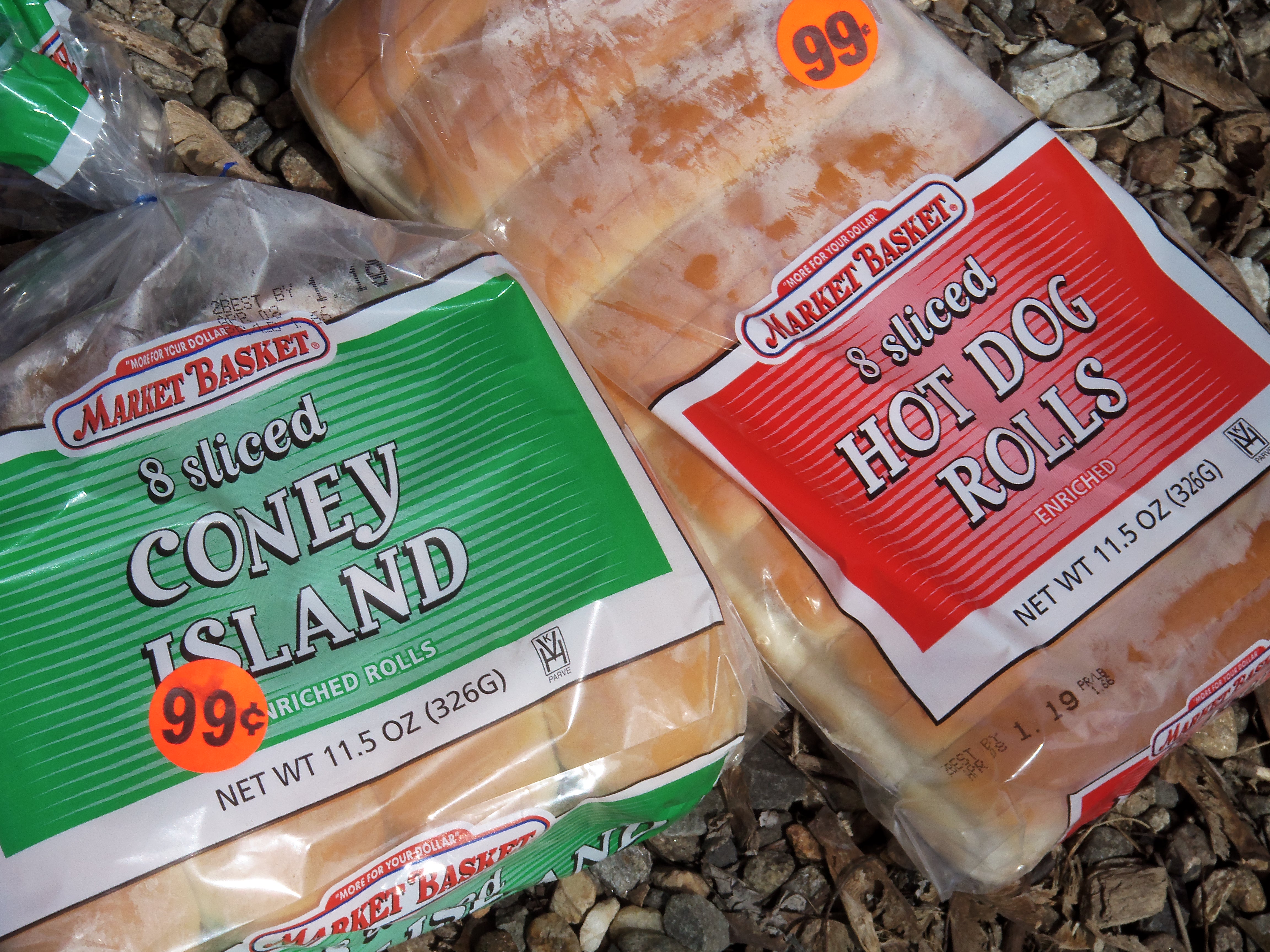
Asked to pick out a hot dog bun, which would you choose -- the ones sliced on the top, at left, or on the side, at right?
Asked to pick out a hot dog bun, which would you choose — the ones sliced on the top, at left, or on the side, at right?

They looked like a flattened loaf of bread cut in fat slices. The side of each “bun,” in fact, was without crust – naked, to my taste.

Pointing to another shelf, I looked at the kind I’d always known – the kind, that in fact, came labeled Hot Dog Buns. Hers, in contrast, were labeled Frankfurter Rolls.

Hmm, we both said without satisfaction.

She had, in truth, grown up in New England and lived nowhere else. And her idea of how to serve a hot dog was unique to the region. Not in something she considered a torpedo roll.

Ah, but the plot thickens. As I bought packages of each this time around, there was no Frankfurter label -- and the Hot Dog tag instead went on what my wife confirms are often called Frankfurter buns or rolls around here. As a further complication, we now have the term Coney Island, which confounds my elder daughter while bringing to my mind something completely different, a miniature hot dog where I grew up, often served covered with "chili." But that's a whole other story.
Ah, but the plot thickens. As I bought packages of each this time around, there was no Frankfurter label — and the Hot Dog tag instead went on what my wife confirms are often called Frankfurter buns or rolls around here. As a further complication, we now have the term Coney Island, which confounds my elder daughter while bringing to my mind something completely different, a miniature hot dog where I grew up, often served covered with “chili.” But that’s a whole other story.

This can, in turn, point to a lot of other regional distinctions. Whether you call a device a watercooler, a water fountain, or a bubbler, as we do here. Or whether you order a soda, a pop, or a cola. Feel free to expand the list. It can go on a long time.

Fast forward, then, to lunchtime at a national conference being held in Rhode Island. I sat down and joined a random group that included a handful of teens. One was from North Carolina. I pointed to the hot dog on his neighbor’s plate. He looked bewildered. “What’s it wrapped in?” he asked.

“Would you call it a hot dog bun?” I prompted.

“No way!”

“Oh yes it is,” said the girl from Connecticut. “It’s what we always use.”

You know where the conversation went from there. Yes it is, no it isn’t.

At least the college cafeteria knew to stock both Hot Dog Buns and Frankfurter Rolls.  As we all discovered.

Hmm. Maybe next time we have a crowd over and we’re grilling hot dogs, I’ll get packages of both – and then see which kind goes first.

WATERTOWN AND THE BOSTON MARATHON BOMBING

When I awoke this morning, my wife greeted me with the words, “You missed it last night; all hell broke loose.” I thought she was talking about her board meeting or maybe a big fire, but instead she told me that all of Watertown, Massachusetts, and several surrounding towns were locked down. And then she related the news of the Boston Marathon suspects, the subsequent shootings in Cambridge, the carjacking, the mad police chase down Mount Auburn Street, and all of the activity taking place around the Arsenal Mall.

The developments are still unfolding – and likely will continue to do so for days – and I won’t attempt to relate what’s being reported. What is difficult is trying to imagine the challenges of coping with the shutdown of a very active community. One I’ve been coming to know with some affection.

This year, my Thursdays have wound up in Watertown, where the Revels Singers rehearse for two hours each week in St. John United Methodist Church on Mount Auburn Street. The choir, ranging up to 80 voices, many of them very fine, is led by George Emlen in works from the Renaissance to the present spanning many nationalities and languages. Last night, for instance, we tackled Welsh and French-Canadian as well as English, and the musical experience was exhilarating. No, I’d never even dreamed of being part of such an ensemble.

Rather than getting stuck in rush-hour traffic, I try to arrive early enough to have dinner at one of the inexpensive but excellent restaurants a block or two down the street. (Don’t let looks deceive you: follow your nose instead.) Watertown is an older suburb of Boston, one with substantial houses typically on small lots, and has become a haven of many ethnic cultures. The church where we practice, for instance, also houses a Korean Methodist congregation. Buses pass by frequently, and pedestrians fill the sidewalks. In one block I pass the Greek kabob and gyro emporium I’ve come to habituate, an acclaimed Chinese storefront with tables and takeout (yes, some of it goes back with me to New Hampshire), a Japanese fusion eatery, an Iranian bakery, an Hispanic-focused grocery, several hair and nails salons, a cigar store or two. (I’d planned to make a list someday.)

Yesterday I even arrived in time to tour the Armenian Library and Museum of America,  which incidentally had free admission this week as an offering of a quiet public place for the community to heal from the tragedy on Monday. (The irony of the free admission now comes, of course, in the closing of the town itself.) As the center of Armenian culture in the New World, Watertown has much to say about genocide and suffering over the centuries.

I was still reflecting on that experience as I ate, until noticing the repeated images on the large-screen TV on the restaurant wall as it showed footage of the two suspects shortly before Monday’s bombings. A man at one table got up, pointed to something on the screen, and commented on a detail, which prompted discussion from other tables. People were paying attention.

From there it was on to rehearsal. A magnolia and the daffodils in front of the church were in full bloom. Spring was in the air. Even afterward, as we returned to the street, we wanted to linger.

Who could have anticipated the state of siege that would erupt a few hours later?

Down to Copley Square and the finish line

There’s something wonderfully small-town about Boston, despite all of its world-class amenities. For those of us who love professional sports, classical music, museums of all stripes, theater and ballet, lectures and the like, there’s far more to do than time will ever permit.

But the scale, especially with all of its smaller cities and towns clustered in close at hand, can be wonderfully human. Or think of Fenway, one of Major League Baseball’s smallest parks, and its oldest.

Nowhere have I seen this balance more acutely than in the Boston Marathon.

The first inkling I had was one April Monday when I was driving along 128, the semicircular freeway around the city. With all of its high-tech business headquarters, it’s often called Silicon Valley East. Approaching one overpass, I noticed the side of the highway was thick with (illegally) parked cars, almost as if there’d been an accident. But then I saw the overpass itself was crowded with people. Only when I turned on the radio for the every-10-minute traffic report did I discover this was where the race route crossed on the way toward Copley Square. The station, by the way, was almost exclusively marathon coverage.

Nor was it alone.

The city’s television stations also provided continuous coverage, from 9 a.m. or so at the start in Hopkinton through the awards at 5 p.m. on Copley Square in the Back Bay. Live cameras broadcast from trucks in front of the lead runners and wheelchair contestants, as well as reporters and cameras all along the 26-mile route. The technical planning and execution of such coverage must be incredible.

While the event has more than 20,000 registered participants and 500,000 spectators each year, you’re still likely to know someone or more who have run in it. In fact, if they’ve qualified, you can follow their progress and times online. That’s another incredible aspect, to my eyes. And then there are all of those who jump in afterward, no need to register — you just get to say you’ve run the marathon.

To share in that joy and community spirit combined with the determined efforts of each of the runners is inspiring, even before we add the outdoors release from New England’s long winter. This is what the evil scheming behind yesterday’s bombing targeted. If the perpetrators thought they were somehow reenacting the Shot Heard ‘Round the World that the Patriots’ Day event commemorates, they have it backwards. We celebrate the resolve and victory of the people over tyranny and fear.

While officials are remaining tight-lipped about what’s happened, we’re getting our news from those we know, even when we live more than an hour away from the action. We’re relieved to hear our daughter’s safe and that a friend crossed the finish line hours earlier, but we’re also troubled by the words coming second-hand from the emergency rooms. We’ll learn more in conversations in the weeks ahead. In the small-town character of Boston, these things hit home, one way or another.

With determination, then, here’s looking ahead to the 118th annual marathon running April 21, 2014, God willing.

Social status versus social value

You see the lists from time to time: America’s richest individuals or families.

You also see how proud people are about finding loopholes to cut their own taxes or lobbying for another advantage over the rest of the public.

Seems we’ve had it wrong. We should be according that respect to America’s top taxpayers. Yes, let them compete for the status of being the most generous Americans, the ones who step forward for their country. We could even break this out by occupation, for extra Top Ten lists. I’d even be in favor of having a monument in Washington inscribed with their names.

Let the rest of them be considered shirkers.

POINT OF REVOLUTION

A lighthouse has stood at this site along Portsmouth Harbor since 1771, where fortifications were first erected in 1632. The long dark stonework along the water was part of Fort Constitution. Historically, it was the site of Fort William and Mary, the first armed skirmish of the American Revolution.

This year’s Patriots’ Day comes next Monday, a holiday in Massachusetts and several other states to commemorate the April 9, 1775, Battles of Lexington and Concord that inaugurated the American Revolutionary War. These days it’s also the occasion of the 117th annual running of the Boston Marathon as well as a late-morning Red Sox game at Fenway.

New Hampshire, on the other hand, traditionally marked the event obliquely, with its own Fast Day the following week, ostensibly originating in 1680 and officially abolished in 1991. We got Fast Day as a holiday free from the office, but the only way we knew when it would fall in a particular year was by paying attention to the Marathon — and we’d get the following Monday off.

While Patriots’ Day marks the historic “Shot Heard Around the World,” the actual first armed skirmish happened months earlier at Fort William and Mary along the Piscataqua River in New Hampshire. On the evening of December 13, 1774, Paul Revere rode north from Boston with reports of the latest British actions, especially in Rhode Island. The news sufficiently angered 400 Sons of Liberty led by John Langdon to march on the fort, one of several protecting the mouth of Portsmouth Harbor, and raid it, carting off 98 barrels of gunpowder, roughly five tons. The next night, a small party headed by John Sullivan carried off 16 pieces of small cannon and military stores.

These supplies were then distributed to hiding spots, including the cellars of Boston churches and at least one New Hampshire home, before being used in the Battle of Bunker Hill on June 17 the next year.

Known as the Powder Major's House because of the gunpowder secreted in its cellar after the attack on Fort William and Mary, the residence of Major John Demeritt in Madbury likely originated around 1723 as the wing now attached to the larger Colonial home.
Known as the Powder Major’s House because of the gunpowder secreted in its cellar after the attack on Fort William and Mary, the residence of Major John Demeritt in Madbury likely originated around 1723 as the wing now attached to the larger Colonial home.

POSITIVE AND NEGATIVE POTLATCH

Among the coastal tribes of the Pacific Northwest was a custom known as the potlatch. Essentially, it was a way for the wealthiest members to enhance their status by redistributing the wealth downward. Starting with blankets and maybe a festive meal.

But then things got out of control. The way things do at a party when you forget about tomorrow, again.

Still, you first need to know everyone in the village and the fact it’s your home. Yes, the way families and neighbors just might function together.

Even so, remember. Maybe it was all Coyote’s fault, after all.

THOSE LIVE BROADCASTS

A confession: I’m one of those rare aficionados of radio, rather than television. It’s not radio in general, however: rather, it’s for classical music, essentially, along with jazz and folk music and, these days, Boston professional sports coverage.

At its best, there’s an intimacy – the host speaks directly to you, in your home or car or, during the summer, as I sit outdoors in the shade. There’s a sharing of good taste, too: here’s a new recording, a composer you ought to know, a fresh performer.

Unfortunately, ever since the Federal Communications Commission changed the ownership rules to allow a few companies to monopolize all the commercial stations, the overall variety and vitality of the airwaves has plummeted. Apart from athletics events, there’s little live coverage, especially at the local or regional level. As for the call-in programs, I’m left yearning for civility and balance. Please!

What survives as radio done well happens on the noncommercial stations. I’m fortunate to be within range of one that makes a special effort to present live concerts, including the Boston Symphony and Boston Pops as they happen on Saturday nights from fall into spring and their Tanglewood performances Fridays, Saturdays, and Sundays through the summer – plus groups that come to play at the station itself or live recordings from concerts throughout New England. The extra touches, too, are important: interviews with the performers, delving into the archives for historic recordings, or news of upcoming events. I love the quirkiness of their late-night host, as well as his comments on the changing weather.

Likewise, the Saturday afternoon Metropolitan Opera broadcasts have undergone a remarkable transformation. As one who began listening when the legendary Milton Cross was host, I find the Margaret Juntwait and Ira Siff announcing booth team an exciting – and often unpredictable – leap forward, along with all the live backstage links during the intermissions. As you could say, it’s Good Radio.

Now, if I could only get the truly eccentric Harvard station to come in on the air – we’re just out of range.

TOO BIG TO WHAT?

When you invest, even if it’s just for retirement, you’re told to diversify your risks.

Why is it, then, that it seems OK to keep having big corporations merge into less and less competition? During the Bush I and Bush II regimes, we saw what that meant for the banking industry: big bailouts on the taxpayers’ tab.

We were, after all, faced with another Great Depression.

Seems to me it would be far healthier to spread the risks here, too: break out into smaller companies – which would make more of them, too.

Along the way, there would be fewer layers of high management – and think of all the savings in executive pay along the way.

Those who advocate a free market need to remember: any company that’s too big to fail without taking down the rest of the economy is a threat. Period.

THE DISAPPEARING INDIVIDUAL

Not too long ago, the pharmacist owned the drug store, the corner bank had its own president, the local publisher owned the newspaper, and so on. Each one knew the community, and each one could make independent decisions. Each one also had a desire to be respected by those he or she served. Often, too, it was a family affair.

Now, of course, the pharmacy is headed by a manager who reports to a district supervisor who may report to an assistant vice-president somewhere who reports to a president of a subsidiary who reports to another vice-president of a conglomerate who reports to a president who reports to a CEO who probably has little real decision-making power, thanks to all of the policies that must be followed, thanks to a board of directors beholden to the major stockholders. As if you could name any of these people. Ditto for the bank and the newspaper and what used to be the local department store.

At each level of hierarchy, there’s little room for discretionary action – it’s all a matter of enforcing policy, especially as it relates to maximizing short-term profit.

Important local leaders have been reduced cogs following orders from afar. And the big money follows. Note, too, that the emphasis is on stockholders, not shareholders, who would include the workers, their communities, and even the faithful customers.

How, then, do we reclaim our full community, and heal the damage? It’s a basic question for democracy, after all, if the American Experiment is to continue, especially with any sense of equality and fairness.