WHAT IF THERE HAD BEEN NO VIETNAM ENGAGEMENT?

Oh, if John Lennon had only penned this one! Just imagine, what if there had been no Vietnam engagement?

What if John Kennedy had not been assassinated and had been free to curtail or even dismantle the CIA?

What if the military-industrial complex President Eisenhower had warned of just a few years earlier had not been called into high gear for yet another round of (highly profitable) business? Would it have been brought under control and reduced greatly, with all of the investment directed elsewhere?

What if the Red-baiting bluff had been called and we’d instead seen Vietnam as a civil war rather than a Communist intrusion into the “free world”?

There would have been no lingering black cloud over America like the one that continues to fester. Even without the antiwar movement, I suspect, the nation would have been bitterly divided by the fiasco that ensued in Southeast Asia.

Would our economy have been unencumbered to grow the way Japan’s did at the time we were saddled with the costs of fighting or the accompanying steep inflation? Or the costs we’re continuing to pay in debt interest and veterans’ benefits?

And, oh yes, maybe there would have been no Hippie Trails novels, either.

Just imagine. And then add a comment on your vision. Music optional.

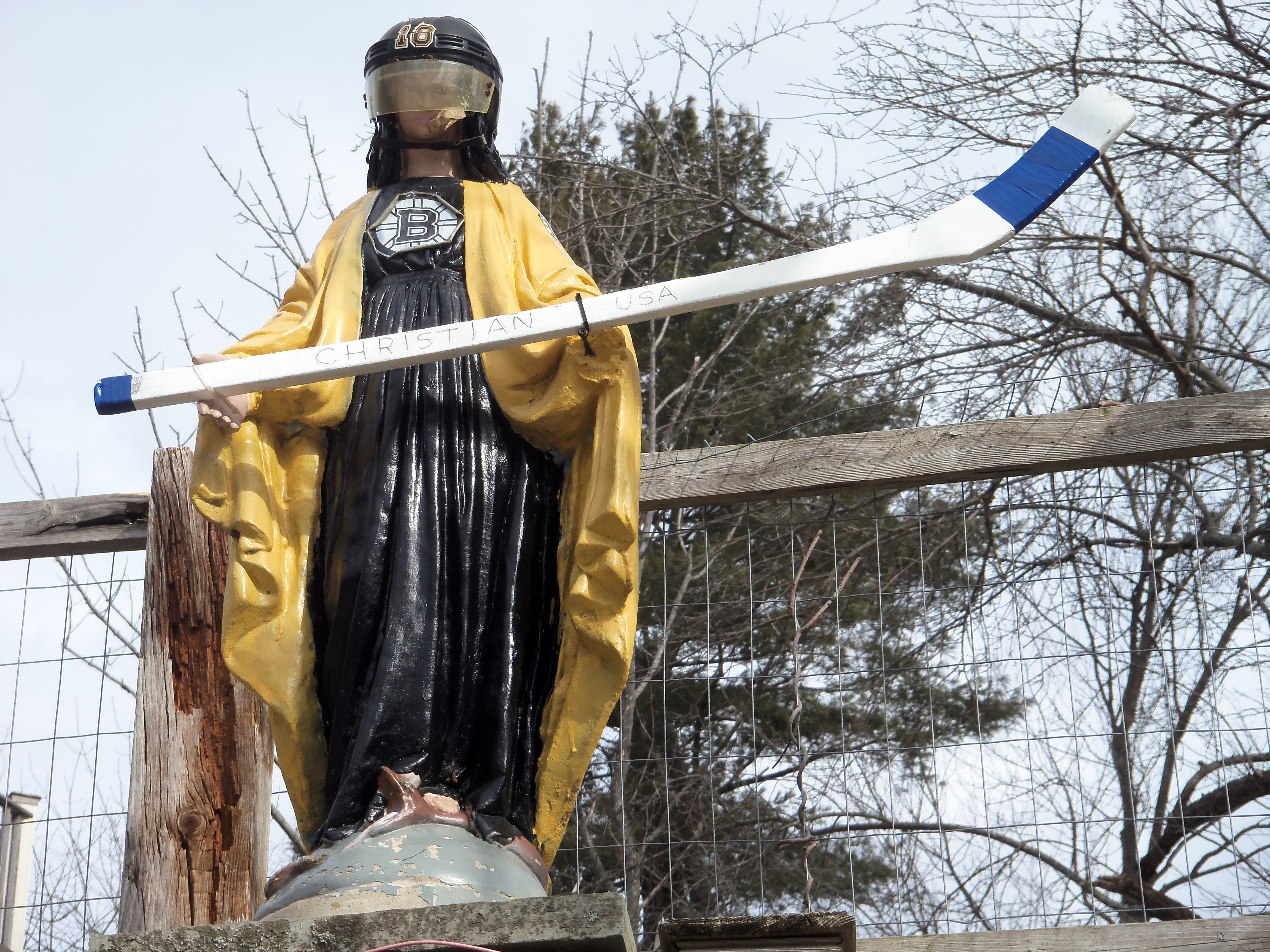
OUR LADY OF THE ICE

Always ready for a miracle.

Or is it Our Lady of the Puck?

New England is hockey country, and Boston Bruins fans are legion. Rest assured, Bobby Orr would no doubt lead their pantheon of saints.

While statues of Mary are common across the country, I know of no others like this. Behind the mask, the face looks feminine. This repurposed icon icon overlooks Chauncey Creek Road in Kittery, Maine.

COCHECO MILLS CLASSICS

A typical water-powered textiles mill would have thousands of these foot-long bobbins feeding its looms.
A typical water-powered textiles mill would have had thousands of these foot-long bobbins feeding its looms.
A sampling of the designs that made the Cocheco Mills world-famous.

The short distance between New England’s mountains and its Atlantic coast means its rivers and streams drop in elevation rather quickly, and that has provided both powerful currents and many opportunities for power-generating dams. As a consequence, the region is peppered with old mills – usually brick but sometimes stone or even framed wood – that were once the industrial backbone of America.

Downtown Dover, for instance, is built around the Cocheco Falls, where the river plunges into the tidewater. The falls are topped with a dam, and the diverted water once powered a complex of textile mills that produced world-famous calico, among other woven products. The Amoskeag Mills in Manchester, meanwhile, were noted for their denim, which supplied Levi Strauss in his legendary San Francisco production. Nor was fabric the only product coming from the mills. Everything from precision tools to locomotives to shoes and socks and cigars was being shipped from the cities and towns along the waterways.

Over the years, many of these mills have fallen into disuse through a combination of newer technologies, cheaper competition from steam-powered Southern mills, and overseas production. But the legacy remains.

As I learn from my elder daughter while examining a glorious sampling of cloth she’s intending to turn into quilts or comforters, the designer Judie Rothermel has recreated some of the classic patterns found at the American Textile History Museum in Lowell, Massachusetts, and reproduced them in partnership with Marcus Fabrics.

The Cocheco Mills Collection, issued serially over several years, is one of the impressive results.

Let me say, some of the technical results are mesmerizing while the colors are deep and delicious.

How did we ever stop making this?

BOBHOUSES

100_6739

Alton Bay on Lake Winnipesaukee is a popular site for bobhouses each winter.

When they lived way up in Maine, with a large lake just down their road, I remember hearing Eric tell about the morning he looked out the window and saw a traffic jam. Miles and miles from the nearest traffic light, here were bumper to bumper pickup trucks heading to and from the lake. Soon, he realized they were removing their bobhouses before the ice melted.

Bobhouses, of course, are part of the male culture of northern New England and many other frozen parts of the world. Since I don’t fish, no matter how much I admire fly fishermen and their skills, I really don’t appreciate the special savvy of landing one’s meal from under the ice. You can do it, of course, by drilling a hole in the thickness underfoot and then sitting or standing out in the cold. But the really serious guys build or buy their own little houses for the tradition – some are quite basic, while others, I’m told, come with TVs and Web connections. Still, I’m curious about what draws men from their warm homes to spend long days or evenings in a very cold environment. One of the answers is that it’s an excuse to drink with your buddies. Another is that it’s just to get away from the women. Except that it turns out some very adventurous women join in on the expedition. Are the fresh fish really worth this much effort?

Even so, that afternoon, Eric looked out again and saw another traffic jam, this time with trailers hauling their boats to the water. Presumably for more fishing.

How did they know this was the day the ice would go? What clues am I missing?

TOURISM SLOGAN

This is New Hampshire, after all. So the tourism officials like to tout it as a place “to be free” to do this or that.

If they were really honest, they’d admit our skinflint ways and caution: “Don’t spend liberally.”

But we really do exist at the expense of our neighbors. This is New Hampshire, after all. For now, we’re all hoping for great skiing weather “up north,” with all of the economic consequences.

FOND MEMORIES OF FORE STREET

My wife is a great cook. And so are the kids. This means that when we dine out, the meal often fails to live up to what we can have at home. The chain restaurants strike us as formulaic or bland. In many, there’s much that’s mostly show with little substance, or pretentious and pricy, or simply uninspired. It’s easy to feel we wasted our money.

On the other hand, we’ve also found some marvelous meals at bargain prices in humble places. including some that folks might describe as sketchy. At least until you take the first bite.  I could mention my favorite Vietnamese restaurants in Worcester, Massachusetts, and Hartford, Connecticut, for starters. Or my regular Greek restaurant in Watertown, Massachusetts. Or our favorite summer hangout for seafood and live oldies in York, Maine. Or dim sum in Boston’s Chinatown. Or Latin American highlighting different countries on different days in Dayton, Ohio.

Of course, when we find a truly authoritative operation – one that sets standards for presentation, skill, creativity, and downright pleasure – we treasure the experience. Our favorite is run by two women in South Berwick, Maine. Whenever we’re ready to spring for a great celebration, that’s our first choice and we’re always delighted.

Once my wife and I got away for a weekend stay in Portland, Maine, and the centerpiece of the trip was a dinner at the famed Fore Street Restaurant, which is set in a kind of William Morris former foundry a couple of blocks from the harbor. She can tell you every glowing detail of our meal, including the local sourcing of ingredients. The wait staff was attentive without being overwhelming or stuffy. And most impressive, a sauvignon blanc was suggested to pair with that evening’s selections – and management priced it close to retail, rather than charging the industry standard of three or four times that figure. It was incredible – the word “stony” fits perfectly – and we’ve never found another that approaches this bottle, not even from the same South African winery.

Well, Fore Street was named No. 16 in Gourmet magazine’s list of top 50 restaurants in the U.S. in 2002.

More recently, I’m so glad one of our regular mechanics and his wife were impressed with their big celebration dinner there a few months ago. And we’re so happy to hear the tradition continues.

THE REAL HEALTH CARE DEBACLE

I keep hearing those folks gloating and pointing fingers over the troubles in rolling out what they deride as Obamacare, and I want to shout, “Where’s your health care plan – one that will provide basic coverage for the remaining two-fifths of the American public?”

There should be an embarrassing silence. Behind all their bluff, they have nothing, not even two aspirin and a glass of water. Just who would they have you phone in the morning, anyway?

They might say we can’t afford it, but that’s another way of saying our current system is outrageously overpriced and needs reform.

But then they say it’s just fine. (For them, maybe.)

But then they won’t even let us take a close look at another model, single-payer, like Canada’s. Thing is, every Canadian I’ve talked to loves it. And if it’s anything like the government-paid system my military surviving spouse mother-in-law has, my family would take it in a heartbeat.

The party-line critics of health care for all Americans have done everything they can to derail the rollout. They’ve kept a lot of the details up in the air and fought funding. No wonder there are screw-ups.

But remember this, it’s much better than anything they’ve offered.

We’re still waiting for their plan.  And waiting. And waiting.

Maybe they’ll look in the mirror in the meantime and see where the real problem is.

SHUTTERING THE BUNKERS

For all of its uber-quaintness and tony appeal today, the neighboring city to our south has long had its seamy side. It was, after all, a seaport – and, for that matter, remains one.

While times have changed and its once notorious districts have long since been gentrified or razed, one bit of that heritage has lingered. We see it along the major highways, usually on the side headed toward the vacation lands north and east, and not always in the city itself but close enough to count.

These are the cement-block bunkers that sometimes tout themselves as bookstores, but we’ve never been fooled. A few actually started out, it seems, as gasoline stations that covered their windows when they converted to the sex trade, while the others may have actually been constructed with this function in mind. Magazines, videos, toys … but not live performances. Maybe there are some clubs elsewhere, though I suspect that requires a trip to Portland or Boston. Maybe Lawrence or Lowell.

These bunkers may have a thin window or two high up in the wall, but the doors are solid. In other words, no peeping. If anything, these blockhouses always look forbidding and forlorn. You might even say they appear shameful or guilty rather than flirtatious and giddy.

Rarely, too, is a car or pickup seen parked in front. And in the past few years, there have been fewer and fewer of those parked on the side, either.

Unlike their cousins on downtown streets in larger cities, where customers may slip discretely through the doorway or out, these offer far less secrecy for their patrons. If anyone knows your car or truck, they know where you are.

As we’ve driven past on the busy roadways, I’ve long wondered how these places stay in business. Magazines of all stripes have been folding or shrinking, and when it comes to racy photography, there’s plenty available online these days. No secret there. Ditto, the videos. As for the toys, well, we have online retailers of all sorts, along with rapid delivery.

Well, we now notice another of these little box stores is shuttered. It’s not in a spot we see any other store wanting. It will be curious to see what happens to the real estate. But there are no signs of mourning, either.

Funny thing, though: just up the road, at the mall, Victoria’s Secret is thriving.

BOUNCE

Letter-writing – even the Christmas epistle – is becoming a lost art. In the process, we also lose a dimension of friendship, especially at a distance. Ping! And the ball’s in your court. And then on the way back.

Dear Santa, all the same.

In the meantime …

CONSIDERING THE COMPETITION

After I moved from the ashram, I spent a year-and-a-half in a small city that very much resembles one I call Prairie Depot in several of my novels. And then I returned to my university as a research associate.

While our institute was set in a town very much like Daffodil, there was one difference I omitted. By this time, the town had a large urban ashram and, for several reasons, I chose not to attend classes or other activity there but instead began sitting with the Quakers in their mostly silent worship in a country meetinghouse.

Still, as the joke went, the ashram owned a third of the town. It had a vegetarian restaurant or two, maybe a bakery by this point, a house painting company, art gallery, significant real estate, and maybe much more.

The university, of course, owned the rest.

Or so the joke went, back in the mid-’70s.

My own experience is much more along the lines of what I describe in my novel, Ashram. We barely owned anything.