THE OTHER CAPE

Rockport, Massachusetts, sits at the end of Cape Ann.

Mention “the Cape” anywhere in New England and people assume you’re talking about Cape Cod, that marvelous arm extending from southeastern Massachusetts. (Well, it does have its own dictionary entry.)

Mention “the Other Cape,” and a few knowing heads will nod or smile in recognition of Cape Ann, jutting from Boston’s North Shore.

It’s not that those are New England’s only two points of land extending into the ocean – the definition of a cape. For perspective, two of Maine’s most photographed lighthouses are on Cape Elizabeth and, close to us, Cape Neddick.

What Cape Ann and Cape Cod share is a certain ambience, a feeling that – well, you’re in a unique place and not just anywhere in New England.

If you’re not familiar with Cape Cod, let me say there are many fine guidebooks that describe the experience. Today’s gallivant, though, takes us ever so briefly to Cape Ann, which by its most generous definitions (probably mine) can be no more than a third the length of its famed rival. While Cape Cod is neatly demarked by the Bourne and Sagamore bridges, Cape Ann is a bit more diffusive. Since we come down from the north, we find that “Cape” familiarity in the air as we come into Ipswich, which claims more “first period houses” (1625 to 1725) than anywhere else in America – 58 in all. It’s a charming community and, like most of Cape Ann itself, has a more varied mix of social classes than you typically find on the bigger peninsula.

My introduction to the town came last fall when K. Peddlar Bridges invited me down to do a poetry reading on his Roadpoet cable-access television show – and we had a blast. Before the taping, I went for a walk through some lovely year-round neighborhoods that could stand as textbook tours of American architectural styles. I crossed a stone arched bridge as geese took V-formation and honked low above me. Turns out the 1764 Choate Bridge is the oldest double stone arch bridge in continuous use in the country. (I don’t make this up, nor do I challenge the accuracy of the claims.) Leading to an impressive Colonial-era garrison house, the span connects to Turkey Shore and Labor in Vain roads. You get the picture. And, yes, you don’t get a better sense of that Puritan outlook than “Labor in Vain,” do you?

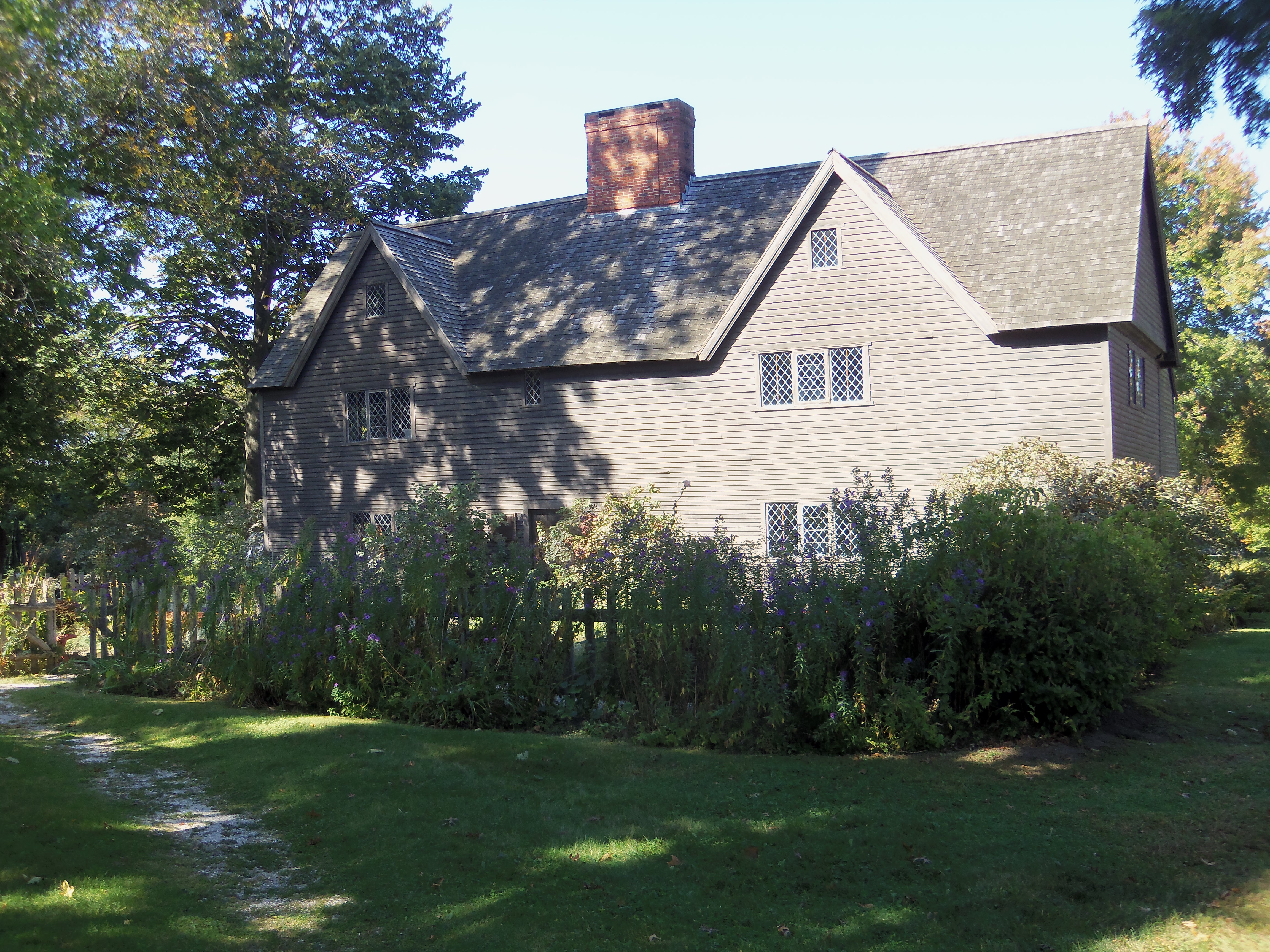
The reproduction 1657 Alexander Knight house in Ipswich, Massachusetts, suggests the difficult life facing the early settlers, especially through a New England winter.
The elegant 1677 Whipple House in Ipswich is considerably smaller than the House of the Seven Gables in Salem but similar in style.

So the next week, my wife and I took off for a fuller exploration. We headed on down the road through gentleman farms and veered off for Crane Beach, passing long vistas of salt marshes where prized hay was once harvested. (It was high in mineral nutrition but gave the milk a salty taste, according to the tales.)

The beach itself was once part of the Crane family’s Castle Hill summer estate, which is another destination. The estate, the 1,234-acre Castle Neck dunes and beach, and adjacent 700-acre wildlife preserve are part of the Trustees of Reservations holdings. (Be advised, there’s an admission fee to the park – $8 a car when we went; up to $25 a car on summer weekends.)

But what a beach! My wife was overjoyed to see white sand, like those of her native North Carolina, rather than the usual gray or brown of New England. And that sand seems to run on forever, with fascinating patches of rippled washboard, tufts of sea oats, and an array of shells we don’t find in our usual rounds of the coast. It may have been October, but our nostrils were greeted with that distinctive Coppertone aroma, and our eyes viewed an array of sun worshippers extending their tans as well as a few daring souls in the water. We walked and walked and, well, might still be walking if we hadn’t felt hunger kick in.

We’ll be back.

Washboarding and footprints decorate the sand at Crane Beach.
Here's a view looking into a dune behind the beach.
Here’s a view looking into a dune behind the beach.

Venturing on, we came into the small waterside village of Essex, where we poked into Woodman’s “in the rough” for a seafood lunch. “Rough,” which is also in the name of an outdoor haunt we love in York, Maine, seems to indicate ordering and picking up from a counter rather than wait staff service, as well as a picnic-flavor rustic decor. As we looked at the blackboard and its prices, we nearly left for cheaper fare, but Rachel caught a posted review by food gurus Michael and Jane Stern – and I knew we weren’t leaving. I’m glad we stayed.

It was fun and filling – they don’t skimp on their portions. We can see why it’s a classic destination for the traditional regional seafood, especially of the “messy” sort. And, as she said, they “know how to do batter.” That’s a high compliment on her part. (Onion rings, anyone?)

The heart of Cape Ann is the city of Gloucester and its varied neighborhoods around the waters. It claims to be from the same year as Dover, although unlike my city, it was abandoned for a period, and is about the same size, roughly 29,000 residents. It lays claim to being America’s oldest seaport and has always been a busy, often brutish, fishing harbor. Gorton’s Seafood uses the city’s sea captain sculpture as its emblem. The Perfect Storm movie captures some of this legacy. These days it’s also the home to a number of whale-watch operations, due to its proximity to the famed Stellwagen Bank fishing grounds. In the 1950s and ’60s poet Charles Olson sought to capture the local spirit in his Maximus series, drawing on Ezra Pound’s literary foundation.

For us, though, the glory of the place is its three large wind-generator turbines rotating gracefully from the highest points along Route 128. They are immense works of art, comforting, landmarks. How anyone can oppose their construction baffles us. And, yes, they do sing … softly.

The trees might give you an idea of the scale and majesty of these Cape Ann landmarks.

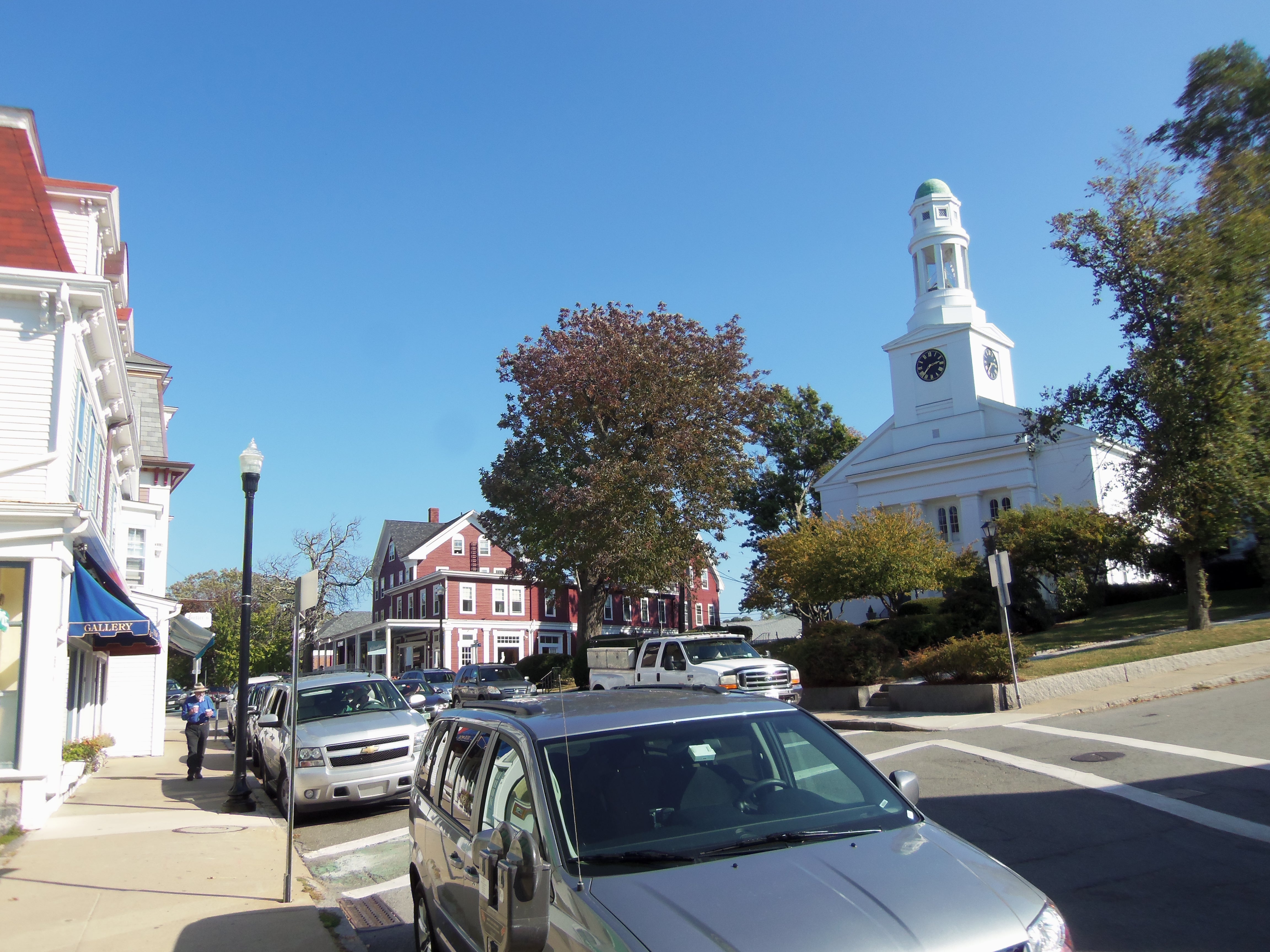
Cape Ann culminates in the town of Rockport, which has long attracted summer artists to its shores. More recently, the three-decade old Rockport chamber music summer festival has developed a loyal following, which led to the 2010 opening of the 330-seat Shalin Liu Performance Center and its year-round offerings that include classical, folk, blues, and jazz. When they say “intimate,” it’s true. What makes this hall truly amazing is that the back of the stage has wooden panels, for acoustical purposes, that roll away to reveal a panorama of the harbor. Maybe the Santa Fe Opera surpasses the view, but I bet you can find folks who can quibble.

The village itself has much of the Cape Cod shopping flavor of boutiques, restaurants, artist galleries, jewelers, and so on – especially in its Bearskin Neck district.

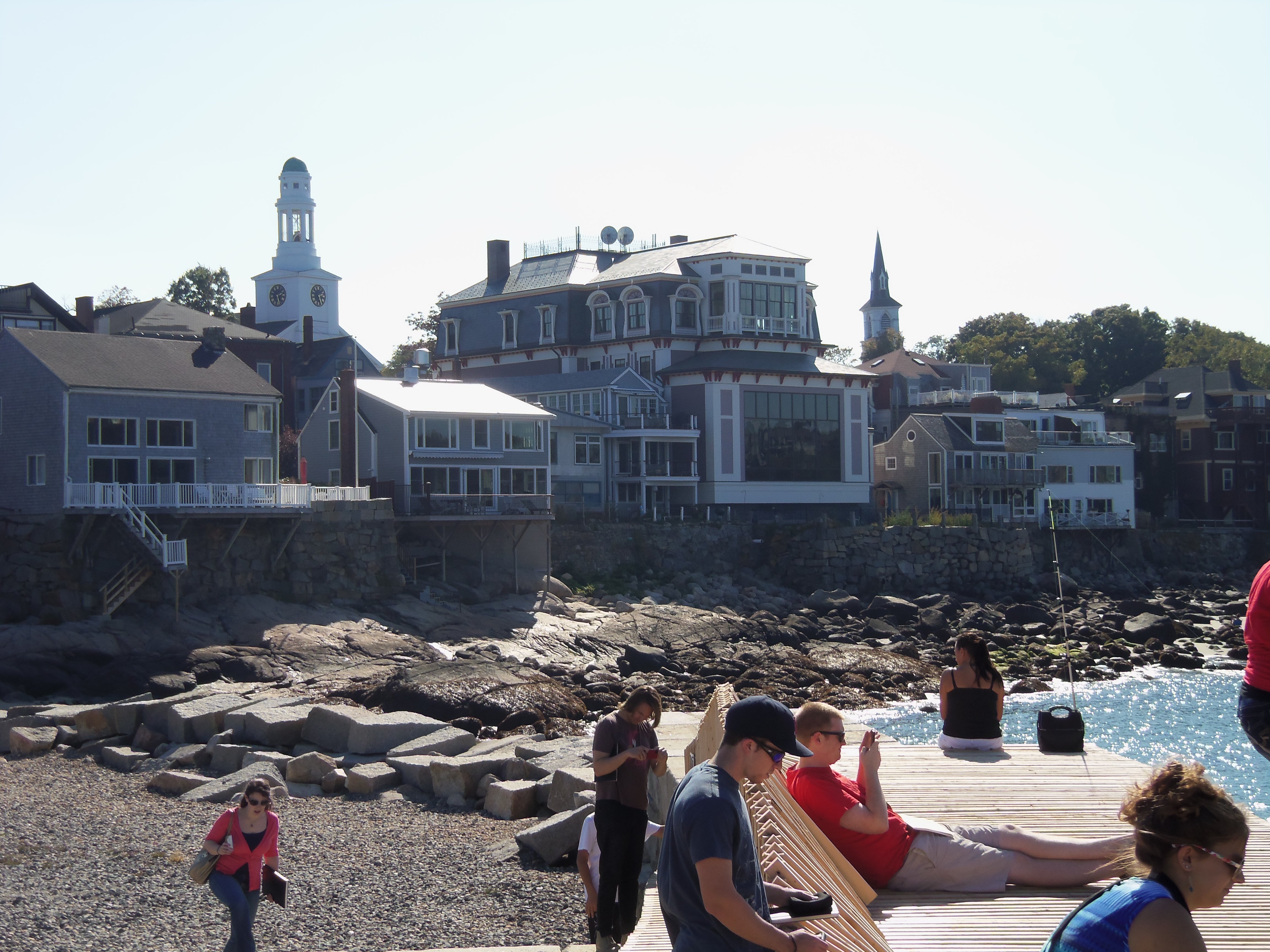
The big window in the largest building overlooking Rockport Harbor is the back of the stage at the Shalin Liu Performance Center. By the way, the tide's out. We were among a crowd enjoying an art installation that doubled as sunny seating on one of the stone wharves.
The big window in the largest building overlooking Rockport Harbor is the back of the stage at the Shalin Liu Performance Center. By the way, the tide’s out. We were among a crowd enjoying an art installation that doubled as sunny seating on one of the stone wharves.
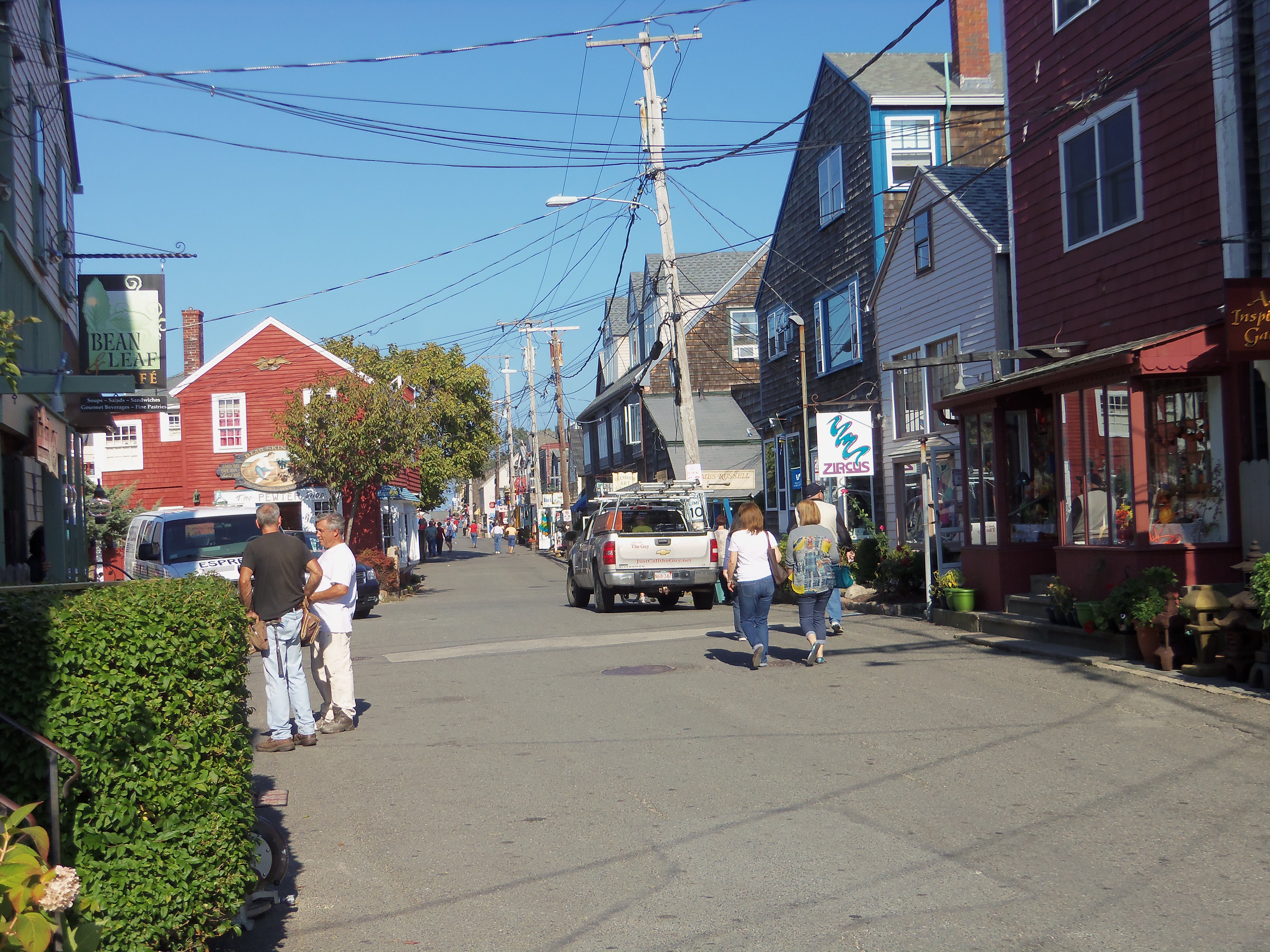
Downtown Rockport has a traditional blend of resort retailers ... and shoppers to match.
Downtown Rockport has a traditional blend of resort retailers … and shoppers to match.

By the way, Massachusetts Bay Transit trains run from Boston’s North Station to Rockport, with Cape Ann stops along the way.

While I mentioned whale watches, I should note we prefer to venture out from Newburyport to the north, in part because the vessel there has the option of heading to either Stellwagen Bank in Massachusetts Bay or Jeffrey’s Ledge in the Gulf of Maine. When it goes to Stellwagen, though, it cruises around Cape Ann and offers fine views of the Straightsmouth Island and Thacher Island twin lighthouses – the 1861 replacements for the 1771 originals – closer to Gloucester Harbor.

Not bad for one day, eh?

GREETINGS FROM THE PAST

Back when I was living in the townhouse apartments “on the hill,” the preschool tot next door was learning he could manipulate me presumably, any grown up into waving to him. All he has to do is wave first.

At first, he was pretty shy, wondering whether he should wave at all when I wiggled my hand or arm in his direction before driving off to the office or the grocery. In time he became more intrigued, hovering at their open front door or staying close to his mother if she were sitting at their stoop.

And then he became bolder. One morning, he parted their upstairs blinds and cried out from the window to me, just so I could see his smile and wave.

The next day, he told me as he rode his bike around the parking lot, “I runned into your car.”

“Oh, where’d you hit it,” I replied, not the least worried, not with all the rust spots that are appearing simultaneously on my well worn vehicle.

“On the tire!” he piped up as I performed a mock inspection.

And finally, he came charging out the door just as I was about to drive off, grinning and hailing me in huge motions. “Welcome!” he cried out. “Welcome to Walmart!”

“Well, say `hi’ to Sam for me!” I chuckled.

His father, a few steps behind, shrugged as they set off on their errands.

CORKING THE STATE LIQUOR COMMISSION

For all of it reputation as the “tax-free state” and “live free or die,” New Hampshire has some pretty convoluted ways of making ends meet. True, we have no sales tax and no income tax, but that simply means finding a lot of nickel-and-dime ways of raising public revenues, starting with a hefty property tax rate. (Renters, of course, get no break on their federal taxes there, either – as I said, convoluted.) And if you dine out, even for breakfast, there’s another big hit, eight percent or so, one of many others. Eventually, it all adds up.

New Hampshire also has a reputation as the go-to state for cheaper liquor, compared to the rest of the Northeast. For all of the official conservative rhetoric of free enterprise, the state clutches its monopoly on the sale of hard liquor, unlike, say, neighboring Massachusetts, with its liberal tradition of neighborhood mom-and-pop “package” stores.

The conflict I see comes in the fact the state is both the regulator of alcoholic beverage sales, ranging from bars to groceries and wine stores and home consumption, and also the distributor. That is, the same agency, the State Liquor Commission, is both the policeman and an active dealer in what it is policing. It’s a situation rife with the potential for favors, favoritism, and outright bribery or corruption. As the Founding Fathers were well aware, whoever polices the police should not be the police. You separate them – the classic separation of powers, each keeping jealous watch over the other.

Not so here in New Hampshire. When it comes to alcohol, the only line of defense might be the Legislature or the Governor and Executive Council as the counterbalance, but that’s not the way it should be, especially when we factor in the possibilities of hefty campaign donations. The enforcer and distributor should be under separate agencies – then, if conflict arises, they appeal to higher authority. As it is, they’re likely to squelch any complainer … or else.

In addition, when it comes to wine, all the supermarkets, grocers, and independent wine shops face a double whammy. They’re required to buy their wine from the state (through the one and only licensed warehouse dealer), even though the state also sells directly against them. In fact, it’s the same agency they must apply to for their very permit to do business in this field. And then the agency adds its own percentage to the product, even if it’s from a winery the state wouldn’t otherwise stock except for the retailers’ order. As I said, convoluted and rife for abuse.

I first noticed this when I found a certain label for sale much cheaper in Massachusetts. Seems the Bay State has one less layer of middleman in the process. So much for the “Taxachusetts” tag we Granite Staters so often brush on our southern neighbor. Tain’t always so.

More recently, I found an example of the state’s monopoly bully at work when a local supermarket was out of several of its more popular varieties. Could it be someone had said something that miffed somebody in the state agency that was supposed to deliver the product, which now was just sitting in the warehouse? Who do you complain to, after all? You can’t switch to a different supplier, either. Where’s the free market free enterprise in this case? The official line may have been that the state was in the midst of shifting from one licensed warehouse operator, which had held the contract for decades, to a new one. But, as the old contractor miffed, the situation “is just the latest example of many where the the commission has cut a special deal” with the new licensee.

For years, I received the weekly release of which bars, restaurants, and convenience stores or supermarkets had their liquor licenses suspended by the State Liquor Commission, usually for underage sales of beverages. Not once did I see a State Liquor Store in that list. Not that they weren’t as prone to violations. As I said, who polices the police?

Yes, New Hampshire gets the revenue. As long as I’m not forced to go to Maine or Massachusetts to get the wine I want, where it’s available, maybe even more cheaply.

Any future MBAs interested in doing a case study? This one could be a doozy.

COUNTING TO SEVEN

Dover, where I live, is proclaimed as the oldest permanent settlement in New Hampshire and the seventh oldest in the United States.

Counting gets tricky, because there were earlier settlements that were abandoned. As best as I can determine, then, here’s the list the counts to seven:

  1. St. Augustine, Florida, 1565
  2. Santa Fe, New Mexico, 1607
  3. Newport News as Hopewell or Elizabeth Cittie, Virginia, 1613
  4. Albany, New York, 1614
  5. Jersey City, New Jersey, as Pavonia, New Netherlands, 1617
  6. Plymouth, Massachusetts, 1620
  7. Dover, New Hampshire, 1623

While I found Weymouth, Massachusetts, as Wessagussett, 1622, the town itself notes 1630 as its settlement. And Taos, New Mexico, 1615, was abandoned by its Spanish missionaries in 1640. As I said, counting gets tricky.

AFTER THE TRAGEDY

Here in New England, the battle for control of the Market Basket supermarkets remains the biggest news story – but with a storybook twist. Rather than ending up as another soulless corporate bottom-line victim, there’s been a resurrection.

The bitter DeMoulas family feud finally led to an agreement less than a week ago in which the Good Guy (aka Arthur T) buys out the other half for roughly $1.5 billion. Ownership stays here at home. And, yes, there have been cheers all around in this remarkable alliance of stakeholders – managers, workers, loyal shoppers, and their communities – against the faction that fired the Good Guy and his visionary leadership.

The boycott held through August. The parking lots were vacant. Workers saw their hours cut. Some managers were fired … and now they’re back.

There’s almost a party atmosphere in the stores, but nobody’s slacking. Managers began showing up to work at midnight just an hour after reports of the agreement surfaced. Suppliers offered to deliver goods directly to the stores, rather than the distribution center, to speed the restocking of depleted shelves.

Many details remain to be ironed out, and a lot of damage will take time to repair. But at least there’s also a rainbow.

STRIKE THREE AND YOU’RE OUT

According to folklore, when intruders disturb a rattlesnake, the first passerby merely irritates the viper. The second passerby becomes truly annoying. The third in rapid succession, though, becomes just too much. And that’s the one the snake strikes.

I think many of us humans have days like that. When we erupt – or someone blows up at us – it’s often far out of proportion to the provocation. What you see merely reflects the third offense or offender – the one that triggers defensive action.

Either way, don’t take it too personally.

SUCH DIFFERENCES

As I said at the time …

Finally, observing the banner in the background of the thirty-fifth reunion pictures, my wife finally connected a date she’d long known with her own experience: “When you were all graduating, I was being potty trained.”

I wonder what I would tell them, given the chance. I’m not judging them, as much as judging myself and all of the intervening years. The long journey to here. I’m not gloating that I have a younger wife, one who’s only a few years older than some of their own children; besides, that wouldn’t have been the case, had my first marriage not failed. I’m finally experiencing the challenges and joys of parenting, while they already have grandchildren – on that front, maybe they really are much older. See, I am envious of those still married to their spouse right out of high school. They took the straight path and got down to business. In contrast, many lonely nights and a sequence of transitory relationships have been my alternative. I think how innocent I was (ignorant is the more accurate term, actually), especially on matters of sex. In the intervening years, even after I realized that certain girls had gone away because they were pregnant or certain guys were homosexual, I simply couldn’t admit that any of us were actually having, gulp, intercourse. Although, years later, looking at the homecoming court photos in the yearbook, the realization flashed upon me, from one’s smile, that she must have recently become sexually active.

Which leads me to the goddesses. The beauties I both idealized and gazed at with masked lust, wondering how the soft touch would feel, how the naked body would look, how two people actually connect. The ones who left me speechless. The ones who were, in many ways, in a league other than the one I inhabited. To my eyes, they were miraculous and mysterious, invested with secret knowledge and magical powers, with taste, social graces, and high style – no matter how middle-class we were or the fact that our conversations rarely went any deeper than howdy. The reunion photos, then, confirm my fears – that goddesses may become hags – yes, mortal, even grotesque. And yet, to my surprise, some have become more beautiful than ever. How can this be? If we could only return, however briefly, for candid discourse, to uncover what thoughts, feelings, and actions lurked behind those Mona Lisa facades, both then and in the subsequent years. Not superficial conversation, but blunt disclosures. Now, however, sifting through the reunion photos, I soon calculate how few of these goddesses attended – which leads to further speculation. To my eye, they were the essence of what Hollywood starlets aspire to represent. Unlike any mythology, however, few remain in any Olympus. Instead, I must confront a youth culture that offered little wisdom.

I must leave it to the girls-turned-to-women to speak of the Adonis club and its deterioration. Besides, I was never a member. On the other hand, I’ve sometimes quipped that if I could do it all over again, I would have hung out with the greasers – that they had what I was lacking. As if they would have had me! Or am I only imagining they had fun in their tweaking of authority?

To reenter those years also means admitting shame, embarrassment, and guilt. I’m not the golden boy my mother expected, or the great talent my youth pastor counseled. For that matter, it’s been many years since I could tie my hair back in a ponytail or part it down the middle. Since I had a beer bottle tossed at me at a party. As I’ve said, it’s been a long road from there to here.

One soon approaching what will be a fiftieth anniversary reunion, if it happens.

ST. LOUIS AND CIVILIZATION

As I said at the time …

We share a debt of gratitude to your grandmother, who has spent many hours assembling a remarkable gift for you – a knowledge of your ancestors. I hope you will come to treasure her findings, and the love she has put into this project.

Through Eide Henry Hopke, you and I also share a common bond, although our legacy from him varies in one crucial aspect. For you, he provides not only your surname, but also some distinctive DNA strands that come only through the male line. For me, he is part of a maternal genetic mix that is ever-expanding, the further back we go. (For example, while Eide Henry is one of my sixteen great-great-great-grandfathers, only George Hodgin carries the equivalent DNA strands for me; Eide Henry’s endowment, meanwhile, comes down through my mother’s father’s mother’s mother, in a bit of a zig-zag path.)

I hope you won’t look at your genealogy simply as a long list of names and dates – a sort of variation on the Biblical begats. (That’s not to deny the frustration and pleasure that goes into the investigative digging and puzzle-solving involved along the way of gathering these details.) Rather, the power comes in building the story of these seemingly common people and the ways they addressed their time in history and the places they dwelled. Researchers who try to connect their ancestry to ancient royalty or who stop the moment they find an ancestor hanged as a horse thief need to rethink their vision. In this venture we need to accept the facts, good or bad, in their full truth; what we eventually have is a personal history, one that will often stand at some distance from the one taught in schoolrooms or give us some insight into a greater framework. As you read historical accounts, you may find that through these ancestors, you, too, are in their time and place. Oh, yes, and as stories go, genealogies can turn up the most unexpected twists. For instance, the first of my Hodson surname ancestors in America arrived as the only surviving family member after their ship had been captured by French privateers (pirates); his great-grandson, a miller, owned a gold mine in North Carolina; and, on my dad’s side, all of my ancestors until the Second World War were staunch pacifists in their religious principles – I knew none of this when I was growing up.

On my mother’s side, Eide Henry emerges as a remarkable figure. Maybe you’ll be the one to figure out how he arrived in the New World, whether he came alone or with family, how he paid for his journey, or what led him to St. Louis; there are certainly many details to fill in about his life, and every answer seems to produce more questions. But what we already can sketch from the facts at hand point to an enterprising character who adapted himself well to his new surroundings. While we don’t know for certain what prompted him to leave Prussia, we can imagine the values the place instilled in him – truthfulness, modesty, self-control, and loyalty, in the words of Peter F. Drucker. “This Prussia had been a military state” and “was not educated, let alone cultured; but it was pious, with a narrow and sentimental Lutheranism,” Drucker notes, including an observation credited to Bismarck “that the Germans require a father figure, and that they will fall victim to a tyrant unless they have a legitimate and lawful king.” (From “The Man Who Invented Kissinger” in Adventures of a Bystander.) We can ask ourselves how much of this played out in Eide Henry’s life – in his decision to serve in the Mexican-American War, for instance, or in naming sons during the Civil War Robert Lee Hopke and Jefferson D. Hopke. This, despite the reported universal opposition to slavery by the German population in St. Louis during this period. (As you grow older, you may come to realize how often our values conflict or how much ambiguity arises in daily life; black-and-white decisions seem to be far rarer than we’d like.) We can also imagine that Eide Henry knew sorrow, in the death of his first wife or young children, and perhaps in the separation from his homeland. He must have known loneliness, too, in those times when he lived apart from his family in order to earn an income. We can look at the portrait your grandmother has collected and see all of these things in his face.

He also opens us to the pervasiveness of German civilization on American life, something that World War I erased from public awareness. Actually, I can speak of two major streams of German influence, the first being what we would consider Pennsylvania Dutch and including the Anabaptist traditions most visible now among the Amish, and a second, which settled largely in Midwestern cities and carried a deep sense of “good living,” meaning learning and progress. Eide Henry would have been part of that second movement, while many of my father’s ancestors were part of the first.

Sometimes we will glean background for our story from the most unexpectedly sources. One of my wife’s favorite books, for instance, is Stand Facing the Stove: The Story of the Women Who Gave America “The Joy of Cooking.” While Anne Mendelson is writing about her mother and grandmother, her opening chapter examines “The Golden Age of St. Louis,” which did “indeed – at least in a brief and glorious interval after the Civil War – seem one of the finest spots on earth to dwell … “ She then turns to Lebenskunstler, “as untranslatable as any word in the German language, which is saying a good deal. It implies a civilized command of living as an art form like singing or painting. German-English dictionaries lamely offer explanations like ‘one who appreciates the finer things in life.’ ‘Life artist’ is the baldly literal rendering, and perhaps as good as any.” Mendelson then goes to present the story of her genealogy in a thoroughly engaging manner, one that can be seen as a model for this enterprise. What interests us most, however, is the points where it overlaps on our own story. For instance, she mentions “Thousands of poor Irish had also come to the region, especially after the potato famine of 1845-46. They competed for work as laborers, artisans, and servants with large numbers of Germans fleeing comparable poverty.” And then she notes “a very different community brought by the abortive stirrings of liberal German nationalism after 1830 and more markedly 1848. They were articulate professionals, or sometimes minor nobility, who rejoiced in a particularly German marriage of cultural ideals, consciously enlightened convictions, and creature comforts.” At this point, it seems more likely that Eide Henry was one of those “fleeing comparable poverty,” yet he still would have been part of that mixture of German life in the city, with its “life artist” influence. While my mother probably had no idea of her Hopke ancestry, she always spoke of St. Louis in almost reverential tones; meanwhile, her mother – who married a Hopke descendant – strikes me as one who hungered for that “life artist” ideal, even though she had not been born into it.

Maybe you forget that St. Louis was once the largest and most important city west of the Appalachian mountains, after supplanting Cincinnati for the honor. Chicago took the lead only later. By 1860, Mendleson writes, St. Louis “had a population of nearly 161,000, and supported a small handful of theaters and a large handful of music societies (well populated with Germans), a library, the new St. Louis Academy of Sciences, Washington University, several foundries, the Pacific Railroad (stretching a magnificent 176 miles westward), a noisy range of political opinions, and sundry German- and English-language newspapers.”

She relates that a “traveler reaching St. Louis by steamer saw first the broad man-made plateau of city levees, swarming with teamsters’ wagons and lined with warehouses. The land rose to a modified grid of streets, orderly enough on paper but at most seasons of the year fed by an inexhaustible supply of mud reputed not to differ greatly from the St. Louis drinking water.” As a teamster, Eide Henry may well have been one of those with a wagon waiting at the wharf; we can imagine, too, what he said of the water.

Much of what I know about Eide Henry is thanks to your grandmother’s generous sharing of material she’s gathered for you. Along the way, she has also filled in large gaps in my knowledge of Eide Henry’s son-in-law, David W. Ward, and even my Munro ancestors from Scotland – all of which somehow come together in Pike County, Missouri, in what can be seen as the northern shadow of St. Louis. None of these people are among her own bloodlines, either, yet she has been faithful to the larger task of bringing their lives to the light.

How it all comes together is largely up to us. Jeremy, I hope you find much in this legacy that will inspire you, add perspective to your own life decisions, and give you an appreciation for the blessings we have because of their efforts.

I’ve spoken of Eide Henry as a remarkable character. I think we can add Patsy Lynn to that list, as well.

Best wishes in all you undertake, Cousin.

AN UNFOLDING GREEK TRAGEDY

For past several weeks, the hottest news story across New England has been over what will no doubt be a textbook case of how to kill your own golden goose in corporate America.

The business is a family-owned chain of 71 supermarkets that has somehow managed to carve out the region’s highest profit rate in a notoriously thin-margin field while simultaneously paying its workers more than its rivals — along with profit-sharing and bonuses — while keeping its prices well below those of the other grocers. (You can imagine, for one thing, that the pilferage that undermines many groceries is nonexistent at Market Basket. Its workers are loyal, at least to the executive responsible for the success — a man who seems to know not just each of them but their family members as well.) Add to that a great deal of flexibility for store managers to respond to customer requests and you can understand the wide variety of ethnic foods found on the shelves; consider the fact that our local Asian restaurants choose to buy their tofu supplies at Market Basket rather than the wholesalers, and you get a sense of how that policy pays off all the way around.

In recent years customers have turned in droves away from the competition, and their loyalty is palpable. Lately, I’ve found parking spaces are always available right by the front doors of those underpopulated stores, unlike Market Basket, where the parking lot and aisles are always overflowing.

Given the win/win/win realities of the still growing Market Basket chain, nobody was prepared for the directors’ decision to ax its successful president. Well, half of the board’s decision.

The half that wasn’t prepared for the impassioned backlash from the public or its own workers, who have essentially shut down the operation.

The board’s decision, as far as anyone can see, was based more on lingering bad blood in the Demoulas family that had previously erupted in a notorious 1990 lawsuit that nearly forced the sale of the company, this time apparently heightened by greed. Seems there’s  a $300 million reserve fund, for one thing.

But if the side that ousted Arthur T. Demoulas and his top aides thinks it can manage the company better than he did, it’s produced no evidence to date. Indeed, each day brings another public relations debacle that has gone unchallenged and signs the victorious side of the board is unaware of what’s happening on the streets. Brand loyalty, as the lore goes, is priceless. And it’s hard to win back. If they’re hoping to sell the chain, its value is plummeting by the hour. How often, after all, have you seen managers and workers stand together in solidarity as they are now?

The daily drama is not subsiding.The region’s newspapers, led by the Boston Globe, have been covering the details thoroughly, and I’ll point you in that direction.

For now, there are the petitions to sign and emails to send.

Here’s one example that was sent to the independent board members:

~*~

Dear All,

I have shopped at Market Basket for 30 years. I appreciated the low prices as well as the availability and quality of ethnic foods. When I learned that the employees were also the highest paid of any grocery in New England, that cemented the choice. I’ve barely walked through the door of a Hannaford or Shaw’s in 15 years.

Yesterday, I went to my local Market Basket, but only to sign the petition and cheer on the workers. I then I bought my groceries at Shaw’s and planned a trip to Costco.

You have had a business model that serves customers, employees, and owners. That this model would be thrown over for no discernible reason except personal animosity and greed is beyond me. I do not know or care if ATD is a good or terrible human being. I do believe he is a supremely competent one. He has run a business that gives customer the lowest prices, employees the highest compensation, and  the owners considerable profit, while maintaining zero debt and ensuring the stability of the company. I have paid close attention to every news report I can find to see if there was any substantial reason for ATD”s removal. Nothing I have heard or read has indicated that new management has better ideas, or for that matter any ideas at all. That, in addition it cared so little for the loyalty and dedication of its employees that made the model work is the final straw.

You’ve lost another customer.

FURROW

Like the American bison that dominated the prairie, the continuous ocean of tall grasses, which for so long spread from a corner of Ohio into Montana and Colorado, has been decimated. Homesteaders – seized by a fever to possess farmland of their own – sowed apprehension in their furrows. Inhabitants and land itself now lay open to chronic infection. After each harvest, the Breadbasket of the World, the Interior States of the American Soul, is left vacant, a stubble desert awaiting rebirth. Descendants of those who made this band agriculturally productive bear both its blessing, in economic output, and curse, as if no one can entirely escape the desperation that prompted settlement in the first place. In the recesses of the psyche, inheritors of these spaces must likewise sense themselves to be buffalo-people, and then fear they, too, may be heir to this fate. Pushed to the fringes, the intrinsic beauty and spiritual potential of the heartland are easily overlooked, both by the remnant population and the world’s policy-makers. Today’s farmers are mechanics, first and foremost. Cry, then, for harmony and healing – a proper reentry into Canaan, a taste of balm in manna. Look, ultimately, to the surviving bison and tall grasses with their underlying lavender shadings. Respect the faint drumming, growing louder.