The turmoil’s turned up, blowing the lid off simmering pot

Let’s take a look.

Over the past year, we’ve witnessed a range of economic jolts that seem vaguely related to the worldwide Covid outbreak, though I’d say the virus only precipitated troubles that would have been inevitable even without it.

The pandemic simply turned up the heat, as it were.

Among the headlines:

  • Soaring prices of houses, many of them going to buyers from California or New York, sight unseen. Who can afford these mortgages? None of us in our old neighborhood could have moved in today.
  • The relocation from big cities to small towns, for those whose jobs can be done from home. Will they stay or fit in? What will their impact be, especially in places that have been economically struggling?
  • A retail apocalypse in the face of rising online shopping – what’s the future of downtown or the malls? (If you’re “going to work” on Zoom, you don’t need to dress up in new clothes, for one thing.)
  • Superrich and corporate takeover of American farmlands – and mobile home parks. Another blow to the middle and lower classes.
  • Systemic problems in the nation’s health-care system, including the uneven distribution of medical services. A fourth of Americans, mostly rural, have no primary physician, and many others are afraid to use the system because of serious past racial abuses. (These appear to be the leading reason many people have not been vaccinated.)
  • The failure of “just-in time,” including the supply-chain issues that have plagued retailers and manufacturers alike. It’s also exposing the vulnerabilities of offshore sourcing to places like China and Indonesia, as well as looming national security weaknesses. (I blame the Walmart influence in shuttering American factories.)
  • While automakers have shut down assembly lines because of the unavailability of computer chips, what we found most striking was all the empty shelves during a run to IKEA, the home design line built on its international flair and savvy. Row after row, empty. So much for our shopping list and research.
  • Inflating food prices. Fuel and weather are only part of the problem. (Well, we should note climate change somewhere in here, though it has nothing to do with Covid.)
  • Customer and voter nastiness, no doubt intensified by the isolation and resentment.

~*~

More telling is the shift in the workplace, with all of the help-wanted signs for jobs that go begging. It’s not that people are lazy, but rather they’ve realized the positions are demeaning, or meaningless, and it costs them more to work than they’re paid. It’s time to admit that minimum wage is insufficient. Many apparently discovered during Covid that their jobs were costing more than they were earning, once child care, transportation, and related costs were factored in.

Add to that the fact that a certain percentage of the populace is, candidly, unemployable – in the old days, you could give them chores around the farm, but even those have been mechanized. So what can they do to still be contributing members of the wider society?

There has been a serious breakdown in the social contract that underpins democracy. And in the work ethic – or ethics, for those who look closer.

For decades now, employers have demanding loyalty but offering none of their own. Sometimes, there’s even a requirement of noncompete agreements, no matter that the worker has paid for the needed education and career. In reality, in a big company, you work for your immediate boss and colleagues and whatever satisfaction you can find – not the remote layers above. The fact is, nobody entering the workforce today will be at the same enterprise at the end of their career. Maybe public service – especially education – will remain the rare exception.

One of the more shocking reports I saw in the past year noted that only a minority of American males between 18 and 65 hold fulltime jobs – I think the figure was just a third of the total. What are the rest doing? School, prison, early retirement, or – as I’m suspecting – under-the-table ventures. They’re not all stay-at-home dads, are they?

~*~

My new community is an interesting place to watch all of this play out. The place has long been stressed economically, with few adequately paying jobs to sustain families, and that’s led to a population outflow.

Qualified contractors, on the other hand, have been booked out solid, as has been the case nationally. (See above housing sales.)

Our new old house needs tons of renovation, but we’re stymied. As my wife says, “I have money I want to give to somebody but just can’t find anyone to take it.” Well, if we had a crew lined up, there would have been the problem of getting building supplies, and then at prices twice what they’d been just months before.

We’re hoping that will all change in the months ahead.

~*~

These are all things that need to be examined closely in the months ahead, especially in the public arena like the upcoming elections, not that I expect much of it will come coherently from the candidates. The fixes, after all, aren’t easy or painless.

In a way, it’s reflected in the matters of even wearing a mask (or not) or getting the vaccine (or not). I’d say Covid has simply made more obvious the deep polarization at work in our nation – and the wider world.

We all have some important and difficult work to do ahead. We can start with small steps.


Why we’re all waiting for the border to Canada to really reopen

Having to wait 72 hours for a Covid test result – but don’t you dare delay much longer – as well as the other current restrictions have meant that the U.S.-Canada border really isn’t open, not the way it was before the coronavirus outbreak.

That’s made for a hard burden where I now live. New Brunswick is very much a part of our community. Just about every long-established family has kin on the other side of the boundary. For almost everyone, it’s meant jobs or services or shopping or even cultural pursuits. There are good reasons our local newspaper covers the two adjoining counties, which share the tidal waters and weather. The virus constraints have devastated the economy of the small city of Calais, to our north, which usually carries heavy truck traffic between the two countries as well as local business at groceries, hardware stores, and other retailers and restaurants; likewise for the town of Lubec, to our south, which has the only bridge connection for Campobello Island. Many folks also have property on the other side of the line, or maybe their boat, or even dear ones buried in cemeteries, and are cut off. You go to the dentist and realize the radio is tuned to a Canadian station, that sort of thing. It’s not all one way, either. I would be back to swimming laps in the nearest indoor pool, for instance, only 45 minutes or so distant. The nearest Costco would be only an hour-and-a-half drive off, rather than eight or nine down around Boston. We’d have some fine dining options available, so I’ve been told, as well as museums and nightlife and even festivals.

The local Passamaquoddy population has long been torn by the international division, especially the differing laws regarding Indigenous peoples. I’ve also heard how the already tightening border regulations have changed other interactions. Guys my age have told me about dating girls on the other side of the water (way back then we were all teens), rowing over to court them and then returning (merrily), something nobody could do today without being detained by the Coast Guard, Customs officials, and who knows else. (Not so merrily.)

It’s also dampened summer tourism, especially by travelers who were hoping  to continue on but couldn’t, or by Canadians who usually boost the crowds at our week-long Fourth of July revels and Pirate Festival weekend.

For me, this has been a lesson in the ways seemingly arcane regulations made in distant places can hit home personally. You know, the kind of thing you might glance over in a news story with a shrug, as I would, not anticipating a trip to Europe or a Caribbean cruise or even a cross-country flight anytime soon.

What unexpected ways have you experienced Covid restrictions?   

The early investors were looking for gold, not Jesus

To understand why a third of Dover became Quaker in the mid-1600s, we need to go back to the very founding of the colony.

The whirlpool in Sir Ferdinando Gorges’ coat of arms eerily reflects his role in New England’s early settlement.

The common presentation of history has New England settlement being prompted by a quest for religious liberty – you know, the Pilgrims and then the Puritans – but close examination finds that’s not the full story.

For instance, the first permanent English habitation, Plymouth in southern Massachusetts, is only half Pilgrims – the other half is diverse individuals looking for economic opportunity. The colony is also heavily in debt to investors in London who dictate much of its operation. Religion isn’t on their radar.

There’s nothing altruistic in the investors’ role. They’re looking for quick returns on their money. Their eye is on gold and silver or at least a shortcut to the Far East and its lucrative spices. Trade for furs could also be lewdly profitable. And then there’s the possibility of creating landed estates in the New World, where they could live at ease as gentlemen farmers supported by the rents paid by their tenants once the time’s ripe.

All of that puts the investors at odds with settlers who are out to establish homes, livelihoods, and security.

~*~

AS A FURTHER COMPLICATION, the investors come in layers. One company holds rights to the development of all of New England and then enters agreements with others interested in specific tracts, sometimes within a specified timeframe.

Sir Ferdinando Gorges is the godfather of all this and plays a crucial role in the birth of Maine, which emerged largely on its border with Dover. Quite simply, the Maine side of the Piscataqua River is a big part of early Dover’s community.

Sir Ferdinando’s business associate, Captain John Mason, emerges more directly as the proprietor of New Hampshire itself.

Together, only two years after the Pilgrim venture, they negotiate with a band of Devonshire merchants to settle on the Piscataqua River, today’s border between New Hampshire and Maine.

~*~

THEIR AGREEMENT SPECIFIES seven settlers – and, as we will see, that implies their families, servants, and laborers – intent on commercial opportunity. Forget religion.

Captain John Mason may have owned the province of New Hampshire, but fate intervened before he could set foot in it.

The Puritans, pointedly, are nowhere to be found. They’re still seven or eight years off in the future. Their arrival to the south of New Hampshire will, however, spark a culture clash and ongoing power struggle that will include Maine. As you’ll see, the plot thickens.

In the meantime, the odds are greatly against the survival of the Piscataqua enterprise.

Other attempts in New England have failed, some without a trace, as would others. The Plymouth colony is faltering.

Remember, nobody finds gold or silver or that shortcut to China.

Even so, Gorges and Mason leave a deep imprint on the future Dover.

As do Edward Hilton, a member of the powerful fishmongers’ guild in London, and his apprentice, Thomas Roberts. Their outpost at Dover Point is the start of the seventh oldest permanent European settlement in the United States – and the third oldest in New England.

Edward has been recognized as the Father of New Hampshire.

Thomas, however, is generally neglected, even though he has a more central role in its continuing development. He even becomes Quaker, for all intents and purposes. And though an apprentice, he’s not a disadvantaged youth looking for a step upward. He comes from a privileged family, and his father, by some accounts, is about to become a baron.

~*~

ALL OF THAT’S PART of what we’ll be celebrating next year – 400 years after their arrival. And my new big book tackles some of the story.


Why L.L. Bean started making all those kayaks, canoes, and duck boots

Maine is bigger than you’d think, and half of it is still unpopulated.

In fact, the easternmost county in the USA is more than twice the size of Rhode Island or New York’s Long Island – or, if you prefer, bigger than the two of them put together. And it’s merely half of Downeast Maine, with Hancock County comprising most of the western flank.

Washington County, aka “Sunrise County,” has a population of only 32,000 – about the size of Juneau or Fairbanks, Alaska, or Dover, New Hampshire, my home of the previous 21 years. You know, the one I repeatedly referred to as a small city. My, how my perspective’s changing!

Most Downeast folks live near the rugged coastline, with the largest municipality in Washington County being Calais, the connection to mainland Canada, followed by Machias-East Machias, Eastport, Lubec, and Jonesport.

The four largest public high schools have about a hundred graduates a year – combined.

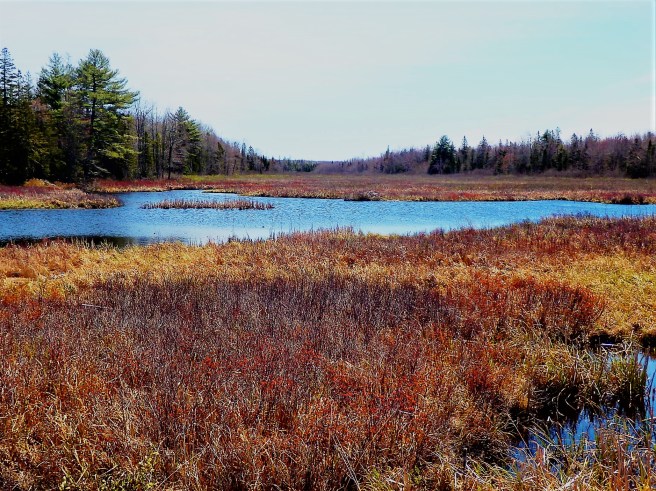
One of the many streams and wetlands.

There are many reasons Downeast reminds me of the Far West, though it’s generally much wetter. In fact, 21 percent of the county is covered with water, much of it as big ponds running along the valleys between the low-elevation mountains. Many of these often island-specked bodies extend two to five miles in length and at least a mile across. And that’s before getting to the bogs and fens or wild rivers and tide meadows or marshes and swamps or prolific beaver ponds. The technical definitions vary, depending perhaps on how wet your shoes get. Quibble as folks might, the northern half of the county seems to be more lakes and wetlands than solid ground. I’m not sure if the Atlantic bays and coves even count in this tally. Quite simply, we’re surrounded by a lot of liquid, so watch where you step.

Lake Meddybemps

What also strikes me is how little development rings the shoreline of the lakes. Many have only a few “camps,” as we New Englanders call the cabins, trailers, or cottages and their docks, with the remainder in full, unspoiled forest. Make a bid, if you must.

It does make for a lot of unspoiled tranquility, for those who are so inclined, if you can deal with black flies and mosquitos. Moose often come as a bonus.

Often you’ll even see a beaver lodge.

Now I’m wondering how our utility bills stack up

With a landmass of 16,577 square miles, the country of Denmark is almost exactly half the size of Maine and has six-times the population of the Pine Tree State. Yet Denmark uses close to 10,000 megawatts of power annually, about double of what Maine uses.

If my math’s right, that means they’re using only a third of what we do, per capita.

How do they do it?

We both have cold winters with long nights. And most of us rely on fuel oil for heat.

And, for the record, nearly half of Maine is uninhabited, year-‘round, meaning the lived-in part of Maine’s about the size of Denmark. They do stay warm and keep the lights on, don’t they?

Running on the wind

One sight always catches our breath as we drive Route 9 across what sometimes feels like the fringe of civilization as we’ve known it. And, for the uninitiated, the state highway from Bangor to Calais can become pretty monotonous in its long uninhabited stretches. As they say, make sure you have a full tank of fuel before you tackle it.

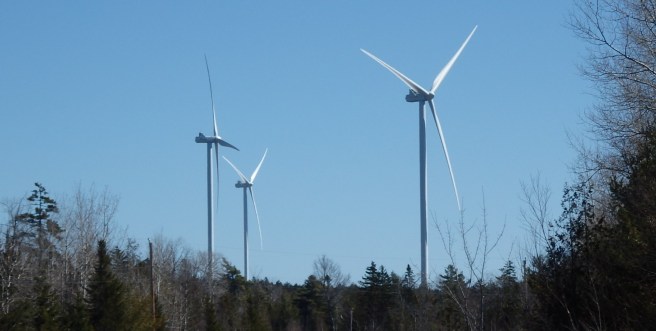
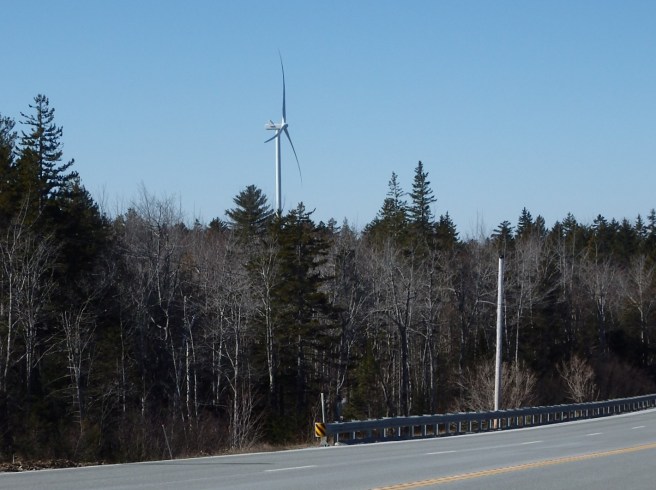
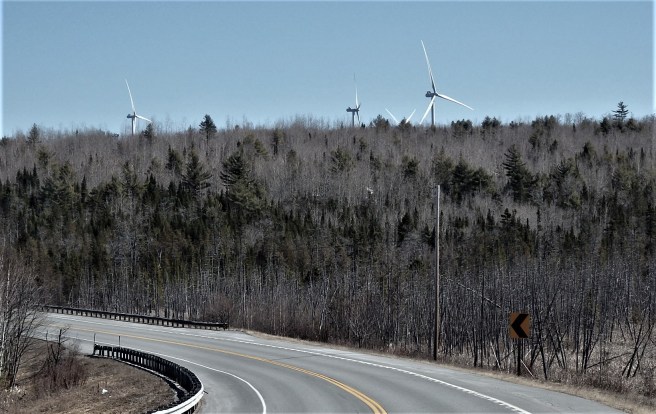
On a clear day, from a dozen miles away you might catch glimpses of a corner of the windfarms on Weaver Ridge and adjoining hills in Hancock County – I’ve counted at least 30 towers before the road dips away – but there are more tucked away in the high terrain. Still, nothing can prepare you for that first flash of the big blades turning gently in the air right in front of your face, or so it seems.

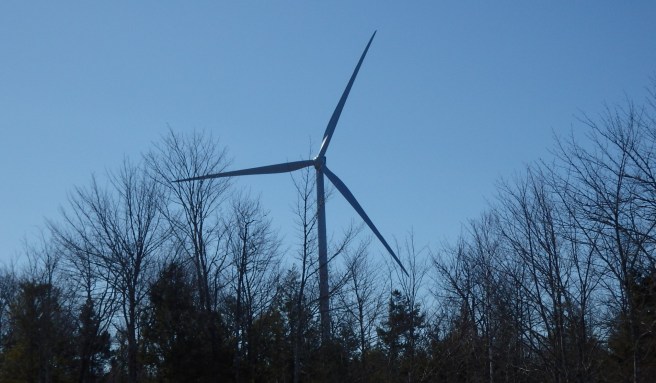
Each blade weighs 1½ tons, even though it appears svelte.

They dance gracefully – sometimes as a solo, then as a pair, or four. You spot them to your left but they suddenly show up on your right – the roadway twists along the slope. As those slip behind you, more giants rise above the hedge of forest. And all too soon, you’ve moved on.

The towers and their blades are bigger than you’d suspect. In fact, at the moment, they’re the tallest wind-powered electrical generators onshore in America, though much larger ones are projected for offshore installation.

The hub stands 382 feet above the ground – that’s more than the length of a football field – and the blade tips reach to 585 feet.

Wind generation accounts for nearly a third of the electrical production in Maine, though the state also imports a fourth of its electricity from Canada, largely Hydro Quebec.

I am baffled by the “not-in-my-backyard” opponents to similar windfarms. They still want energy for their computers and refrigerators and lighting, right?

A tractor-trailer rig could easily be parked in the gearbox or “cabin” attached to the hub.

As if these “spoil the view”? I find them mesmerizing, even enhancing as a kind of sculpture and a reminder of the currents in the air itself. They definitely look better than a toxic oil refinery – and there’s no awful smell. For that matter, they strike me as much more attractive than a television transmitter or cell phone tower as a hilltop crown. And they do remind us of the charming Dutch windmills in a much smaller scale.

The latest installation, 22 Vesta towers and turbines, cost $150 million and went into full operation earlier this year.

Sometimes they seem to play peek-a-boo as you drive.

No more Comcast!

Or Xfinity, as they also say.

I was perplexed that they kept raising the price on our broadband service, seemingly monthly, and then privately complained about monopoly abuse. We haven’t had a TV for years, but for some reason, that didn’t affect the pricing, however they tried to justify that.

Canceling when we moved, though, was a great pleasure. Besides, our new provider is $720 a year cheaper for the same service, perhaps because there’s some competition.

Not everybody’s sticking to broadband for digital access, either.

As a blogger and author, though, I’m just not ready to do all my online stuff on a smart phone. Not that the option couldn’t be tempting.


Truly subversive

After his conversion in prison, Charles Colson held aloft Francis of Assisi and the early Quaker George Fox as his two examples of what happens when a person devotes his whole life to Christ.

Earlier, when Colson was in the White House, he oversaw the FBI creating subversives’ files for Fox and fellow Quaker William Penn, founder of Pennsylvania, and anybody else whose name they found on public Quaker Meeting newsletters.

Yes, beware of true religion.


Moving past Covid

Yes, we were Zooming, as our monthly gathering of religious leaders in town has been doing for the past year, but the suggestion did come as a jolt.

For decades now, the largely informal group has been a way of supporting each other, clergy and laity, as friends and neighbors, and out of that has grown joint activity, such as our community-wide Thanksgiving, Blue Christmas, and Martin Luther King services or overnight shelter for the homeless in the depth of winter or recognition of challenges we face as congregations. It’s one of the things I will especially miss in moving from Dover.

“We need to think carefully about how we come out of Covid,” the Congregational pastor mused. “We need to give it the same attention we did going into the restrictions.”

We still haven’t had the conversation. Maybe we will on our next agenda. But she’s right. Our new normal won’t be the same as the old.

I’ve been hoping that when the restrictions are lifted and we’re all immunized, we’ll be hungry to be back in public get-togethers more than ever, including worship. But there’s also the reality that we’ve fallen out of social habits and may cling to our newer stay-at-home routines. There’s a recognition that for some, continuing the online connections may be beneficial – for invalids or people living at a distance, especially. In addition, a Zoom session can be more convenient than driving hours to a committee meeting, as we’re finding, though it also has drawbacks.

As organizations, we appear to have kept a loyal core but also seen, I sense, newer participants drift away. Can we find ways to lure them back or attract others once we’re “open again”?

~*~

You’ve probably already seen the report that for the first time since the figures were kept, church, synagogue, and similar membership in the U.S. has fallen below 50 percent. Some of the reaction has noted a difference between joining in a congregation in contrast to unaffiliated “spiritual” identity. Some other commentators have derided religion altogether, but we should also be aware of declining membership in various associations across the board. One of the things that struck Alexis de Tocqueville about American society in his travels in 1831-1832 was the degree to which we were joiners. Not just in churches but also trade and economic associations, fraternal societies, political parties, lodges and clubs, sports teams, choruses, bands, and theatrical groups, and more.

While I don’t consider myself to be especially “social,” I’m still a member of a half-dozen groups, and I’m not counting those that are essentially an annual donation and a membership card or magazine in return.

Not so for the younger generation. One daughter does belong to the county beekeepers’ group, but that’s it.

As others have noted, that’s not a good sign for building democracy or community.

~*~

But folks are understandably restless. Already, everyplace seems to be booked up for vacation travel. (Glad we have a place that’s suddenly “in.”)

That transition from lockdown to normal now promises to transpire over the summer, giving organizations a chance to anticipate the changes and readjust more slowly. There’s so much we don’t know, after all.

And we haven’t even touched on the future of retailing and other local business.

What are you looking forward to post-Covid? And when?

Think you’ll miss Zoom?


A vital extension opens on the community trail

Dover’s four-mile-long community trail is a gem and has provided more than a few photo ops I’ve shared here at the Barn. Its southern leg starts at the Amtrak station downtown and, until recently, ended unceremoniously at residential Fisher Street with some delightful scenes in-between. Considered the urban leg, it’s paved for bicycle use as well as pedestrians and runners.

The northern leg kicks off at Fourth Street and follows the Cocheco River up to Watson Road, with its waterfalls and dam. One kink in that route – approaching at the Spaulding Turnpike bridge – was cleared up a few years ago, as was improved access to the trail itself at Fourth Street more recently. Some memorable cross-country skiing from the Watson Falls down to the Spaulding and back had me feeling I was up in the White Mountains rather than still inside the city limits.

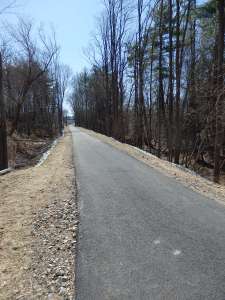
Now, after being on the drawing board for more than six years, a 2,000-foot-long portion of the rail-to-trail pathway has extended the southern end almost all the way to the Sawyer Mills apartments and made ready access for middle- and high-school students.

No motorized vehicles allowed. What a delightful luxury! I think of the trail as Dover’s own Central Park.

There were complications getting permission to skirt some commercial properties along the way, as well as drainage issues and some serious poison ivy. Remaining railroad ties made walking difficult – forget the bicycle or the baby stroller.

Now that winter’s over, the stretch has been graded and paved and, where necessary, fenced off – in a stylish way, I’d say – and while some final touches remain, it’s already attracting happy pedestrian traffic.

You can bet I’ll be checking it out on my return visits.

It’s somebody’s back yard. Really. An industrial parking lot is just ahead on the trail.