Ready for a few recent thoughts arising from all of our teleconferencing (trademark?)?

(By the way, I’m wondering if that “?)?” is a first in the English language.) (Along with opening a writing in a parenthetical mark.)

To the point: After all of this time Zooming, specifically, I’ve finally found a visual background that works for me, almost a stage setting.

In our new old house, my workstation is in what’s also my bedroom rather than somewhere up in an attic. In common with many New England homes, there’s no closet, so when the laptop’s camera is in its usual, sharp focus, my hanging clothes are in full view.

How embarrassing. Or candid. At least I’m not naked, in all my senior-citizen glory.

I’ve played with several photographic backgrounds as alternatives, but they do use up valuable bandwidth, sometimes even interfering with the signal or pixilating my face, and they get wonky if I so much as twitch.

Moving myself and the said laptop to another room gets complicated, especially when I need to reach for a book or paper (back in the earlier room) for reference. New lighting conditions are an additional consideration.

Do we all need a stage manager or producer or even a dramaturge working on our behalf, much less sound engineers? I hope not!

So the solution, where low-tech me is? Voila! Or amazement. I chanced upon the “blurred background” option on the Zoom toolbar and like it. In fact, it can even look dramatic, keeping the focus on (drumroll, please) me. Maybe I’ll keep it.

~*~

As long as we’re on the subject of Zoom, does anyone else find conversation or dialogue unnatural and awkward? There’s hesitation when we’d simply join in and then jump out contrasting to talking over each other because we have no eye contact or other non-verbal cues regarding each other. There are times I’m sure I come off cold simply because I’m stepping back to listen yet other times I no doubt seem rude piping up the same moment others do, like drivers all trying to enter an intersection at the same moment.

By the way, I do think our faces are appearing in a less harsh light than we did earlier in this transition.

For a while, it seemed we were all at less ten years older, children excluded. We looked ghastly.

~*~

I’m also discovering there are many people I recognize more by the sound of their voice than by their faces. Maybe it’s a consequence of joining a new community in the age of Covid, but there is a world of difference between individuals unmasked on my computer screen and masked (or not) somewhere out in public, often miles out of context.

How has your Zooming changed? Any advice to share? Or off-the-wall particulars?

The Puritans came to establish a utopia, not religious chaos

The conventional explanation that the Puritans migrated to New England for religious freedom misses the obvious.

When the Puritans first arrive in 1629, followed the next year with the beginning of their great flood of migration, theirs is a well-orchestrated and well-financed scheme to establish a utopia, one based on their Calvinist Protestant worldview. In many ways, it ranges well beyond the confines of religion.

They set forth in droves.

Crucially, sensing that their mission could be corrupted by false teachings and practices, they squelch unorthodoxy and dissent early on. Within the first decade of their arrival along Massachusetts Bay, they banish Samuel Gorton, Roger Williams, and Anne Hutchinson, who find refuge in Williams’ new colony of Rhode Island. Early Quaker history turns its focus there and neighboring Cape Cod, for good reason, though much also happens north of Boston in Salem, Hampton, and Dover.

Hutchinson’s brother-in-law, the Reverend John Wheelwright, also takes flight and founds the town of Exeter, on the other end of Great Bay from Dover, in New Hampshire.

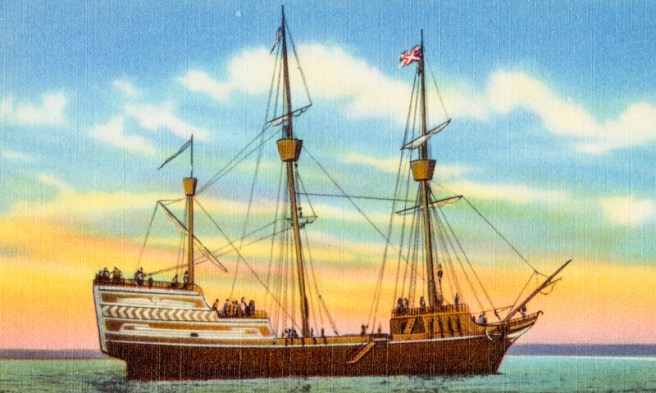
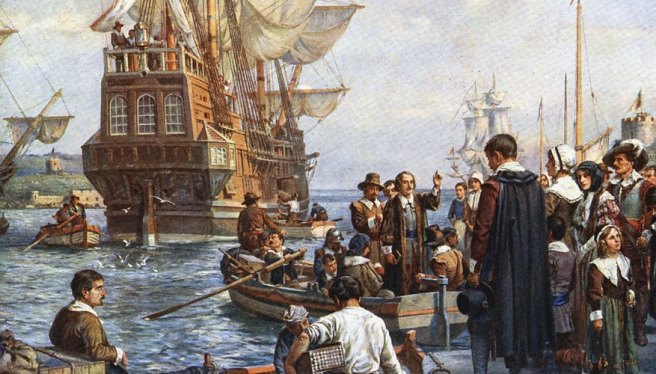
The Arabella, one of the Puritan fleet. Imagine spending two months confined to a vessel like this in often turbulent waters.

Others head more or less straight to Dover. Among them is Hansard Knollys, a minister whose evolving theology will lead him to being a founder of the Baptist denomination when he returns to England. He’s not quite there yet when he formally organizes the church in Dover as a congregational society just six years after its first services. Had he been a bit clearer in his theological evolution, Dover could have established the first Baptist church in America, a year before Williams in Providence. Oh, well.

But that does leave an opening for the Quakers a decade later.

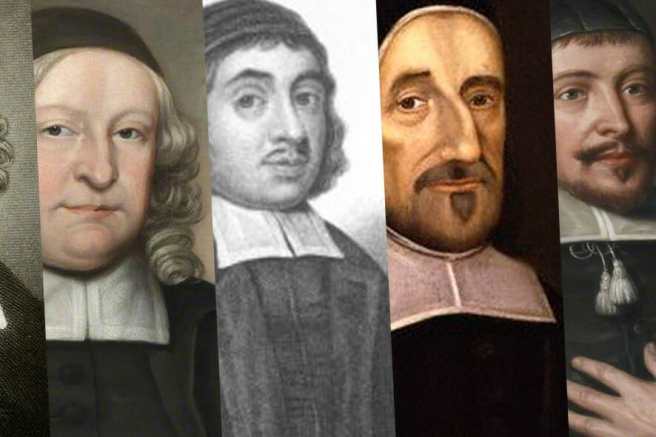
Yes, Puritans. They do look like a smug, judgmental lot. Of course, that’s a judgmental view on my part. I’d hate to get in an argument with them. Ahem.

All the more, I sense that Knollys leaves enough nonconformist thought in his wake to lead some independent spirits in Dover to privately question the ongoing Puritan preaching. As my new book will note, there are hints of that in the town records – supposedly subversive thinking that has to await the arrival of the itinerant Quakers for confirmation and action.

As we’ll see, it’s a volatile mix awaiting the spark for explosion.

Parts of Maine often resemble the Far West 

Maine is larger than the rest of New England combined, and except for much of Vermont, it was settled much later than the rest of the six-state region. That is, the parts of the state that were ever settled at all. Half of the Pine Tree State has no year-round population at all, for good reason.

The result is that there are paved roads where you can drive for miles and see nary a utility line or a mailbox, much less a house. Often, the only human activity you detect is timbering or mining. Hunting and fishing are a way of life. It wasn’t that far out of Bangor I used to see the bear-hunt guide sign.

Those roads remind me of driving from town and out toward a mountain pass on my way to trails in the high country out West.

There are trails for hiking or ATVs just about everywhere, many of them through conifer forests like those of the Far West. Here’s one at Shackford State Park within Eastport’s city limits.

Downeast Maine’s open blueberry barrens on the ridges, meanwhile, give me a sensation of the Big Sky Country of Montana or the Horse Heaven Hills of Washington state, except that the blue overhead isn’t the same deep intensity.

I believe that the presence of Indigenous peoples is another part of the mix. Eastport is adjacent to the Passamaquoddy’s Pleasant Point Reservation, as we’re reminded every time we drive to or from our island. They’re one of the four tribes comprising the Wabanaki Alliance in the state.

Yes, there is a kind of frontier feel around here. I’d suggest calling the area the Far East, but that name’s already been taken.

Fact is, many of the old ships that sailed to the Far East were built along these shores rather than those of the Far West.

Merrymaking at Mare Mount

Speaking of juicy.

Sandwiched in between the arrival of Pilgrims at Plymouth and the Puritans at the Massachusetts Bay colony, we have the libertine plantation at Mare Mount, or Merrymount, on Boston’s South Shore. It’s a provocative whiff of how New England life could have turned, had Thomas Morton successfully warded off the rival raiders.

The very name “merry” at the time was often a synonym for sexual trysting. As for Merry-Mount? It couldn’t have been more graphic.

Unlike Plymouth, this settlement was prospering and welcoming misfits.

Think of hippie. Maybe even commune. Dancing naked with Natives around a giant maypole, one that’s flagrantly phallic. Not just pagan but also reflecting some lingering Devonshire traditions taken to an extreme. (Significantly, for comparison, most of early Dover’s settlers came from Devon, not the East Anglia of Puritan culture.)

Thomas Morton, founder of Merrymount and a thorn in the Puritans’ side

That’s the short version, though there’s much more sketched out in my upcoming book.

And after Merrymount comes crashing down, its founder finds shelter in Sir Ferdinando Gorge’s Maine, not far from Dover.

No, early New England wasn’t all stern Puritans, not by a long shot, no matter how much they tried to keep a lid on.

Nearly two decades later, facing the Quaker outbreak, did Puritan authorities fear the Friends movement might trigger another Merrymount in their midst? As I’ll show, Quakers were anything but quaint and respectable when they show up, though I can assure you they stayed sober rather than make merry. Ahem.

But they were still an alternative to the Puritan rigidity.


Dealing with the off-season in a tourist town

Come the first touch of chill here, and three-quarters of the population begins to vanish. Those folks quietly pack up and return to their primary residence, as have the many tourists. It rather reminds me of living in a college town, but in reverse.

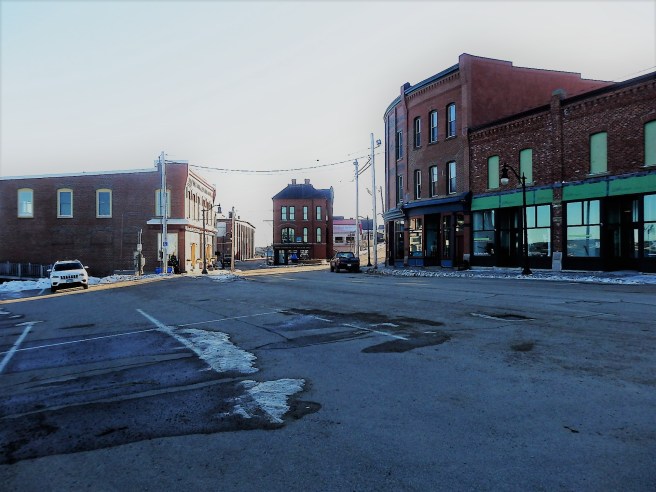
Downtown Eastport in the off-season. The Tides Institute and Museum sits in the old bank building in the center of the scene.

The waterfront and downtown are no longer crowded and festive. Many of the stores, galleries, and eateries are closed up, as are the whale watch, water taxi, and passenger ferry to Lubec. By Halloween, roughly two stores, a diner and a restaurant plus a gallery or two remain open downtown, plus the IGA, two banks, and Family Dollar over on Washington Street.

It makes for a challenging business model, trying to pay the rent and all on a four-month retail prime time. Here the highly watched Black Friday, the make-it-or-break-it financial hurdle of American retailing, doesn’t wait till the day after Thanksgiving but probably hits sometime around the beginning of August.

I have to admire the entrepreneurs who manage it anyway, especially those who stay open through the slim volume of the two-thirds of the year when Eastport’s remote fishing village nature is most prominent.

It also means a lot of do-it-yourself involvement. If you want to see movies, you join the film society. Music? Pitch in with the choir or orchestra. Theater? You guessed it. Dining out? One of the neighboring towns must be having a church supper. Seriously.

And you turn out for others.

Yes, it means more work than just sitting on the sidelines, and with a small population, keeping things going can be a struggle.

But one thing I’ve noticed. It doesn’t take long to be appreciated when you take part.


Brother William takes a roundabout route

When Edward Hilton settles on Dover Point, his brother William is dwelling in the Plymouth Bay colony. It’s one more suggestion, in fact, that Edward knew about the Piscataqua watershed before setting forth himself.

William arrives on the second ship to the Pilgrim plantation, followed by his wife and family on the next. They definitely aren’t Pilgrims (the term wasn’t even in use then – Separatists was more accurate). And, for that matter, despite sharing a basic Calvinist theology, the Separatists hold some sharp differences from the Puritans who show up later.

Critically, roughly half of the settlers at new Plymouth aren’t members of the Separatist faith. And that includes the only ordained minister in the colony.

Thus, when William and his wife arrange for a secret Anglican (that is, Episcopal) baptism for their infant, a scandal erupts that sends them scurrying northward and brings to light the sordid background of the now disgraced minister who is promptly banished. (No spoiler here – but you’ll still have to read the book.) These events do present a grittier alternative to the Thanksgiving scenario we usually trot out about the Pilgrim experience.

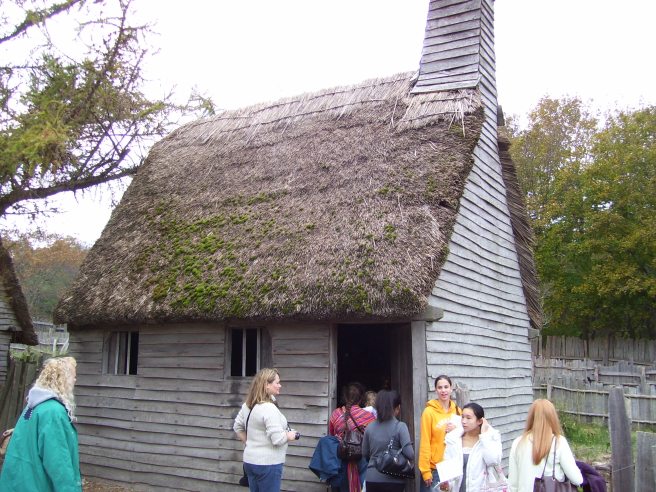
I wonder how much early Dover resembled the 1630 village at the Pilmoth Plantation living history museum. These houses were dark and drafty, at best. Photo by Swampyank via Wikimedia Commons.

William winds up in New Hampshire, settling at the Pannaway plantation at the mouth of the Piscataqua River, where he’s soon making salt to be used for preserving fish for shipment.

And then, in the demise of Pannaway, he’s finally at Dover Point.

This isn’t the way his arrival in Dover is commonly painted. Quite simply, he isn’t one of the first two settlers. Thomas Roberts, Edward’s apprentice, earns that honor.

Still, like his brother, William is both a member of the powerful fishmonger guild in London and literate. And things get a bit rowdy when he moves on from Dover to live on the Maine side of the river.

Yeah, if you’re looking for gossip, there’s some juicy stuff on his part, especially when we meet his last wife. She’s definitely not holier-than-thou.

No, the settlers don’t own the land – they can merely hold it and pay rents

It’s hard for modern Americans to understand a basic reality of European colonies in the New World.

None of the players in the story own the land they’re dealing with.

Not the settlers, even though they’re clearing it and building on it.

Nor the proprietors or investors, either. They’re more like developers who offer leasing opportunities. Think of rental agents.

Nor the Indigenous tribes, surprisingly, even though many of the settlers also negotiate a payment to them for their land. The use of their land, more accurately. Admittedly, the payments are largely symbolic – a bushel of corn a year, for example.

No, quite simply, all land “belongs” to the king, and he allocates the privilege of using it as a means of leveraging his own prestige and power.

Under the feudal system, that would mean grants to barons and other lords in return for their fealty.

They, in turn, could dole some out to knights, who then become wealthy, as well.

Add to that the gentlemen farmers, living off the rents to their estates.

And then yeomen, who are still free on their own tenants, as their small holdings were called.

And husbandmen.

And, somewhere below that, the serfs who are bound to the land and its holder. Well, by this point in time, they’d been freed but were still at the bottom of the ladder.

King James I

~*~

THIS IS THE MODEL OF LANDHOLDING – not landownership – up through the American Revolution.

Its assumptions are quite different from those of modern Americans. What do you mean? I don’t own the ground under my house and barn?

No, you don’t. And you still have to pay rent on it.

~*~

AS A FURTHER COMPLICATION, charters could be revoked or rewritten.

Falling out of the king’s favor would have costly and dire consequences.

As my upcoming book describes, this land arrangement affected Dover and the rest of New England through a series of realignments and controversies and attempted evictions.

In fact, it almost leads to a rebellion in Boston Harbor against the king a century-and-a-half before Paul Revere’s midnight ride. Well, that’s one aside I don’t develop. There’s too much else going on along the Piscataqua.


Come on down to where the town really connects

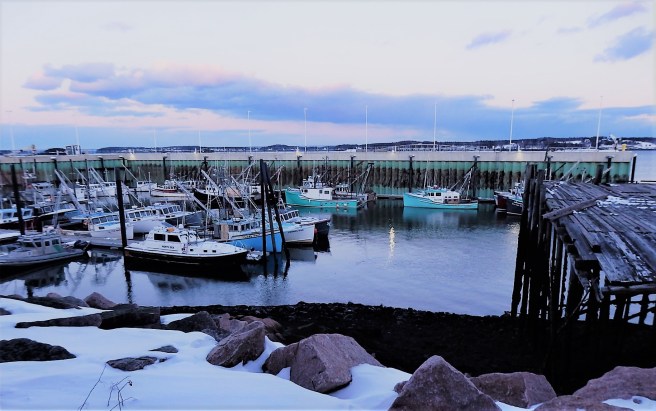
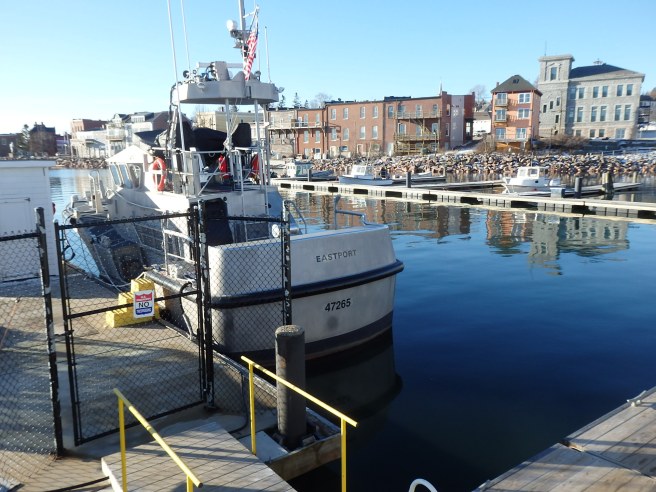
Locally, it’s known as the Breakwater, rather than the town pier or wharf or dock or safe harbor. And it’s the heart of Eastport, the centerpiece and focal point, as well as the home of the commercial fishing fleet and U.S. Coast Guard station.

It’s snuggled up right next to our small, struggling, and potentially quaint downtown. Here’s how it looks from the walkway this time of year.

It even broke down and collapsed in the winter of 2014, taking a few fishing boats with it.

Rebuilding was another matter. Officially, it reopened in September 2017, though details may have been completed later. The versions differ, up to “two winters before last.”

Eastport has the deepest natural harbor in the continental United States and is said to have rivaled New York’s in shipping at one point. I’ve seen photos of a cruise ship tied up here, and it truly overwhelmed the dock and town in its size.

The waterfront has – and had – other piers, with pilings that can still be seen – the old vaudevillian appearing steamship dock, for one, or the more recently gone Northeast Marina and Fuel Depot, as prominent examples. And, yes, definitely, what was once the world’s largest sardine cannery, as well as a solitary brick shell from the era still standing over the water with some folks hoping for a redevelopment before it caves in.

Significantly, there is the Cargo Terminal, our industrial shipping complex at Estes Head just around the bend. It has both high security and tractor-trailer traffic, so you don’t stroll around there.

Still, the breakwater at the end of Sullivan Street beckons us, even with its seemingly perilous heights above the water at low tide.

And here’s how downtown looks from the Breakwater.

A ‘mild case’ can still be the sickest you’ve ever felt

Here we are, coming up on the second anniversary of the Covid outbreak here and abroad, and we’re still in the midst of its disorder. So much for that initial hope of a two-week or six-week lockdown, max, which even then unfortunately had too many holdouts from the precautions. Can we blame them for leaving the Pandora’s box open for all that’s followed?

Once that first round passed, after its devastation in large urban areas like New York City, we had a breather in which medical procedures were more clearly understood and improved and vaccines became available. We’ve even been able to gather in public again, albeit in fewer numbers and spaced apart while still wearing masks. Surface contamination is no longer a major worry, either.

Where I live, the illness has often seemed to be a distant threat. While I have friends who came out of retirement to resume long hours as medical professionals, their tales of a stress still seemed confined to largely quarantined hospitals and clinics, even though they were only just down the street. Well, I also got updates from fellow clergy who couldn’t visit patients in person, that sort of thing. Still, two years later, I knew of only two cases in our Friends Meeting, both quite mild. Further east, in remote Washington County, Maine, fewer than 3,000 cases and 43 deaths have been tallied, last I looked, though those figures have nearly tripled since November.

Still, the threat kept getting closer and more personal. The surge in the Omicron variant forced the cancellation of the final Christmas performances of our beloved Boston Revels, for example. Traditionally low-rate New Hampshire recently reported the highest per capita figures in the nation. Our twice-a-month local newspaper’s half-dozen or so obituaries now regularly mention “of Covid complications” as the cause of death. (Nobody, presumably, dies directly of the infection or is at least willing to admit that openly. Am I guessing there’s a social stigma?)

We have endured the screeching dissent and violent reactions from those who feel entitled to do whatever they want in public, regardless of any harm to others, and that seems to be spiking.

How long, though, will it take for the emotional frustration of the other side to erupt?

For starters, there’s a growing weariness among those of us who have been wearing masks and getting our booster shots, in part to protect others from suffering from the illness, while enduring the arrogance of those who pooh-pooh the odds, putting their own “liberty” above the common good, and then putting the rest of the populace at risk while expecting overworked medical professionals to come to their rescue and forcing heart attack patients and crash victims to be juggled about for unavailable intensive-care beds.

Look, I know Christian Scientists who have gotten the shots, not for themselves – remember, they generally avoid doctors as a matter of their faith – but out of a sense of social responsibility for others. In contrast, I’m sensing that many of those who refuse vaccinations are also among those accusing lower-income Americans of “entitlement” when it comes to economic and social support, rather than turning the focus to the One Percent who actually benefit financially from overt entitlement in public legislation and regulation. Are these the same ones who scoff at widespread examples of global warming and impending disaster? The willful ignorance, selfish, self-centered behavior, and bullying outrage me. And before they quote – or misquote – Scripture for their positions, I can imagine them refusing Moses’ orders to paint lambs’ blood above their doors for protection from the Angel of Death – “Who are you to tell me what to do?” – but it’s the firstborn who suffer if they don’t. Drat! I can confess a vindictive urge – you know, of the smite-my-enemies vein – but revisiting the Exodus text, I’m seeing that in only one of the first nine plagues are the Israelites exempted from the evil consequences. Pointedly, all Egyptians, not just the pagans, suffer from Pharaoh’s refusal to act in accord with Divine direction.

No matter what, in the end, reality will win out, though it won’t be selective in choosing its victims.

What happens if this affliction spreads to strike down all who haven’t been vaxxed? Costly treatments that could have been avoided will be borne by all, regardless, through Medicare, insurance companies, and unpaid debts to hospitals, more than by the defiant unvaxxed ill and dying. The workforce will continue to be impacted, too.

The Omicron variant, as we’re seeing, is also hitting vaccinated people, but with lesser impact.

We look at the statistics and hear the stories that the new variety is less deadly but more infectious, along with the note that breakthrough cases among the vaxxed hit far more gently than among the unprotected, but we need to listen more closely.

Unless a patient is in need of a respirator, the diagnosis is to stay home, there’s no room at the hospital. Good luck if you’re living alone, and good luck to the rest of the household if you’re not.

Moreover, it’s considered a mild case unless you’re hospitalized or die.

As for those “mild” cases? More than one person has been quoted as saying they’ve never felt so sick in their life.

So far, I’ve been lucky, but my family’s finally been hit, notably in their recent visit to me. My test and my wife’s came back negative, but not so for the rest, despite all their precautions.

Would coming down sick be a sufficient lesson for the nay-sayers? Or would it make them dig in more deeply in denial?    
 

The Piscataqua’s first European settlers set up at two sites

From the git-go, there’s been a rivalry between Portsmouth and Dover, though a closer look reveals it’s more nuanced than what we usually think.

The 1622 contract for developing the Piscataqua watershed allows for more than one vessel to arrive and more than one settlement to be planted along the river.

Scotsman David Thomson is the head of the operation. He sets forth in the Jonathan and establishes his fortified Pannaway plantation at the mouth of the river in today’s Rye – not Portsmouth, contrary to the Port City’s claims of founding. He’s highly placed politically, somehow having the ear of King James I. And specifically, he’s the only one named in the grant.

Pannaway faces the open Atlantic, with salt marsh to its back.

As the scene stands today. The landscape has changed but not the waterways.

~*~

IN CONTRAST, when the Providence arrives a month later, she apparently sails straight up the river to today’s Hilton Point aka Dover Point, where Edward Hilton and Thomas Roberts then set up operations. They disembark at Pomeroy Cove, which they name for Leonard Pomeroy, one of the three principal backers of the project. He’s also Lord Mayor of Plymouth, England, home of the company, and co-owner of the ship that’s brought them this far.

As I detail in my upcoming book, Hilton likely knew of the site even before setting sail. It was far enough inland to be sheltered from violent storms. Vast forests extended from the riverbanks, with timber for shipbuilding, piers, and barrels as well as homes and bridges and wild game for the taking. Best of all, the point was a confluence of rich tidal waters, with the Great Bay estuary on one side along with its tributary streams and, on the other side, the Piscataqua and its Cochecho and Salmon Falls rivers. Cod, salmon, sturgeon, eels, herring, oysters, clams, and lobsters are bountiful. Why go out to sea when the fish come right up to you?

While Pannaway is thoroughly documented, in part through its stream of visitors, its existence is short-lived, and the site’s abandoned by 1626, when Thomson relocates to an island in Boston Harbor and disappears soon after. His widow then promptly marries Samuel Maverick – yes, the source of that word. It’s a rough-and-tumble world.

~*~

OUT OF THE SPOTLIGHT of documentation, Hilton and Roberts continue on, in time joined by Edward’s brother William and their sister or possibly cousin Rebecca along with more family.

Either way, Roberts and Rebecca soon marry and start a farm about a mile from the point – they later move it another mile-and-half – but theirs will still be the oldest family-owned farm in the future United States well into the 20th century.

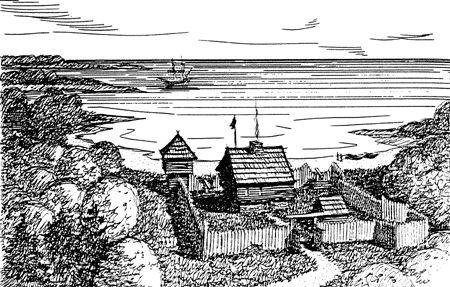
The Hilton Point settlement as it’s commonly been envisioned.

It must have been lonely through much of that first decade. The Hilton-Roberts clan was definitely on the frontier, and ongoing war in Europe cut off much ship traffic.

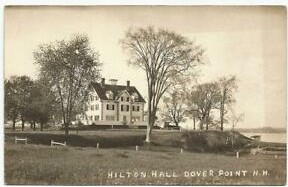
How much, if anything, did Hilton Hall originate in the early settlement at Dover Point? If the house was anywhere near this size, my perspective changes completely.

Edward Hilton is, however, definitively rewarded for his six years of habitation and hard labor by a charter giving him clear control at Dover Point. And they must be prospering, as seen in assessments placed on their province or his brief return to England for the legal document, perhaps a fish delivery, and definitely a marriage.

While Thomas and Rebecca Roberts remain in Dover for the rest of their lives, her brothers eventually move on – Edward to Exeter and William, by degrees along the Maine side of the Piscataqua. All of their lives take colorful turns along the way, which I relate in the book.

Even though Portsmouth baldly claims 1623 as its founding date, it had no European settlement until the Laconia Company chose to set up operations there in 1629 or 1630, calling their site Strawbery Banke. Yes, that was one more convolution of investors.

~*~

AND THAT’S THE BARE-BONES VERSION. There’s plenty in my upcoming book to flesh it out, some of it rather earthy – especially when we get to the contemporaneous and scandalous Merrymount plantation down on Plymouth Bay.

Fact: New Hampshire is the second-oldest state to be settled in New England. Older than Connecticut, Rhode Island, Maine, or Vermont.