No, the settlers don’t own the land – they can merely hold it and pay rents

It’s hard for modern Americans to understand a basic reality of European colonies in the New World.

None of the players in the story own the land they’re dealing with.

Not the settlers, even though they’re clearing it and building on it.

Nor the proprietors or investors, either. They’re more like developers who offer leasing opportunities. Think of rental agents.

Nor the Indigenous tribes, surprisingly, even though many of the settlers also negotiate a payment to them for their land. The use of their land, more accurately. Admittedly, the payments are largely symbolic – a bushel of corn a year, for example.

No, quite simply, all land “belongs” to the king, and he allocates the privilege of using it as a means of leveraging his own prestige and power.

Under the feudal system, that would mean grants to barons and other lords in return for their fealty.

They, in turn, could dole some out to knights, who then become wealthy, as well.

Add to that the gentlemen farmers, living off the rents to their estates.

And then yeomen, who are still free on their own tenants, as their small holdings were called.

And husbandmen.

And, somewhere below that, the serfs who are bound to the land and its holder. Well, by this point in time, they’d been freed but were still at the bottom of the ladder.

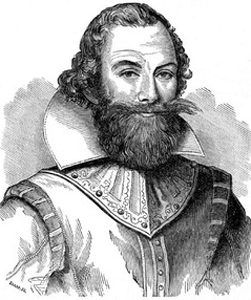
King James I

~*~

THIS IS THE MODEL OF LANDHOLDING – not landownership – up through the American Revolution.

Its assumptions are quite different from those of modern Americans. What do you mean? I don’t own the ground under my house and barn?

No, you don’t. And you still have to pay rent on it.

~*~

AS A FURTHER COMPLICATION, charters could be revoked or rewritten.

Falling out of the king’s favor would have costly and dire consequences.

As my upcoming book describes, this land arrangement affected Dover and the rest of New England through a series of realignments and controversies and attempted evictions.

In fact, it almost leads to a rebellion in Boston Harbor against the king a century-and-a-half before Paul Revere’s midnight ride. Well, that’s one aside I don’t develop. There’s too much else going on along the Piscataqua.


Come on down to where the town really connects

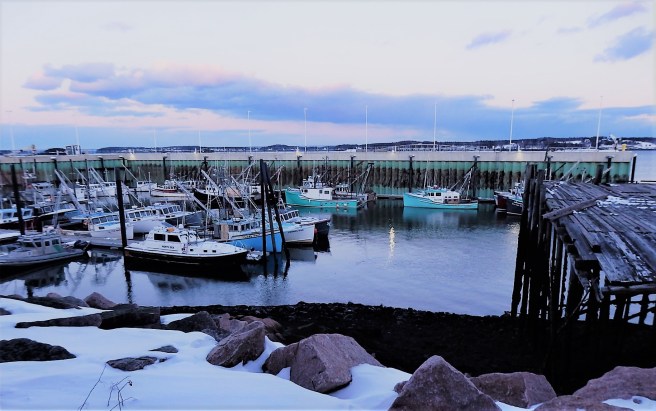
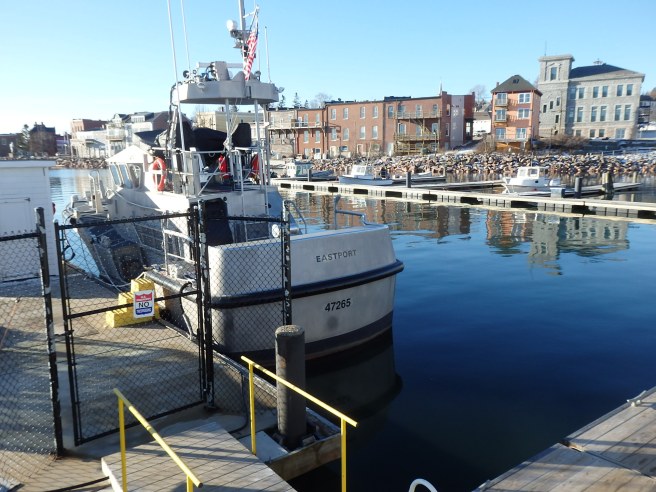
Locally, it’s known as the Breakwater, rather than the town pier or wharf or dock or safe harbor. And it’s the heart of Eastport, the centerpiece and focal point, as well as the home of the commercial fishing fleet and U.S. Coast Guard station.

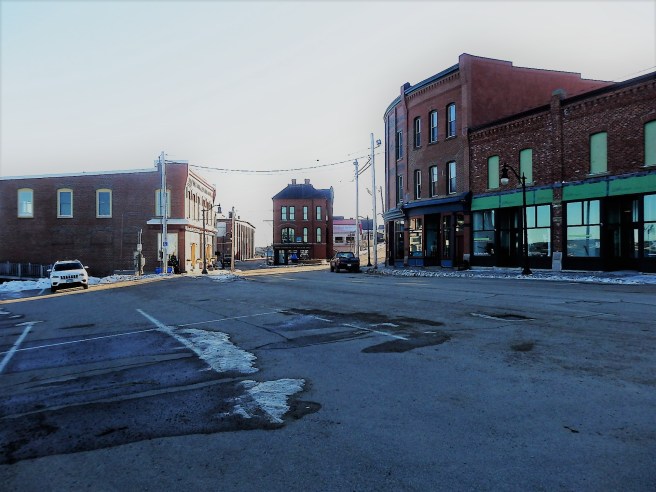
It’s snuggled up right next to our small, struggling, and potentially quaint downtown. Here’s how it looks from the walkway this time of year.

It even broke down and collapsed in the winter of 2014, taking a few fishing boats with it.

Rebuilding was another matter. Officially, it reopened in September 2017, though details may have been completed later. The versions differ, up to “two winters before last.”

Eastport has the deepest natural harbor in the continental United States and is said to have rivaled New York’s in shipping at one point. I’ve seen photos of a cruise ship tied up here, and it truly overwhelmed the dock and town in its size.

The waterfront has – and had – other piers, with pilings that can still be seen – the old vaudevillian appearing steamship dock, for one, or the more recently gone Northeast Marina and Fuel Depot, as prominent examples. And, yes, definitely, what was once the world’s largest sardine cannery, as well as a solitary brick shell from the era still standing over the water with some folks hoping for a redevelopment before it caves in.

Significantly, there is the Cargo Terminal, our industrial shipping complex at Estes Head just around the bend. It has both high security and tractor-trailer traffic, so you don’t stroll around there.

Still, the breakwater at the end of Sullivan Street beckons us, even with its seemingly perilous heights above the water at low tide.

And here’s how downtown looks from the Breakwater.

A ‘mild case’ can still be the sickest you’ve ever felt

Here we are, coming up on the second anniversary of the Covid outbreak here and abroad, and we’re still in the midst of its disorder. So much for that initial hope of a two-week or six-week lockdown, max, which even then unfortunately had too many holdouts from the precautions. Can we blame them for leaving the Pandora’s box open for all that’s followed?

Once that first round passed, after its devastation in large urban areas like New York City, we had a breather in which medical procedures were more clearly understood and improved and vaccines became available. We’ve even been able to gather in public again, albeit in fewer numbers and spaced apart while still wearing masks. Surface contamination is no longer a major worry, either.

Where I live, the illness has often seemed to be a distant threat. While I have friends who came out of retirement to resume long hours as medical professionals, their tales of a stress still seemed confined to largely quarantined hospitals and clinics, even though they were only just down the street. Well, I also got updates from fellow clergy who couldn’t visit patients in person, that sort of thing. Still, two years later, I knew of only two cases in our Friends Meeting, both quite mild. Further east, in remote Washington County, Maine, fewer than 3,000 cases and 43 deaths have been tallied, last I looked, though those figures have nearly tripled since November.

Still, the threat kept getting closer and more personal. The surge in the Omicron variant forced the cancellation of the final Christmas performances of our beloved Boston Revels, for example. Traditionally low-rate New Hampshire recently reported the highest per capita figures in the nation. Our twice-a-month local newspaper’s half-dozen or so obituaries now regularly mention “of Covid complications” as the cause of death. (Nobody, presumably, dies directly of the infection or is at least willing to admit that openly. Am I guessing there’s a social stigma?)

We have endured the screeching dissent and violent reactions from those who feel entitled to do whatever they want in public, regardless of any harm to others, and that seems to be spiking.

How long, though, will it take for the emotional frustration of the other side to erupt?

For starters, there’s a growing weariness among those of us who have been wearing masks and getting our booster shots, in part to protect others from suffering from the illness, while enduring the arrogance of those who pooh-pooh the odds, putting their own “liberty” above the common good, and then putting the rest of the populace at risk while expecting overworked medical professionals to come to their rescue and forcing heart attack patients and crash victims to be juggled about for unavailable intensive-care beds.

Look, I know Christian Scientists who have gotten the shots, not for themselves – remember, they generally avoid doctors as a matter of their faith – but out of a sense of social responsibility for others. In contrast, I’m sensing that many of those who refuse vaccinations are also among those accusing lower-income Americans of “entitlement” when it comes to economic and social support, rather than turning the focus to the One Percent who actually benefit financially from overt entitlement in public legislation and regulation. Are these the same ones who scoff at widespread examples of global warming and impending disaster? The willful ignorance, selfish, self-centered behavior, and bullying outrage me. And before they quote – or misquote – Scripture for their positions, I can imagine them refusing Moses’ orders to paint lambs’ blood above their doors for protection from the Angel of Death – “Who are you to tell me what to do?” – but it’s the firstborn who suffer if they don’t. Drat! I can confess a vindictive urge – you know, of the smite-my-enemies vein – but revisiting the Exodus text, I’m seeing that in only one of the first nine plagues are the Israelites exempted from the evil consequences. Pointedly, all Egyptians, not just the pagans, suffer from Pharaoh’s refusal to act in accord with Divine direction.

No matter what, in the end, reality will win out, though it won’t be selective in choosing its victims.

What happens if this affliction spreads to strike down all who haven’t been vaxxed? Costly treatments that could have been avoided will be borne by all, regardless, through Medicare, insurance companies, and unpaid debts to hospitals, more than by the defiant unvaxxed ill and dying. The workforce will continue to be impacted, too.

The Omicron variant, as we’re seeing, is also hitting vaccinated people, but with lesser impact.

We look at the statistics and hear the stories that the new variety is less deadly but more infectious, along with the note that breakthrough cases among the vaxxed hit far more gently than among the unprotected, but we need to listen more closely.

Unless a patient is in need of a respirator, the diagnosis is to stay home, there’s no room at the hospital. Good luck if you’re living alone, and good luck to the rest of the household if you’re not.

Moreover, it’s considered a mild case unless you’re hospitalized or die.

As for those “mild” cases? More than one person has been quoted as saying they’ve never felt so sick in their life.

So far, I’ve been lucky, but my family’s finally been hit, notably in their recent visit to me. My test and my wife’s came back negative, but not so for the rest, despite all their precautions.

Would coming down sick be a sufficient lesson for the nay-sayers? Or would it make them dig in more deeply in denial?    
 

The Piscataqua’s first European settlers set up at two sites

From the git-go, there’s been a rivalry between Portsmouth and Dover, though a closer look reveals it’s more nuanced than what we usually think.

The 1622 contract for developing the Piscataqua watershed allows for more than one vessel to arrive and more than one settlement to be planted along the river.

Scotsman David Thomson is the head of the operation. He sets forth in the Jonathan and establishes his fortified Pannaway plantation at the mouth of the river in today’s Rye – not Portsmouth, contrary to the Port City’s claims of founding. He’s highly placed politically, somehow having the ear of King James I. And specifically, he’s the only one named in the grant.

Pannaway faces the open Atlantic, with salt marsh to its back.

As the scene stands today. The landscape has changed but not the waterways.

~*~

IN CONTRAST, when the Providence arrives a month later, she apparently sails straight up the river to today’s Hilton Point aka Dover Point, where Edward Hilton and Thomas Roberts then set up operations. They disembark at Pomeroy Cove, which they name for Leonard Pomeroy, one of the three principal backers of the project. He’s also Lord Mayor of Plymouth, England, home of the company, and co-owner of the ship that’s brought them this far.

As I detail in my upcoming book, Hilton likely knew of the site even before setting sail. It was far enough inland to be sheltered from violent storms. Vast forests extended from the riverbanks, with timber for shipbuilding, piers, and barrels as well as homes and bridges and wild game for the taking. Best of all, the point was a confluence of rich tidal waters, with the Great Bay estuary on one side along with its tributary streams and, on the other side, the Piscataqua and its Cochecho and Salmon Falls rivers. Cod, salmon, sturgeon, eels, herring, oysters, clams, and lobsters are bountiful. Why go out to sea when the fish come right up to you?

While Pannaway is thoroughly documented, in part through its stream of visitors, its existence is short-lived, and the site’s abandoned by 1626, when Thomson relocates to an island in Boston Harbor and disappears soon after. His widow then promptly marries Samuel Maverick – yes, the source of that word. It’s a rough-and-tumble world.

~*~

OUT OF THE SPOTLIGHT of documentation, Hilton and Roberts continue on, in time joined by Edward’s brother William and their sister or possibly cousin Rebecca along with more family.

Either way, Roberts and Rebecca soon marry and start a farm about a mile from the point – they later move it another mile-and-half – but theirs will still be the oldest family-owned farm in the future United States well into the 20th century.

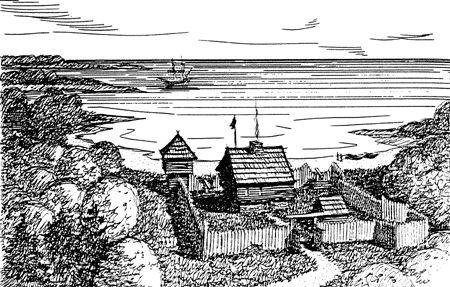
The Hilton Point settlement as it’s commonly been envisioned.

It must have been lonely through much of that first decade. The Hilton-Roberts clan was definitely on the frontier, and ongoing war in Europe cut off much ship traffic.

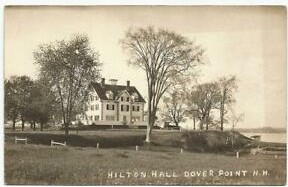
How much, if anything, did Hilton Hall originate in the early settlement at Dover Point? If the house was anywhere near this size, my perspective changes completely.

Edward Hilton is, however, definitively rewarded for his six years of habitation and hard labor by a charter giving him clear control at Dover Point. And they must be prospering, as seen in assessments placed on their province or his brief return to England for the legal document, perhaps a fish delivery, and definitely a marriage.

While Thomas and Rebecca Roberts remain in Dover for the rest of their lives, her brothers eventually move on – Edward to Exeter and William, by degrees along the Maine side of the Piscataqua. All of their lives take colorful turns along the way, which I relate in the book.

Even though Portsmouth baldly claims 1623 as its founding date, it had no European settlement until the Laconia Company chose to set up operations there in 1629 or 1630, calling their site Strawbery Banke. Yes, that was one more convolution of investors.

~*~

AND THAT’S THE BARE-BONES VERSION. There’s plenty in my upcoming book to flesh it out, some of it rather earthy – especially when we get to the contemporaneous and scandalous Merrymount plantation down on Plymouth Bay.

Fact: New Hampshire is the second-oldest state to be settled in New England. Older than Connecticut, Rhode Island, Maine, or Vermont.

The turmoil’s turned up, blowing the lid off simmering pot

Let’s take a look.

Over the past year, we’ve witnessed a range of economic jolts that seem vaguely related to the worldwide Covid outbreak, though I’d say the virus only precipitated troubles that would have been inevitable even without it.

The pandemic simply turned up the heat, as it were.

Among the headlines:

  • Soaring prices of houses, many of them going to buyers from California or New York, sight unseen. Who can afford these mortgages? None of us in our old neighborhood could have moved in today.
  • The relocation from big cities to small towns, for those whose jobs can be done from home. Will they stay or fit in? What will their impact be, especially in places that have been economically struggling?
  • A retail apocalypse in the face of rising online shopping – what’s the future of downtown or the malls? (If you’re “going to work” on Zoom, you don’t need to dress up in new clothes, for one thing.)
  • Superrich and corporate takeover of American farmlands – and mobile home parks. Another blow to the middle and lower classes.
  • Systemic problems in the nation’s health-care system, including the uneven distribution of medical services. A fourth of Americans, mostly rural, have no primary physician, and many others are afraid to use the system because of serious past racial abuses. (These appear to be the leading reason many people have not been vaccinated.)
  • The failure of “just-in time,” including the supply-chain issues that have plagued retailers and manufacturers alike. It’s also exposing the vulnerabilities of offshore sourcing to places like China and Indonesia, as well as looming national security weaknesses. (I blame the Walmart influence in shuttering American factories.)
  • While automakers have shut down assembly lines because of the unavailability of computer chips, what we found most striking was all the empty shelves during a run to IKEA, the home design line built on its international flair and savvy. Row after row, empty. So much for our shopping list and research.
  • Inflating food prices. Fuel and weather are only part of the problem. (Well, we should note climate change somewhere in here, though it has nothing to do with Covid.)
  • Customer and voter nastiness, no doubt intensified by the isolation and resentment.

~*~

More telling is the shift in the workplace, with all of the help-wanted signs for jobs that go begging. It’s not that people are lazy, but rather they’ve realized the positions are demeaning, or meaningless, and it costs them more to work than they’re paid. It’s time to admit that minimum wage is insufficient. Many apparently discovered during Covid that their jobs were costing more than they were earning, once child care, transportation, and related costs were factored in.

Add to that the fact that a certain percentage of the populace is, candidly, unemployable – in the old days, you could give them chores around the farm, but even those have been mechanized. So what can they do to still be contributing members of the wider society?

There has been a serious breakdown in the social contract that underpins democracy. And in the work ethic – or ethics, for those who look closer.

For decades now, employers have demanding loyalty but offering none of their own. Sometimes, there’s even a requirement of noncompete agreements, no matter that the worker has paid for the needed education and career. In reality, in a big company, you work for your immediate boss and colleagues and whatever satisfaction you can find – not the remote layers above. The fact is, nobody entering the workforce today will be at the same enterprise at the end of their career. Maybe public service – especially education – will remain the rare exception.

One of the more shocking reports I saw in the past year noted that only a minority of American males between 18 and 65 hold fulltime jobs – I think the figure was just a third of the total. What are the rest doing? School, prison, early retirement, or – as I’m suspecting – under-the-table ventures. They’re not all stay-at-home dads, are they?

~*~

My new community is an interesting place to watch all of this play out. The place has long been stressed economically, with few adequately paying jobs to sustain families, and that’s led to a population outflow.

Qualified contractors, on the other hand, have been booked out solid, as has been the case nationally. (See above housing sales.)

Our new old house needs tons of renovation, but we’re stymied. As my wife says, “I have money I want to give to somebody but just can’t find anyone to take it.” Well, if we had a crew lined up, there would have been the problem of getting building supplies, and then at prices twice what they’d been just months before.

We’re hoping that will all change in the months ahead.

~*~

These are all things that need to be examined closely in the months ahead, especially in the public arena like the upcoming elections, not that I expect much of it will come coherently from the candidates. The fixes, after all, aren’t easy or painless.

In a way, it’s reflected in the matters of even wearing a mask (or not) or getting the vaccine (or not). I’d say Covid has simply made more obvious the deep polarization at work in our nation – and the wider world.

We all have some important and difficult work to do ahead. We can start with small steps.


Why we’re all waiting for the border to Canada to really reopen

Having to wait 72 hours for a Covid test result – but don’t you dare delay much longer – as well as the other current restrictions have meant that the U.S.-Canada border really isn’t open, not the way it was before the coronavirus outbreak.

That’s made for a hard burden where I now live. New Brunswick is very much a part of our community. Just about every long-established family has kin on the other side of the boundary. For almost everyone, it’s meant jobs or services or shopping or even cultural pursuits. There are good reasons our local newspaper covers the two adjoining counties, which share the tidal waters and weather. The virus constraints have devastated the economy of the small city of Calais, to our north, which usually carries heavy truck traffic between the two countries as well as local business at groceries, hardware stores, and other retailers and restaurants; likewise for the town of Lubec, to our south, which has the only bridge connection for Campobello Island. Many folks also have property on the other side of the line, or maybe their boat, or even dear ones buried in cemeteries, and are cut off. You go to the dentist and realize the radio is tuned to a Canadian station, that sort of thing. It’s not all one way, either. I would be back to swimming laps in the nearest indoor pool, for instance, only 45 minutes or so distant. The nearest Costco would be only an hour-and-a-half drive off, rather than eight or nine down around Boston. We’d have some fine dining options available, so I’ve been told, as well as museums and nightlife and even festivals.

The local Passamaquoddy population has long been torn by the international division, especially the differing laws regarding Indigenous peoples. I’ve also heard how the already tightening border regulations have changed other interactions. Guys my age have told me about dating girls on the other side of the water (way back then we were all teens), rowing over to court them and then returning (merrily), something nobody could do today without being detained by the Coast Guard, Customs officials, and who knows else. (Not so merrily.)

It’s also dampened summer tourism, especially by travelers who were hoping  to continue on but couldn’t, or by Canadians who usually boost the crowds at our week-long Fourth of July revels and Pirate Festival weekend.

For me, this has been a lesson in the ways seemingly arcane regulations made in distant places can hit home personally. You know, the kind of thing you might glance over in a news story with a shrug, as I would, not anticipating a trip to Europe or a Caribbean cruise or even a cross-country flight anytime soon.

What unexpected ways have you experienced Covid restrictions?   

The early investors were looking for gold, not Jesus

To understand why a third of Dover became Quaker in the mid-1600s, we need to go back to the very founding of the colony.

The whirlpool in Sir Ferdinando Gorges’ coat of arms eerily reflects his role in New England’s early settlement.

The common presentation of history has New England settlement being prompted by a quest for religious liberty – you know, the Pilgrims and then the Puritans – but close examination finds that’s not the full story.

For instance, the first permanent English habitation, Plymouth in southern Massachusetts, is only half Pilgrims – the other half is diverse individuals looking for economic opportunity. The colony is also heavily in debt to investors in London who dictate much of its operation. Religion isn’t on their radar.

There’s nothing altruistic in the investors’ role. They’re looking for quick returns on their money. Their eye is on gold and silver or at least a shortcut to the Far East and its lucrative spices. Trade for furs could also be lewdly profitable. And then there’s the possibility of creating landed estates in the New World, where they could live at ease as gentlemen farmers supported by the rents paid by their tenants once the time’s ripe.

All of that puts the investors at odds with settlers who are out to establish homes, livelihoods, and security.

~*~

AS A FURTHER COMPLICATION, the investors come in layers. One company holds rights to the development of all of New England and then enters agreements with others interested in specific tracts, sometimes within a specified timeframe.

Sir Ferdinando Gorges is the godfather of all this and plays a crucial role in the birth of Maine, which emerged largely on its border with Dover. Quite simply, the Maine side of the Piscataqua River is a big part of early Dover’s community.

Sir Ferdinando’s business associate, Captain John Mason, emerges more directly as the proprietor of New Hampshire itself.

Together, only two years after the Pilgrim venture, they negotiate with a band of Devonshire merchants to settle on the Piscataqua River, today’s border between New Hampshire and Maine.

~*~

THEIR AGREEMENT SPECIFIES seven settlers – and, as we will see, that implies their families, servants, and laborers – intent on commercial opportunity. Forget religion.

Captain John Mason may have owned the province of New Hampshire, but fate intervened before he could set foot in it.

The Puritans, pointedly, are nowhere to be found. They’re still seven or eight years off in the future. Their arrival to the south of New Hampshire will, however, spark a culture clash and ongoing power struggle that will include Maine. As you’ll see, the plot thickens.

In the meantime, the odds are greatly against the survival of the Piscataqua enterprise.

Other attempts in New England have failed, some without a trace, as would others. The Plymouth colony is faltering.

Remember, nobody finds gold or silver or that shortcut to China.

Even so, Gorges and Mason leave a deep imprint on the future Dover.

As do Edward Hilton, a member of the powerful fishmongers’ guild in London, and his apprentice, Thomas Roberts. Their outpost at Dover Point is the start of the seventh oldest permanent European settlement in the United States – and the third oldest in New England.

Edward has been recognized as the Father of New Hampshire.

Thomas, however, is generally neglected, even though he has a more central role in its continuing development. He even becomes Quaker, for all intents and purposes. And though an apprentice, he’s not a disadvantaged youth looking for a step upward. He comes from a privileged family, and his father, by some accounts, is about to become a baron.

~*~

ALL OF THAT’S PART of what we’ll be celebrating next year – 400 years after their arrival. And my new big book tackles some of the story.


Why L.L. Bean started making all those kayaks, canoes, and duck boots

Maine is bigger than you’d think, and half of it is still unpopulated.

In fact, the easternmost county in the USA is more than twice the size of Rhode Island or New York’s Long Island – or, if you prefer, bigger than the two of them put together. And it’s merely half of Downeast Maine, with Hancock County comprising most of the western flank.

Washington County, aka “Sunrise County,” has a population of only 32,000 – about the size of Juneau or Fairbanks, Alaska, or Dover, New Hampshire, my home of the previous 21 years. You know, the one I repeatedly referred to as a small city. My, how my perspective’s changing!

Most Downeast folks live near the rugged coastline, with the largest municipality in Washington County being Calais, the connection to mainland Canada, followed by Machias-East Machias, Eastport, Lubec, and Jonesport.

The four largest public high schools have about a hundred graduates a year – combined.

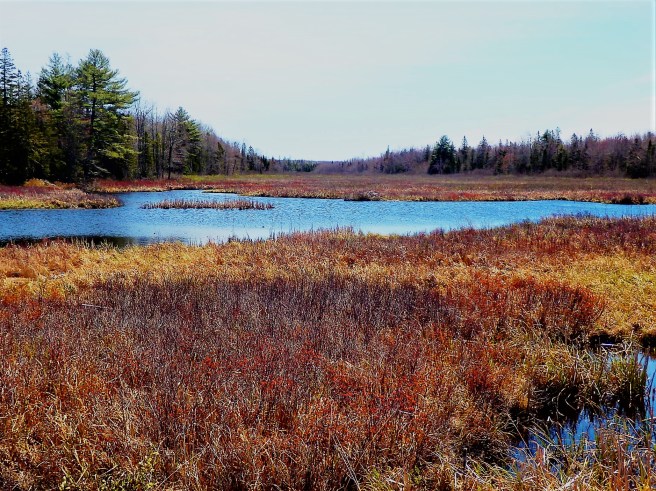
One of the many streams and wetlands.

There are many reasons Downeast reminds me of the Far West, though it’s generally much wetter. In fact, 21 percent of the county is covered with water, much of it as big ponds running along the valleys between the low-elevation mountains. Many of these often island-specked bodies extend two to five miles in length and at least a mile across. And that’s before getting to the bogs and fens or wild rivers and tide meadows or marshes and swamps or prolific beaver ponds. The technical definitions vary, depending perhaps on how wet your shoes get. Quibble as folks might, the northern half of the county seems to be more lakes and wetlands than solid ground. I’m not sure if the Atlantic bays and coves even count in this tally. Quite simply, we’re surrounded by a lot of liquid, so watch where you step.

Lake Meddybemps

What also strikes me is how little development rings the shoreline of the lakes. Many have only a few “camps,” as we New Englanders call the cabins, trailers, or cottages and their docks, with the remainder in full, unspoiled forest. Make a bid, if you must.

It does make for a lot of unspoiled tranquility, for those who are so inclined, if you can deal with black flies and mosquitos. Moose often come as a bonus.

Often you’ll even see a beaver lodge.

Now I’m wondering how our utility bills stack up

With a landmass of 16,577 square miles, the country of Denmark is almost exactly half the size of Maine and has six-times the population of the Pine Tree State. Yet Denmark uses close to 10,000 megawatts of power annually, about double of what Maine uses.

If my math’s right, that means they’re using only a third of what we do, per capita.

How do they do it?

We both have cold winters with long nights. And most of us rely on fuel oil for heat.

And, for the record, nearly half of Maine is uninhabited, year-‘round, meaning the lived-in part of Maine’s about the size of Denmark. They do stay warm and keep the lights on, don’t they?

Running on the wind

One sight always catches our breath as we drive Route 9 across what sometimes feels like the fringe of civilization as we’ve known it. And, for the uninitiated, the state highway from Bangor to Calais can become pretty monotonous in its long uninhabited stretches. As they say, make sure you have a full tank of fuel before you tackle it.

On a clear day, from a dozen miles away you might catch glimpses of a corner of the windfarms on Weaver Ridge and adjoining hills in Hancock County – I’ve counted at least 30 towers before the road dips away – but there are more tucked away in the high terrain. Still, nothing can prepare you for that first flash of the big blades turning gently in the air right in front of your face, or so it seems.

Each blade weighs 1½ tons, even though it appears svelte.

They dance gracefully – sometimes as a solo, then as a pair, or four. You spot them to your left but they suddenly show up on your right – the roadway twists along the slope. As those slip behind you, more giants rise above the hedge of forest. And all too soon, you’ve moved on.

The towers and their blades are bigger than you’d suspect. In fact, at the moment, they’re the tallest wind-powered electrical generators onshore in America, though much larger ones are projected for offshore installation.

The hub stands 382 feet above the ground – that’s more than the length of a football field – and the blade tips reach to 585 feet.

Wind generation accounts for nearly a third of the electrical production in Maine, though the state also imports a fourth of its electricity from Canada, largely Hydro Quebec.

I am baffled by the “not-in-my-backyard” opponents to similar windfarms. They still want energy for their computers and refrigerators and lighting, right?

A tractor-trailer rig could easily be parked in the gearbox or “cabin” attached to the hub.

As if these “spoil the view”? I find them mesmerizing, even enhancing as a kind of sculpture and a reminder of the currents in the air itself. They definitely look better than a toxic oil refinery – and there’s no awful smell. For that matter, they strike me as much more attractive than a television transmitter or cell phone tower as a hilltop crown. And they do remind us of the charming Dutch windmills in a much smaller scale.

The latest installation, 22 Vesta towers and turbines, cost $150 million and went into full operation earlier this year.

Sometimes they seem to play peek-a-boo as you drive.