My initial visits to eastern Maine back in the early 1990s shocked me with the prevalent poverty. I thought I was in West Virginia. A harsh reality is often overlooked between the picturesque coast and the wilderness adventures in the north.
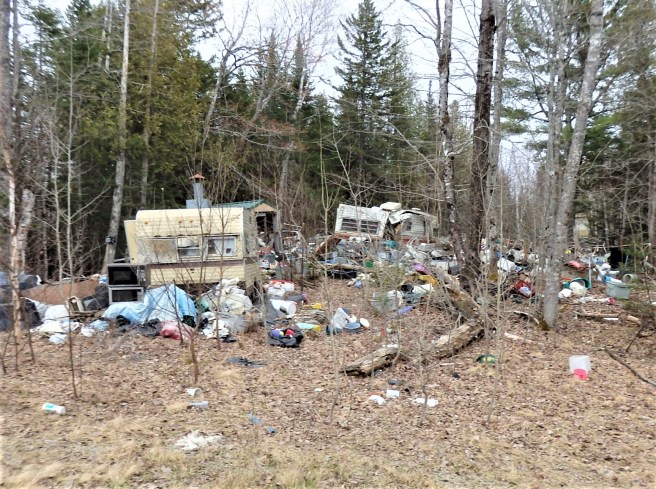
That awareness has been amplified after moving Downeast. Many rural homes are surrounded by debris, everything from boat hulls that will never sail again to earthmoving equipment that has gone to rust to a row of cars that would otherwise qualify as a junkyard.
Here’s an extreme case.
Maybe they thought they could salvage something of value?
I know that everywhere you go, everybody seems to have their nose stuck in their cell phone, oblivious to just about everything going on around them. You know, the bubble people.
Or, where I’m now living, they have those phones up in the air taking pictures so they can look at what’s in front of them later.
Oh, my. What a world.
As a writer, I’m supposed to be active on all platforms as a matter of marketing , but as many others are discovering, those venues rarely lead to book sales or loyal readers. Let’s be honest.
I’ve toyed with some of them, but drifted away, even Twitter.
My primary social medium is here at WordPress, blogging. I know how to manage my posts easily. The Reader feels to me like a real mailbox, with dispatches from around the world – postcards, letters, clippings. As for you?
For that matter, I’ve never quite “got” Facebook. It’s cumbersome to navigate, most of the content feels like gossip cluttered with advertising, and I don’t like having to sign in to see what should be public information for local retailers, schools, or public events.
Still, living in a small town, I’m finding that’s where the local “party line” is, and checking in regularly is essential. I still have qualms about the bigger corporate picture, with its shadowy agendas.
Recently renewing contacts with folks from my ancient past has also had me turning to FB.
What’s surprising me, though, is the gap between those who are active in a social medium and those who are “members” but rarely or even never check in.
It’s not just FB. Even email accounts. I suspect many of my contacts are that way, too. Hello! Anybody there? Did you get my message? When was the last time they posted or commented? Take that as a clue to their presence … or absence.
The numbers, then, might not be nearly as big or influential as they’re boasted.
Meanwhile, I keep falling down these Internet rabbit holes, pursuing arcane information.
Where are you spending your time online? Or even elsewhere?
Cochecho or Piscataqua plantation, for a while Bristol or Bristow, and even Northam, but the one that stuck was Dover.
Just as the names Hilton Point and Dover Point keep bouncing around, for the same place, though the latter has also largely replaced Dover Neck.
Neighboring Strawbery Banke did get renamed Portsmouth, after the harbor town in Devonshire, but Dover was never named for the village with the famed white cliffs in Kent.
No, the inspiration’s better than that.
The name comes through Dover’s second minister, George Burdet, who was more Anglican than Puritan, though apparently not outwardly. The proprietors of the colony at the time, Lord Saye and Lord Brooke, are both staunch Puritans, and the cleric works for them. In fact, he even manages to become the colony’s governor, or agent – a dual role forbidden to ministers in Massachusetts. Some even see him as trying to become a little pope in his power.
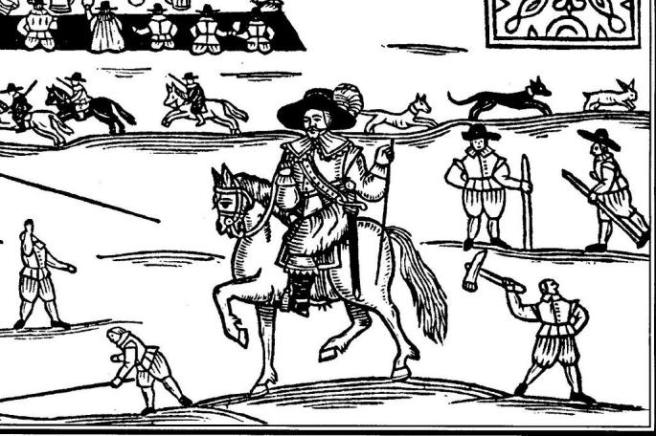
In calling the settlement Dover, Burdet pays honor to the anti-Puritan wit and attorney Robert Dover, who created the Cotswold Olympick Games near Cambridge in the heart of the Puritans’ East Anglia.
Meet Robert Dover.
As my upcoming book details, there’s a long list of reasons the neighboring Puritan landlords forbid their servants from attending the pagan festivities. Besides, Dover was likely a secret Roman Catholic while openly ridiculing the Puritans. We can imagine what he would have said of Quakers.
Burdet, however, winds up fleeing Dover amid sexual scandal, only to generate more where he lands in Maine. Yes, the plot keeps thickening.
As for, “Roll over, Dover,” if we put it up for a vote, which inspiration would you chose? The picturesque cliffs or the scoundrel in the pulpit?
Our local radio station is licensed to the high school. Seriously. And it’s as quirky as KHBR-AM 570 in the legendary TV series “Northern Exposure,” even without Chris Stevens as the DJ. Or I’d contend, even more.
The television show never got into young people, for one thing, but there aren’t many in Sunrise County, where the seven public high schools together have about 200 graduates a year, half of them from just two schools. A private academy adds another 100. It’s a long stretch, by the way.
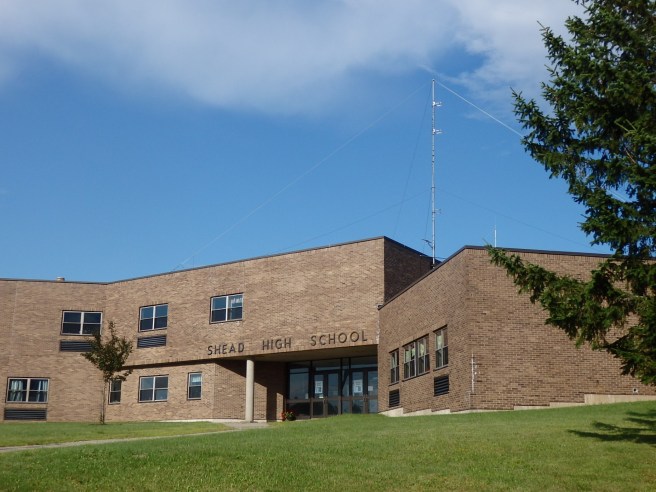
Pointedly, Eastport’s Shead Memorial High has only about a hundred students, down from 300 a few decades earlier, and a faculty of 11, some of whom also teach at the junior high or elementary. The principal serves all three. The school proudly proclaims its emphasis on personalized education, which I applaud. What’s obvious is the incredible student-faculty ratio.
One big challenge is in trying to find ways to lure more of the younger generation into staying put here. Maybe the economic tide is changing in that direction.
In the meantime, the radio station gives them an opportunity to learn production skills. In fact, the station started out as a school club in 1983 and took off from there. Throughout the day, the station’s IDs feature the different kids, however bashfully, and it’s charming.
Much of the programming is a stream of music, a mix of blues, jazz, rock, country, bluegrass, and more, I’m assuming streamed from somewhere. Yes, and there are public service announcements as well as the honor rolls and other local touches. Truly. And then the DJs kick in, including some of the kids, with surprisingly sophisticated tastes.
They’re not the only ones.
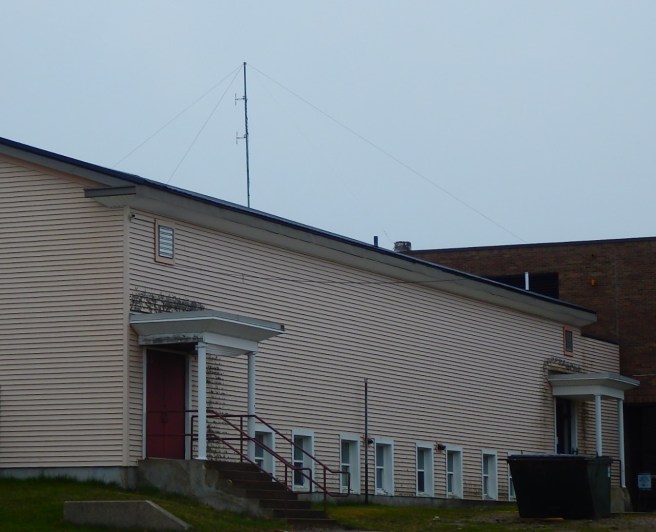
The station’s modest tower sprawls over the high school. Here it’s seen from the front.And from the back, by the gym.
The local demographics skewer sharply upward, and volunteers at the station are welcome. In fact, they create much of its most distinctive programming. As I was saying about do-it-yourself participation?
There’s Cracklin’ Jane, with only 78 rpms, a weekly theme, and radio dramas from a golden age, including commercials for brands that no longer exist. And others like Sam’s Caffeine Café, yes, it’s redundant, but mostly acoustic Americana two mornings a week; the Bass Lady’s informed insights into anything with a bass line, Chloe’s folksy Friday afternoon transition; Firedog’s Electric Doghouse, Boldcoasting; and the like.
Well, this is a town filled with eccentrics and geezers. Its low-power radio station reflects that. And to think, it all started as a school club in the ’80s!
I think of it as Radio Free Eastport, broadcasting to the free spirits on and around our islands.
A fair number of the Piscataqua’s early settlers were from prosperous, even well-connected, families.
The question is just what prompted them to relocate to the primitive, even harsh, conditions along the Piscataqua River.
David Thomson, the son of a Scottish minister, has the King’s ear and a debt of gratitude.
The Hiltons are part of an extensive and prosperous fishmonger clan.
Thomas Roberts’ father, by some accounts, becomes a baron. Even if he didn’t, Thomas still becomes a member of the powerful fishmonger guild.
The Hilton brothers weren’t exactly out of the loop, either.
~*~
Powerful? Take Francis Champernowne, a 1640 signer of the Dover Combination, a remarkable document stating the residents’ desire to be freed from being subjected to company-town decisions being made in England. While I see scant evidence that Francis actually resided in today’s Dover, he did have extensive landholdings in New Hampshire, including the current towns of Greenland – named for his Green Land farm – and Madbury, then part of Dover and named after his ancestral home, Modbury, in Devon, England.
His father, Sir Arthur Champernowne, owned at least eight merchant ships or privateers and had fished New England since 1622. In 1635, Sir Arthur financed a settlement under his son, Francis – likely the southern part of Kittery, Maine, which became known as Champernowne’s Island, today’s Cutt’s or Gerrish islands – as well as another on Braveboat Harbor in York. Francis may have also lived at Strawbery Banke (today’s Portsmouth) until 1640.
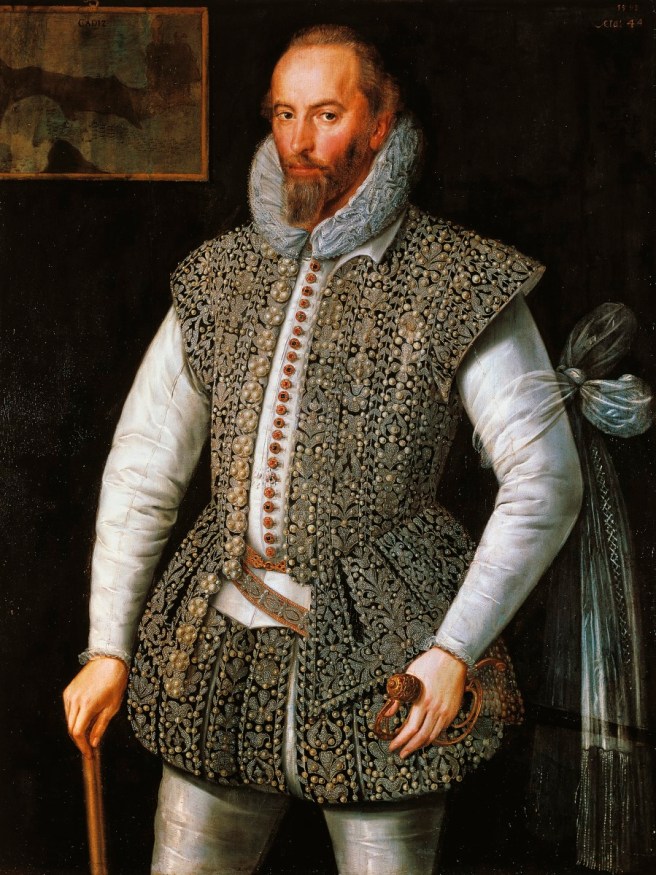
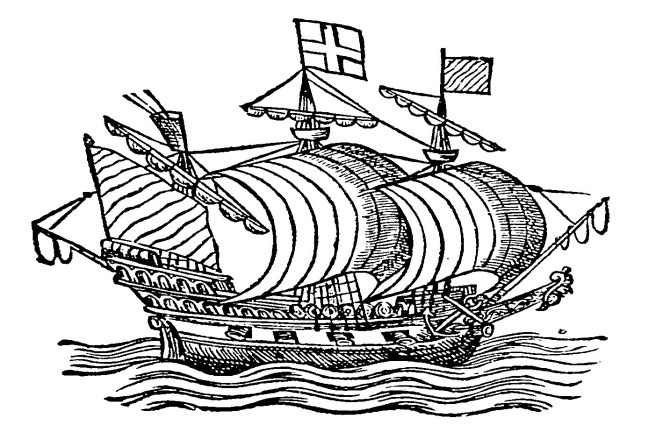
Sir Walter Raleigh. His nephew was a big settler along the Piscataqua, Did he dress anything like this?
Captain Francis was well-placed. His great-aunt Catherine was the mother of both Sir Walter Raleigh and Sir Ralegh/Raleigh Gilbert, an important explorer and adventurer of the New England and Canadian coastline. Captain Francis was also a “beloved” nephew of Sir Ferdinando Gorges, proprietor of Maine and unofficial godfather of New England itself.
Francis was often at sea, to England and Barbados, especially. During the early part of the English civil war, his Royalist leanings led him to join King Charles I’s fleet under the Earl of Marlborough. Returning to Dover by 1646, he left for the Caribbean in 1649 but returned to Maine in the early 1650s, where he later became a commissioner and justice under Charles II. In April of 1678, he signed the articles of peace with the Abenaki at Casco. He was an ardent Anglican and died in Kittery.
It’s enough to make me think living conditions back in merry old England weren’t that great, either.
~*~
The Waldron family that soon comes to dominate the growth around the Lower Falls, or today’s downtown Dover, came from wealth in Warwickshire, England. William drowns, but brother Richard turns Dover into something of a personal fiefdom while rising to become Speaker of the Assembly once New Hampshire is under Massachusetts rule. He builds the first saw mill and grist mill at the falls, has extensive shipping connections, dominates the fur trade with the native Pennacooks. He didn’t exactly start from scratch.
You’ll be hearing a lot more about him. Man, will you.
Fishing is dangerous, hard work, done in all seasons and kinds of weather. It’s also an inescapable source of livelihood for many families along the Maine coast.
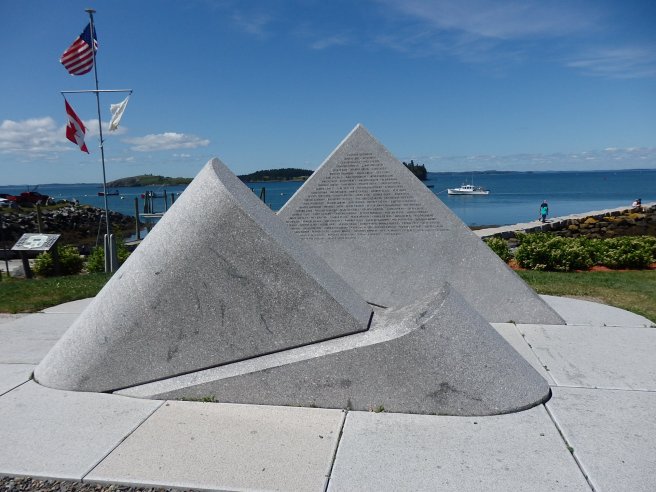
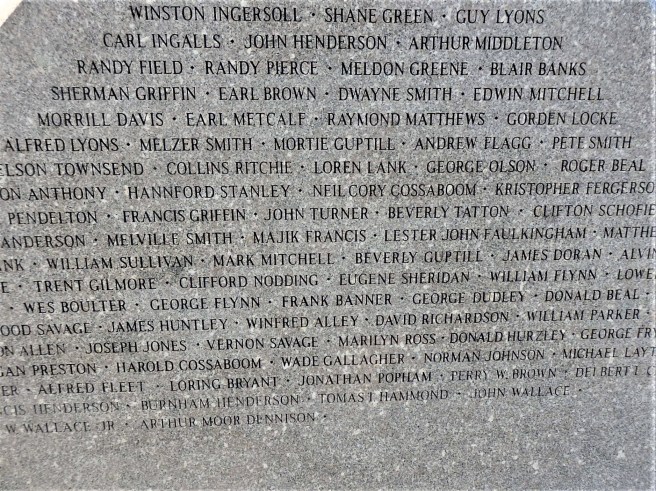
The two stones in the Lost Fishermen’s Memorial in Lubec rise like waves beside each other, one representing fishermen from the Canadian side of the channel and the other, from the American side. Three flags fly over the site – Old Glory, the Maple Leaf, and the Passamaquoddy Nation’s.The inscribed names of those lost since the year 1900 are mesmerizing – women and men, some of the surnames repeated. As people say respectfully, so-and-so has the sea in his blood, and it seems to run in families.Maine granite sculptor Jesse Salisbury created the monument in 2016, and names have been added since.
Some people and places just get bad raps for no reason. That used to be the case for the neighborhood just south of Battery Street. Or Assault and Battery, as the ditty went.
Or, in the more salacious version, Sodom and Gomorrah.
You can read the street sign yourself.
Residents of the allegedly more reputable North End of town, meanwhile, got dubbed Dog Islanders, after the tiny island at its tip, one that once had a lighthouse nobody in town could see.
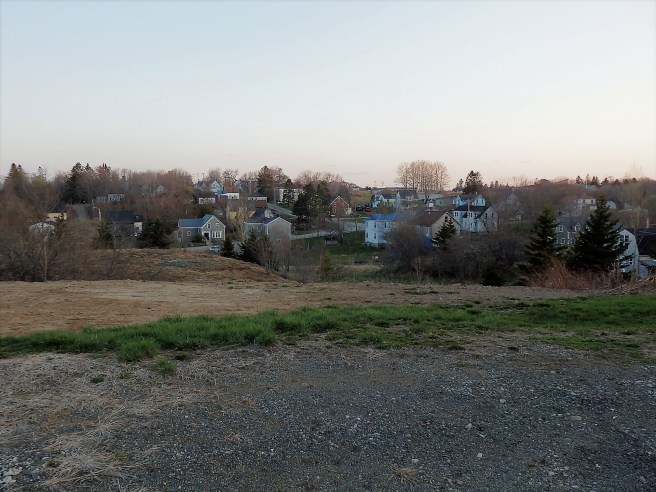
The neighborhood viewed from South Street.
Definitively, the two parts of the village were separated by Shackford Cove (aka Huston’s) , which ran further inland than it does today, as well as a seemingly nameless stream at the bottom of some steep banks. And the cove did have four shipyards at one time as well as the world’s largest sardine cannery a bit later.
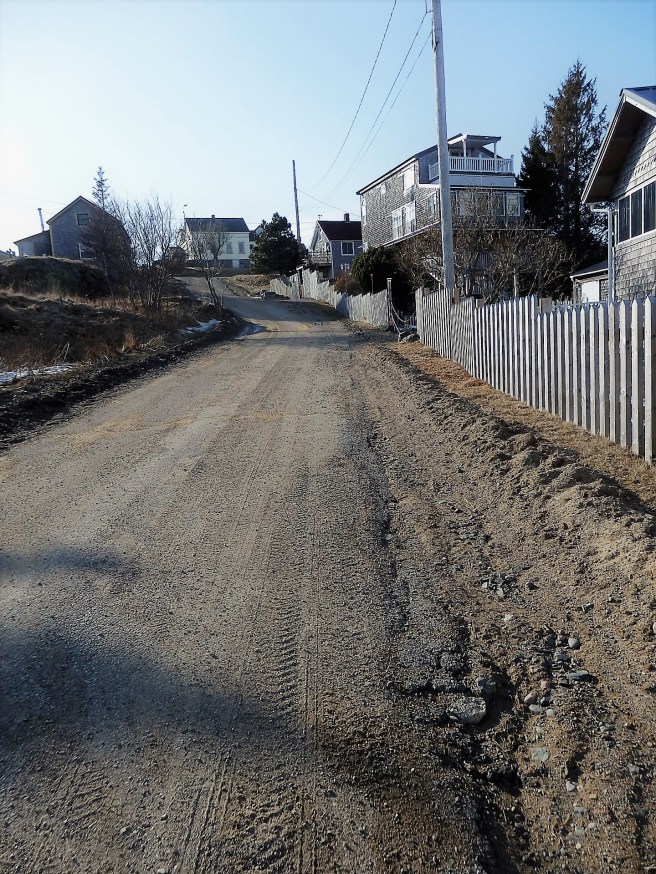
There are also some steep streets that end in the ocean.
Today, though, it has some fine homes mixed in, a few with some of the most spectacular views in town.
One of my key insights into Dover’s early character came after noticing that the majority of its early residents came from Devonshire – or Devon – rather than the East Anglia shires of Norfolk, Suffolk, Essex, and Cambridge that dominated New England’s Puritan migration, construction, and social order.
And that holds for even the Puritans who take over Dover in 1633 (or so).
In his groundbreaking Albion’s Seed: Four British Folkways in America (Oxford University Press, 1989), David Hackett Fischer elaborates on what he calls the various folkways of four distinctly different regions of Britain, which in turn gave Colonial Massachusetts, Virginia, the Delaware Valley, and the Backcountry their unique natures – divergences that continue, to various degrees, today.
I had already observed that Dover and, for that matter, New Hampshire’s only other towns of the first 70 years – Hampton, Exeter, and Portsmouth – weren’t built around a definitive town square with its church, town hall, and common, as were typical towns in Massachusetts. It’s a hint that the differences run much deeper.
While Fischer goes into great detail on East Anglia’s impact on Massachusetts, he does not in turn examine Devon. At most, he touches on it as he turns to a larger and vaguer area that provided the Cavalier migration into Virginia, one with a center more in South England rather than the South West of Devon. And much of his presentation focuses on the ways they evolved in Virginia, contrasting life in Massachusetts.
Still, he points to differences that go back into antiquity. The language and laws of Devon and its neighboring shires for example, were shaped by West Saxons to the east and Celts to the north and west. In contrast, East Anglia’s are rooted in its Danish occupation.
From the little I’ve been able to glean thus far comes statements that Devon was regarded as backward by many, a repository of the “old England” of superstition and legend. It was a place of seafaring, with Plymouth as a principal port and Bristol just to the north, and of large manors with their landed gentry.
The merchants of Devon sent ships far on the sea. It was in their blood.
There are also suggestions of crucial ways its social manners and religious affinities deviated, affecting how Dover residents interacted with the itinerant Quakers.
No, the English weren’t all alike, not by a long shot. Often, they couldn’t even understand the dialect from another part of Britain.
I would love to see a comprehensive study of those Devon folkways along the lines of Fischer’s earlier work. It would no doubt give us a much more detailed picture of life along the Piscataqua in those seminal decades of settlement. How they cooked and dressed, for instance, or raised their children or treated illnesses or buried their dead, as starters.
Still, my upcoming book shares what I’ve found so far.
When it comes to finding your way about town, you need to know more than just the names of the streets.
Eastport’s a city of islands, with Moose Island the biggest and most inhabited. It’s roughly six miles long and three wide, at the most, but that still adds up to 20 or so miles of shoreline, I’m guessing.
So people will refer to Buckman Head or Estes Head or Todd Head or Kendall Head or, for variety, Harris Point, punctuated by coves.
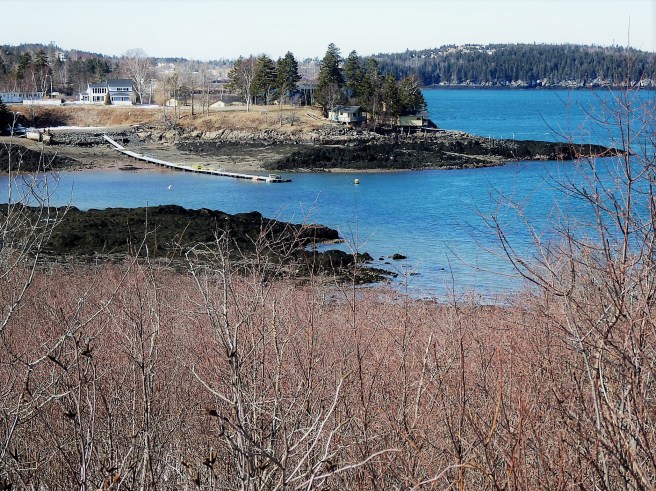
Harris Cove and Harris Point at low tide. Deer Island, New Brunswick, lies beyond.
So there’s Broad Cove or Deep Cove, which flank Shackford Head, or Prince Cove, for instance. As well as Carrying Place, Half Moon, and Johnson coves. Plus a few more. And that’s before we get to the neighboring towns, up and down the coast, which also name places this way.


 Jnana's Red Barn