A trail of misunderstanding and betrayal

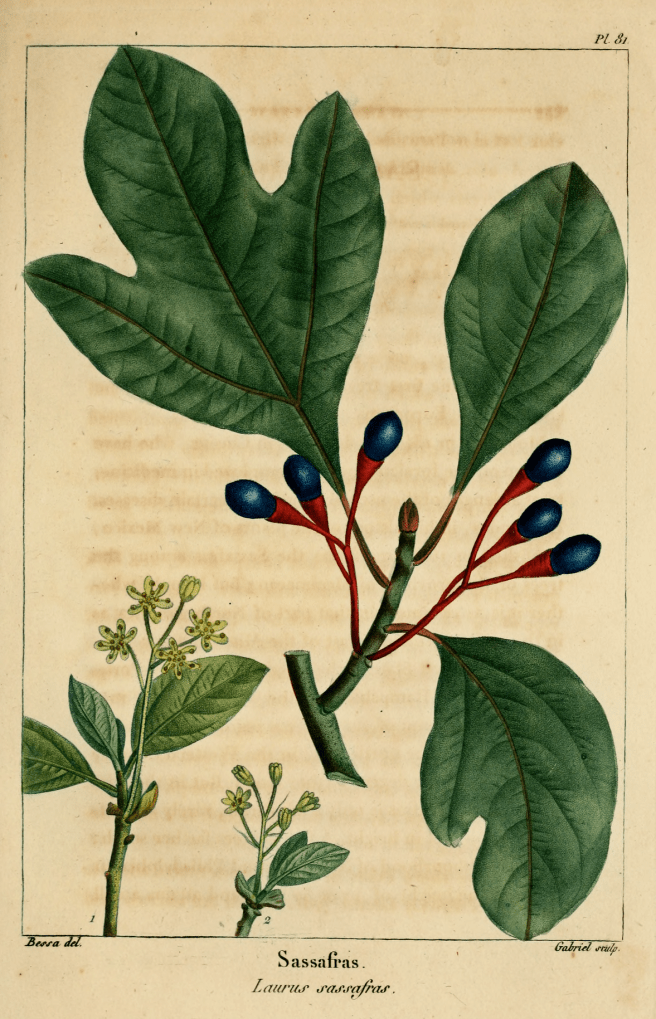
Martin Pring, after becoming the first known European explorer of the Piscataqua River in 1603, then continued south to Cape Cod, where his party engaged in harvesting sassafras tree bark and roots, “a plant of sovereign virtue for the French pox,” as he elaborated in his journal. It was highly lucrative back in Europe and would handsomely repay the Bristol investors backing his journey.

French pox, do note, was what we now call syphilis. If only it worked as a remedy or a cure.

Sassafras was also touted as “good against the plague and many other maladies,” as well, just in case. And you thought it was merely a “tonic” served as tea or the flavoring for root beer?
During their six weeks ashore at Truro, Pring’s crew built a barricaded encampment. It was often visited by as many as 60 Wampanoag at a time, sometimes bringing different kinds of food to the party.

In one instance, in response to the playing of a kind of guitar, groups of up to 20 broke into dancing in a ring and singing “lo, la, lo, la, la, lo,” which works when you don’t know the words. For his part, the young musician was rewarded with gifts of tobacco and pipes, fawn skins, and snake skins up to six feet long, “which they used for girdles.”

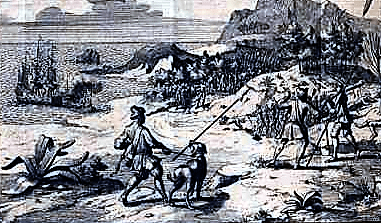
But it was an uneasy relationship. Pring’s two mastiffs in particular terrorized the Natives. Anytime the sailors felt threatened, they’d release the big canines. As Pring recorded, the Wampanoag were more afraid of the two dogs than they were of 20 men.

The tension finally exploded when about 140 “savages armed with their bows and arrows” approached the barricade and a “a piece of great ordinance” was shot off in response as a warning and call to arms.

Recognizing that they’d worn out their welcome, the Englishmen quickly packed up and scooted off behind the protection of the mastiffs and set off for home while the Wampanoag set a mile-width of forest aflame and chased the ship in their canoes.
Of course, we’re never told what so soured the relationship. I doubt that the mariners were very tidy or respectful in their ravaging the forest, and I suspect that may have had something to do with their reaction.

Still, when the Pilgrims arrived in 1620, remains of Pring’s palisades were still visible.

What do you imagine had so enraged the Wampanoags?

Whatever it was, it seemed to set the pattern for much of what followed.

~*~

The episode is rarely told in American history, and, when it is, it’s quickly skimmed over.

Like so much of the New England record that follows, we’re rarely given the Natives’ side of the events.

One thing we can be sure of, though, is that there were huge differences in expectations and values, to say nothing of hygiene or manners.

For instance, as I’ve heard, the Wampanoag word for “treaty” translates as “making relatives,” which is hardly what English settlers had in mind for their part. Far from it. Something similar no doubt happened when the colonists “purchased” land from a sachem.

As the Wampanoag believed, “the land knows you,” more than the other way around.

Quite simply, from their end of these transactions, they were betrayed.

~*~

These days, residing in Downeast Maine – that is, Passamaquoddy country, which stretches over into Canada as well – I’m learning of another series of these one-sided deals.

Joe Clabby’s excellent A History of Eastport, Passamaquoddy Bay, and Vicinity chronicles much of the federal and state maltreatment, misrepresentation, and mismanagement regarding the tribe and its members. One instance, by no means the most outrageous, is this, from 1950: Indian Agent “Hiram Hall allowed the state to charge the Passamaquoddy Fund $8,000 per home for home construction (the homes are worth only $2,500).” This came more than a year after the tribe requested that the state remove him for misappropriation of state aid, favoritism, and disinterest in tribal government.

Driving to and from Eastport, I pass many of these houses, now in serious need of repair. Don’t blame the residents.

As I relate in my new book New England relations with the Natives got off on the wrong foot, starting with the kidnapping of Squanto and four  others. (Virginia hadn’t done any better.)

Shame, shame, shame.
Sawmills, before those for grain

One of the first thing the colonists typically built was a sawmill. From what I’ve seen to date, it always came before a gristmill. I would have thought food would have been the priority, but there are suggestions they imported their flour or even bread instead.

That raises questions of just exactly what their meals were. The Puritans were devoted to their beer and tobacco – and that extended to even their children.

For that matter, how early was Beantown a synonym for Boston?

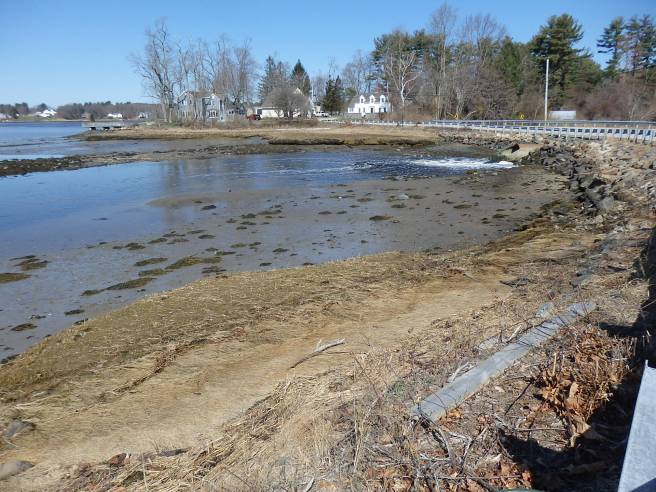
More than a dozen years after the settling of Hilton Point just across the river, Alexander Shapleigh built the first of two tide mills at his Kittery House estate. Water from the incoming tide was impounded and released later in the day to power the mills. Here’s the site today.
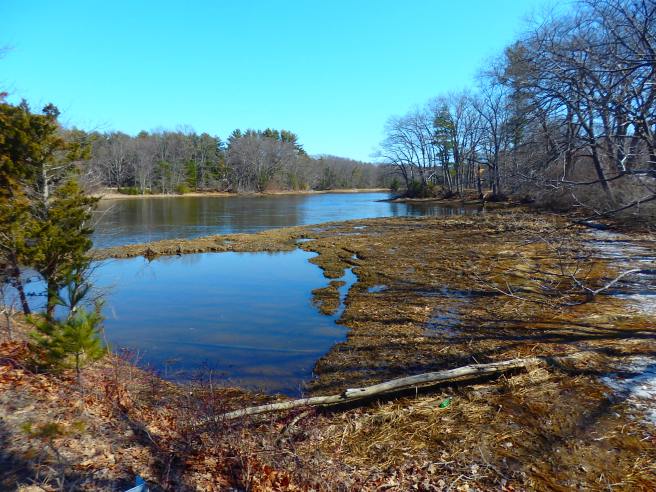
The mill pond remains in today’s Eliot, Maine.

So why sawmills? The early settlers along the Piscataqua apparently erected log cabins, along with fortifications. For that matter, the sole surviving garrison house, preserved at the Woodman Institute, was essentially a log cabin built around 1675.

But flat boards were needed for shipbuilding, wharf planking and bridges, and barrels – for shipping dried fish, especially. Perhaps lumber itself was also an export to Barbados, the Bahamas, and the West Indies.

Let’s remember, too, the construction of dams and mills and their operation required sophisticated skills.

I’m guessing that few of the early English settlers along the Piscataqua were menial day laborers.

~*~

Welcome to Dover’s upcoming 400th anniversary.


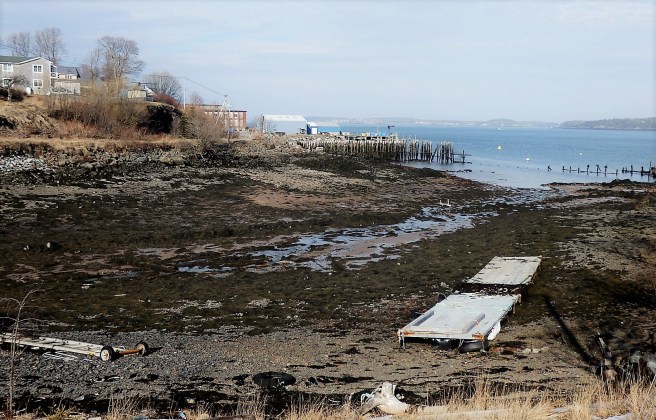
Looking today, it’s hard to envision this as a center of shipbuilding

This cove is where Caleb Stetson Huston became Eastport’s most noted shipbuilder and marine architect. Here he created more than one hundred vessels from 1840 to 1870, surpassing the number of his father, Robert Huston, had built. He was no doubt responsible for repairing many more.

A third-generation shipbuilder, C.S. Huston at one point owned four shipyards on Shackford Cove – his father’s, on the south side of the water, and the William H. Hall and Jacob Shackford yards on its north side, as well as Aymar’s spar shop at the South End bridge, which has long since been filled in.

And how it can look six hours later.

As an innovative entrepreneur, he early on erected a steam capstan to haul boats out of the water, along with a 600-foot marine railway made of thick beams set up as interlocking boxes filled with stones.

Huston lived in a Second Empire style house overlooking the yards, which he purchased from Hall in the late 1850s.

Part of the C.S. Huston house on Third Street incorporates a section of the “Red Store” that John Shackford erected in 1787 at the foot of Shackford Street.

The shift to ships built of steel rather than wood changed everything. Maine had seemingly endless lumber at hand, but not steel. That also allowed for bigger vessels, meaning fewer could suffice for shipping. Finally, with the advent of the automobile, passengers stopped relying on steamships and that, too, ceased at the corner of this cove. But not before the world’s largest sardine cannery extended from its shore – a building 250 feet long.

At high tide it can appear to be quite scenic.

It seems so quiet today.

‘Congratulations! You are qualified to get better services and a better rate.’

This is what I got in the mail from our cable company, a month or so after it had hiked our broadband fees by 30 percent. He they were now, returning with a pitch to cut the monthly bill to $5 under what we were paying earlier but with television channels included.

The first problem? We don’t have TV and don’t want it!

“Redeem your upgrade today.”

Who are they kidding? You can bet that a year from now that monthly bill will skyrocket. Trying to scale that back to where we were would be with just the broadband becomes the second, and bigger, problem.

Of course, the third problem overshadowing all of this is the inefficiency of unchecked monopoly. Where are the Teddy Roosevelt Republicans when we need them?

How do these companies justify their rates, anyway?

Those who lived here for millennia need to be acknowledged, too

One of the things the Dover 400 project is doing is raising an awareness of the Indigenous peoples who inhabited the region for millennia before European colonists arrived.

The tribes were far more varied than the generic “Indian” label conveys. Sometimes they were in open conflict with each other, and there were many differences in language, culture, and lifestyles. There were also alliances with other tribes, creating subtle but significant relations across the region.

Some lived in permanent villages, often along streams. Others ranged from ancestral site to site through the year in a cycle of fruit, vegetable, and animal fare.

As hunters and fisherfolk who often traveled by water and lived in villages along the shores, many of their names for places are often translated as some variation of “water,” with distinctive nuances that are lost to Western ears but still hint of sharp observation of the character and advantages of each site.

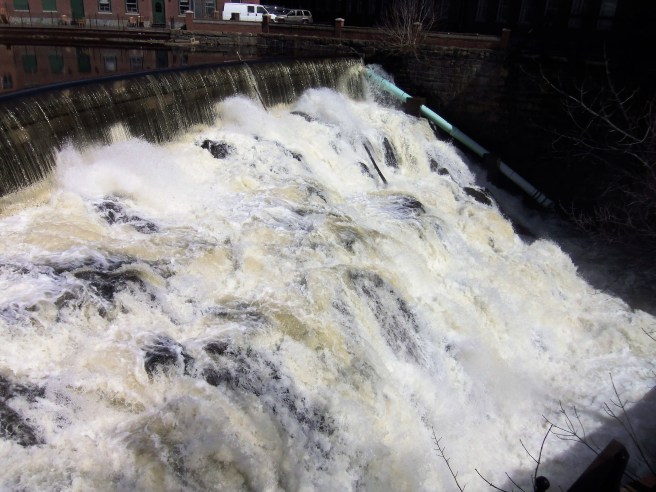
Their name for Hilton Point, for example, is something along of the lines of “place encircled by water,” while Cochecho is more like “foaming falls,” each one, however, unlike other points or coves or waterfalls.

As for our own names applied to these places? I doubt we give them a second thought other than perhaps their spelling.

And, to our loss, we have none of their mythopoetic stories in their original richness – narratives rooted in their unique environment. At least we can begin to listen to those told by surviving tribes in neighboring Maine.

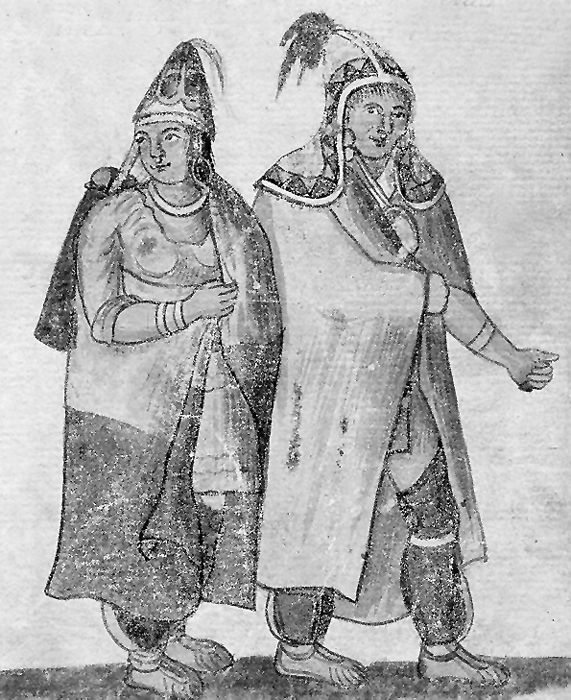
There are good reasons the Abenaki and other New England tribes didn’t dress like the High Plains Natives far to the west.

  ~*~

WHEN THE ENGLISH ARRIVED in New England, most of the tribes had been decimated by pandemics, many of the illnesses resulting from contact with earlier explorers and traders. The sharp loss of population gave the Pilgrims an opening in their settlement at Plymouth.

The first traders brought items the Natives appreciated as useful – metal pots, knives, blankets – that could be obtained in exchange for furs.

As we know, the dynamic changed. We’ve rarely heard the Indigenous voices tell their side of the struggles. The English, French, and Dutch all have barbaric actions to atone for.

The marker at Ambush Rock on Route 101 in Eliot, Maine, for example, makes it sound like the victims were an innocent party on its way home from church one Sunday in 1697. There’s no mention that the prime target, Major Charles Frost, was Richard Waldron’s cohort in the notorious “games” of 1676 that ended up in the arrest of nearly 400 Natives who were then executed or sold into slavery. The Natives waited 21 years for revenge. Frost was the highest-ranking militia officer in Maine.

For me, the missing details change my view of the event entirely. It’s not an isolated instance.

~*~

DOVER WAS IN PENNACOOK COUNTRY, a tribe closely related to the Abenaki – the identities are sometimes merged, suggesting change over time. The Pennacook spanned over much of New Hampshire, neighboring Maine, and parts of Massachusetts. The English jurisdictions didn’t match theirs.

Another consideration is how many of the English settlements occurred at earlier Indigenous villages, as seems to be the case both at the falls in today’s downtown Dover or neighboring Exeter, Newmarket, Durham, Rollinsford, Somersworth, and South Berwick.

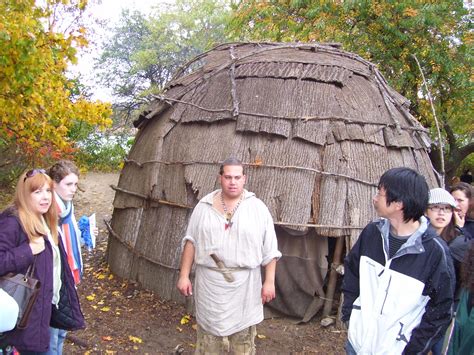
A wigwam at the Plimoth Plantation living history museum allows visitors to explore a typical Indigenous winter dwelling. The interior is bigger than you’d expect. (Photo by Swampyank via Wikimedia Commons.)
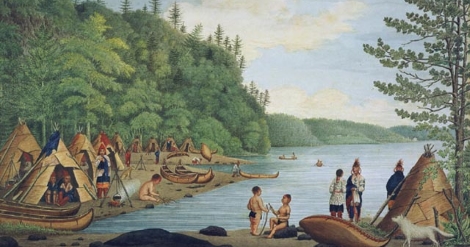
A Pennacook encampment much like those in the Piscataqua watershed.

~*~

ONE THING THAT WAS OBVIOUS TO ME in a visit to the Plimoth living history museum in Massachusetts was how superior the Wampanoag’s communal wigwams were for living through winter compared to the Pilgrim’s drafty cottages of 1630.

I’m sure the same can be said of the shores of the Piscataqua.

~*~

Welcome to Dover’s upcoming 400th anniversary.

The cruise ships are coming!

As our City in the Bay has been redefining itself, in part thanks to its lively arts scene and surrounding natural wonder, tourism has been ticking up, even in the face of Covid-19.

Part of Eastport’s appeal is the deepest natural harbor in the continental U.S., a port that at one time, back when there was a lot of smuggling, was the second-busiest in the nation – something a shift in federal tax laws and heightened enforcement soon curbed.

Still, we have a long history of steamship travel, right up to the auto age.

And now, this year, hooray, we’re even anticipating the return of passenger vessels, albeit of the increasingly popular “small” ship variety rather than the floating cities that can overrun a seaport.

First, the 210-passenger, 325-foot Pearl Mist is scheduled for five visits, most of them 3½ hours ashore, as part of a seven-night round-trip out of Portland. Other stops on its Fundy Bay circuit include Rockland and Bar Harbor in Maine, and St. Andrews, St. John, and Grand Manan Island in New Brunswick. Fares run from about $4,000 and up.

Second, in September we host the innovative 530-passenger, 459-foot Roald Amundsen expedition ship on a 10-hour stopover. Originally, this was to be part of an adventurous 44-day navigation across the Arctic Ocean in a Northwest Passage venture from Vancouver, British Columbia, an ultimate bucket-list voyage. But the fares, starting around $57,000, may have been too pricy for the Covid-antsy market, causing it to be broken up into segments – the first ending at Nome, Alaska, and the second continuing from there on to Greenland and ending at Halifax, Nova Scotia. Eastport is now tucked in as the cherry in a shorter, more affordable, New England dessert.

More exciting is the news that the Amundsen is now scheduled to return next year as part of an even more audacious 94-day cruise – a Pole-to-Pole adventure that will originate in Vancouver, British Columbia, and traverse the Northwest passage before coming to Eastport and then continue on to equatorial warmth, the Panama Canal, the Pacific coast of South America, and finally shore visits on Antarctica. Think of going from icy summer to the edge of autumn in New England to the tropics and on to spring while exploring three continents. The lowest fares figure out around $600 a day.

And little Eastport will be part of that.

In Maine, the bulk of the cruise action hits Bar Harbor, at the edge of popular Acadia National Park, where frequently two ships a day debark during the summer season, and in Portland, which gets especially busy during the fall foliage season.

We’re really not set up for the mega-cruise vessels that have dominated the industry. Let’s see how our emerging niche shapes up.


The Tides Institute as a vehicle of preservation and change

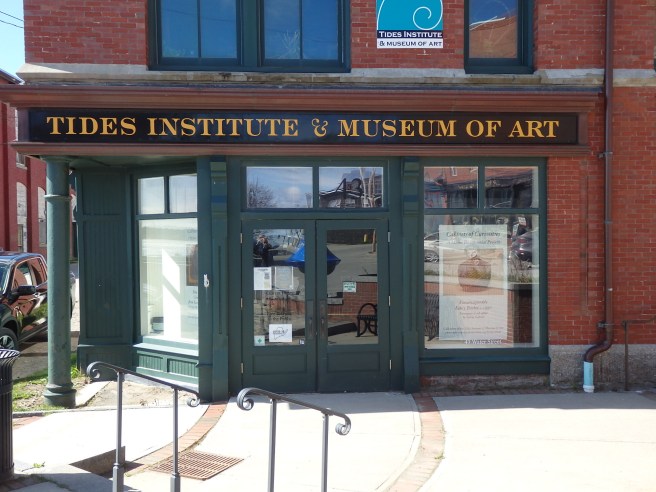
The catalyst of re-envisioning Eastport is the Tides Institute and Museum of Art, founded in 2002 by director Hugh French. Its mission has been in acquiring and presenting wide-ranging collections of artworks and historical documents reflecting the coastal region, as well as educational and preservation efforts that include eight significant buildings in the town – four of them in the downtown district – and guest artists residencies each summer.

The leadership is rounded out by French’s wife, Kristin McKinlay, who is director of exhibitions and the StudioWorks residency program, and by Jennifer Dolanski, Artsipelago/program specialist, plus eight trustees, only one of them living in Eastport. The others reside in places like Boston and New York City.

There are also concerts in its 1818 church that housed the Free Will Baptists, plus other events at its 1828/1829 Seaman’s Church, which housed the Congregationalists.

Oh, yes, every New Year’s Eve there’s the maple-leaf drop at 11 pm Eastern – midnight for our Canadian neighbors – followed by the giant sardine an hour later. Both the maple leaf and sardine were commissioned creations.

I suppose TIMA was inspired in part by the Island Institute, founded in 1983 to help Maine islands from Portland to Acadia tackle pressing environmental and socio-economic issues. The Rockland-based organization’s impressive publications include the annual magazine, Island Journal, as well as data analyses to guide public policy. Its focus is on sustainable livelihoods and communities in changing times that include rising sea levels, bringing together marginalized communities, and economic survival.

The heart of the enterprise is in a former bank on Water Street downtown.

In contrast, for now, TIMA’s focus seems to be more on art and architecture, principally – especially the small downtown on the National Register of Historic Places.

In essence, it’s building a future rooted in the past but not stuck there. It’s really the way every art moves, too, no matter how revolutionary some of the leaps may seem.

Renovation of the former Masonic lodge downtown is designed to house additional exhibition space and perhaps mixed use upstairs.

I do have to wonder whether TIMA has taken on too much. The restorations appear to have stalled, perhaps before Covid set in, and both of the churches need significant repair, inside and out. The institute has, all the same, helped distinguish Eastport as a fine arts center in a visually stimulating setting in Maine, an identity that may attract new residents in a time of national population change.

Frankly, it was one of the things that lured me here, as well as my wife and elder daughter.

A map is seen much differently from the water

One awareness I’ve gained living in New England is that when you’re out on the water – say in a sailboat, fishing boat, whale watch, or ferry – the geography fits together quite differently than it does on the land.

For example, where I now live in Maine, it’s only four miles or so from our downtown to the one just south of us. That is, if you’re just looking, going by water, or a bird. To drive, though, you have to head north and loop around Cobscook Bay, a distance of 38 miles and about 46 minutes. At least it has no traffic lights.

The water perspective is especially important in understanding the dynamics of early Dover, centered as it was at Hilton Point and Dover Neck between the Piscataqua River and Great Bay. For example, the heart of the town of Kittery was in today’s Eliot, just a mile away by water but 18 miles by land. And today’s Kittery was ten miles downstream or even longer by land.

Hilton Point was just to the left of the “cat” in Piscataqua, while the Shapleigh Kittery House was just to the cat’s right. Getting there by land, though, means going all the way up to the Salmon Falls River. Even finding a map like this of the watershed can be a challenge. Usually, it’s divided by the state line that runs up the river.

Oyster River, or today’s Durham, was only four to eight miles to the west, depending whether you were stopping at wharves along the way or going all the way to the Lamprey River’s falls and the landing.

A trip by boat between Eliot/Kittery and Oyster River/Dover was – and still is – no big deal.

In fact, by water they were closer to Hilton Point than was the village at Cochecho Falls, today’s downtown Dover.

For perspective, I’ve read that a man on the Isles of Shoals thought nothing of rowing ten miles – six of them on the open ocean – for an evening in Portsmouth and then ten miles back in the dark.

In comparison, the relocation of families from Eliot/Kittery to Oyster River becomes much more sensible than a land-based movement would suggest, and much less puzzlingly.

Also, the boundary between New Hampshire and Maine largely dissolves. The watershed becomes the defining perspective.

In terms of understanding history, “Piscataqua” can mean not just the original settlement at Hilton Point but also the expansion across both sides up and down the river. That seems to be the case when Portsmouth, Kittery, and New Castle all claim a 1623 founding.

You might even say it muddies the water.

~*~

Welcome to Dover’s upcoming 400th anniversary.


Selling Natives into slavery was not an isolated instance  

One of the more disquieting things my examination of early Dover and New England stirred up for me is an awareness of a prevalent expression of white supremacy.

It starts out as fear, expressed in the emphasis on fortifications. The Plymouth settlers, for instance, spent much of their first year on building palisades rather than farming, which led to a nearly disastrous shortage of food through the winter. The defenses were apparently intended against Native raiders more than the Spanish, French, Dutch, or pirates.

Later, Puritans required palisades around their houses of worship as well, as happened at Dover’s second meetinghouse, and ordered that all men carry arms, which were lined up against the wall during public assemblies such as religious services.

~*~

THE PREMISE OF WHITE SUPREMACY COMES THROUGH CLEARLY embedded in descriptions of the Indigenous as savages or pagans and is intensified in the resolution of legal conflicts in an unjust system of jurisprudence. Natives always came out on the losing end, with no means of appeal.

Especially telling is the reaction to the killing of John Stone and seven of his crew in 1634 in retaliation for his kidnapping and murder of the Pequot sachem Tatobem. Even though Stone had previously been banned from Boston for drunkenness, adultery, and piracy, and news of his death brought outright joy to some residents in the city, officials demanded the Natives turn over the warriors responsible to face trial. The Pequot, however, refused, even after paying atonement.

Simmering tensions erupted in 1636 after the killing of trader John Oldham and several of his crew on a journey to Block Island, Rhode Island. Even though Oldham was a troublemaker banished from the Plymouth colony, his death caused sermons across Massachusetts and prompted military action that quickly escalated into war.

Telling of the implicit racism is Roger Williams’ line of congratulation to John Winthrop in 1637 for disposing of “another drove of Adam’s degenerate seed.”

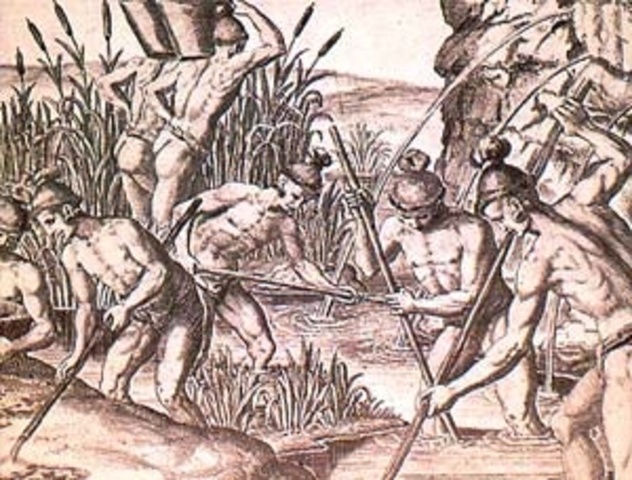
Natives being hunted down and captured.

~*~

BY 1638, MOST OF THE PEQUOT had been massacred or sold into slavery in Bermuda or the West Indies. An estimated 1,500 warriors had died in battle or been hunted down. And what followed was a landgrab by the colonists.

Military leader John Underhill, responsible for the massacre of Pequot women and children fleeing their burning village, then came to Dover, where he was briefly governor of the upper province, meaning Dover.

Bluntly? From the colonists’ perspective, a bad white man was worth more than a noble Native.

~*~

SLAVERY WAS PART OF NEW ENGLAND from the beginning.

When David Thomson settled at Pannaway in 1623, he had a Native as a slave, presented to him by an Indian leader. Yes, there was slaveholding among the Indigenous, too.

And whites could be enslaved as well, as was seen in threats to sell Quaker children in the late 1650s.

A key turn in the emergence of Merrymount in 1625 was the sale of some of the project’s indentured English male servants to Virginia and the impending sale of more to the tobacco estates, where death within a year was likely. Thomas Morton used the situation to rally the remainder to resist and stay put, leading to his libertine colony south of today’s Boston.

The origins of African slaves in New England are murky, but Pequots were exported so that they could not escape and return to their families or be freed in retaliatory raids. Instead, they were exchanged for Blacks, who could be held at less risk.

Natives labored in Barbados and the West Indies after being exchanged for Africans as slaves.

In 1637, during the Pequot War, the first American-built slave ship, the Desire, was constructed in Marblehead, Massachusetts, outfitted with leg irons and bars, and armed. She set sail to the British West Indies carrying Boston rum, dried fish, and captive Pequots, and returned seven months later with tobacco, cotton, salt, and enslaved Africans from the Caribbean plantations.

Thomson’s friend Samuel Maverick bought two Blacks as slaves in 1638. Another prominent slaveholder was John Winthrop.

In 1641, the Massachusetts Body of Liberties document included a formal recognition of slaveholding.

~*~

UP TO THE AMERICAN REVOLUTION, despite opposition, some Quakers held slaves, and Dover was not exempt. Up to ten were manumitted, likely with the equivalent of a year’s wages. There’s more on this in my book.

~*~

Welcome to Dover’s upcoming 400th anniversary.


As the story goes, he’s a perfect villain

The three Quaker women who come to Dover in 1662 and 1663 are tormented principally by Major Richard Waldron. He and his brother William arrived from a staunchly Puritan family in Warwickshire in 1635, and after returning to England to marry a woman against her family’s wishes, Richard returns to Dover. History does not record her name, only his second wife’s. In 1642 he buys up rights around the dramatic waterfalls of the Cochecho River about five miles north of Hilton Point.

In building mills there and establishing a village, Richard consolidates power and wealth. He has, for one thing, obtained a monopoly on fur trade with the Natives and, for another, rises to head the colony’s militia, a politically powerful position. In addition, he serves 22 years as a deputy of the General Court of Massachusetts, its assembly, seven of them as its Speaker. He votes to impose the anti-Quaker acts of 1656 and 1657.

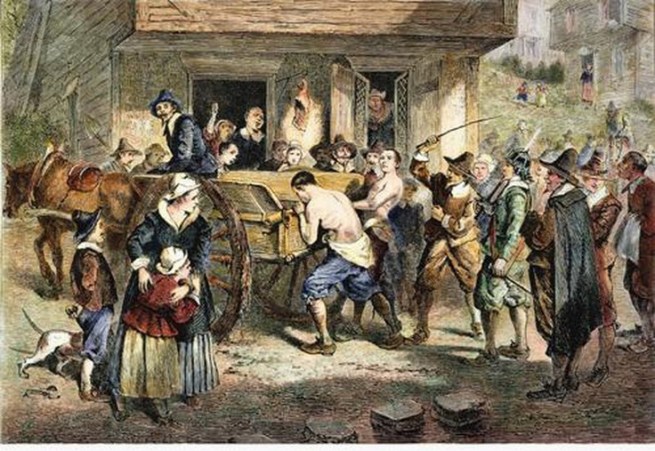
Richard Waldron was influential in the passage of the anti-Quaker Cart and Whip act and other punishments.

Dover is not his only residence – at least three of his children are born in Boston and he has ships on the sea. He’s also the magistrate who imposes the Cart and Whip sentence on the Quaker women who come to Dover – in effect, a death sentence if constables in towns down the road follow through on his order. Even his wife is appalled by his cruelty.

He’s also the mastermind behind the invitation to the Natives to participate in a mock war game and festivities in 1676. After the 20 armed Natives fire their weapons, they are surrounded and arrested, along with 350 or more, mostly women and children. Seven or eight of the leaders are sent to Boston and executed. The rest are sold into slavery in the Barbados or West Indies.

Major Richard Waldron masterminded the sham war game that led to the captivity of local Natives who came in peace.

The Natives do not forget Waldron’s deceit and cunning. Knowing they cannot trust the English, they form an alliance with France. Many of them convert to Catholicism under French priests.

In 1689, they take their revenge, attacking and burning garrisons at Cochecho village, killing 23 and taking 29 captive to Canada. Quakers are not spared. Waldron, however, is singled out for torture and death.

The early morning raid is the beginning of devastating violence large and small across northern New England that does not end until the end of the French and Indian Wars in 1763.

Every family in Dover would suffer losses. They were far from the only ones.

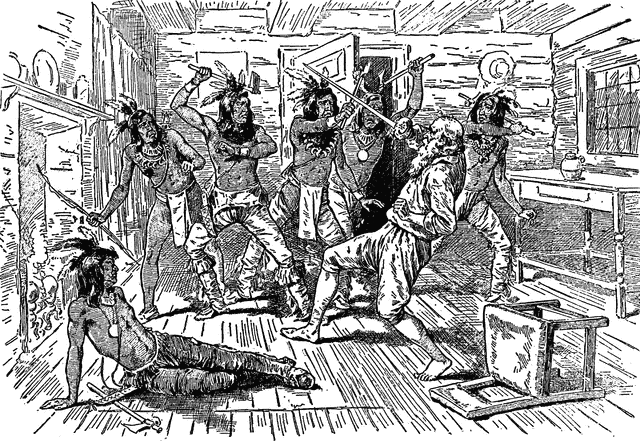
Major Waldron was singled out in revenge.

Behind the scenes, an ominous shift in the settlement’s character had been occurring, centered on Waldron. The sixth son of a well-off Puritan family, he was “immensely able, forceful, and ambitious,” arriving with his oldest brother in 1635, when he was barely twenty. In 1637, he returned to England, married a young gentlewoman despite her parents’ opposition, and brought her to Dover. Her name and dates are unknown. He then married Anne Scammon and had eleven children.

By 1642, he had accumulated the rights to land around the falls in today’s downtown Dover and erected his first sawmill. Emerging as the town’s central figure, he eventually controlled much of the Native trade and amassed large land holdings. In pressing for Dover to submit to Massachusetts jurisdiction, Waldron placed himself in opposition to Thomas Roberts, who then lost office when the Dover province was subsumed by the Massachusetts Bay colony.

Waldron, in contrast, became a deputy to the Massachusetts General Court, or legislature, in 1654, where he served for the next twenty-two years, seven of them as its general speaker, one of the most powerful political posts in New England. How much time was he spending in Boston during this period, and how much in Dover? At least three of his children – Elnathon, Esther, and Mary – were born in Boston.

Brother William also held public office and eventually purchased a part of the Shrewsbury Patent in today’s town of Stratham. He was, according to Massachusetts governor John Winthrop, “a good clerk and a subtle man,” one who “had an inclination toward drink and contention,” which leaves me wondering about Richard as well. While crossing a small river at Kennebunk on his way back from Saco, Maine, in 1646, William drowned. Whatever his skills as a public official, his business dealings left him in debt to many creditors. Like the Hilton brothers, we have a case where the younger brother fared more successfully than his elder.

After his death, another brother, George, showed up in Dover after 1650, when he was a chandler in London. From 1659 through 1677, he was taxed as a resident of Dover. His domestic life, however, was strained. In June 1661, he was in court for being absent from his wife, and again in the fall of 1662, when she was reported dead twelve months. In June 1680, he petitioned the court to be rid of his son, “who instead of holding me hath rather destroyed me and what I had in drinking.” Impoverished, elderly, and nearly blind, he appealed for a guardian. Mrs. Richard Waldron took him in until her husband’s return.

Richard, on the other hand, flourished, not just in politics. He traded widely, as is seen in the death in Algiers around 1669 of his son, Paul, “probably on board one of his father’s vessels.” Another son, Timothy, died while a student at Harvard. Daughter Esther died on the Isle of Jersey. Quite simply, his family wasn’t stuck on the banks of the Cochecho or Piscataqua rivers.

The Cochecho Falls and the village that grew up around them were part of Richard Waldron’s power base.

As Jere Daniell observed, “By the 1670s the portion of Dover known as Cochecho had become something like Waldron’s personal fiefdom, and citizens in the other areas of settlement rarely challenged his social authority.”

A man like that had to have enemies and a capacity for revenge.

From everything I’ve seen, he was quite unlike Nicholas Shapleigh just across the river.

~*~

Welcome to Dover’s upcoming 400th anniversary.