More on the early Scots around Dover

The Scottish prisoners of war who had been deported in chains to New England and sold into indentured servitude were becoming free men about the time the Quaker movement came to the New World. It must have added to the volatile social, economic, political, and religious mix.

My book Quaking Dover examines the tensions between the traditions and values of the settlers from Devonshire and those of the Puritans originating from East Anglia. In the Piscataqua watershed, the Scots no doubt added another dimension to that culture clash.

Their number in a sparsely populated area is impressive – more than 50 men in Berwick, Maine, plus Oyster River, Exeter, and Hampton in New Hampshire. In short, they were a significant part of the inhabitants, even before many of them scooted off to places like York, Maine, or Boston.

~*~

A historical marker on Sligo Road in Rollinsford, opposite Berwick along the Salmon Falls river, summarizes the life of one as thus:

Near this place lived David Hamilton of Westburn born in the parish of Cambuslang, Scotland, in October, 1620; captured by Oliver Cromwell at the Battle of Worcester, England. September 3, 1651 brought to America as a prisoner in chains on the “John and Sarah” in the same year; settled near here and married Annah Jaxson of Lanark, Scotland; killed by Indians on September 28, 1691.

The marriage to Anna Jackson took place in 1662 in either Dover or Saco, Maine. She is believed to be the daughter of Richard Jackson, another Scottish POW. We are left wondering whether she had somehow managed to rejoin her father in New England or whether Hamilton knew her in Scotland and arranged for her passage. I’ve found little more about her father and nothing about her mother, although the fact that he died in 1691 in Berwick has me wondering if he, like Hamilton, fell in an attack by Natives.

David and Anna settled in Rollinsford and had seven sons.

He was slain in 1691 while working on his farm. His wife presumably predeceased him.

Today, Hamilton House can be seen across the river from the site of their farm.

That house gets its name from their great-grandson Jonathan, a wealthy merchant who built a manor overlooking a broad cove of the Salmon Falls. There, he had ships unloaded and repacked.

The site, with a classic Georgian house erected by later residents, is now maintained as a museum by Historic New England and open to the public.

~*~

The Oyster River connection brings into the picture an early settler who bought seven of the prisoners. He was Valentine Hill, who arrived in Oyster River in 1643 and established a large farm and saw mill at the falls. His 1649 house, now part of the Three Chimneys Inn, is one of the oldest structures in New Hampshire. His prominence is reflected in his construction of a meetinghouse in 1655 for the village, which was still part of Dover. Or should we say the Scots laboring for him did? The Puritan minister at First Parish held services there as well as at the Fort Meetinghouse on Dover Neck.

Through his first wife, Hill was distantly related to William Hutchinson, whose wife Ann had been banished from Massachusetts in a religious controversy and resettled in Rhode Island, where many of her followers later joined in the Quaker movement.

Valentine appears to have been thoroughly Puritan, but not so his likely nephew John, who settled in Oyster River in 1656; many of his descendants were active Friends in Dover. I’m assuming that John was the son of a John Hill who settled in Dover by 1639.

~*~

One Scottish POW who definitely had a line of Quaker descendants was John Bean, who settled in Exeter. As I describe in my book, Joel and James Bean and their two sisters left Dover to assist the growth of Friends Meetings in Iowa and then the West Coast, including roles in the founding of two colleges.

Their great-great-grandfather Bean was a recorded Quaker minister in Brentwood, New Hampshire, but stubbornly refused to submit to eldering from New England Yearly Meeting colleagues and was ultimately “disowned,” or removed from membership. Even so, he then led a splinter Quaker body in town. Was that the Scottish heritage at work?
 

What revelations will turn up in Dover’s early public records?

In preparation for Dover’s 400th anniversary, dedicated volunteers have been poring over early records. In many cases, these served both the town and its tax-supported church, back to the 1600s. Many of these have been digitized and posted on the City of Dover website, but they can be very hard to read.

Even so, they’re being transcribed for release as part of this year’s big celebrations.

Moreover, in the light of scholarly advances, these hold the potential of drastically revising an understanding of our legacy.

I think it will be exciting.

Factor in the Scottish prisoners of war

Quakers weren’t the only significant minority along the Piscataqua watershed in the colonial era.

One that doesn’t appear in my book Quaking Dover is the Scottish conscripts who had been defeated by Oliver Cromwell and his Puritan army at the battles of Dunbar in 1650 and Worcester in 1651, with some then showing up in what would become Berwick, Maine, and Oyster River in New Hampshire, now the town of Durham.

The Scots had sided with Charles II as king rather than Cromwell’s commonwealth. Hence, the “Bonnie Charlie” of the folksong lament, “Will yae ne’er come back again?” I now see the song also applying to the sons and brothers lost in the battles.

Despite their shared Calvinist theology, the Puritans took up to 16,000 defeated Presbyterians (Covenanters) as prisoners of war and treated them harshly. Many died in an infamous death march to Durham, England, or of illness later. Of the 3,000 survivors, around 900 of the healthiest were then deported to the American colonies, where they were sold for 20 to 30 pounds apiece (the cost of their passage) into indentured servitude, a form of slavery with freedom after five to eight years of satisfactory labor. The numbers of soldiers, I should caution, vary widely, depending on the source, at least until we get to the passengers on the ship Unity, 150 when it set sail late in 1650, and an additional 272 who reached Boston Harbor aboard the John and Sarah in late 1651.

I had come across passing references to some who had been sent from there to Berwick, Maine, but had not known of the enormity they endured or of their impact on the Piscataqua. One roadside historical marker, as I now understand, sanitizes their history.

~*~

The Old Berwick Historical Society has pursued the story of about 25 Scots who were brought to reconstruct and expand a sawmill on the Great Works river, on a site now on Brattle Street in South Berwick.

For full details, check out their website and its post, The Scottish Prisoners of 1650.

For an idea of the impact of that number, remember that neighboring Dover, the largest town in the region, had about 60 households.

The Puritans in the New World did continue to rub salt in the Scots’ wounds.  Before the town of Berwick was set off from Kittery in 1713, the English often called the settlement Unity, after the first ship that had transported the prisoners.

B. Craig Stinson’s Oyster River Scots, available online at the Scottish Prisoners of War Society’s thorough website, names another 22 who were taken to what was then part of Dover and then examines 18 of them. His list is drawn from the tax list at Oyster River, 1657-1659, most of them arriving on the John and Sarah. These are men who had fulfilled their indenture obligations, been freed, but were still in the settlement. Many of them later moved on to new locations.

~*~

Cultural clashes with the New England Puritans were inevitable. The records tell of Scots being taken to court for using foul language or bold confrontations with militia leaders as well as one husband put in the stocks for kissing his wife on Sunday and a minister being barred from preaching.

Considering the imbalance of European men and women in the New World, I am surprised by the number of Scots who managed to marry after they had paid off their indenture. According to the New England Historical Society, many of the brides were Irish housemaids who had been brought to the region, in this case likely Scots-Irish; a few others were even the daughters of the men’s former bosses. Notably, few of the former prisoners of war returned to Britain. Still, I’ve wondered if any of them had left wives and families behind and somehow reunited with them in New England.

In subsequent generations, I do see some descendants marrying into Quaker surnames, but not many.

One notable exception, told in my book, is Quaker Richard Otis’ third wife, Grizel, the daughter of Scottish POW James Warren of Berwick.

In the devastating 1689 attack on Cochecho Village, her husband and a stepson and stepdaughter were slain, while she, her three-month-old daughter, and other family members were taken captive to Montreal, where she was renamed and remarried to a French-Canadian farmer and had five children. After being widowed again, she returned to Dover without her children and established a prominent public house, or tavern.

The Otis story is part of my book.

Town meeting and grassroots democracy

New England’s annual town meetings are often hailed as an epitome of participatory democracy, but I have yet to hear an examination of how they mutated from the original Congregational churches’ model of self-governance, back when the town and Puritan parish were one.

As long as voting on town affairs was limited only to males in good standing with the local congregation, up to two-thirds of a town’s households were excluded from the deliberations.

In New Hampshire, that wasn’t the case, even after Massachusetts annexed the colony. What happened then, I’ll venture, is that the Quakers and Baptists tempered the deliberations in the future Granite State in ways that eventually seeped elsewhere.

Quakers, or more formally Friends, served as a loyal opposition, one that wouldn’t take up arms in its cause but that would nonetheless hold firm to its convictions. Like the Baptists, they also believed in a separation of church and state.

The Quaker practice of conducting community business in a monthly session meant seeking unity on an issue without ever taking a vote. A vote, after all, would create a minority. Instead, when differences arose, due consideration might produce a synthesis – not a compromise. The former would be superior to either of the earlier positions. The latter would mean settling on the lowest common denominator.

Crucial to this process was the Meeting’s clerk, carefully listening to all involved.

A skillful town moderator, so I’ve heard, needs similar abilities.

I’m curious to hear how this played out in Rhode Island and on the Cape, where Friends and Baptists were also an influence.

Do note, the Puritan colonies had none of the toleration of Maryland, New Jersey, Pennsylvania, or New York to the south and west, yet they lacked the town meeting heritage.

I do want to hear more.


Add to this to our list of items made obsolescent in our lifetimes

Even before many folks switched to unlisted numbers, in part to evade obnoxious ding-a-ling solicitations, the annual telephone book began shrinking. The migration from landline to cell phones was apparently the final straw, along with Yellow Pages regulars who turned instead to website searches or FaceBook.

What was long a standard reference volume for local communities is now long gone.

When’s the last time you saw a phone book?


Whoosh into the urban void

Decades have passed since I’ve been in any part of New York City. In the late ‘60s and early ‘70s, though, most of my buds were from there or nearby, so I wound up staying in all five boroughs. And I was reintroduced in the mid-80s as well.

I became fascinated with the transit rails and even imagined what I cast as Subway Hitchhikers, their psychedelic underground adventures now available in my novel Subway Visions.

Oh, the history! The city has certainly undergone a wild ride in the years since, some of them admittedly terrifying.

As improbable as my hitchhikers seemed at the time, reality has since produced several parallel developments.

The first was the Mole People, the homeless who created villages in the tunnels starting in the Reagan era.

The second was the Subway Surfers, daredevil youths who would ride the tops of the trains or more recently, hang from the sides.

I thought they had faded from the scene, but a spate of recent fatalities is proving otherwise.

As for the adrenaline rush? Or is it testosterone?

Maybe someone will be able to describe it to the rest of us. I’m not sure I’d want to see the movie version, sedate as I’ve become now.


We’re in the midst of a quiet but widespread labor strike

The so-called “worker shortage” needs to have a new label, along with a clearer perspective. In too many ways, that “explanation” often comes down to blaming the victim, with its sense that people who are unemployed are lazy.

Not that those bandying the charge would accept the conditions of those “help wanted” positions. You know, the “entry-level” openings that are really no-respect, dead-end drudgery and require “reliable transportation” on late nights and weekends at minimum wage. Sorry, it doesn’t add up.

Or the plight of the long-haul independent truckers who are burdened by the costs of their rigs and the long hours away from their homes and families. As many of them age, they’re hanging it up and nobody’s stepping into the trap. Well, that’s one aspect of the “supply-chain problems” we’re encountering.

And then we should also admit the number of people who are simply unemployable today, sometimes for medical, mental, or emotional conditions.

What we’re seeing is a confluence of long-simmering problems finally erupting in the aftermath of Covid.

The health-care system is a prime example, far more complicated than we dare get into here. But Europe seems to train its doctors at less cost and in less time than we do in the USA, and there are arguments that primary-care physicians are capable of delivering much that we’re turning over to costly specialists. Much of the staff, meanwhile, has minimal health benefits, if any.

Wages adjusted for inflation have been declining for decades.

Breaking the unions has been a factor, along with company expectations of 24/7 availability plus worker loyalty without extending reciprocal security.

Keeping stores open seven days a week, by the way, is a relatively new custom. It does add to the low-pay “help wanted” slots.

At the core, what workers are selling is their time is exchange for something, not all of it money. They’re finding that many jobs aren’t worth the cost to them once child care, transportation, clothing, and the like are factored in.

There’s also the trap of being pitted against lower paid labor elsewhere (not just China) without reaping any of the profits from higher productivity here, which has been ballooning in the wealth of the superrich but definitely not trickling down.

One of the surprises has been the number of workers in their 50s who have been dropping out, especially males. Perhaps they’re working on their own “under the table,” but many have simply “had it” with the drag. Work, from what I’ve too often seen, no longer earns any respect. And the traditional work ethic carries an unwritten requirement of being paid a livable wage in exchange. Again, it’s not adding up.

Has anyone connected crackdowns on undocumented residents and their being deported with the shortages? These were the invisible workforce that was sustaining so much of the economy. As I was saying about respect?

Posts on my Chicken Farmer blog examine work and jobs in much more detail from a personal level.

From that perspective, I’d say we’re encountering a free-market reaction to low pay and unrewarding employment situations. This one-by-one, “disorganized labor” job action will be much more difficult to address than the traditional sitting down at a negotiating table and emerging with a new contract.

Is anybody even talking about the big picture here? I’d like to know.

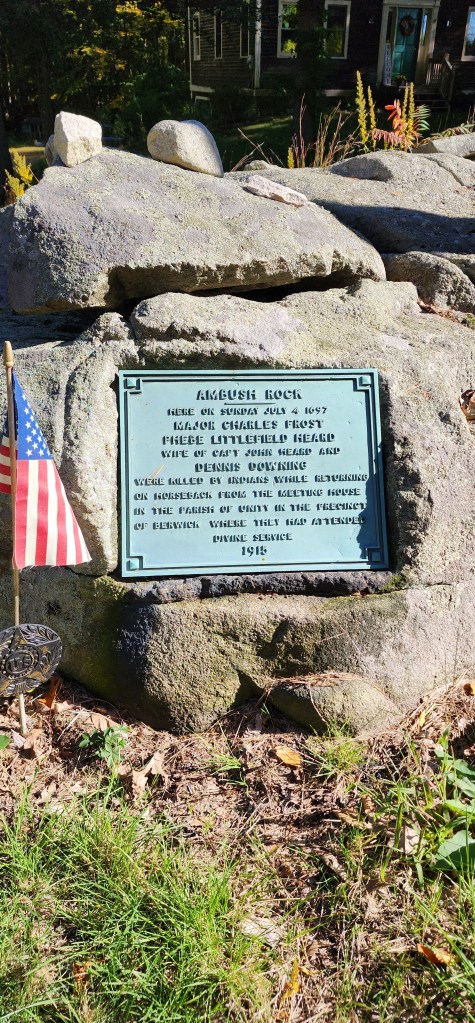
Ambush Rock

What the marker in Eliot, Maine, doesn’t mention is that Major Charles Frost and Dover’s Richard Waldron concocted the mock wargame that led to the hanging of Native men sent to Boston and the sale of about 350 Penacook women and children into slavery in the West Indies.

This was hardly an attack on an innocent party, then. The Natives waited years to extract revenge, and did it at a time and place that spared others.

My history Quaking Dover adds details.

English relations with the Natives were strained from the very beginning

One of the troubling revelations I found in researching my new book Quaking Dover is the depth of the English injustice and violence toward the Indigenous people of what we know as New England. It goes all the way back.

Forget the happy images of that first Thanksgiving feast where the Natives are portrayed as the special, very welcome, guests of the Pilgrims.

Squanto, after all, had been kidnapped, enslaved, and spent five years in England before the first English settlement took hold on Plymouth Bay.

Explorer Martin Pring, who established a fortified camp at Truro on Cape Cod in 1603, fled under attack by enraged Natives after he had set his mastiffs on them and fired his cannon in their direction.

The Pilgrims’ military leader, Myles Standish (not one of their faith, by the way), led the 1623 Wessagussett massacre, prompting Natives to abandon their villages for safer ground.

The Pequot war, 1637, was ultimately a land grab ending with the construction of New England’s first slave ship to trade the Native survivors into slavery in the West Indies in exchange for Africans.

And that’s before King Phillip’s war, with the mock wargame in Dover, or the waves of combat across northern New England until the treaty ending the French and Indian wars in 1763.

The outlook, of course, of “savages” and “heathens” was only part of the problem. The English insisted on addressing legal conflicts only in colonial courts. Not surprisingly, the decisions all seemed to come down against the Natives, with no independent course of appeal.

The pressure finally exploded in 1689 with the devastating raid on Cochecho Village and then Oyster River, both in Dover – hostilities that would continue another seven decades.

Are you ready for a fuller story?

When you see someplace you’ve known now in the news

The train derailment in East Palestine, Ohio, has me mentally revisiting a part of my landscape from forty years ago.

At the time, I lived two counties to the north but was a member of one of three old-style Quaker Meetings in Columbiana County, where the accident took place. So I was down there at least once a week most of the year. The county was a mix of industrial and suburban, especially where it bordered Rust Belt Youngstown, and rural Appalachia along with touches of New England. One corner abutted the Ohio River and West Virginia.

The rail line in the headlines was like those running through a small city where I had worked in another corner of the state, a place I call Prairie Depot in my fiction. And East Palestine itself could be adjacent to the city at the core of my novel, Hometown News.

Churches included Mennonite and Brethren, in the peace tradition, as well as Evangelical Friends at the other end of the Quaker spectrum.

Retracing the terrain via satellite maps, I was struck by how much I’ve forgotten, even parts I had known fondly. Others were pretty gritty, even back then.

From a distance now, it’s like encountering a ghost in a haunted house I thought I’d left behind.