He’s a man who never really fit in. Anywhere.
That doesn’t necessarily make a leader.
Or why he can’t quite slink away.
You never know what we'll churn up in cleaning a stall
He’s a man who never really fit in. Anywhere.
That doesn’t necessarily make a leader.
Or why he can’t quite slink away.
Quite simply, Britain betrayed the settlers in her colonies, from Ireland onward. The American plaint, “Taxation without representation,” reflected that all too succinctly. Where were the colonies’ representatives in Parliament or the House of Lords? What voice did they have?
The colonists identified as English but must have seen they were definitely second-class citizens. Or maybe third.
As I note in my book Quaking Dover, the Massachusetts Bay colony’s Calvinist intransigence had been at odds with the Crown from its inception. The first shot heard ‘round the world could have erupted at any point.
My pivotal question is just what turned the Loyalists in Virginia so far as to reject the monarchy as well and then join in taking up arms in the revolutionary cause by 1776?
The other colonies moved somewhere in between.
Not that all of this falls much within the scope of my little 400-year history volume as I try to keep a focus.
The ’60s and early ’70s unleashed a revolution, one I tend to see from the progressive side of the experience.
But after writing about it in many of my novels, I’m having to acknowledge a dark underbelly.
There was a strand of ghouls who opposed any kind of common action, including politics. They were deeply angry but wanted to hide in a hole rather than celebrate oneness with each other and the greater universe and then work to advance that awareness.
That points, unfortunately, to the Trumpist ultra-right wing or Libertarians with no broader community sense other than what they can get out of it directly – or otherwise get out of supporting, period.
What I’m having to see as anarchy.
Yup, I’ve overlooked those who just wanted to escape any, well, Peace & Love revolution outside of their own turtle shell.
Maybe that’s the side the younger generations have perceived all too clearly in their negative view of hippie, despite the many other aspects they openly pursue.
Dover’s second minister, the Rev. George Burdet, made a quick exit from town amid scandals, quickly followed by more in York, Maine. He had even briefly been “governor,” or the agent in charge of the New Hampshire province, making him in charge of both its religion and politics. Or, as historian George Wadleigh quipped, a wannabe pope.
Beyond that, as I observed in Quaking Dover, Burdet “was obviously on a downward spiral, as Thomas Gorges wrote to John Winthrop in 1641, noting that Burdet was at Pemaquid and ‘is grown to that height of sin that it is to [be] feared he is given over. His time he spends in drinking, dancing, singing scurrilous songs, and for his companions he selects the wretchedest people of the country. At the spring I hear he is for England.’ Later that year, the younger Gorges added of Burdet, ‘the dishonor of his profession and monster of nature, is now gone for England by way of Spain.’ That description of drinking, dancing, and singing rather seals the Robert Dover connection for me, even if Merrymount’s Thomas Morton, the more obvious reveling partner, wouldn’t return to Maine for another year or two.”

So here’s where he spent that wild binge – 110 miles or so from Dover, or a two-hour drive away today.

As for Robert Dover, who gave Burdet the inspiration for naming the New Hampshire settlement? He was an anti-Puritan wit and attorney. That, in contrast to the South English port famed for its white cliffs.
Reports of the cleric’s subsequent movements vary, possibly ending in Ireland, “where he was named chancellor and dean of a diocese. He died in Ireland in 1671, ‘after founding a much respected county family.’ Had he reunited with the wife and children he’d left behind?” As I say in my book, “Or was he, in fact, a bigamist? Also, there’s no mention of prison.”
Turn to Quaking Dover for the details.
What my Pemaquid visit made me realize is how little history of early Maine I had encountered in drafting my book, and how tenuous so much of it I’ve found since remains. Yes, the early settlements, including Pemaquid, were obliterated and abandoned during the decades of warfare with the French and their Native allies, but there had been significant settlement before that, something that kept getting swept away.
Coming to Colonial Pemaquid’s state-maintained historical site in Maine, I wasn’t prepared to find this.

It was far more than the wooden palisades found across much of early New England. It looked to me far more like something out of Scotland or a Monty Python movie.
This wasn’t even a reproduction of the first fort there, but rather the second.
The first was Fort Charles, built 1677 after the village had already been destroyed. That fortification was overrun and destroyed by the French and their Native allies in 1689.
Most of the usual attention to warfare between the English colonists and the Natives focuses on King Phillip’s war, which heavily impacted southern New England. Much of the heaviest toll, however, happened in the decades after that when the tribes allied with the French to the north. Those outbursts afflicted northern New England, including Dover, New Hampshire, for decades later.
That’s where Pemaquid, fortified to hold the Maine at the edge of English claims in the New World, comes into play with my story, Quaking Dover.
Dover was often on the frontier of English settlement, a thin ribbon along the coastline but barely reaching inland and thus nearly impossible to defend, at least much north of Boston.
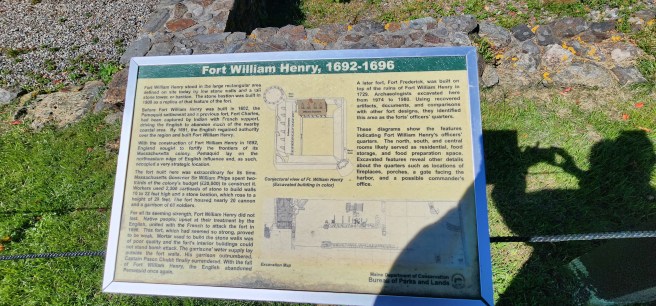
Once the English did reclaim this stretch of Maine from the French, the New Englanders built a new, second fortification, Fort William Henry, erected in the large rectangular area defined on the site today by low stone walls and a tall stone tower, or bastion. The stone bastion you see was built in 1908 as a replica of that feature of the fort.
As Maine’s online documentation explains, before the second Fort William Henry was built in 1692, the Pemaquid settlement and the previous fort had been captured by the French and their tribal allies, driving the English to abandon much of the nearby coastal area. By 1691, however, the English regained authority over the region and built Fort William Henry.
(I am fascinated by the tenacity of those who kept returning despite the costly odds.)
As you will find, with the construction of Fort William Henry in 1692, England sought to fortify the frontiers of its Massachusetts eastern district. Pemaquid lay on the northeastern edge of English influence and, as such, occupied a very strategic location.
The fort built here was extraordinary for its time. Massachusetts Governor Sir William Phips spent two-thirds of the colony’s budget (£20,000) to construct it. Workers used 2,000 cartloads of stone to build walls 10 to 22 feet high and a stone bastion, which rose to a height of 29 feet. The fort housed nearly 20 cannon and a garrison of 60 soldiers.
(Note that the costs were born by the New Englanders, not the British Crown.)
For all its seeming strength, Fort William Henry did not last. Native people, upset at their treatment by the English, united with the French to attack the fort in 1696. This fort, which had seemed so strong, proved to be weak. Mortar used to build the stone walls was of poor quality and the fort’s interior buildings could not stand bomb attack. The garrison’s water supply lay outside the fort walls. His garrison outnumbered, Captain Pasco Chubb finally surrendered. With the fall of Fort William Henry, the English abandoned Pemaquid once again.
(If this were fiction, I can’t imagine what to do with a name like Captain Pasco Chubb. Especially as an Englishman.)
Well, that’s an official account, one I for now I find no reason to quibble with. What does change my earlier perspective, however, is Fort Frederick, erected in 1729 and dismantled in 1775 to keep it out of British occupation in the Revolutionary war.
It never faced hostilities with the Natives, which seriously makes me reconsider a much earlier reoccupation of Maine by English settlers, something I had largely ruled out before 1763, the end of the French and Indian wars. Now see that’s not quite accurate, though it still seems to apply Downeast, where I now live.
So much for these confessions of an amateur historian.
As a passerby noted while observing renovation work in town, the median age of tradesmen in the U.S. is 57. It’s no doubt higher here in Maine and Sunrise County, especially.
There’s a lot of work needing to be done, too: carpentry, plumbing, roofing, masonry, insulating, windows … We have a long list ourselves and are still looking for help.
Forget the “Go west, young man,” advice of yore. Many youths would be well-advised to go into the construction trades, pronto. Financially, they’d be way ahead of those with a college degree but heavily in debt. They could even live wherever they want.
Hey, kids, if you love to hunt and fish or sail and camp, Sunrise County would fill your dreams. You’d definitely be welcome.
On a more personal note, send me your references and let’s talk.
A comment from a professional historian after one of my Quaking Dover presentations has me realizing how much more needs to be seen in fresh light.
New England history, he said, is told through Harvard. And then, to smaller degrees, Yale and Williams College. A more accurate verb might be “filtered” or “focused,” but the implication was clear. The tale is party-line. Even Greater Boston-based.
When I delved into the roots of tiny Dover to the north, from the perspective of its Quaker Meeting, I had no idea how unconventional my stance would be.
The traditional history, I will argue, is Puritan-based and largely pushes aside the earlier settlers and the cultural differences or influence they had.
The well-organized Puritan invasion began full-force in 1630 with Massachusetts Bay and then the Connecticut colonies. Their utopian vision was far more fragile in practice than we’re led to believe. In that first decade, Roger Williams, Ann Hutchinson, and Samuel Gorton were banished, leading to the establishment of Rhode Island and quickly afterward, in reaction, Harvard College. Their own charter was under threat of revocation from the king, and they placed cannon on Boston Harbor to fire on Royal Navy ships, if needed. Think about that. And its Pequot War enslaved Natives who were exchanged for Africans, spurring the lucrative slave-trade.
That’s a lot in a small space in a short time.
Settlement to the north was not immune.
In New Hampshire, two of the four colonial towns were established by religious dissidents fleeing Massachusetts. Dover’s Edward Hilton conveyed his charter (exactly how or for how much remains unclear) to the Lords Saye and Brook for their own management … or mismanagement. As my book details, the New Hampshire province and neighboring Maine quickly became a hotbed of dissidents and misfits – a story that is largely overlooked in the traditional accounts. Let me just say it was a ripe time.
What I’ve also been seeing is that the story of dissent has focused on Rhode Island and largely ignored the north, including Salem, Massachusetts.
Should one of my upcoming presentations redress that?
A monument at Colonial Pemaquid acknowledging to the 1635 tragic sinking of a ship caught me up short. I had forgotten the vessel’s impact on Dover.
As background, the ship had been commissioned for Sir Walter Raleigh’s last expedition to America in 1617 and in several subsequent incarnations been involved in some high seas adventures, staving off repeated boarding by pirates and beating off three Spanish ships. Not that I knew that in my initial research.
As the monument at the Maine historical site proclaims, the Angel Gabriel was a 250-ton galleon carrying settlers to new lives in New England in August 1635 when it anchored at the village of Pemaquid. Most of the passengers and crew got off the ship before nightfall to rest on land as guests of the villagers. That night, August 14-15, a storm later known as “The Great Colonial Hurricane” struck the area and the Angel Gabriel was torn from her anchors and destroyed.
Or maybe it had happened earlier and the ship had limped into harbor. Still, I’m quoting there, from an account that continues: “In the mid 1970s, efforts were made to locate the wreck in Pemaquid Harbor with divers and a magnatometer and sideccan sonar but no artifacts form the ship were ever located.”
For context, “The Angel Gabriel was very similar to the Mayflower but 18 feet longer and bearing four more gun ports per side.”
I am now curious to see whether the small museum displays a trunk that went down with the ship and was found floating the next day. It belonged to a passenger named John Cogswell and his descendant of the same name agreed to lend the trunk for display.

This marker, though, stirred up some memories of a section that got cut from the final version of my book Quaking Dover.
Here’s what I had:
Three Dover Combination signers shared a tragic introduction to the New World when their ship, the Angel Gabriel, broke up in the August 14 “Great Colonial Hurricane of 1635,” either in the harbor at Pemaquid, Maine, or at the Isles of Shoals.
[Note the clarification in the site of the disaster in the bronze monument.]
Twenty-one-year-old William Furber settled next to his brother-in-law, John Bickford, at Oyster River and later relocated to Bloody Point, opposite Hilton Point on Great Bay. He married Elizabeth Clarke, daughter of William Clarke and Elizabeth Quick, in 1642 in Dover.
(The Bickford family, meanwhile, has John landing at Dover in 1623 and marrying Temperance Furber in 1624 in New Hampshire. If these dates and locations can be supported, they would significantly change the early history of the Piscataqua settlement. Their son, John, though, was born in 1625 in Devon, England.)
Samuel Haines was an indentured servant or apprentice to John Cogswell, who was also aboard and survived. They were bound for Ipswich [Massachusetts], where Haines finished his obligations the following year and may have moved at that time to Northam, as Dover was also called.
He did, however, return to England in 1638 and married Ellenor Neate within a few weeks after his arrival, suggesting they were engaged before his coming to America.
After a year-and-a-half, they set sail and established their home in Northam/Dover, where he had ten acres of land near the meetinghouse. Later, he had twenty acres on the Back River, where his neighbors were fellow Angel Gabriel survivors William Furber and John Tuttle.
He was taxed in Dover in 1648 and 1649.
In 1650 he leased Captain Francis Champernown’s Green Land farm for two years, and then secured ninety-one acres adjoining it, where he built a permanent home, and another ten acres where he eventually owned a mill. In 1653 he was one of the petitioners successfully asking the Massachusetts General Court to change the town name from Strawbery Banke to Portsmouth. That year he began the first of ten successive years as a town selectman. In 1666 he helped run the town line between Portsmouth and Hampton.
He was also the first deacon at the formal organization of the first church in Portsmouth in 1671.
At much of this time, the population of what now constitutes New Castle, Portsmouth, Greenland, and Newington was only fifty to sixty families.
Much less is known about survivor John Tuttle, who was about seventeen years old at the time of the disaster. After their rescue, he arrived in Chebasco (in Essex or Ispwich, Massachusetts). His age and destination suggest his situation may have been similar to Haines’. By 1638 Tuttle settled in Dover, where he was known as Shipwreck John and had a farm on today’s Bellamy River – one that grew into what was long known as America’s oldest family-owned and operated enterprise. (Never mind that Thomas Roberts’ heirs nearby would have a longer claim.) Tuttle’s son Thomas was killed by a falling tree while still a young teenager, leaving John Jr. to continue the family name.
~*~
Successive Tuttles became prominent Quakers. And, as I inserted, the monument is more specific about the scene of the disaster than I’d previously found.
Given a former resident of the White House’s insistence an election was stolen, let me argue that he’s upset because he couldn’t steal it a second time.
You know, the cheater who justifies his actions by claiming that everybody’s doing it. Except that they aren’t.
That sort of thing.
So for proof on the election, I’ll hold back until he offers evidence for his case regarding 2020. Pipe up or shut up, please. Or, as we might also insist, get off the toilet.
Please remember, he never won the popular vote in either run. It was all up to the Electoral College.
Or, in an earlier questionable presidential election case, the Supreme Court, which is no longer impeccable as a result.
Just sayin’ …
 Jnana's Red Barn