It’s not all about food or forestry, either

As long as we’re at the Common Ground Fair in Unity, Maine, let me mention a few presentations today that go beyond the solid fare of food, forestry, livestock, fleece and fiber.

For instance, a home funeral demo is followed by discussions on green cemeteries and community death care teams for those interested in alternatives to costly funeral traditions. There’s also a blacksmithing demo and a hands-on assembly of a ¼ scale timber barn. Chicken first aid could be amusing, as could the basic of breeding your own pigs.

Of special interest to me are the two contradances, a traditional shape-note sing (hope I remembered to pack my Sacred Harp hymnal) alas at the same time as an Indigenous storytelling session, and three Maine legends appearing together: folksinger Noel Paul Stookey, comedian Tim Sample, and guitarist David Mallett.

I’ve sung in the choir behind Stookey twice and can say he’s an amazing person and musician.

Here’s a taste of what’s on tap

Many of the presentations at the annual Common Ground Fair in Unity, Maine, focus on healthy garden and kitchen practices.

Today’s workshops and discussions include seed saving for the home gardener, my love affair with garlic, stories of climbing fruit trees, weird and whacky wire weeders you can make, beekeeping, honey harvesting and winter preparation, cider apple tasting, growing curcubits, unusual edible plants in the landscape, three-season gardening, year-round vegetable production, building and maintaining healthy soil, green manures, heritage tomatoes, and running a “from scratch” kitchen. There’s also canning, cooking your way to health with mushrooms, health and healing with products from the hive, medicinal uses of tannins, a panel answering your questions about herbs, a solar cooking demonstration, a children’s apple pie contest, and judging of baked goods and dairy and cheese entries. Remember, that’s just one day out of the three and there are plenty of other things happening at the same time.

Among the specialties being offered by the 43 food vendors you’ll find maple fried dough, Zylabi fried dough, sausage and chicken gumbo, jambalaya, red beans and rice, chai tea, traditional empanadas, Maine fish tacos, hummus and falafel pita sandwiches, spiced beef and lamb bowls, bialys, sourdough bruschetta, tofu fries, seaweed salad, sambusas, oysters on the half shell, eggplant and hummus sandwiches, pad Thai, Asian rice bowls, festival sweet dumplings, lamb shawarma, elote (street corn), switchel, fried shitake mushrooms, chicken tikka, aloo palak, chicken and lamb flatbreads, vegan egg rolls, and wild blueberry crisp. Maybe there’s only one way to find out what some of those are.

The lamb and oysters definitely have my attention.

For more conventional tastes, there are Italian sausages, burgers, smoothies, French fries, lemonade, cheesecake, thin crust pizza, soft pretzels, Belgian waffles, popsicles, and coffee and tea.

If that’s not enough, tomorrow includes growing rice in Maine(!) and yesterday had a future of psilocybin in Maine (21+ must have ID).

I think it’s a good example of ways America’s cuisine has expanded in the past 50 years. Back in my youth, mushrooms were an exotic item that came out of cans.

How about you?
We’re off to a most uncommon country fair

There’s no Ferris wheel, no cotton candy, no neon lighting, no celebrity performers – for years there wasn’t even coffee, until fair-trade organic became an option – but the three-day event still draws roughly 60,000 folks to a two-lane road toward its grounds in the rolling farmland of central Maine.

For the first dozen years I lived in New Hampshire, I heard about the most recent gathering and spotted its current T-shirts at contradances and farm markets afterward, but my work schedule didn’t fit attending.

And then, newly remarried, I took some precious vacation time that gave me a first-hand experience – including the now legendary traffic jam that rivaled any big city. Once there, we encountered a number of people we already knew, even though we lived three hours away.

Another dozen years passed before we returned, from the other direction, and this year’s an encore.

It’s the Common Ground Fair, a three-day weekend affair held a few weeks after Labor Day – more or less an equinox celebration held by the Maine Organic Farmers and Gardeners Association, or MOFGA,  the nation’s oldest and largest statewide organic organization in America.

It’s like a Whole Earth Catalog come to life. Of, if you’ve ever wondered where the hippies went, a good place to see places the movement has evolved and continues in practical ways.

Not all of it’s back-to-the-earth, either. Sustainable living, local economies, and spirituality augment the emphasis on organic agriculture and food use. There’s even a workshop on organizing a labor union.

Here’s hoping for some prime fall weather.

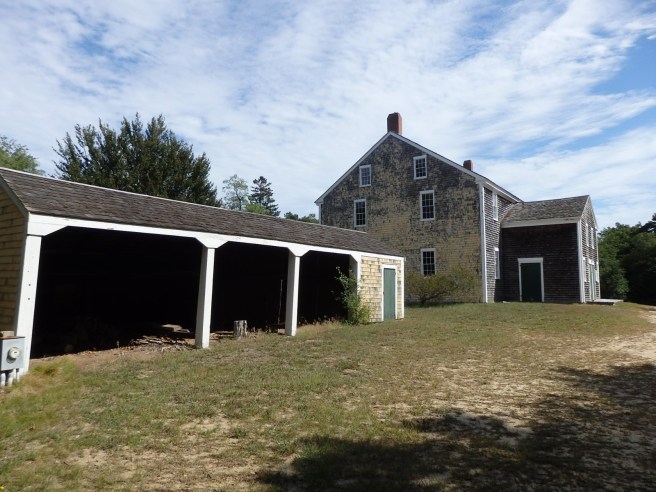
Where were the schoolhouse and horse sheds?

Or maybe a large outhouse, as one map indicates.

I keep wondering if the Pine Hill school, at the fringe of the city cemetery, was originally one of Dover Friends early schoolhouses.

The Meeting apparently had a second one in Maine.

But horse sheds were also common around Quaker meetinghouses.

East Sandwich on Cape Cod, which has a lot more

Not that I’ve found any evidence of these now.


I’m rather glad I waited to read the First Parish history

As a parent, you really try to keep your kids from a lot of painful encounters but they never listen to your advice, as far as you can tell, which seems to be futile no matter how hard you try, and then the next thing you hear is crying.

Maybe that’s a good thing, if from their experience they learn more than you knew.

There are several books that fall into that model. Had I read them before completing Quaker Dover, I might have overlooked some fresh insights. But now that my book’s out, I really appreciate what else I’m finding.

Donald R. Bryant’s History of the First Parish Church is one of them. The 160-page volume, first published in 1970 and enlarged in 2002, offers another side of my argument of the Quaker invasion in town, for one thing, while relating other parts of the early years with, well, perhaps more discretion. And, my, I do admire his resources and tenacity.

One of my favorite sections is the profile of John Williams that Bryant works into the narrative. Williams, a member of the parish, was, as he says “a visionary, a leader in bringing textile manufacturing to America,” and a cofounder of what became the big millworks in today’s downtown.

But he also became part of the faction of 26 male members who announced in 1828 they were leaving the church to join the Unitarian Society in establishing a new congregation. The split among the heirs of the Puritans into Unitarian or Trinitarian Congregational at the time paralleled a similar one among American Quakers into Orthodox and Hicksite. New England somehow remained Orthodox, as far as Friends went.

The plot within First Parish further thickens over the kind of minister it needed along with the construction of a new, and present, house of worship. What follows in the parish history is a turmoil that includes the changing economics of the town I haven’t yet found in the Quaker Meeting.

Bryant’s history then turns largely to the successive ministers rather than the congregation’s members and their influence in the community.

Still, I appreciate the comments by David Slater at the end of the book. He was First Parish pastor when I first came to Dover and quite engaging. He offered a checklist on how church life was changing that remains relevant, though nothing hit me more than this:

“Christianity is becoming more and more counter-cultural.”

That takes me back to the Quaker invasion into Dover, back in the mid-1600s.

As for the city’s other congregations? I’m anxious to hear more.

Johnny Appleseed was really a preacher

More accurately, John Chapman, who distributed Swedenborgian church tracts with those packets of seeds all along the American frontier of his time.

As was William Penn, on the Quaker side, largely still confined in old England.

It’s curious how individuals’ religious motivations get excised from the sanitized histories.

The Book, or Bible, if you prefer, is filled with a lot of revolutionary vision for those who want to reclaim and then pursue its fulfillment.

So starting with apples, which do get a bad but undeserved rap at the beginning of the epic, seems a fitting place to begin.

End of sermon. For now.

We have four principal towns in Way DownEast Maine

They’re Calais, Eastport, Lubec, and Machias. Or the other way around, depending on how you’re driving or sailing.

Like pearls on a string, one that hugs the coastline of vast Washington County.

The image of four anchors arrayed along a map makes sense, each one with its own distinctive attraction.

Their combined population comes to barely eight thousand.

The terrain around here is much more real than Acadia, for sure, if you’re the least bit interested in the Real Maine.

Gratitude to the public library

Dover’s public library has been quite proactive in developing an online presentation of the city’s historical profiles and images. I’ve found those resources to be very useful for fast checks when drafting these posts and related material, for certain.

Its dark-hued historical room upstairs is a treasure chest of local lore, as I discovered decades ago chancing upon Dover’s Quaker family records serialized in the fat volumes of the New Hampshire Genealogical Record, 1903-1909. They’ve since been keyboarded and made available online, if you Google, though I’m still relying on my photocopies.

In time, as a library cardholder, I even had online access to U.S. Census records from home in the wee hours. What a privilege!

If it weren’t for the Covid restrictions and my relocation to far eastern Maine, I’d like still be digging around on the top floor there. I certainly encourage others to do so.


Opa!

In relocating from Dover, I do miss its annual Labor Day weekend Greek festival – the food, conversations, dancing with live music, and overall happy vibe. What they call kefi.

For Greek Orthodox congregations across North America, these events have become a traditional way of celebrating their culture, welcoming the surrounding community to sample it, reenforcing the bonds of their membership, and conducting some needed fundraising, sometimes for local charities as well as the church itself. The deep commitment of the volunteers and the overall organizational skill always amaze me, and it has been fun to be part of the food-serving line some years.

Earlier in the summer, neighboring Portsmouth usually has its own, similar but also with differences, and both weekends draw big crowds, jammed parking, and partisan comparisons. Dover’s has free admission, unlike Portsmouth, which has more dance addicts.

The festivals closet to Sunrise County are in Portland and Lewiston, downstate five or so hours away. Or, for variety, Halifax, Nova Scotia, which has a four-day schedule but is a six-hour drive away – or seven if you take the shortcut ferry ride across Fundy Bay.

~*~

For the Labor Day weekend, Eastport has a much more low-key observance, the Salmon and Seafood Festival.

Things get wilder the following weekend, then the pirates invade for what’s our blowout to the summer tourist season.

What are you doing special for the holiday weekend?