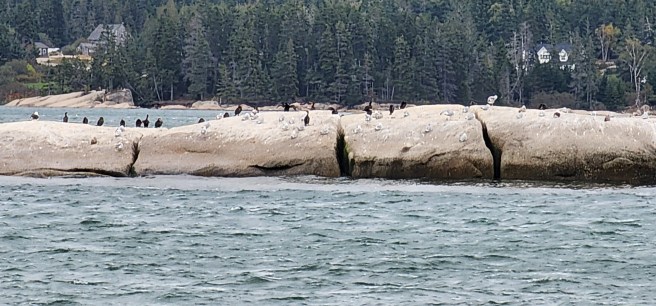
clusters of sails
how do you know how to mix

rolling waters as the pulse of the earth
a breathing
we ride
You never know what we'll churn up in cleaning a stall
clusters of sails
how do you know how to mix

rolling waters as the pulse of the earth
a breathing
we ride
Now that we had the history of our old house back a century-and-a-half, there was still a 20-year gap of getting from Lucy M. Hooper, Anne Dodge, and Mary Roberts, who were named in the 1875 deed transfer, and the Shackford Est of the 1855 Eastport map.
Which Shackford was the Est, presumably for Estate, in the 1855 map?
It was a prolific family in town at the time.
Shackford is a name existing as three places in Eastport: a cove just south of the downtown, a head of land occupied today by a state park, and a residential street.
Just who were they?
I was already working this line from the earliest materials and trying to see if I could connect someone to the material you’ve already seen.
The central question, remember, was how far back did this house go?
It was time to take Captain John Shackford senior seriously.
I’d love to hear other novelists and short story writers discuss their reasons for selecting the names they apply to the figures in their stories.
For that matter, I’d love to hear readers’ reactions. Like what’s your favorite connection there?
I’ve avoided using names of people I’ve known well. Surprisingly, it became a problem especially in my ashram novel where the best Sanskrit names had already been given to my fellow residents. Elsewhere, it eliminates a wide swath of common names, starting with John, James, Robert, Thomas, and William for males. Or Jack, Jimmy, Bobby, Tommy, and Billy, more colorfully.
Had I known they wouldn’t be reading my work anyway, maybe I should have used the names and left people guessing. I’ve tried to be gentle, though, and perhaps that’s a weakness.
Though I’m not one to apply nicknames in everyday life, I have found them useful in my fiction. As examples, I’ll offer “Big Pumpkin” and “Elvis” for the swami in Yoga Bootcamp.
~*~
There’s also the matter of which figures get named and which ones can pass through unnamed. We don’t want to tangle a reader, do we?
A major consideration in revising my output was an attempt to reduce the number of named characters. For a big book, like the five-generation span of What’s Left or the four-year college life of Daffodil Uprising or the burgeoning social life of Kenzie in Pit-a-Pat High Jinks, this was a challenge.
I did find myself shading Greek tradition in What’s Left: repetition of a name within a family is common but would have been utterly confusing here.
As an alternative, I tried to limit some to a single chapter, treating it like a short story; when it was done, so were they.
Should abuses creep into one part, they are reformed by those that remain sound.
James Madison in Federalist No. 43, citing Montesquieu

He plays everything. Even automobile hubcaps. And he’s a fine tenor, as we discovered one spring. Even a devilish composer, shown by his setting of a Longfellow poem we tackled under his direction.
He has a discerning ear, fine sense of humor, and rocks as well as Renaissance. He’s also a clean conductor, with supporting gestures, even when he’s playing ukelele on the podium.
Our Mister Music, or Music Man, as Gene Nichols is known in Washington County, Maine, and beyond. Director of Quoddy Voices.
I’m still not quite sure was his center of gravity is, but his orbit is quite wide.

I do find her enhanced natural style quite comforting.
Even during our briefest of light daytime.


Things are getting crafty around here.
Not to be confused with the Depression-era novelist Thomas Wolfe, the journalist Tom came to prominence in the final years of the New York Herald Tribune, my favorite newspaper ever.
With its clean, classic design, smart writing and editing, and sometimes playfully tabloid headlines, it was a standout in a very competitive newspaper market but looking for one more edge to assure its survival.
Voila, Wolfe emerged with his hyper, supercharged, Pop art zeitgeist, in-your-face, “Look at this!” writer for the paper’s Sunday magazine (which would continue on its own as New York magazine after the newspaper itself ceased publication). He even moved up to the daily paper itself as a columnist, alongside Jimmy Breslin.
Quite simply, he was fun to read.
Maybe it was a reflection of his Manhattan success or the counterculture themes he picked up on, but Wolfe created a marketable visual image as a dandy in a white, often three-piece, suit, with oversized glasses. He was about getting attention for himself, counter to the usual advice to reporters to make themselves invisible so they could more objectively view the events unfolding before them.
Not so, Tom. Or, in my case, with the college prof who thought I’d be the next Tom Wolfe.
His Electric-Acid Kool-Aid Test, following Ken Kesey and the Merry Pranksters as avatars of LSD, became a bestselling sensation leading memorably to the Right Stuff about astronauts.
Apart from this writing style, he knew how to sniff out a trend. In contrast, I ultimately went counter-trend.
I do wonder how much he influenced me. Perhaps in Subway Visions.
As for others, Hunter Thompson seems to have most closely built on the legacy.
By the way, the novelist Wolfe was notorious for excess writing, too, though of a masterly sort.
As for the Herald Trib, you can get a taste of it in my post “Establishing my creds” of September 11, 2014.