PRACTICE AS THE WAY ITSELF

Central to a life in art is the matter of practice. By this, I do not mean a dry run for a finished performance or product, but rather the repeated exercises that make an action habitual or proficient or even, in its variant, practical. Everyday, useful, helpful, sensible. At its core, the Greek root for practice means “to do,” something we see repeated when a musician practices scales, a physician practices medicine, an attorney practices law, an athlete practices basketball – it’s what one does or must do to be a musician, a physician, an attorney, a ballplayer. In its purity, a practice is pursued apart from an intended outcome – a concert, a healing, or courtroom victory – but rather as the daily discipline itself, which may in turn possibly lead to discovery and increased proficiency. To accomplish this requires time and physical space for experiment: what if I try it this way, what happens if I change that?

All of this requires time, of course – especially time free of specific outcome. (The Shakers, for all of their “Hands for work, hearts to God” ethic, left enough unencumbered time in their labors to experiment and invent – the creative acts that have become their legacy and living witness.) Still, I often find myself coming to my writing with a sense of guilt. (For that matter, even sitting down to read can be accompanied by that burden.) Other people lay claim to my time and attention. They see my writing, revising, and publishing as feeding my own vanity, rather than their needs and desires. There are dishes to wash, a garden to weed, a lawn to mow, walls needing paint. Looking to larger issues, some point to a world full of social injustices and programs that cry out for volunteer action. Somewhere deep in my bones I even carry that ancestral aversion to art for art’s sake, superfluity, escapism, dissolution. (Nowhere do they note how Jesus kept returning to the wilderness for prayer and renewal, leaving the fervid crowds far behind.) This is all complicated by the American measure of ultimate success – the almighty dollar. Its corollary, that a professional is superior to an amateur. Or that making the best-seller list is the measure of a great author. (No poets need apply.) (Inducing its own layers of anxiety and guilt: could I be making more? Have I sold out? Am I somehow now trapped by expectations?) Here, I could have been working overtime at the office.

All of this complicated by Samuel Johnson’s admonition, “No man but a blockhead ever wrote except for money.” (Which may even be a grumpy acknowledgement that writing remains work, paid or unpaid. Or of his frequent status as a hack writer.)

To push this a step deeper, consider the practice of prayer. I’ve long sensed that poetry and prayer – or, from another perspective, art and religion – spring from a common root in antiquity. The spells, rituals, and restrictions that accompanied fertility, hunting and harvesting, and death lead to both pathways. (“And God saw that is was good,” in Genesis 1, has the meaning of “good to eat” – that is, nourishing – that soon evolves into morally and aesthetically good as well.)

I’m not alone here. For instance, Carmine Starnino, in “Lazy Bastardism: A Notebook” (Poetry, January 2010), admits a similar unease about both reading and writing and then says, “My first contact with poetry was the ‘Our Father’ and ‘Hail Mary.’ Yes, they’re prayers, but they’re also pockets of linguistic energy … epic-accented statements … wonderfully archaic usages.” In his reflection, he argues, “Other prayers were loaded with religiosity, but uninterestingly flat,” and concludes, “Writing poetry is not, in itself, a prayerful activity. That’s because prayer is not a craft; it is the opposite of a craft,” one he sees as essentially secular: “poetry might even be said to be a menace to religious belief … because poetry, to work, needs to strip religious belief of its theological privilege.” To which he adds, “The best religious verse … flirts with faithlessness.” As he move on to other topics, he leaves me recognizing how narrow his understanding of prayer ultimately is and how much of his argument can be turned as a critique of poetry, as well. Many well-crafted poems, I find, remain uninterestingly flat – contrived and spiritless. Many hover well within the bounds of literary privilege. Read at weddings or funerals, they sound obscure and stuffy, as welcome as the parking attendant. Just as we struggle to define a poem within the range of writing today, so too does prayer run a range, from the unintelligible babbling of glossolalia (“praying in tongues,” in Pentecostal practice, as a craft, in some cases, to a raw emotional outpouring, in others) to intimate confessions to the formal Book of Prayer-type compositions of Starnino’s experience. At one end are those who pray for something specific (including a job, love, money, or healing), on to those who seek only to know God’s will and then to those mystics who sit silently waiting to listen to the divine voice in their hearts and bones. The tradition of English poetry, meanwhile, is prey to sermonizing, however secular or prosaic. Only when we break free of our prevailing orthodoxy – religious or artistic – do we truly “flirt with faithlessness,” finding ourselves defenseless in the face of ecstasy or despair, in the face of the one that cannot be named. This is the realm of epiphany, sacred or secular (or both).

I think Starnino loses the trail when he sees poetry as a craft, rather than a practice. Craft emphasizes a finished artifact, unlike practice, which embraces the activity itself. Practice can often resemble a hike in the woods or taking a trail up a mountain, with all the stages of attention or inattention that go with it. As you build stamina and endurance, you can also gain freedom. Whether mountain climbing, praying, or writing poetry, you may unexpectedly break free of the exertion itself – and cross into a state of oneness I’ll call the Zone. Others may discuss whether such moments of communion are epiphanies or a state of grace, or even secular or sacred, but when they come when I’m writing or revising, the lines seem to appear on their own, each move feels surefooted, the world around me appears as vibrant imagery and context. In this realm, I would declare poetry or literature to be a state of awareness, more than any artifact on a page or bound between covers. Likewise, the Zone may appear – it can never be summoned – in any of a number of disciplined activities. My wife experiences it while cooking and gardening; I enter it while dancing or singing, as well. Often, the Zone overlaps multiple ongoing activities: I jot the lines of a poem at a bend in the trail approaching a mountaintop.

I am left wondering why we cannot remain in the Zone long. Whether it would even be healthy. Whether we need some resistance or grit to balance the ethereal. Whether this reflects a basic mind/body, spirit/flesh duality.

Still, sustained practice is not easy. It remains work. Given a choice, the rational decision would be to sit back and devour great pages already given to us by others. (Or view great paintings or plays or films or dance productions and so on.) We can even ask, do we need more books? Who’s reading the ones we have now? I’m not speaking of all the junk fiction, junk movies, junk television, either. All that other kind of butt time. (Yes, I see a need for a slew of Creative Reading programs, more than Creative Writing, but that’s another facet of the work.)


HAS THEE BEEN REFRESHED?

It’s an ancient question after the hour of worship, along with “Has thee been fruitful?” or “How has Truth prospered?” A related question would ask just what draws each of us to sit in the communal quiet in the first place. On the one hand, there’s a need for relief from the conflicts of daily life – a desire for a time of lightness and joy. But ours is not a religion of escape, and I’ve become quite aware that the quest for social justice is also a central Biblical theme. Some weeks, in fact, we come quite close to “praying the newspaper,” as our hearts carry a world of suffering to the invisible altar.

While we reflect on the world, on one hand, we also examine ourselves in our worship. Maybe it’s impossible, if not just difficult, to be as thoroughly honest with ourselves at the deepest levels as we’d like. A therapist, after all, keeps redirecting the client back to the questions being skirted. Still, it’s important we try. Salvation, including being saved from our own negative thoughts and actions, has a root word related to healing. As I’ve been sitting on a succession of Psalms week after week, I’ve come to appreciate the authors’ growing candor – first, to admit the array of enemies, something many of us might have difficulty addressing – and then, in asking that they be smited or the petitioner be sheltered from their assault, which becomes an act of distancing and handing over the desire for revenge; it’s not, after all, no longer, “Let me smite them!” As we survey the realm of struggle around us, let me suggest that saving the world has a direct connection to saving ourselves, in all senses of the meaning. (I’ve always liked the bumper sticker, SAVE THE WHALES.)

Placing the question “Has thee been refreshed?” within this framework has a dimension of renewal and recharging for the work at hand. It’s for more than an hour, then, isn’t it.

TALLY HO, PIMLICO

As I said at the time, I’ve been thinking about names. Especially place names. Take “Baltimore,” a name most of us use repeatedly and never consider. There’s Balty More, kind of salty. Or Balta moor, rather Mediterranean. The name itself sounds Irish. I know, they were English. But it sure sounds like Ballyhagen or . . .

Of course, not everybody pronounces quite the same. I was in Florida a couple of years back and we went out to a restaurant owned by a woman and her husband, who had retired from Tennessee and, well, got so bored with the retirement life they went back into business just to take their minds off the boredom. So, following the dinner, she asked us where we were all from and the first of my colleagues replied, “I’m from Los Angeles,” and she said, “Oh, that’s very nice,” and the second colleague replied, “I’m from Chicago,” and she said, “Oh, that’s a nice city,” and the third said, “I’m from right here in Florida,” and of course she had to ask what neighborhood, and then my fourth colleague drawled, “I’m from right outside Atlanta,” and naturally they had that Southern thing going right away, in ways we Northerners can never know about. Finally, she turned to me and I said, as some folks around here do, “Bal’mer.” All of my colleagues looked at me queerly. Bal’mer? Not Bal-ty more? But not that lady, no sir. Without missing a beat, she came back, “Oh! Merlin!” Yessirree. I’m from the state of Merlin.

But back to Bal’mer, which sounds like something you put on a wound. Especially a burn.

At one time, the name made sense. Unique, except for the home plantation, wherever that was back in the British Isles. Named for the good Lord Baltimore, and all that.

But it’s time for a change.

For one thing, there are so many other Baltimores around the country, we’re only the biggest of them these days. I mean, there are all of those West Baltimores, New Baltimores, and North Baltimores, and so on running around, who needs them?

Even the Baltimore and Ohio Railroad decided it was time to change its name to CSX or whatever. Even here, in the metropolis, we have problems confusing, as we do, between Baltimore City and Baltimore County.

No, friends, it’s time for a change. New and improved, as they say in the advertising business.

We could turn to the original names, but Fells Point just doesn’t ring quite right. And Jonestown just won’t work, not after the Reverend Jim and his little band of suicidals. Nor would Otterbein, with its sectarian overtones as a denomination that no longer exists, for that matter. Harbor City doesn’t quite say it. Our nicknames Charm City, Mobtown, Crabtown, and so on, fail us as well.

What I am proposing is Pimlico.

Yes, this is Horse Country. And Pimlico has a nice ring to it. Consider the crowd that does Paris and Rome each year. Would they ever say, “I did Paris, Rome, and Baltimore”? Hell, no. But now try “Paris, Rome, and Pimlico” and you see what I mean. Pimlico has the kind of sound to it to reflect our definite up scaling of the city. It sounds just a tad racy, too.

Say Pimlico it shall be.

Remember, when you see the shining college students outside your favorite supermarket and they ask you to sign the petition, do not hesitate. And remember to vote yes on Proposition Fourteen, to rename Baltimore City and Baltimore County. Either or both.

Then we call all unite in saying, with renewed vigor: “Tally Ho, Pimlico!”

If only …

NAMING THE CHANGES

My fondness for mountain laurel goes back to my days of living in the ashram in the Pocono Mountains of Pennsylvania. There, the undergrowth of the forest was filled with these blossoms in season.

Over the years, my own spiritual practices have undergone many changes. Even in a tradition like the one I’ve embraced, seemingly free from the annual routines of a liturgical calendar or outward emblems, there appear cyclical changes mirroring those of the seasons. Cycles, too, like those of progressing from childhood and parenthood into retirement or release. In Salem Quarterly Meeting in Ohio, the session each Fifth Month meant rhubarb in the applesauce. See it as sacrificial and special.

There are times of struggle, doubt, and distrust. Times of whirlwind passion and excitement. Times of discovery. Times of drought or deep winter, relying on what’s brought out of storage. Times of renewal and recharge.

This has manifested as periods where I’ve been able to dedicate significant time to meditation, solitude, travel in ministry, prayer, Bible study, research into history and theology, organizational service, teaching, correspondence, or writing, as well as to regular disciplines such as fasting or physical spiritual exercise (the hatha yoga sessions or even wilderness hiking). Emphatically, however, one would predominate while others would likely be absent or greatly diminished. In addition, they would be strongly impacted by the events of my daily life itself – whether I was single, married, divorced, or “in relationship,” my hours and nature of employment, my friendships and faith community, my driving patterns through the week.

The result of all of this would be a crazy-quilt tapestry or a ricochet trajectory if it weren’t for a spiraling within it. That is, over the years, various periods and interests begin to overlap one another, creating a kind of harmony or accumulated depth. My asparagus bed in New Hampshire has roots in my experience of asparagus along irrigation canal banks in Far West desert three decades earlier. A dog sitting through Quaker meeting here is a reminder of dogs sitting through predawn meditation sessions in the Pocono Mountains, or of the cats aligned on the scaffolding outside the windows, as if they, too, were deep in concentrated worship. I read a particular Psalm and see the passage taking twists I hadn’t perceived earlier.

In my own life, my childhood was filled with natural science, hiking, and camping, each with its mystical visions and moments. Adolescence led into politics, classical music, opera, and writing complicated by unrequited sexual yearning. Without romantic companionship, a Lone Ranger journey. Rejection of existing creed while ensconced in church office was followed by flight into atheism and hippie excess landing, inexplicably, in a yoga ashram with its Hatha exercises and sustained meditation. From there, into Quaker practice, though of the ABC – or “anything but Christ” variety. The ashram lessons were applied here, in circles of deepening prayer life. By steps, I moved toward Christocentric and Plain speech, and an especially faith fervent language. Among the Wilburite Friends as well as Mennonites, especially, I came to wrestle within Scripture while similtaneously undergoing repeated Dark Night journeys and questioning. Turning to therapy, I wondered if anyone could come along with me through all of this. By now I was no longer meditating to get high, or transcend, but rather to center down to the Seed. Here, with all of its committee work, I was engaged in a religion that combines mystical experience with social witness and activism. In a nutshell, then.

Each swirl also stirs up something from before. What failed in earlier marriage or relationships reappears. What has been left unfinished is not left entirely behind. What has been shredded remains to be woven. I heard this opera in its entirety a hundred times. Have I ever heard this note before?

I moved from the Midwest to the East Coast and back before heading on to the Pacific Northwest in what seemed an epiphany but instead shattered amid volcanic eruption and devastation. I left the wilderness for another kind of wilderness, back across the Midwest to the East Coast. The pendulum, as they say. Here, I now see life as both linear and circular – that is, spiraling. The spirit requires flesh, or is it that flesh requires spirit? Seasons include times that are full or overflowing, and times that are barren or dry. I now welcome the questioning that is not hostile is both essential and healthy.

My first spring in the orchard, I expected all of the trees to blossom simultaneously. They don’t. The apricots and cherry petals give way to plums, pears, and peaches. The apple blooms arrive last, when others are already gone.

Experiencing a new place through a full year or repeated years provides a much different understanding than a tourist gets – even one who spends several months there. Relocating requires a year-and-a-half to gain familiarity with the new surroundings – to get beyond the obvious, to establish friendships, to be oriented with the elements one finds essential or special. A favorite restaurant, a woodland pathway or place to swim, a boutique or gallery.

There are seasons for a person of faith, from winter to spring elation and then into fullness, dryness, struggle, or disillusionment. To harvest, perchance. Marriage? Family? Children? Extended into joy, compassion, humility, appreciation – one begins observing and naming.

The turning point in my own journey came when I accepted a new name.

MARIAH WATKINS

One of my wife’s childhood heroes, George Washington Carver, is proof that some of the best mothers never have children of their own. After his own mother’s death as a consequence of being stolen from one slave-owning family and carried off to a plantation, before being bought back – how vile, the entire institution – young George was cared for, first, by the sickly wife of the slaveowner, and third, by an art teacher who directed him on to her own father, a college professor of botany. But most important was Mariah Watkins and her husband, Andrew.

We know very little about this black couple, except for her influence on the boy who emerged from spending a night in their barn. In another circumstance, George might have been shot. Instead, she called out for him to wash up and come inside for breakfast. What’s your name, she asked. Carver’s boy George, came the reply. No, she corrected, from now on you’re George Carver. (The Washington came later.) He lived with them while attending the Lincoln School for Negro Children. She gently instilled a deep religious awareness in him, presenting him with her beautiful, large family Bible, which he used daily for the remainder of his life, and also nurtured a sense of responsibility for the advancement of his own people. Essentially what we know about her comes in the correspondence they continued over the years. (Among the few other bits we know is that she was a midwife who cared for about 500 babies, including the painter Thomas Hart Benton.)

You can also trace the two connections between George and another great agricultural reformer, Norman Borlaug, whose Green Revolution is credited with saving the lives of a billion people.

Indirectly, then, by feeding a single child that first morning, Mariah put into motion events that would feed a billion humans – a miracle overshadowing the multitude Jesus’ disciples fed with those few loaves and fishes on the banks of Galilee.

WIND BLADE

100_8492

Several months ago, while driving on Interstate 95 to Boston, a remarkable view caught my eye. Headed in the opposite direction was a very long trailer, one at least three times longer than the usual tractor-trailer rigs. A few miles down the road, I glimpsed another. And then a third.

They were blades for wind-powered electrical generators being erected atop several ridges in Maine. Perhaps you’ve read some of the controversies erupting over proposals to build these “wind farms” in suitable locations across the country. But this was the first time I got an inkling to the size of each tower.

Earlier this month I came across two similar propellers, this time settled in a parking lot, no doubt waiting for a few more to join in a caravan. Even before being erected on a summit, they’re an amazing sight. Somehow, the gleaming sun on the metal reminds me of watching whales lolling in the ocean. Whales, you may recall, were the source of the oil used to illumine many homes in early America. They were another source of energy from New England.

100_8486

100_8490

HOW HUMBLING

Even though I’ve never asked previous clerks how they experienced sitting at the head of an institution founded in the 1660s, I found it humbling. The mere thought of superintending the construction of our present meetinghouse (1768) is overwhelming, as is the faithfulness that led the congregation through the Revolutionary and Civil wars. To think of the succession of mighty Quakers who came here in traveling ministry reflects the history of the movement itself, beginning with Elizabeth Hooton, who first nurtured George Fox in the emerging faith. Dover Friends sat down to worship originally in homes and barns, then in our first two meetinghouses, and finally in the room we know so well.

Visit historic Plimoth Plantation, and you get a taste of what Dover must have been like – already four years old at the time those enactors portray. It’s probably not that different from what the first Friends encountered just 3½ decades later when they stirred up what would become our Meeting. Just think of the differences in dialects and vocabulary. (Plimouth, to represent a population of slightly more than a hundred people, employs seventeen dialects, moderating them enough to make them understandable to modern visitors; Dover was likely no less divergent.) From all the evidence of smoke-filled houses, bitter winters, mosquito-infested summers, this must have been a rough-and-tumble community where Friends required generations to evolve into the sedate image we often treasure.

There aren’t many places in the United States having organizations with such long histories. We know only a portion of ours. Even so, we’ve been entrusted with this legacy, and to fulfill it and pass it on. How humbling, indeed.

MYSTERY SOLVED?

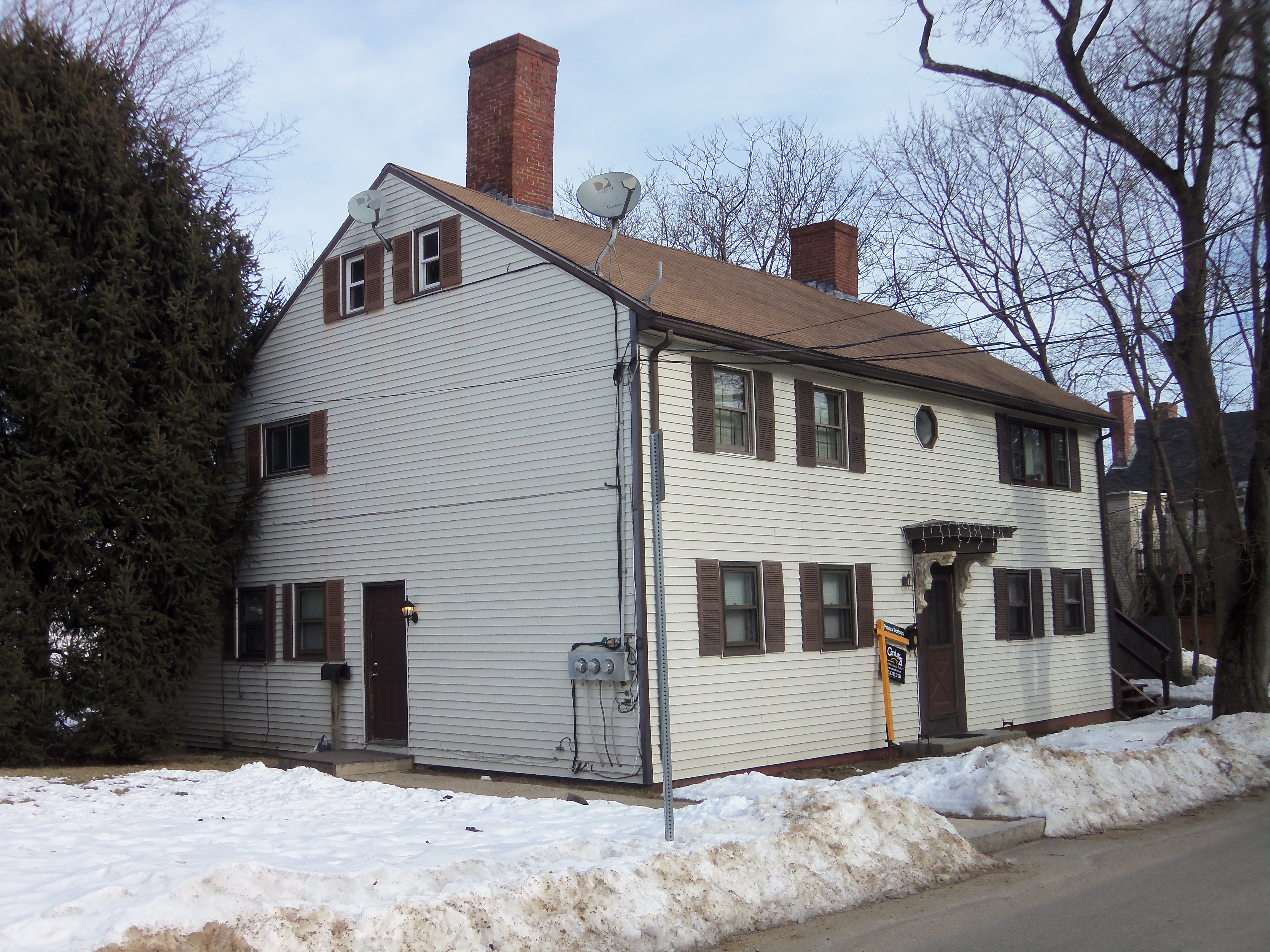
While Dover Friends (Quakers) proclaim that we worship in our third meetinghouse, erected in 1768, our history of the previous two structures becomes a bit foggy. Even so, ours is the oldest house of worship in use in the city.

In his authoritative New England Quaker Meetinghouses (Friends United Press, 2001), Silas Weeks mentions that our first house of worship was built about 1680 on Dover Neck, just south of the present St. Thomas Aquinas High School. Correcting an earlier version of the relocation of the structure to Maine, he writes that in 1769 “the 1680 house from Dover Neck was taken apart and re-erected in Eliot at the corner of what are now State and River Roads. There is a bronze plaque marking the site …” (Alas, there goes the tale of its being skidded by oxen across a frozen Piscataqua River. Taken apart and put on a boat now seems more likely.)

Apparently, when our current house was built, we had no need for the smaller structure. I suspect that until our current meetinghouse was available, Dover Friends met for worship in the two smaller structures and gathered together for business sessions.

The disposition of the second house, though, had eluded his investigation. It had stood at what Silas “believed to be the present corner of Locust and Silver Streets,” but there was no indication it had been incorporated in later buildings on the site.

A publication from the Dover Chamber of Commerce, however, may have the answer. Dover’s Heritage Trails, a guide to historic walking tours through the city, notes this at 3-5 Spring Street: “This old dwelling was Dover’s second Quaker Meeting House, built originally at the corner of Silver and Locust Streets and moved to this location in 1728, before Spring Street existed.”

Silas reported “The second was erected in 1712 on land belonging to Ebenezer Varney. The deed, transferred to Friends in 1735, described the site …” in ways that support the Silver and Locust location. My guess is that the structure was moved in 1828, since the Chamber pamphlet mentions that neighboring houses were built in 1810 and 1811.

The building has no doubt changed a lot, inside and out, since it was erected three centuries ago -- including the addition of chimneys. But the shape is right for a Friends meetinghouse.
The building has no doubt changed a lot, inside and out, since it was erected three centuries ago — including the addition of chimneys. But the shape is right for a Friends meetinghouse.

As they say, the plot thickens. And to think, the answer to our search may wind up just a bit more than a block up the street from where we gather.

LION’S TOOTH SALAD

Maybe it was simply a day of firsts.

As I was lunching al fresco for the first time this year, having savored our first asparagus of the season (which I’d sautéed with minced garlic leaf in olive oil and then fried two eggs atop the mixture), I realized I was still hungry. So glancing up, I noticed a sprout of dandelion, got up, plucked a leaf, brought it to the table, wiped it in some of the remaining egg yolk, and … it was good. It was very good. Somehow, the yolk overcame whatever bitterness I expected at the end of the bite.

So I harvested the remainder of that cluster (which also doubled as weeding, let’s be candid), went indoors to rinse it and fry another egg to serve with it, covered the resulting salad with salt and coarse-ground fresh pepper … and it was still good. Very good.

So for dinner, another round, this time with a fresh mustard vinaigrette my wife had just made … and it was still good. Very good.

Maybe I’m hooked. Yes, we’ve read some fine food writers who’ve extolled their pleasure in fresh dandelion every spring, before the leaves turn too bitter and too tough. Until now, though, our dandelions were treasured only by our pet rabbits.

Not anymore. Another first.

Now, to see how it works blanched. Or maybe as a spinach substitute, say in a Florentine-style dish.

Not that I have any intention of turning the Red Barn into a food blog. Oh, no. I know my limitations.

ROSES AND THORNS

In any relationship, it is difficult enough to know one’s own actions and thoughts completely or accurately, much less the other’s. Misunderstandings are inevitable – “You promised,” “I never said that,” “Why didn’t you phone?” “I did what?”

The gaps become especially obvious during a breakup. Like a mirror that smashes to the floor, the image comes apart. Spider webs span gaps. The reflection distorts. Here, silences – the interstices of what is unseen or left unsaid – become as important as what is harshly trumped or cruelly enacted. Sometimes, it appears that figures previously hidden by the mirror itself now become visible; even motions that had been observed but dismissed return with ominous significance. Excuses no longer suffice.

Moreover, if one partner has been cheating, the mask itself now drops away. Some misunderstandings, it turns out, were intentional. “I know I said that, but I never meant it.” Stones, then, are finally thrown directly at the looking glass, and through it. A hammer is held in the fist.

“Do you love me?” becomes a meaningless question. Petals fall from long-stem roses given as an expression of passion. In the fractured mirror, even blossoms shatter.

And then there’s the personal complication. As Diane Wakoski of the Motorcycle Betrayal has observed: “I suppose part of my adult fascination with American adolescence is that I didn’t live one, except in very scattered ways. I was, all my life, trying to escape my … background. … Thus my lifelong snobbery about highbrow things.”

But there’s no escape, now, is there.