TALLY HO, PIMLICO

As I said at the time, I’ve been thinking about names. Especially place names. Take “Baltimore,” a name most of us use repeatedly and never consider. There’s Balty More, kind of salty. Or Balta moor, rather Mediterranean. The name itself sounds Irish. I know, they were English. But it sure sounds like Ballyhagen or . . .

Of course, not everybody pronounces quite the same. I was in Florida a couple of years back and we went out to a restaurant owned by a woman and her husband, who had retired from Tennessee and, well, got so bored with the retirement life they went back into business just to take their minds off the boredom. So, following the dinner, she asked us where we were all from and the first of my colleagues replied, “I’m from Los Angeles,” and she said, “Oh, that’s very nice,” and the second colleague replied, “I’m from Chicago,” and she said, “Oh, that’s a nice city,” and the third said, “I’m from right here in Florida,” and of course she had to ask what neighborhood, and then my fourth colleague drawled, “I’m from right outside Atlanta,” and naturally they had that Southern thing going right away, in ways we Northerners can never know about. Finally, she turned to me and I said, as some folks around here do, “Bal’mer.” All of my colleagues looked at me queerly. Bal’mer? Not Bal-ty more? But not that lady, no sir. Without missing a beat, she came back, “Oh! Merlin!” Yessirree. I’m from the state of Merlin.

But back to Bal’mer, which sounds like something you put on a wound. Especially a burn.

At one time, the name made sense. Unique, except for the home plantation, wherever that was back in the British Isles. Named for the good Lord Baltimore, and all that.

But it’s time for a change.

For one thing, there are so many other Baltimores around the country, we’re only the biggest of them these days. I mean, there are all of those West Baltimores, New Baltimores, and North Baltimores, and so on running around, who needs them?

Even the Baltimore and Ohio Railroad decided it was time to change its name to CSX or whatever. Even here, in the metropolis, we have problems confusing, as we do, between Baltimore City and Baltimore County.

No, friends, it’s time for a change. New and improved, as they say in the advertising business.

We could turn to the original names, but Fells Point just doesn’t ring quite right. And Jonestown just won’t work, not after the Reverend Jim and his little band of suicidals. Nor would Otterbein, with its sectarian overtones as a denomination that no longer exists, for that matter. Harbor City doesn’t quite say it. Our nicknames Charm City, Mobtown, Crabtown, and so on, fail us as well.

What I am proposing is Pimlico.

Yes, this is Horse Country. And Pimlico has a nice ring to it. Consider the crowd that does Paris and Rome each year. Would they ever say, “I did Paris, Rome, and Baltimore”? Hell, no. But now try “Paris, Rome, and Pimlico” and you see what I mean. Pimlico has the kind of sound to it to reflect our definite up scaling of the city. It sounds just a tad racy, too.

Say Pimlico it shall be.

Remember, when you see the shining college students outside your favorite supermarket and they ask you to sign the petition, do not hesitate. And remember to vote yes on Proposition Fourteen, to rename Baltimore City and Baltimore County. Either or both.

Then we call all unite in saying, with renewed vigor: “Tally Ho, Pimlico!”

If only …

NAMING THE CHANGES

My fondness for mountain laurel goes back to my days of living in the ashram in the Pocono Mountains of Pennsylvania. There, the undergrowth of the forest was filled with these blossoms in season.

Over the years, my own spiritual practices have undergone many changes. Even in a tradition like the one I’ve embraced, seemingly free from the annual routines of a liturgical calendar or outward emblems, there appear cyclical changes mirroring those of the seasons. Cycles, too, like those of progressing from childhood and parenthood into retirement or release. In Salem Quarterly Meeting in Ohio, the session each Fifth Month meant rhubarb in the applesauce. See it as sacrificial and special.

There are times of struggle, doubt, and distrust. Times of whirlwind passion and excitement. Times of discovery. Times of drought or deep winter, relying on what’s brought out of storage. Times of renewal and recharge.

This has manifested as periods where I’ve been able to dedicate significant time to meditation, solitude, travel in ministry, prayer, Bible study, research into history and theology, organizational service, teaching, correspondence, or writing, as well as to regular disciplines such as fasting or physical spiritual exercise (the hatha yoga sessions or even wilderness hiking). Emphatically, however, one would predominate while others would likely be absent or greatly diminished. In addition, they would be strongly impacted by the events of my daily life itself – whether I was single, married, divorced, or “in relationship,” my hours and nature of employment, my friendships and faith community, my driving patterns through the week.

The result of all of this would be a crazy-quilt tapestry or a ricochet trajectory if it weren’t for a spiraling within it. That is, over the years, various periods and interests begin to overlap one another, creating a kind of harmony or accumulated depth. My asparagus bed in New Hampshire has roots in my experience of asparagus along irrigation canal banks in Far West desert three decades earlier. A dog sitting through Quaker meeting here is a reminder of dogs sitting through predawn meditation sessions in the Pocono Mountains, or of the cats aligned on the scaffolding outside the windows, as if they, too, were deep in concentrated worship. I read a particular Psalm and see the passage taking twists I hadn’t perceived earlier.

In my own life, my childhood was filled with natural science, hiking, and camping, each with its mystical visions and moments. Adolescence led into politics, classical music, opera, and writing complicated by unrequited sexual yearning. Without romantic companionship, a Lone Ranger journey. Rejection of existing creed while ensconced in church office was followed by flight into atheism and hippie excess landing, inexplicably, in a yoga ashram with its Hatha exercises and sustained meditation. From there, into Quaker practice, though of the ABC – or “anything but Christ” variety. The ashram lessons were applied here, in circles of deepening prayer life. By steps, I moved toward Christocentric and Plain speech, and an especially faith fervent language. Among the Wilburite Friends as well as Mennonites, especially, I came to wrestle within Scripture while similtaneously undergoing repeated Dark Night journeys and questioning. Turning to therapy, I wondered if anyone could come along with me through all of this. By now I was no longer meditating to get high, or transcend, but rather to center down to the Seed. Here, with all of its committee work, I was engaged in a religion that combines mystical experience with social witness and activism. In a nutshell, then.

Each swirl also stirs up something from before. What failed in earlier marriage or relationships reappears. What has been left unfinished is not left entirely behind. What has been shredded remains to be woven. I heard this opera in its entirety a hundred times. Have I ever heard this note before?

I moved from the Midwest to the East Coast and back before heading on to the Pacific Northwest in what seemed an epiphany but instead shattered amid volcanic eruption and devastation. I left the wilderness for another kind of wilderness, back across the Midwest to the East Coast. The pendulum, as they say. Here, I now see life as both linear and circular – that is, spiraling. The spirit requires flesh, or is it that flesh requires spirit? Seasons include times that are full or overflowing, and times that are barren or dry. I now welcome the questioning that is not hostile is both essential and healthy.

My first spring in the orchard, I expected all of the trees to blossom simultaneously. They don’t. The apricots and cherry petals give way to plums, pears, and peaches. The apple blooms arrive last, when others are already gone.

Experiencing a new place through a full year or repeated years provides a much different understanding than a tourist gets – even one who spends several months there. Relocating requires a year-and-a-half to gain familiarity with the new surroundings – to get beyond the obvious, to establish friendships, to be oriented with the elements one finds essential or special. A favorite restaurant, a woodland pathway or place to swim, a boutique or gallery.

There are seasons for a person of faith, from winter to spring elation and then into fullness, dryness, struggle, or disillusionment. To harvest, perchance. Marriage? Family? Children? Extended into joy, compassion, humility, appreciation – one begins observing and naming.

The turning point in my own journey came when I accepted a new name.

MARIAH WATKINS

One of my wife’s childhood heroes, George Washington Carver, is proof that some of the best mothers never have children of their own. After his own mother’s death as a consequence of being stolen from one slave-owning family and carried off to a plantation, before being bought back – how vile, the entire institution – young George was cared for, first, by the sickly wife of the slaveowner, and third, by an art teacher who directed him on to her own father, a college professor of botany. But most important was Mariah Watkins and her husband, Andrew.

We know very little about this black couple, except for her influence on the boy who emerged from spending a night in their barn. In another circumstance, George might have been shot. Instead, she called out for him to wash up and come inside for breakfast. What’s your name, she asked. Carver’s boy George, came the reply. No, she corrected, from now on you’re George Carver. (The Washington came later.) He lived with them while attending the Lincoln School for Negro Children. She gently instilled a deep religious awareness in him, presenting him with her beautiful, large family Bible, which he used daily for the remainder of his life, and also nurtured a sense of responsibility for the advancement of his own people. Essentially what we know about her comes in the correspondence they continued over the years. (Among the few other bits we know is that she was a midwife who cared for about 500 babies, including the painter Thomas Hart Benton.)

You can also trace the two connections between George and another great agricultural reformer, Norman Borlaug, whose Green Revolution is credited with saving the lives of a billion people.

Indirectly, then, by feeding a single child that first morning, Mariah put into motion events that would feed a billion humans – a miracle overshadowing the multitude Jesus’ disciples fed with those few loaves and fishes on the banks of Galilee.

WIND BLADE

100_8492

Several months ago, while driving on Interstate 95 to Boston, a remarkable view caught my eye. Headed in the opposite direction was a very long trailer, one at least three times longer than the usual tractor-trailer rigs. A few miles down the road, I glimpsed another. And then a third.

They were blades for wind-powered electrical generators being erected atop several ridges in Maine. Perhaps you’ve read some of the controversies erupting over proposals to build these “wind farms” in suitable locations across the country. But this was the first time I got an inkling to the size of each tower.

Earlier this month I came across two similar propellers, this time settled in a parking lot, no doubt waiting for a few more to join in a caravan. Even before being erected on a summit, they’re an amazing sight. Somehow, the gleaming sun on the metal reminds me of watching whales lolling in the ocean. Whales, you may recall, were the source of the oil used to illumine many homes in early America. They were another source of energy from New England.

100_8486

100_8490

HOW HUMBLING

Even though I’ve never asked previous clerks how they experienced sitting at the head of an institution founded in the 1660s, I found it humbling. The mere thought of superintending the construction of our present meetinghouse (1768) is overwhelming, as is the faithfulness that led the congregation through the Revolutionary and Civil wars. To think of the succession of mighty Quakers who came here in traveling ministry reflects the history of the movement itself, beginning with Elizabeth Hooton, who first nurtured George Fox in the emerging faith. Dover Friends sat down to worship originally in homes and barns, then in our first two meetinghouses, and finally in the room we know so well.

Visit historic Plimoth Plantation, and you get a taste of what Dover must have been like – already four years old at the time those enactors portray. It’s probably not that different from what the first Friends encountered just 3½ decades later when they stirred up what would become our Meeting. Just think of the differences in dialects and vocabulary. (Plimouth, to represent a population of slightly more than a hundred people, employs seventeen dialects, moderating them enough to make them understandable to modern visitors; Dover was likely no less divergent.) From all the evidence of smoke-filled houses, bitter winters, mosquito-infested summers, this must have been a rough-and-tumble community where Friends required generations to evolve into the sedate image we often treasure.

There aren’t many places in the United States having organizations with such long histories. We know only a portion of ours. Even so, we’ve been entrusted with this legacy, and to fulfill it and pass it on. How humbling, indeed.

MYSTERY SOLVED?

While Dover Friends (Quakers) proclaim that we worship in our third meetinghouse, erected in 1768, our history of the previous two structures becomes a bit foggy. Even so, ours is the oldest house of worship in use in the city.

In his authoritative New England Quaker Meetinghouses (Friends United Press, 2001), Silas Weeks mentions that our first house of worship was built about 1680 on Dover Neck, just south of the present St. Thomas Aquinas High School. Correcting an earlier version of the relocation of the structure to Maine, he writes that in 1769 “the 1680 house from Dover Neck was taken apart and re-erected in Eliot at the corner of what are now State and River Roads. There is a bronze plaque marking the site …” (Alas, there goes the tale of its being skidded by oxen across a frozen Piscataqua River. Taken apart and put on a boat now seems more likely.)

Apparently, when our current house was built, we had no need for the smaller structure. I suspect that until our current meetinghouse was available, Dover Friends met for worship in the two smaller structures and gathered together for business sessions.

The disposition of the second house, though, had eluded his investigation. It had stood at what Silas “believed to be the present corner of Locust and Silver Streets,” but there was no indication it had been incorporated in later buildings on the site.

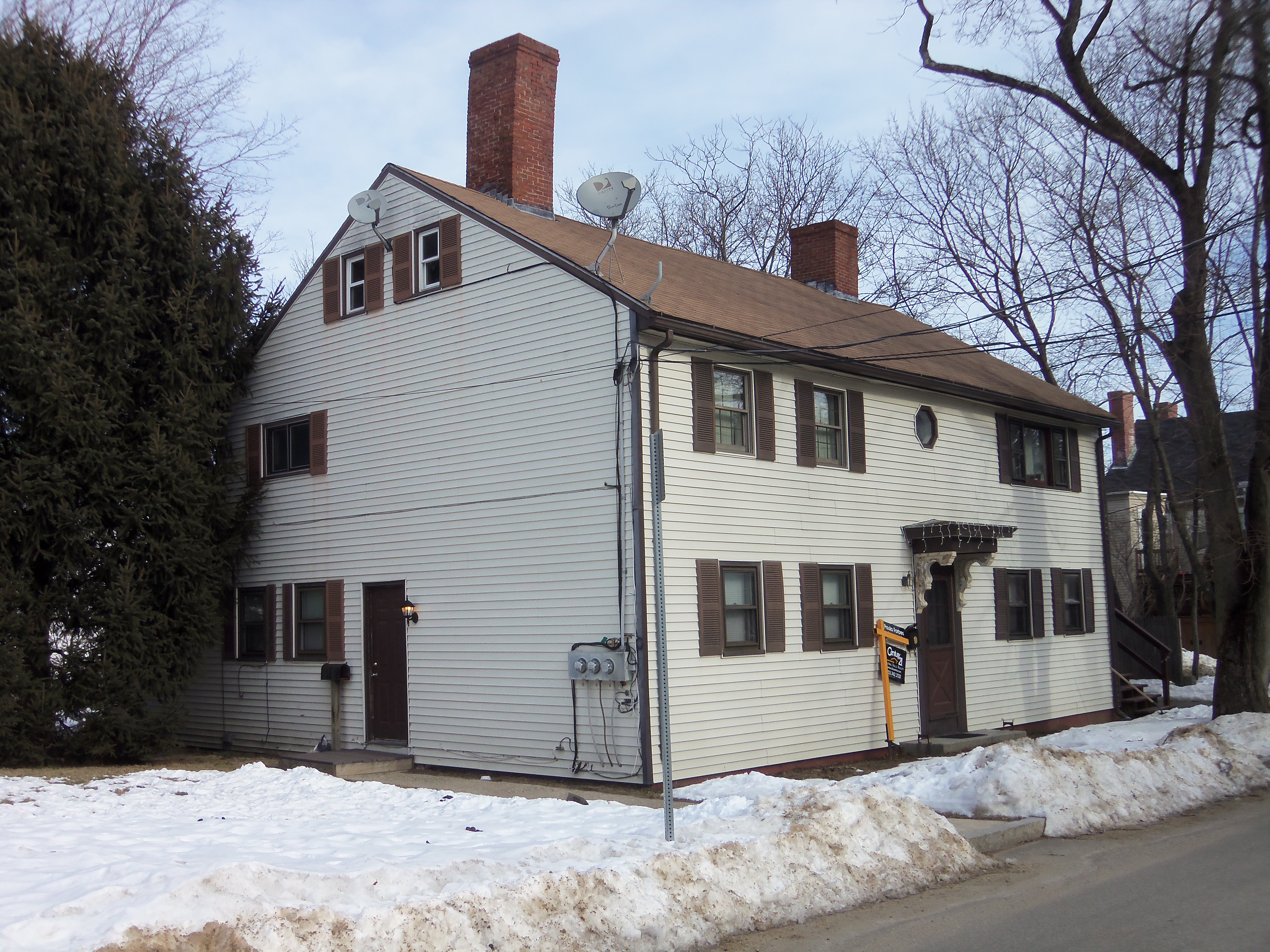
A publication from the Dover Chamber of Commerce, however, may have the answer. Dover’s Heritage Trails, a guide to historic walking tours through the city, notes this at 3-5 Spring Street: “This old dwelling was Dover’s second Quaker Meeting House, built originally at the corner of Silver and Locust Streets and moved to this location in 1728, before Spring Street existed.”

Silas reported “The second was erected in 1712 on land belonging to Ebenezer Varney. The deed, transferred to Friends in 1735, described the site …” in ways that support the Silver and Locust location. My guess is that the structure was moved in 1828, since the Chamber pamphlet mentions that neighboring houses were built in 1810 and 1811.

The building has no doubt changed a lot, inside and out, since it was erected three centuries ago -- including the addition of chimneys. But the shape is right for a Friends meetinghouse.
The building has no doubt changed a lot, inside and out, since it was erected three centuries ago — including the addition of chimneys. But the shape is right for a Friends meetinghouse.

As they say, the plot thickens. And to think, the answer to our search may wind up just a bit more than a block up the street from where we gather.

LION’S TOOTH SALAD

Maybe it was simply a day of firsts.

As I was lunching al fresco for the first time this year, having savored our first asparagus of the season (which I’d sautéed with minced garlic leaf in olive oil and then fried two eggs atop the mixture), I realized I was still hungry. So glancing up, I noticed a sprout of dandelion, got up, plucked a leaf, brought it to the table, wiped it in some of the remaining egg yolk, and … it was good. It was very good. Somehow, the yolk overcame whatever bitterness I expected at the end of the bite.

So I harvested the remainder of that cluster (which also doubled as weeding, let’s be candid), went indoors to rinse it and fry another egg to serve with it, covered the resulting salad with salt and coarse-ground fresh pepper … and it was still good. Very good.

So for dinner, another round, this time with a fresh mustard vinaigrette my wife had just made … and it was still good. Very good.

Maybe I’m hooked. Yes, we’ve read some fine food writers who’ve extolled their pleasure in fresh dandelion every spring, before the leaves turn too bitter and too tough. Until now, though, our dandelions were treasured only by our pet rabbits.

Not anymore. Another first.

Now, to see how it works blanched. Or maybe as a spinach substitute, say in a Florentine-style dish.

Not that I have any intention of turning the Red Barn into a food blog. Oh, no. I know my limitations.

ROSES AND THORNS

In any relationship, it is difficult enough to know one’s own actions and thoughts completely or accurately, much less the other’s. Misunderstandings are inevitable – “You promised,” “I never said that,” “Why didn’t you phone?” “I did what?”

The gaps become especially obvious during a breakup. Like a mirror that smashes to the floor, the image comes apart. Spider webs span gaps. The reflection distorts. Here, silences – the interstices of what is unseen or left unsaid – become as important as what is harshly trumped or cruelly enacted. Sometimes, it appears that figures previously hidden by the mirror itself now become visible; even motions that had been observed but dismissed return with ominous significance. Excuses no longer suffice.

Moreover, if one partner has been cheating, the mask itself now drops away. Some misunderstandings, it turns out, were intentional. “I know I said that, but I never meant it.” Stones, then, are finally thrown directly at the looking glass, and through it. A hammer is held in the fist.

“Do you love me?” becomes a meaningless question. Petals fall from long-stem roses given as an expression of passion. In the fractured mirror, even blossoms shatter.

And then there’s the personal complication. As Diane Wakoski of the Motorcycle Betrayal has observed: “I suppose part of my adult fascination with American adolescence is that I didn’t live one, except in very scattered ways. I was, all my life, trying to escape my … background. … Thus my lifelong snobbery about highbrow things.”

But there’s no escape, now, is there.

ALL HAIL THE DETERMINED GARDENER

Although I do my share of the weeding and much of the spading, I’m not the gardener. My wife is the one who studies the varieties of plants, selects and orders, fusses and sows, evaluates soil and sunlight, while I’m more likely to mow, do the composting, construct the raised beds, and transport ferns, Quaker ladies, and ox-eye daisies from the wild. In recent years, our elder daughter has taken delight in getting seedlings started and transplanted, especially, as well as making jams from the fruit we harvest. (The younger one could care less.)

While my dad, mainly, raised vegetables and tomatoes behind the garage when I was growing up, and my mother fussed over flowers that generally failed, and despite my later experiences living on a hippie farm and then the ashram as well as my first wife’s efforts in Ohio, Indiana, and the fertile desert country of Washington state, my perspectives on gardening center on Rachel and her world. Everything before was simply preparation. Little did I suspect, when we set out to buy a house as part of our marriage, how much she was calculating garden opportunities; many of the urban New England properties, surprisingly, have little usable space for raising plants. Only after bidding successfully on the house we now inhabit did we learn that it included not just a small but manageable strip beside the driveway but a half-lot on the other side of the house, as well – the side we’ve come to call the swamp.

But that’s the beginning of another story.

PASSAGE INTO THE QUIET

From my earliest days of practicing meditation, I’ve been aware of an invisible wall of resistance or restlessness before passing into the comforting depth on the other side. For whatever reasons, it reminds me of those early experiences of a sonic boom, when planes overhead would “break through the sound barrier” – not that we sense a loud crack of arrival, but there is a distinct change all the same. Maybe it’s an awareness that the air in the room feels different – heavier, like water, is one description. Maybe it’s not that far removed from the ancient Jewish priests who “passed through the veil” to offer sacrifice in the most holy space in the Temple.

My actual experience of meditative worship has also changed, from the initial goal of getting naturally high or stoned – of transcending out of the world – to the present centering down into the essence of life, but the wall remains. Some weeks it’s more pronounced than others; other weeks it’s quite faint. Even so, coming to that point Bill Taber referred to as “soft eyes” worship, where Friends begin removing their eyeglasses, is delicious. Even the clock stops ticking.

Frequency of practice can make a difference. Sitting in meditation twice a day, for instance, generally allows a deeper session than an every-other-week or once-a-month schedule does. Suitable physical exercise, charitable activity, or spiritual reading may also guide the experience. We speak of preparing for worship, but rarely of the unspoken flow within the hour itself. What I do know is how much easier it is to pass through that barrier when I’m sitting with others. That is, as early Friends sensed, even when two or three gathered in the Name.