GLIMPSED FROM THE FREEWAY

When I grew up in the heavily farmed Midwest, a beaver dam or lodge was a rarity, an awe-inspiring emblem of wilderness.

But if you pay attention while driving the freeways around here – including those near Boston – you’ll catch a glimpse of a beaver lodge and then recognize the surrounding pond, frequently soon followed by another.

The sight reminds me of a wonderful documentary I once watched on public television. The program followed the life of a beaver colony through an entire year, and then, at the very end of the hour, the camera pulled back from the dam and lodge to reveal a busy limited access highway at the edge of the pond.

It’s enough to make me appreciate both kinds of engineering.

This beaver lodge appears to sit securely in remote wilderness ...
This beaver lodge appears to sit securely in remote wilderness …
... until you turn around to see it's built right at the side of a busy freeway.
… until you turn around to see it’s built right at the side of a busy freeway.
Further back in the pond is the large lodge that first invited me to pull over to the side of the road.


WHAT IF THERE HAD BEEN NO VIETNAM ENGAGEMENT?

Oh, if John Lennon had only penned this one! Just imagine, what if there had been no Vietnam engagement?

What if John Kennedy had not been assassinated and had been free to curtail or even dismantle the CIA?

What if the military-industrial complex President Eisenhower had warned of just a few years earlier had not been called into high gear for yet another round of (highly profitable) business? Would it have been brought under control and reduced greatly, with all of the investment directed elsewhere?

What if the Red-baiting bluff had been called and we’d instead seen Vietnam as a civil war rather than a Communist intrusion into the “free world”?

There would have been no lingering black cloud over America like the one that continues to fester. Even without the antiwar movement, I suspect, the nation would have been bitterly divided by the fiasco that ensued in Southeast Asia.

Would our economy have been unencumbered to grow the way Japan’s did at the time we were saddled with the costs of fighting or the accompanying steep inflation? Or the costs we’re continuing to pay in debt interest and veterans’ benefits?

And, oh yes, maybe there would have been no Hippie Trails novels, either.

Just imagine. And then add a comment on your vision. Music optional.

GOING PAPERLESS, TO SOME DEGREE

It’s been a little over a year since I went largely paperless, as the high-tech crowd would put it. Not entirely by choice, but rather because my printer died and the one we have for the household no longer interacts with any of our three laptops. So much for technology. Alas.

Yes, it can be an annoyance, especially when I have a choral score to print out or my wife’s found some great coupons. But we’ve found ways to cope.

When my printer went kaput, I was already finding that most poetry journals were accepting submissions only online, and that included the printed quarterlies. Keeping duplicate files of online and printout versions was troublesome and led to several embarrassing duplicate acceptances. So I decided to go to online-submissions only, and had only a few instances where I had to decline an opportunity.

Blogging, of course, has allowed me to move many pieces straight to the Internet without using paper, so that’s cleaned up a corner of my studio.

The big breakthrough was the ebook publishing with Smashwords. There’s no more need for multiple printed manuscript copies or files of postal correspondence to cope with. It’s so clean!

Not that the piles of paper don’t continue. Rather, they’re smaller these days. I’ll still pay my bills with a check, thank you, and there are always paper notes for consideration. Admittedly, I used to jest that sorting papers was one of my hobbies. In a way, it still is.

The fact is I love the feel and look of paper when it’s used well – fine stock and good typography, especially, along with masterful photography or illustration. And I still have a lot of that to sort through, to say nothing of all my years of journaling, which I’ve done with fountain pens for nearly two decades now. The old-fashioned fountain pens I ordered the same time I bought a PC that’s long been out of commission. The pens that dance in my hands, unlike this keyboard.

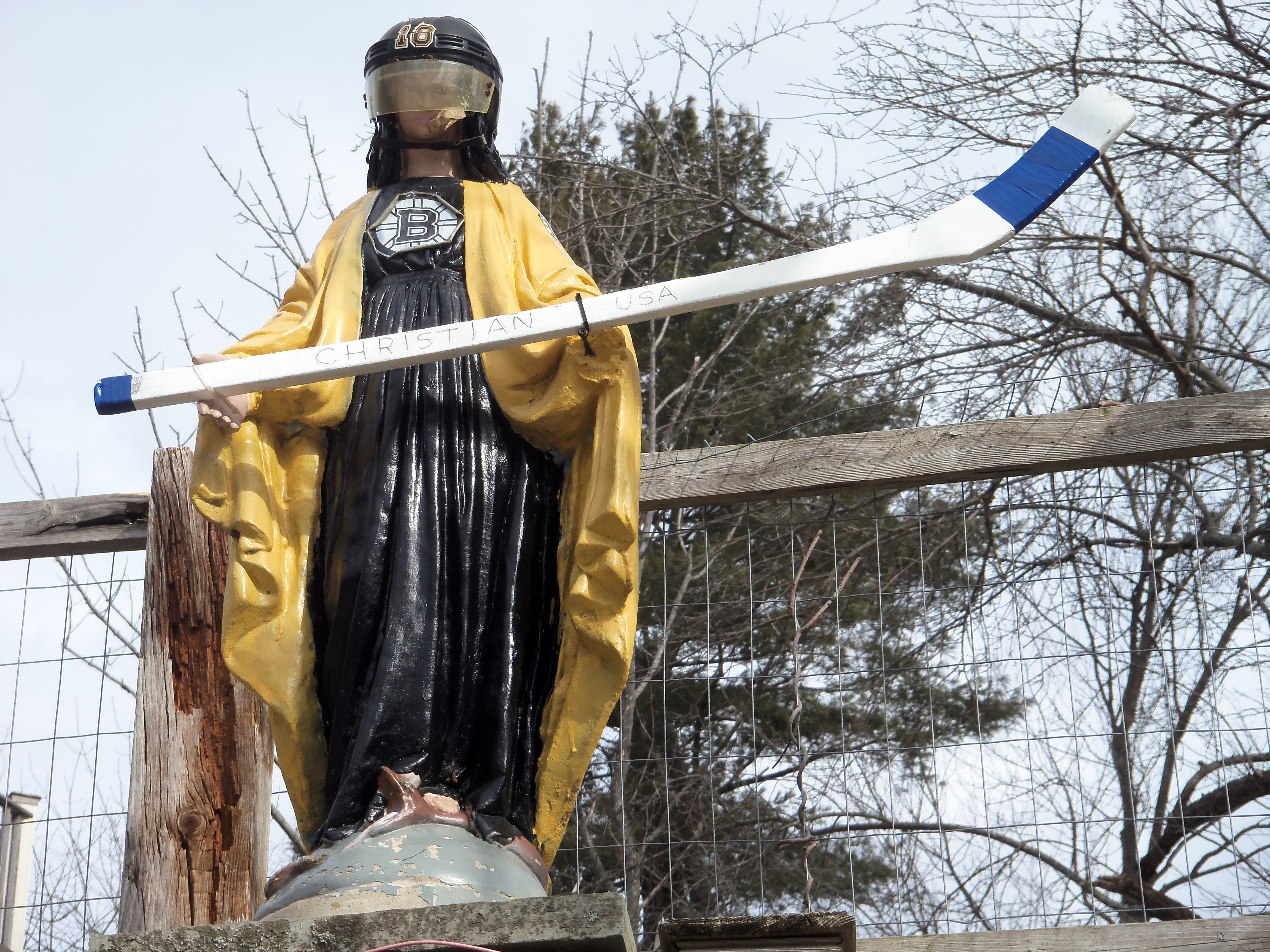
OUR LADY OF THE ICE

Always ready for a miracle.

Or is it Our Lady of the Puck?

New England is hockey country, and Boston Bruins fans are legion. Rest assured, Bobby Orr would no doubt lead their pantheon of saints.

While statues of Mary are common across the country, I know of no others like this. Behind the mask, the face looks feminine. This repurposed icon icon overlooks Chauncey Creek Road in Kittery, Maine.

HUNTER-GATHERER DIMENSIONS

As I told them: 

Although Jnana does not hunt, he observes points at which ancient traditions – including hunting and gathering – influence modern religious practices, meditation high among them. Jnana also acknowledges the role organized sportsmen have performed in restoring populations of wildlife, and has learned from hunters eminently adept at reading animals’ ways in the field. These days, living in New Hampshire, he keeps an eye open for moose rather than elk along the highway.

IN THE PERSPECTIVE OF TIME

As a writer, I love taking a phrase and rolling it around, substituting one word or thought and seeing what happens.

With the Grimms’ fairy tale opening, “A long time ago, when wishes came true,” I began substituting “prayers” for “wishes” and realized many people seem to assume that prayers really did have more effect a long time ago – say back in the time of Moses or King David – than these days.

But that also has me wondering about the depth of our wishes today. Are we too directed by advertising and material possessions to seek what’s truly desirable? The fairy tales and Holy Scripture, as I recall, have a lot to say on that account.

THIS SECRET SOCIETY OF READERS

One of the more baffling questions for just about any author, I suspect, is the one that asks, “Who are your readers?”

Yes, I know about genres and their core audiences – Chick Lit, aimed at unmarried females in their 20s; Romance, middle-age women; Sci-Fi, geeky males; Young Adult, well, it’s self-explanatory. I even know that commercial radio programmers could target their listenership to hit an average, say, of 24.7-year-old women in the office.

For a poet, though, or the novelist working outside common genres, this question becomes more problematic. I can imagine those I hope will find the work appealing, but the reactions often turn up elsewhere. I’m thinking of a writer who hoped her work would speak to her friends, only to hear them say, “I don’t read books,” as if it’s a badge of honor. (Oh, for shame!)

What that suggests is that rather than expecting a boffo bestseller, we writers might envision a much smaller-scale enterprise – connecting with readers one-on-one, as an underground understanding. Let it be private and personal, then. Our own quiet conversation.

Whether my Hippie Trails novels find their appeal more for those who lived through the era or among younger readers undergoing similar searching is still taking shape. I would hope both. But I am enjoying the feedback I’m receiving, from wherever.

It’s not the big-business Manhattan operation I once dreamed of or the San Francisco counterculture success, either. But here we are, connecting, in our own little underground society. Little do the others know what they’re missing now, do they?

WEATHER REPORT UPDATE

Noticed a few months ago I wasn’t checking the weather forecast as much as I did when gainfully employed.

Back then, I faced an hour-long commute each way and knowing the outlook might prompt me to leave earlier or take a less vulnerable route. Trying to navigate a downhill curve in a freezing rain was one experience I never wish to repeat, and I’ve seen enough vehicles slide off the road while trying to go faster than the nasty conditions allowed, well, to keep me from trying to press my luck. Arriving early might also help, since we’d often be handed an early lockup on the first edition of the newspaper to give the delivery crew an extra edge, and anything to lessen the deadline pressure on all of us would be a blessing. A storm might even mean packing for an overnight at the office, as some of my colleagues did during one really big blizzard. The forecast could even prepare me for changing my plans at home beforehand when shoveling out the driveway would take priority.

This time of year, flash flooding, sleet, fallen limbs, or power outages can also be a problem.

This is northern New England, after all.

Now that I’m retired, the commute’s no longer an issue, except for my weekly trip to choir practice in Boston – and if the weather’s treacherous, I have the option of staying home, which was never the case with my job. Since we rarely need both cars on conflicting schedules, it’s much easier to leave them at the end of the driveway to cut down on the snow shoveling. Our biggest weather concern is frost at crucial times in the garden. Or, during the summer, the Atlantic water temperatures when I’m considering a swim at the beach.

This winter, though, has rekindled some of the obsession. We’ve had far more single-digit and zero-degree nights than usual, plus a constant snow covering with more than six feet total by the beginning of March, even as most of the storms have veered south of us. My fascination has come in tracking four different online forecasts and seeing how far off target they’ve been. As for agreement, forget it. You could just as easily toss a coin. (And that percentage thing they throw at us? A 60 percent chance of snow in practical terms means nothing: either it snows or it doesn’t. In other words, it’s all or nothing.)

Considering everything, though, it’s rather nice to not be complaining about the weather itself. I can more or less take it as it comes, thank you, with all of my sympathy to those who must venture forth, regardless. At the moment, I think I’ll put another log on the fire.

MYSTERY OR MAGIC

“A long time ago, when wishes came true” is my favorite opening in the Grimms’ collected fairy tales. Much better than the formulaic “once upon a time.”

As I look back at my own “long time ago,” the “wishes came true” part of the proposition easily has me wondering just what I really wished for all along, before landing here? What specifics would have spurred the leap from fantasy into reality and shortened what often seemed an all too long and painful journey?

After all these years, I broached the subject with a longtime correspondent and there we were, reflecting on that point way back when our lives might have taken a different path. Meaning why didn’t we take the leap and marry?

“Well, you essentially believe in mystery while I expect magic,” she said, a reaction that long left me wondering about the difference.

Yes, I could almost hear her peals of delighted surprise at unanticipated happy turns and realized that reflected her idea of magic.

And yes, I suppose I could be labeled as a mystic, in part from all my years of meditation, with its sense of an underlying unity of the universe. (For more on that, go to my As Light Is Sown presentations.) As a mystic, I am instead seeking harmony and rightness that accompanies, well, I’ll just call it the Holy Way for now. Essentially, nothing happens by sheer accident; we just know so little of what’s going on behind the scenes when a miracle occurs.

In contrast, as the commentaries on the fairy tales insist, when good things happen in their stories, it’s a one-time deal, never to be replicated. Except that the good folks live happily ever after.

That’s why I’ll still take the mystical over the magical. I’ll take a miracle any day, while magic can be tricky.

OF MINISTERS, ELDERS, AND OVERSEERS

Traditionally, Quaker meetings recognized and nurtured individuals who had spiritual gifts as ministers, elders, or overseers. These roles could be filled by men or women, and their service extended over the entire congregation.

A person who offered vocal ministry during worship might be designated as a minister, if the messages were considered theologically sound. Because a minute would be drafted and approved in the meeting’s records, the individual would be known as a recorded minister.

Elders were those who held the ministers and ministry in prayer through the service. In other traditions, they might be called bishops, except that in Friends meetings, they function within the congregation, rather than over it. In the novel, Miz Lil and the Chronicles of Grace, Miz Lillian Leander upholds this role, even though her Lutheran denomination might not recognize its importance.

Overseers were individuals who were skilled in sensing the needs of others and in knowing how to respond. They were the ones who could transform the meeting for worship into a community of faith or a people of God.

After the painful divisions within the Society of Friends in the 1800s, these distinctions typically fell by the wayside. For quietist Meetings, there was an increasing aversion to hierarchy, especially one where ministers or elders might be appointed for life; other Friends, especially those west of the Appalachian Mountains, moved progressively toward services led by a pastor – someone who was often expected to embody all three gifts.

Still, the work’s there to be done, by somebody. Some forms, I’ll argue, work better than others.