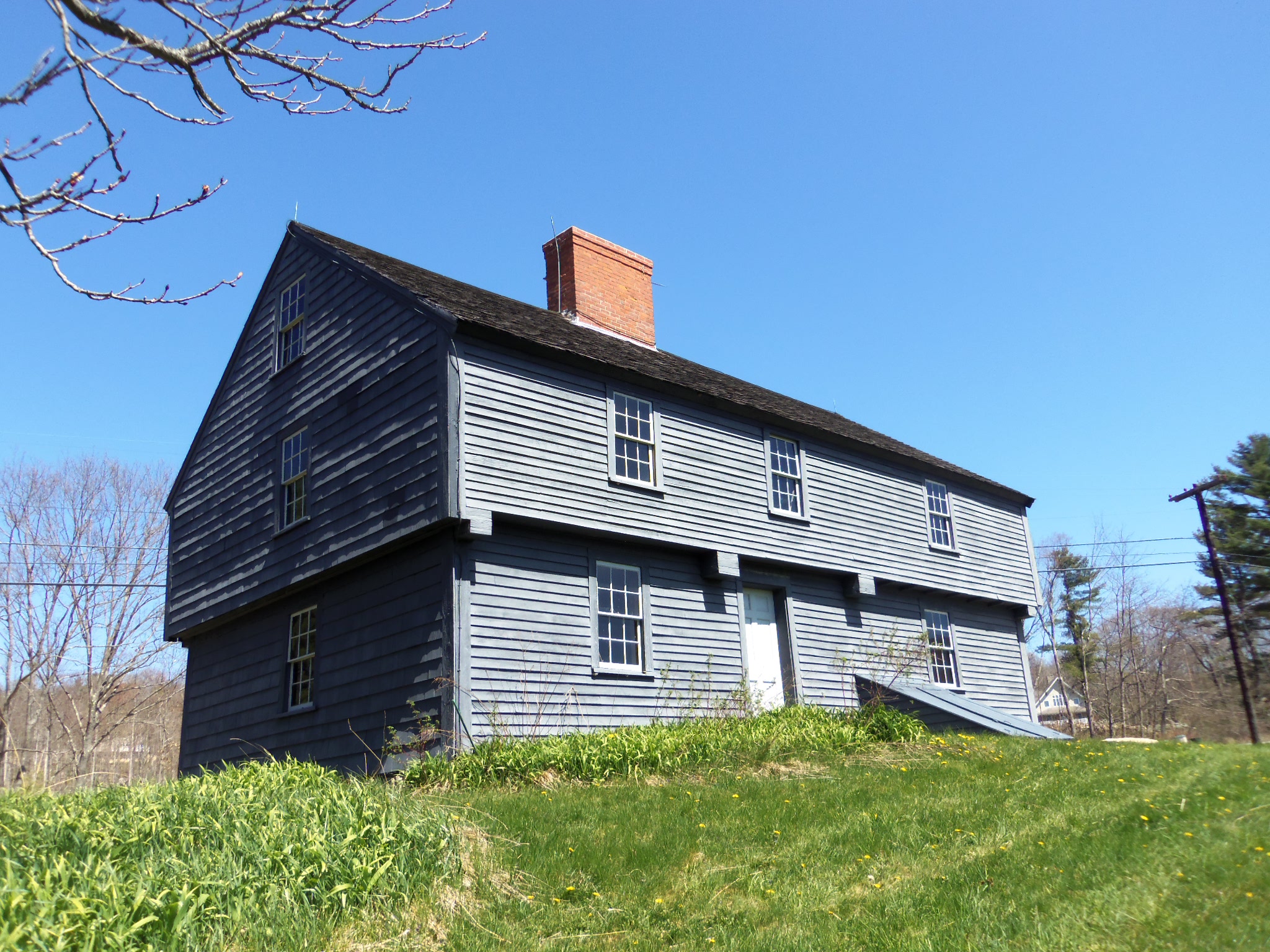
GARRISON HOUSE

The distinctive overhang design allowed for self-defense from within.

From the outbreak of King Philip’s War in 1675 until the conclusion of the French and Indian War in 1763, much of northern New England was under an ongoing threat of violence along its frontier. Nearly all of the English settlement in Maine was pushed back to a few towns nearest New Hampshire, and many villages, including Dover, suffered devastation and massacre.

Indeed, officials ordered many residents to construct fortified garrison houses, like this reproduction along Cider Hill Road in York, Maine, where families could retreat for armed protection when an alarm was sounded.

The site overlooks the inland tidal salt marshes that give rise to the York River. The hay from such spots was prized, even though feeding it to cows would produce a distinctively salty milk.
Also on the site is a more traditional New England style of construction -- shingle siding that weathers to gray.
Also on the site is a more traditional New England style of construction — shingle siding that weathers to gray.

BIRDS OF OUR YARD

Quaker7 116

feeder, especially:

  • goldfinch
  • purple finch
  • house sparrow
  • black-capped chickadee
  • junco
  • tufted titmouse
  • nuthatch
  • mourning dove
  • pigeon
  • pheasant
  • cardinal
  • blue jay
  • catbird
  • cowbird
  • mockingbird
  • starling
  • purple grackle (such a funny word!)
  • cedar waxwing
  • downy and hairy woodpeckers
  • phoebe
  • pine siskel
  • rufus towhee
  • hummingbird
  • robin (as an afterthought!)
  • blue-gray gnatcatcher
  • Peregrin falcon and/or Cooper’s hawk or sharp-shinned hawk
  • common grackle
  • grosbeak
  • bluebird

report of one wild turkey one November

overhead:

  • geese
  • hawks
  • crow
  • gulls
  • raven
  • bald eagle
  • swallows

*   *   *

someday maybe I’ll know by song
all the birds that stay hidden in our treetops

AT THE FEEDER

I’ve already mentioned my astonishment at the range of wildlife we’ve had at our property inside the city limits. We’ve enhanced that, of course, by keeping our bird feeders up through the year. In fact, they devour much more in warm weather than in the depths of winter.

Watching them along with the garden can provide a marvelous awareness of the changing seasons. Here are some notes I made in the passing:

EVEN IN WINTER GARB NOW EMERGING


LATE SUMMER

already the goldfinches are losing their bright yellow,
shifting over to their “traveling clothes”
cardinal flower still scarlet
the sunflowers nearly past
will we have any pumpkins in this crazy year?

a stream of crows, maybe a hundred, all headed south
(the ten thousand roosting together in a cemetery, how spooky)

admiring the white gull against blue sky
and the black band on its wing
four white droplets fall away and vanish
never seen that before!

today, two large hawks, soaring

*   *   *

and the goldfinches lost their yellow …
how sudden and uniform this molting!
now-dun at the feeder


MIDWINTER

cardinals singing boisterously, 5 a.m.

a raven or two in our yard
regular visitors
under our bird feeder

corn / cracked corn in the mix

poem copyright 2014 by Jnana Hodson

SOUNDS FROM THE HIPPIE ERA

For many, as we’ve already noted, the hippie experience revolved around its music. Just think of Woodstock and the many ways it was the explosion that spread the movement across America and the globe.

Each of us likely has a musician or band we most identify with the era. Maybe it’s tracing the Beatles in their evolution to “Lucy in the Sky With Diamonds” and beyond, including the individual paths after the breakup, or the Rolling Stones or, of course, the Grateful Dead.

I think, too, of Crosby, Stills, and Nash whenever I turn to the jam sessions depicted in my Hippie Drum novel.

Personally, it’s Sly and the Family Stone, Jethro Tull, and the Incredible String Band who most embody the hippie sound in my ear. Maybe with Leonard Cohen, James Taylor, and Leo Kotke or Leon Redbone thrown in. Whatever happened to those folks around me who introduced these musicians, anyway?

Whether you were there or came along much later, there are probably a few favorites of your own. Were they at Woodstock? Did anyone else even know of them? What memories do they stir up? Please fire away in the comments section here!

I’m hoping we got that list of top musicians started yesterday. But there’s more than a list to consider. Get busy. Fire away. And we’ll listen.

WHAT KIND OF HIPPIE WERE YOU? OR ARE YOU TODAY?

Maybe it was a New York Times Op-Ed piece at the time that pointed out six or more levels of maturity or psychological development in the adult population, and then saw hippies as falling into three of them. One may have been second from the bottom, that is, just going along for the ride, while the other two were closer to the top, probably reflecting the appeal the movement had for many college students and graduates and/or social activists (think antiwar/anti-draft, for starters). I found it interesting there was a gap in the middle.

I suspect this is one of the reasons it’s difficult to define “hippie” clearly – we covered a wide spectrum of individuals and motivations. Just listen to the argument today over “hip,” “hipster,” and “hippie” for something similar. These days, I’m leaning more toward something along the lines of the “boho” term that would embrace beatnik and hippie as continuations of a stream of counterculture, but that’s still in embryo as far as my thinking.

What I am curious about today is how we’ve grown and matured along the way. On one hand, Robert Bly’s Iron John took aim at the “soft male,” the sensitive hippie guy, who now needed to gain some inner strength and responsibility. 

On another, I recall reading the singles ads back when I was searching and coming across more than one self-proclaimed mid-40s “flower child” who was still clueless and passive, and my reacting, “It’s time to grow up,” even as I intuitively backed away. And that was two decades ago.

But it does seem to me there’s a wide stream of individuals continuing in that Bohemian mode. In my case, I’m still a poet and writer who’s moved into the radical Christian tradition called Quaker. And I have a beard, not that it’s necessary.

As for the rest of you, ‘fess up. The comments section is open!

AN UPDATE, OF SORTS

The world of fellow bloggers keeps reminding me how far behind the curve our northern New England calendar can be when it comes to springtime. We still have snow in parts of the yard, for one thing. Yet since we’re near the ocean, our weather is a week ahead of places only a few miles inland, meaning to our west or our north.

Still, there’s been a definite change in the air. A very welcome change. And even a few signs of green, in addition to the final gray puffing of the pussy willow stalks.

Let’s not neglect those gardening bloggers in the Southern Hemisphere, either, reminding us of their approaching autumn.

For many of us, then, it never lets up. Plug on as we will!

~*~

Although I’ve posted in previous seasons on our use of seaweed as a mulch for our garden, I don’t think I reported on the results. Yes, many things get lost in the cracks of daily living.

The short answer is that I’ve been returning to the beach lately to load up on more. A lot more. Since the master gardener in our household can’t seem to get enough of this magical mixture, I fill black plastic bags and tote them home in the trunk as I can. So far, that’s been five trips.

While last year’s weather wasn’t exactly typical, meaning we can’t factor out its impact cleanly, we can say that we had our best garden yet – and the seaweed appeared to play a big role.

Since our soil is largely clay-based, we’re usually plagued with garden slugs, but last year they were at a minimum. Apparently, the slugs don’t like the salty mineral nature of the mulch when it’s fresh, and they don’t like its prickly nature when it’s dry. On top of it all, the plants love the mineral nutrients. And so I’m trying to load up between the end of the frozen weather and mid-May, when the town down the road in Maine closes its beach parking to non-residents like me.

~*~

While I’m still thinking about the snowfall, I can say our seasonal total unofficially came to a hair under 80 inches. (Yes, we can still get more, but it will melt quickly.) We’ve had more, but this just felt onerous. At least we didn’t get any storms that dropped two or three feet in one swoop to push the season’s total into three figures.

Where we live, harsh winters come in one of two varieties: either unusually cold and dry or else with a heavier than normal snow total. This year we had both rolled into one. Four months of snow cover and all those near-zero lows (or below) have taken a toll on even the heartiest among us.

And, yes, the black flies and weeds are already appearing. Mud season is upon us, after all.

SLEEPING LATE

Back in my college years, I was definitely a night owl. Did much of my best work after midnight, in fact.

But my first job after graduation required me to be at the office no later than 6:30 in the morning most days – sometimes at 5 or 5:15. It was never easy, although I did find that a nap when I got home allowed me to socialize in the evenings.

Moving to the ashram, with its daily predawn meditation sessions, was no less grueling.

In the years after, though, there were many days when I could “sleep late” or “sleep in,” often till noon or so on a day off or when I didn’t have to be in the office till much later. Those were glorious.

When I remarried, however, a new tension arose: my wife is an early riser. No matter how late she turns in, she’s usually awake by 4. On top of it, I wound up going back to the second shift, which meant I’d make a serious effort to be in bed and asleep by 2 a.m. We could have been playing team-tag.

Now that I’m in what’s considered retirement, I’m pretty free to let my natural rhythm settle where it may, apart from mornings or nights when something’s scheduled. What’s surprising is how much I’m turning into an early bird rather than a night owl. I find the early hours conducive to clear thinking and writing – maybe I’ll even get back to meditating and exercising first thing in the morning.

It’s staying up late – even on choir rehearsal nights, with the long commute home afterward – that’s become the challenge.

Never would have expected this, believe me.

Now, if I can only get the power nap going in the early afternoon.


ALONG THE ISINGLASS

Quaker4 085

As I said at the time …

After dropping the kid off at school for a rare Saturday session (costume design class), noon, I stop off at Mount Isinglass for a short hike, in part to eat up a bit of time before our customary Saturday afternoon wine tasting and opera broadcast.

While most of our snow has melted, the woods are still covered, even in Gonic. The trail’s quite icy, with a few bare spots for relief.

Amazing how many people rely on their dogs as an excuse to take a walk – as the droppings in the snow attest.

Still, a good exercise, this trek before the snowpack is completely gone, at least if I don’t slip, fall, and injure myself.

Coming down near the river and former bridge, I view a black pool of stilled water brimming slightly over the usual banks, a complete contrast to the two snowy forest hillsides it cleaves. The utter beauty is timeless, and yet totally of the moment. While the water is quiescent, the air resounds with the ferocious chords of the cataract just out of sight.

I approach the top of the falls, the water gaining inevitable velocity and muscle, some of it careening into rockface and then pushing across the current. The narrow, sloping trail down to the base of the cascade, however, remains ice covered, and the places I would normally cross to the river are now mid-stream anyway. I back off, and head back, rather than attempting to scale the cliff to a possible overlook from above.

The temptation becomes too much, and I venture off the return trail, my feet crashing through snowpack that still comes to my knees, until I come to a place where the falls are in view off to the side below me. Rather than the miniature Niagara I’d expected, however, the water’s not rounding off to drop vertically, as I’d seen it in high water here the previous autumn. Rather, it shoots straight out – sometimes into a sheer wall of rock.

All of this wild power – untamed, exuberant, destructive or even cleansing, hissing like strong wind with drumming somewhere deep within. Anyone pulled into the current would be broken by the weight, crushed on the rock, torn by the crossfire. The mill that once channeled this energy has long been swept away by such outbursts, with only a few foundation stones remaining. Downstream, this water will be used at least twice to generate electrical power, but here it explodes for its own glory.

What is it that attracts us to cataracts? The description that comes to mind is “awe,” an acknowledgment of natural, inexplicable power far greater than our own mortal existence. Or maybe the seemingly inexhaustible stream of profusion that outlasts our own span of concentration and observation.

Even so, as the Psalmist noted, “He leads me beside the still waters,” not down to the base of the torrent. I think of two Plain meetinghouses in Ohio, both named Stillwater – one Quaker, the other Old Order German Baptist Brethren. The still water as a place of clarification, the sediment dropping away, a clear drink or safe place to water livestock and wildlife. Waterfowl, too, take refuge. Here the energy is latent and gathering, ready for release. In the meetinghouses, the worshipers gather, still themselves, become clear, preparing for the channel of the week ahead.

The contrast within one stream couldn’t be sharper, one as the other face of its complement.

On the walk back to the car, an icy beech leaf turns translucent on the snowy trail.

a beech leaf
translucent with ice

floating on snow

January 094

PAPER-FREE DIGITAL ANXIETIES

Do we read less closely online than we do on paper?

Do pieces get lost in the email and social media deluge of new material? (With paper, are we more likely to revisit a piece and ponder it? More likely to use it a springboard for response or action?)

Do we keep things in our inbox or mailbox folders? Or do we delete most of them once they’re read? (Or do we scan them, rather than reading?) Or just save them, “for later”?

I don’t know about you, but I’m feeling flooded. There seems to be way too little time to keep up, and my mind is feeling like a sieve. Now, we’re all on to the next …

FORGET THE ROBINS

Yeah, I know that seeing the first robin of the year is supposed to be a harbinger of spring, but the reality is that it’s possible to see them all winter, even where we live.

Just consider the day we looked out the window in the middle of February and saw 10 flocking together in our driveway – and believe me, we were a long way from the end of winter. There were more on the snow on the other side of the house, too.

The true bird of spring tidings is the buzzard. That’s right, the one more properly called a turkey vulture, back from wintering in Florida. (I happen to think there’s a lot of symbolism there. And they call the senior citizens “snow birds”? Maybe a better term would be “bait.”)

Yes, you can observe the stray vulture around here in the middle of winter, but they arrive in numbers just as the air’s turning from the depths. Sometimes it’s just as the last snow of the year is melting, in years like this when we’ve had a heavy and sustained pack build. Doesn’t matter, really. Somehow, they know.

Unlike the robins.